10, 20, 30 or 44 Grind Settings: How Many Do You Actually Need
The step count on a built-in grinder ranges from 10 to 44 across this catalogue. It sounds like a precision spec worth shopping on. Mostly it isn't — here is what a "setting" physically changes, how much of that range espresso ever touches, and the trade-off the number on the box never mentions.
Reader-supported: we may earn a commission if you buy through our links, at no extra cost to you. Prices below are what we recorded for each listing in September 2026 and move constantly — confirm the live price before buying.
The short answer
A grinder's setting count tells you how finely the manufacturer sliced up the adjustment collar into click stops. It does not tell you how good the grinder is, how wide its usable range is, or how many of those clicks you will ever touch for espresso. In this catalogue alone the spread runs from a 44-setting dial on the Grindora to a 13-position grinder built into the De'Longhi Magnifica Start, a super-automatic — with a 30-setting grinder on the Chefman Crema Deluxe in between, and two machines, the GeniCup and the AIRMSEN, that ship with a burr grinder but don't publish a step count at all.
None of that is a ranking. A higher number means finer increments between clicks across whatever physical range the burrs can travel, not a bigger range and not a better burr. For espresso specifically, only a narrow band near the fine end of any grinder's travel is ever usable, so the number that matters is how many of the machine's clicks land inside that band — a figure no spec sheet prints, because it depends on the beans, the roast and the basket, not just the grinder.
What a "setting" actually adjusts
Every burr grinder built into a home espresso machine uses a conical burr: two ridged surfaces, one fixed and one that rotates, set a small distance apart. Beans fall between them and get sheared down until they're small enough to fall through the gap. Turning the adjustment collar moves the rotating burr closer to or further from the fixed one, which changes the size of that gap — and the size of the gap is what determines particle size, which is the entire ballgame in espresso extraction.
A "setting" is just a labelled stop along that adjustment path. The collar has a fixed number of physical positions it can click into — 10 on some machines, 44 on the Grindora — but the total distance the burr travels from its coarsest position to its finest position (call it the mechanical range) is a separate number the setting count doesn't reveal. A 44-position dial covering the same physical range as a 10-position dial simply divides that range into smaller increments per click. It doesn't grind any finer at its finest setting, and it doesn't grind any coarser at its coarsest. It just gives you more stops in between.
That distinction matters because the two things buyers conflate — "more settings" and "more control" — are only sometimes the same thing. More settings genuinely means finer increments, which can help you land exactly on the extraction window you want instead of overshooting it. It does not mean a wider range, and it says nothing about how consistent the burrs are from one grind to the next, which depends on burr alignment and finish quality rather than how many labels are printed around the dial.
The coarse-to-fine range you actually use for espresso
Home grinders built into espresso machines are almost always dual-purpose: the same dial that produces espresso-fine grounds can usually wind out to something coarse enough for drip or French press. That's most of the dial's range. Espresso itself needs particles fine enough to build resistance against roughly 9 bar of pump pressure for about 25 to 30 seconds — coarser than powdered sugar, finer than table salt, and the acceptable window is genuinely narrow. Too coarse and water rushes through in twelve seconds, producing something sour and thin; too fine and the shot chokes, drips for a minute, and turns bitter. That failure mode is covered in more depth in why your espresso tastes bitter, and it's the same mechanism regardless of which of these five machines is doing the grinding.
The practical consequence: on a 44-setting grinder like the one built into the Grindora, it's plausible that only a handful of the finest clicks are ever usable for espresso, with the rest of the dial serving coffee methods this article isn't about. On a 13-position grinder like the one in the De'Longhi Magnifica Start, the same espresso window might only correspond to one or two clicks, because the whole dial covers less physical ground to begin with — a super-automatic doesn't need to double as a French press grinder, so the manufacturer doesn't need to give it French-press-range travel.
So "how many settings do you need for espresso" has an uncomfortable answer: fewer than the box implies, on any of these machines. What actually matters is whether the espresso-relevant portion of the dial is divided finely enough that you can nudge your way into the window instead of jumping straight over it.
Why 44 settings and 13 settings can both make good espresso
These two machines solve different problems, and the setting count is a symptom of that rather than the cause of it. The Grindora is a manual semi-automatic: you choose the grind, you choose the dose, you tamp, you pull the shot, and the 44 settings exist so that when your first shot runs too fast or too slow, you have a fine enough increment to correct it by a hair instead of overshooting into the opposite problem. That's a dial built for a person who is going to adjust it repeatedly, chasing a specific shot time as beans age or roasts change.
The De'Longhi Magnifica Start is a super-automatic: it grinds, doses, tamps and brews behind a single button, running through one of three one-touch recipes with adjustable intensity. Its 13-position grinder isn't undersized for the job — it's matched to a closed system the manufacturer already tuned end-to-end, where the grind, the dose and the brew pressure are engineered to work together inside a fixed basket geometry. You're not hand-correcting a shot time click by click; you're picking a strength level and letting the machine hold its own recipe steady. Fewer adjustment points isn't a compromise in that context, it's a different division of labour — precision moves from the dial to the engineering behind it.
The Chefman Crema Deluxe sits closer to the Grindora's end of that spectrum. It's built around a double boiler that lets it brew espresso and steam milk at the same time rather than switching between the two, and its 30 grind settings serve the same manual dial-in logic as the Grindora's 44 — a semi-automatic machine, aimed at someone who wants to tune the shot themselves, just with a slightly coarser increment between clicks.
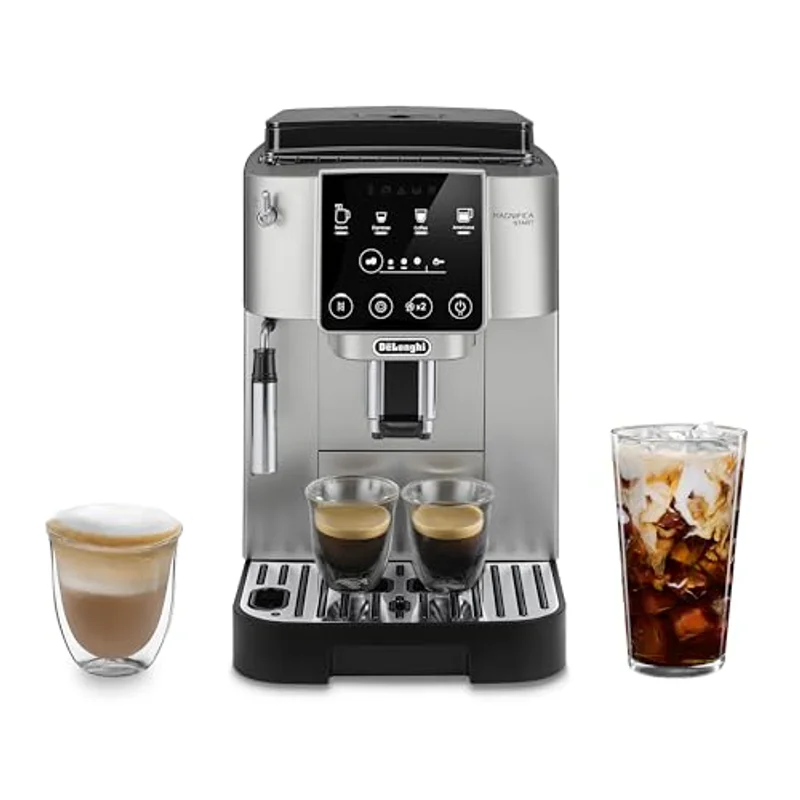
De'Longhi Magnifica Start
Super-automatic espresso machine with a built-in conical burr grinder and a milk frother. Grinds, doses and brews behind one button rather than asking you to dial in a shot by hand — the 13-position grinder is matched to that closed, one-touch workflow.
$649.95 Check price →The picks, by step count
Sorted by what the listing actually publishes, highest to lowest — and, for the two machines that don't publish a number at all, what you get instead.
44 settings — Grindora Espresso Machine with Grinder
The finest increments in this lineup. A 20-bar pump and a built-in grinder with a 44-position dial, aimed squarely at someone who wants to make small, repeated corrections while dialling in a new bag of beans rather than accepting whatever the first click gives them. Also comes with a milk frother, so the fine-grind control doesn't come at the cost of skipping milk drinks.
30 settings — Chefman Crema Deluxe with Double Boiler
A step down in increment count but a step up in plumbing: a genuine double boiler means it can pull a shot and steam milk simultaneously instead of making you wait for one before starting the other, which matters more for a household making back-to-back lattes than an extra fourteen clicks on the grinder would. The 30 grind settings, a built-in grinder and a steam wand are specified directly on the listing, alongside "professional" positioning that tracks with the double-boiler build.
13 settings — De'Longhi Magnifica Start
The fewest clicks here, and the only super-automatic in the group — the case made above in why 44 and 13 can both work. If a low setting count on its own reads as a red flag, it's worth separating that reaction from what the machine is actually asking you to do with it, which is nothing: no grind decision, no dose decision, no tamp.
Unpublished — GeniCup and AIRMSEN
Both the GeniCup Espresso Machine with Grinder and the AIRMSEN Espresso Machine with Burr Grinder ship with a built-in grinder, and neither listing states a step count. That's not unusual — plenty of budget and mid-range machines advertise "adjustable grind" without quantifying it — but it does mean we can't tell you where either one sits on the 10-to-44 scale in this article, and neither should any other page that hasn't checked the current listing. The GeniCup pairs its grinder with a 68 oz water tank and a cold-brew mode, which is worth a closer look in the best espresso machines with a cold brew mode. The AIRMSEN pairs its burr grinder with a milk frother steam wand aimed at cappuccino, latte, cold brew and Americano styles — if the steam wand is the bigger question mark for you than the grind dial, steam wand or automatic frother covers that decision on its own.
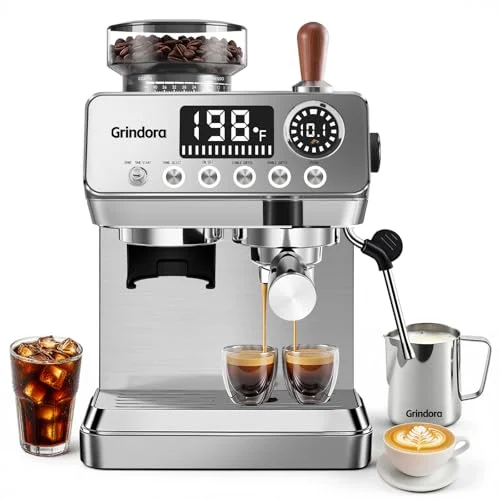
Grindora Espresso Machine with Grinder
20-bar pump with a built-in grinder offering 44 grind settings, plus a milk frother. The finest increment count in this lineup, built for a buyer who expects to keep adjusting the dial as beans and roasts change.
$199.99 Check price →Where more steps stop making a taste difference
Every extra click on a grinder's dial is a smaller and smaller slice of the same mechanical range, and at some point that slice gets smaller than the other sources of variation already sitting in your workflow. A double shot is conventionally built around roughly 18 grams of dry coffee in and about 36 grams of liquid out over that 25-to-30-second window — and small differences in how much coffee you actually dosed, how hard you tamped, or how warm the group head happened to be that morning routinely move the shot time by more than one click's worth of grind adjustment would. On a 44-position dial, chasing a single-click difference is often chasing a variable smaller than your own dosing scale can resolve.
That's not an argument against fine adjustment — it's genuinely useful for correcting a shot that's running clearly too fast or too slow. It's an argument against treating the step count itself as a taste metric. A shot's day-to-day consistency depends far more on whether you're dosing, tamping and timing the same way every time than on whether your grinder offers 30 clicks or 44 between "too coarse" and "too fine." Warm-up time and shot consistency walks through another variable in that same category — one that has nothing to do with the grinder at all, and often moves a shot more than the twentieth versus twenty-first click would.
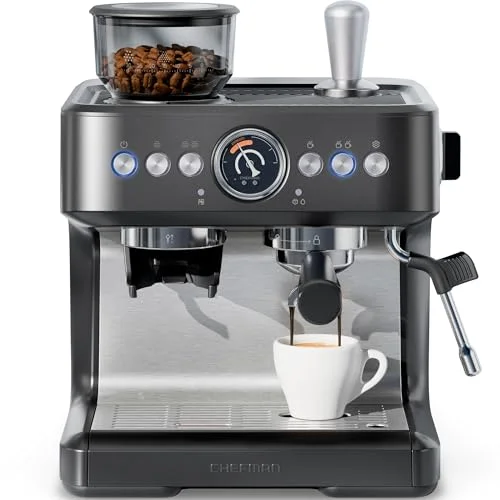
Chefman Crema Deluxe with Double Boiler
A double boiler that brews espresso and froths milk at the same time, paired with a built-in coffee grinder offering 30 grind settings and a steam wand. Positioned as a professional-leaning build for a household that wants both drinks moving at once.
$299.99 Check price →Retention and single dosing: the trade-off the number hides
Nothing about a setting count tells you how much ground coffee a grinder holds onto between uses. Grounds cling to the burr chamber and the chute regardless of how many click positions the dial has, and a grinder with 44 finely spaced settings can retain exactly as much leftover coffee as one with 13 coarsely spaced ones — retention is a function of the chamber's shape and the chute's path, not the adjustment mechanism sitting above it.
That matters because retained grounds are stale grounds. Coffee that sat in a chute since yesterday's shot doesn't leave when you grind fresh beans today — it gets pushed out ahead of the new grounds, mixed into your next dose, and it's already lost freshness the fine adjustment on the dial can't buy back. None of the five machines here publish a retention figure or a bean hopper capacity, so if that's a deciding factor for you, it's worth checking the current listing directly for hopper size rather than assuming a higher setting count implies a cleaner chute — the two specs aren't related.
This is also where "single dosing" — weighing out exactly the beans for one shot and grinding only that — runs into the limits of a built-in grinder regardless of step count. A grinder designed to be topped up from a hopper and ground on demand isn't built to be emptied and refilled between every shot, so switching roasts or beans mid-week means running through whatever's retained in the chamber first. That's a structural property of built-in grinders generally, not a downside specific to any one machine on this list, and it's a genuine cost on top of the machine's price — one line item among several covered in what an espresso machine really costs to run, which is where wasted or stale coffee actually shows up on a yearly total.
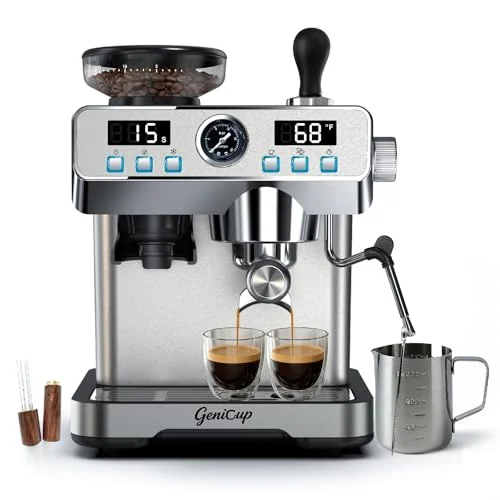
GeniCup Espresso Machine with Grinder
20-bar pump, built-in grinder and a 68 oz water tank with a cold-brew mode — no grind-setting count published, so check the current listing if that number is a deciding factor.
$199.99 Check price →Side by side
All five machines, by published grind-setting count. Prices are what we recorded in September 2026 for each listing and move constantly — confirm the live price before buying.
| Machine | Grind settings | Class | Milk | Price | |
|---|---|---|---|---|---|
| Grindora with Grinder | 44 | Semi-automatic, 20 bar | Milk frother | $199.99 | Price |
| Chefman Crema Deluxe | 30 | Semi-automatic, double boiler | Steam wand | $299.99 | Price |
| De'Longhi Magnifica Start | 13 | Super-automatic | Milk frother | $649.95 | Price |
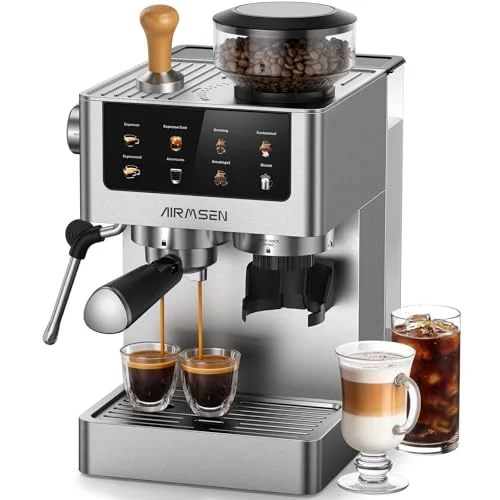 AIRMSEN with Burr Grinder AIRMSEN with Burr Grinder | Not published | Semi-automatic, 20 bar | Steam wand | $179.99 | Price |
| GeniCup with Grinder | Not published | Semi-automatic, 20 bar | None specified | $199.99 | Price |
How we compared these
We compare published specifications, listing copy and live pricing — we do not physically test these machines and we do not run a testing lab. Where a listing states a grind-setting count, as Grindora and Chefman do directly in the product title, we've reported it as given. Where a listing doesn't state one, as with the GeniCup and the AIRMSEN, we've said so rather than estimating a number, and we're not going to guess at a figure the manufacturer hasn't published. We show no star ratings and no review counts anywhere on this page, because Amazon's product data returns none for these machines, and inventing a number would make this page look more authoritative than it deserves to be.
Where a claim here is a judgement rather than a specification — that the espresso-usable portion of any dial is narrow, that dosing variance often swamps a single click of grind adjustment — we've said so in our own voice and shown the mechanism behind it, so you can weigh it yourself. The general grinding and extraction facts (conical burr mechanics, the roughly 9-bar brew pressure, the 18-gram-in-36-gram-out starting ratio, the 25-to-30-second target window) are standard background rather than product claims specific to any one machine.
Frequently asked questions
Do more grind settings mean better espresso?
Not directly. More settings mean finer increments between click stops across whatever mechanical range the burrs travel — useful for making small corrections to a shot that's running too fast or too slow, but not a measure of burr quality, alignment or how wide the usable range actually is. A well-aligned 13-position grinder can outperform a poorly finished 44-position one.
How many grind settings do I actually need for espresso?
Fewer than the total count on the dial. Espresso only needs particles within a narrow window — coarser than powdered sugar, finer than table salt — and on any of these grinders only a portion of the full dial, usually clustered near the fine end, falls inside that window. The rest of the range typically serves coarser brew methods like drip or French press.
Why does the De'Longhi Magnifica Start get away with only 13 settings?
Because it's a super-automatic: the grinder, dose and brew pressure are engineered together as a closed system tuned by the manufacturer, and you select a strength level rather than hand-adjusting the grind between shots. A semi-automatic machine that expects you to dial in your own shot, like the Grindora or the Chefman Crema Deluxe, benefits more from a finer increment because you're the one making the corrections.
What matters more than the number of grind settings?
Consistency of dose and tamp, burr alignment, and how much ground coffee the grinder retains between uses — none of which the setting count reveals. A grinder with a coarse increment but consistent output can be more reliable day to day than a finely stepped one paired with inconsistent dosing.