Quick answer
Buy a manual steam wand if you're willing to spend a few weeks getting worse before you get better, in exchange for a milk texture you can shape to the drink — tight and glossy for a flat white, looser for a cappuccino. Buy an automatic frother if you want the same result on a Tuesday morning with no attention paid to it, and you're willing to accept that "the same result" is also the ceiling. Neither is the more serious choice: a wand rewards a household with one person doing most of the making; an automatic system rewards a household where two or three people want a decent latte without learning a skill for it.
Things to know before you buy
- Both systems use steam. An "automatic frother" isn't a separate technology — it's a wand plumbed to a sensor that stops or adjusts once milk hits a target temperature, instead of leaving that judgment to you.
- The skill lives in your hand, not the machine, on a manual wand. Identical steam pressure can produce very different milk depending on the angle and depth you hold the pitcher.
- Automatic systems trade range for repeatability. They're built to land in a safe, drinkable middle every time, not to chase the tightest microfoam a trained hand can pull off.
- Milk fat content changes both systems' results — texture depends on protein and fat behaving predictably, a property of the milk, not just the machine steaming it.
- Whichever you choose, the wand or nozzle has to be cleaned after every single use. Dried milk residue is the single biggest reason a milk system stops working well.
What microfoam is, and why it's hard
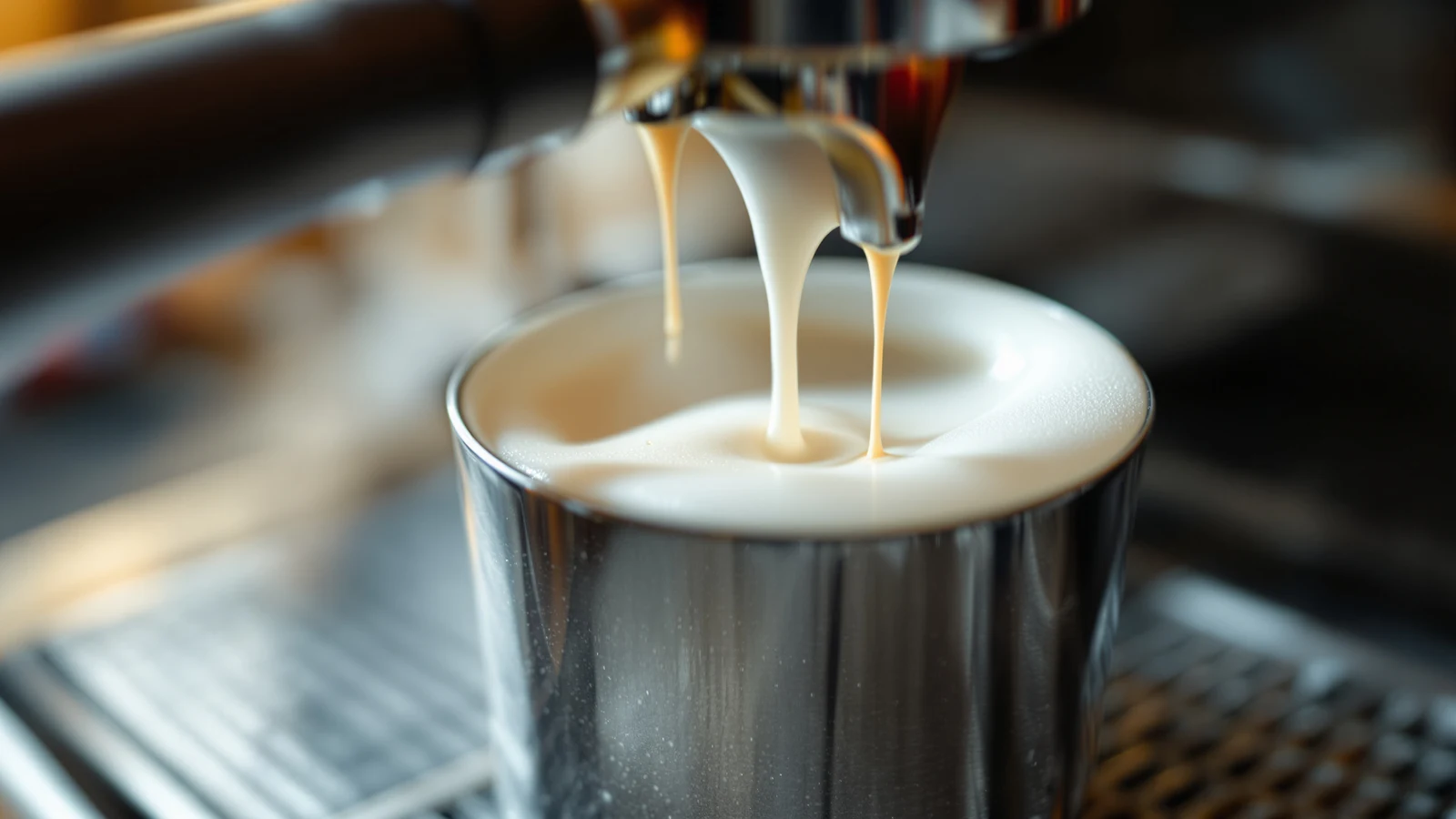
Microfoam is steamed milk where the bubbles are small enough that you can't really see them — the milk looks glossy and pours like thick paint rather than looking foamy or separated. That texture is what lets a flat white or a latte taste like milk and espresso in the same mouthful, instead of espresso topped with a layer of bubbles that has nothing to do with the coffee underneath.
Getting there means doing two things at once and stopping both at the right moment. First, you introduce air near the surface early in the steam — "stretching" — which creates the foam; too long and the bubbles are too big, too briefly and there's none. Second, you submerge the tip deeper to spin the milk into a whirlpool, which breaks the bigger bubbles down into microfoam's fine, glossy texture and brings the pitcher up to temperature evenly. Miss the whirlpool and you get big bubbles sitting on unheated milk underneath — the classic beginner result.
The other constraint is temperature, unforgiving in both directions. Steamed milk starts tasting notably sweet around 140–150°F, because heat breaks lactose into simpler sugars the tongue reads as sweetness. Push past roughly 160–170°F and the proteins holding the foam together denature and collapse, the texture turns thin, and the milk tastes scalded rather than sweet. There's a genuine window to hit, not just a direction to head in — as narrow a target as the roughly 9 bar espresso itself brews at, which our pressure explainer covers on the coffee side.
The manual wand: control, and the weeks it takes
A manual steam wand vents pressurized steam through a tip with several small holes, and everything past that point is up to you: how deep and at what angle you hold the pitcher, how long you stretch before submerging for the whirlpool, and when you judge the milk done by temperature, sound and feel. That's the entire appeal and the entire cost in one sentence — nothing about the machine decides when to stop, which is what lets an experienced hand pull a tighter, glossier foam than most automatic systems produce, and pour it into a rosette if they've practiced that too.
It's genuinely a skill with a learning curve measured in weeks, not one attempt. Early sessions tend to produce visible bubbles and milk that's under- or over-heated because you misjudged the pitcher's temperature by feel — normal, not a sign the machine is broken. What changes it is repetition: learning the pitcher's feel at 100°F versus 140°F, the hissing-to-tearing-paper sound shift that signals a correctly started whirlpool, and the muscle memory for holding the tip just below the surface. Most people who stick with it reach reliably drinkable microfoam within a few weeks and keep improving toward latte art for months after.
Chefman Crema Deluxe Espresso Machine
Built around a double boiler — the detail that matters most for a wand-first household, letting you brew espresso and steam milk from separate boilers at once instead of waiting for the machine to switch modes. It also carries a built-in coffee grinder with 30 grind settings.
$299.99 Check price →
The double boiler changes the daily math more than any technique tip does. On a single-boiler machine, the wait while it reheats and switches from brew to steam temperature is dead time at the counter — often the exact window a first-timer gets impatient and rushes the stretch. Our guide to warm-up time covers that reheat window; removing it doesn't make the technique easier, but it removes one more variable while you're still learning.
Automatic frothers: consistency and their ceiling
An automatic milk system steams milk with essentially the same physics — heat, air, agitation — but a sensor and a preset program decide the stretch time, whirlpool depth and stop point instead of you. Put the pitcher under the wand, engage it, and walk away; the machine shuts off once it reads the target temperature, and the result is the same drink whether it's your first morning with the machine or your five hundredth. That's the entire trade: you give up the top end of what a trained hand can do — the tightest microfoam, deliberately shaped for a specific drink — in exchange for a floor that never drops, no matter who's making the coffee or how rushed they are.
For a lot of households that trade is the correct one. If more than one person makes their own coffee, nobody has to have practiced anything to get a decent flat white — the machine doesn't care who's standing at it. If your habit is one latte before work with five minutes to spare, removing the judgment call about stretch time and stop point removes exactly the part most likely to go wrong when you're rushed. The ceiling is real, but for most people making one or two drinks a day, it lands at "good enough to stop thinking about."
Breville BES450BSS Bambino
Pairs its automatic milk-texturing steam wand with a compact, brushed-stainless body that gives up the built-in grinder to get there. The wand still steams real milk to a set temperature automatically rather than relying on a separate frothing chamber, which is the more direct comparison to a manual wand's texture than a fully enclosed frother is.
$299.95 Check price →
No grinder is the trade-off behind the Bambino's compact footprint, so budget for a separate burr grinder. And "automatic" only ever describes the milk step here — the shot itself is still a semi-automatic pull. If even that feels like more routine than you want, a capsule machine removes the shot-making question too; see our espresso machine versus pod machine comparison for what that trade costs.
Cleaning: the part that decides whether you keep using either
This is the part most buying guides skip, and it decides whether a milk system gets used for years or gets avoided within a month. Milk left on any wand or steam tip dries into a hardened film within minutes, and once dried, it's harder to remove and starts to restrict the tiny holes the steam passes through — which is how a wand producing fine microfoam in month one starts producing weak, uneven foam by month four, with nothing else about the machine having changed.
The daily routine is short but non-negotiable: purge the wand with a burst of steam into a cloth immediately after steaming, while the milk is still wet, then wipe the outside down. A manual wand's tip is usually a single piece, simple to purge and wipe; an automatic system routes milk through more hidden geometry — a sensor housing, an internal channel — that a quick wipe can't fully reach, so it depends more on a periodic deeper clean using whatever cycle the manufacturer specifies for that model.
Neither route escapes descaling — mineral buildup from hard water affects the boiler regardless of which milk system sits downstream, and it's a separate job from wiping milk residue off a wand. Our running-cost guide breaks out what descaling supplies add to a year of ownership. A manual wand forgives a slightly lazier cleaning habit because there's less for milk to hide in; an automatic system's convenience at steaming time asks a bit more discipline at the deep clean.
Milk choice changes the answer
Neither system texture-tests milk in a vacuum — what you pour in changes how forgiving each route is. Whole dairy milk has the fat and protein balance both manual wands and automatic systems are designed around, which is why it's the easiest starting point on either: it holds a stable foam through a wider margin of stretch time and temperature, so small technique mistakes on a manual wand are more forgiving, and an automatic program calibrated against typical dairy fat content performs closer to its intended result.
Lower-fat dairy foams more readily in raw volume but that foam collapses faster once poured — true on a manual wand and, just as much, on an automatic system, since the physics don't care which produced the foam. Plant-based milks vary widely by brand in how their proteins behave under heat, and a milk that steams well on a manual wand — where you can watch and adjust in real time — can behave differently on an automatic program tuned around dairy's more predictable curve, sometimes under-foaming or separating in a way a preset cycle won't catch.
That's the case for leaning manual if your household regularly switches between dairy and a specific plant-based milk: a hand can feel when foam isn't building right and adjust on the spot, where a fixed program keeps running regardless. If your household is consistently one type of milk, that variability mostly disappears, and the choice comes back to how much you want to think about the process at all.
The picks
All three of the machines below are semi-automatic, not super-automatic — meaning you still pull the shot yourself, and the difference between them is entirely in how the milk step works and what else ships alongside it. None of these figures are ratings; they're the published specs and the prices we recorded in mid-September 2026.
01Hands-off milk
Breville BES450BSS Bambino
For the household that wants a good latte with zero technique
Automatic microfoam steam wand · no built-in grinder · compact, brushed stainless
The pick if the point is removing milk as a skill entirely. The wand still steams real milk rather than relying on an enclosed frothing chamber, so texture reads closer to a manual wand's than a fully automated pod-style system does — with the stretch time and stop point handled for you.
The trade-offNo grinder included, so pair it with a standalone burr grinder — pre-ground coffee wastes what the rest of the machine can do.
02Best value wand
Chefman Crema Deluxe Espresso Machine
For learning the wand without waiting on a single boiler
Manual steam wand · double boiler, brew + steam simultaneously · built-in grinder, 30 settings
The pick for someone committing to learn a manual wand: the double boiler means brewing and steaming don't compete for the same heating element, so there's no dead time at the counter switching modes. A built-in grinder with 30 settings dials in the rest of the cup from the same unit.
The trade-offTechnique is on you — expect a rough few weeks of visible bubbles before it becomes reliable.
03Most grind control
Gevi 20 Bar Espresso Machine with Grinder
A manual wand with the widest grind range of the three
Manual steam wand · built-in grinder · 11.5"W × 12.01"D × 16.53"H
The same manual-wand learning curve as the Chefman, with a grinder and a published footprint — useful if you're measuring a specific counter spot rather than guessing. At 16.53 inches tall, give it clearance above for the hopper lid, as with any bean-to-cup machine.
The trade-offNo double boiler, so brewing and steaming share the same heating cycle rather than running at once.
| Machine | Milk system | Grinder | Price | |
|---|
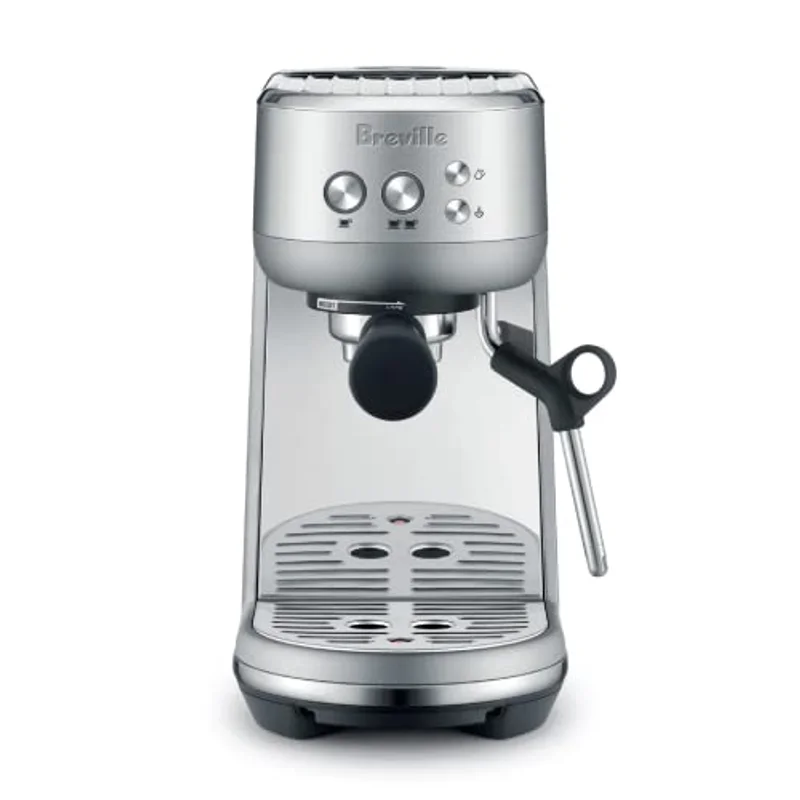 Breville Bambino Breville Bambino | Automatic microfoam wand | None | $299.95 | Price |
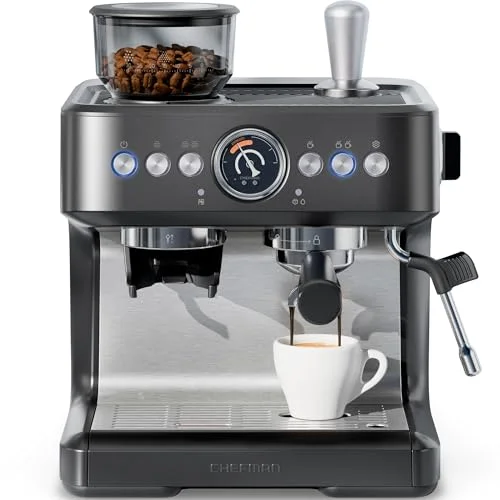 Chefman Crema Deluxe Chefman Crema Deluxe | Manual wand | Built-in, 30 settings | $299.99 | Price |
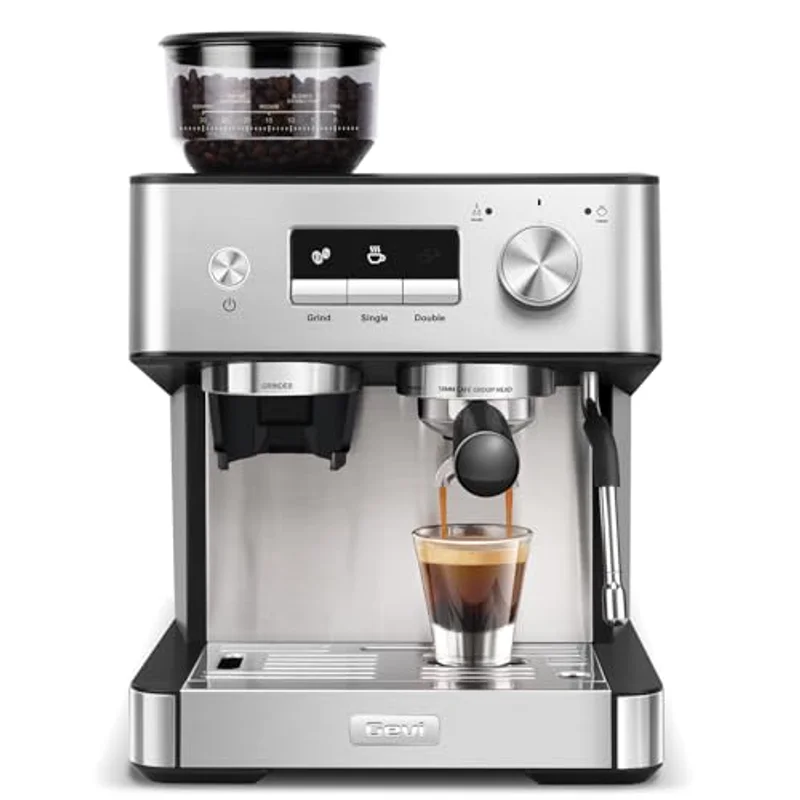 Gevi 20 Bar with Grinder Gevi 20 Bar with Grinder | Manual wand | Built-in | $309.99 | Price |
If you're still not sure
Default to manual if you already know you'll make coffee for years regardless of how the first month goes — the skill compounds. Default to automatic if the honest answer is "I want a good latte and don't want to think about it," because a system nobody has to learn is a system still getting used a year later. A machine used daily with average milk beats one that made perfect microfoam twice before it went in a cupboard.
How we compared these
We compare published specifications, what's stated in the listing, and live pricing — we do not physically test these machines, we do not run a testing lab, and we do not publish ratings we cannot verify. Amazon's product data returns no rating and no review count for the machines on this site, so there are no stars and no invented review sentiment anywhere on this page. The mechanics discussed above — what microfoam is, why temperature and agitation matter, how milk fat content changes foaming behavior, and why dried residue degrades any wand over time — are standard, well-documented espresso and dairy-science background, not claims about any product's performance.
Where we describe a trade-off as our own judgment — that manual technique typically becomes reliable within a few weeks, or that an automatic system's ceiling still sits comfortably above "good enough" for most households — we've said so in our own voice rather than presenting it as fact. Prices were recorded in mid-September 2026 and move constantly; confirm the live price before buying. For the step-by-step technique itself, see our guide to frothing milk at home.
Our top picks
Editor's Pick
Breville Bambino
Automatic microfoam for the household that wants consistency without anyone learning a wand.
Check price →
Best Value
Chefman Crema Deluxe
A double boiler and a manual wand for less than the Bambino, plus a built-in grinder.
Check price →
Premium Choice
Gevi 20 Bar with Grinder
A manual wand and grinder with a published footprint, for measuring your counter before you buy.
Check price →
Frequently asked questions
Is a manual steam wand better than an automatic frother?
Neither is objectively better — they optimize for different things. A manual wand gives a trained hand more range, including tighter microfoam and latte art, but takes weeks of practice to get consistently right. An automatic system removes the skill requirement and gives the same result every time, at a ceiling below what a practiced hand can do but well above "bad." The right choice depends on how many people are making coffee and how much you want to think about the process.
How long does it take to learn a manual steam wand?
Most people reach reliably drinkable microfoam within a few weeks of daily practice, improving toward tighter texture and latte art over the following months. Early attempts commonly produce visible bubbles or milk that's under- or over-heated, because judging temperature by feel takes repetition to learn — a normal part of the curve, not a sign of a faulty machine.
Does an automatic milk frother work with any type of milk?
It works most predictably with whole dairy milk, since automatic programs are generally tuned around dairy's fat and protein behavior under heat. Lower-fat dairy and plant-based milks vary more in how they foam and can behave less predictably on a fixed program than on a manual wand, where a person can adjust the stretch time in real time.
Why does my steam wand produce worse foam over time?
The most common cause is dried milk residue narrowing the small holes in the steam tip. Milk left on a wand dries within minutes and, once dried, restricts steam flow, showing up as weaker or less even foam even though nothing else has changed. Purging the wand with a burst of steam into a cloth immediately after each use, while the milk is still wet, prevents most of this.
Keep reading