Best Espresso Machines
Buying guide · Under $1,000

The best espresso machines under $1,000 — where the extras stop being extras.

This is the tier where a real portafilter, a proper steam wand and temperature control stop being upgrades you pay extra for and start being the baseline. Here is exactly what the jump from $300 buys, whether you still need a separate grinder, and who should stop reading and buy something cheaper instead.

By Ilane Tall · Updated September 15, 2026 · Research-based.4 machines compared, $599.00 to $699.95

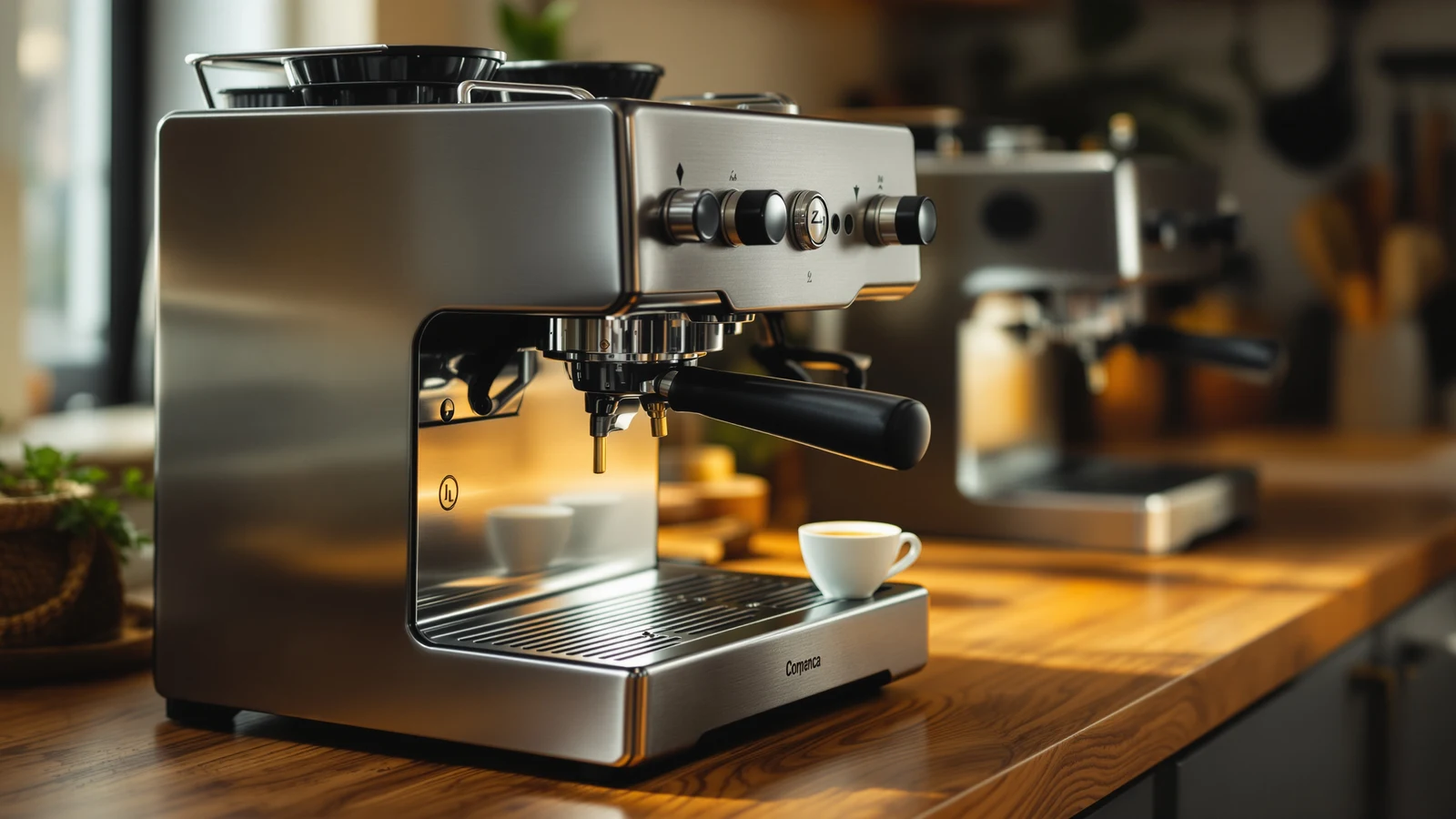
A stainless steel semi-automatic espresso machine with a portafilter and steam wand on a kitchen counter, representing the under-$1,000 buying bracket

Reader-supported: if you buy through the Amazon links here we may earn a commission at no extra cost to you. It never changes which machine we recommend.

A thousand dollars sounds like a lot to spend on a machine that makes the same drink a $300 one claims to make. In practice it's the bracket where three separate compromises stop being compromises at once: the grinder is no longer an afterthought bolted onto a cheap chassis, the steam wand is powerful enough to texture milk for more than one drink in a row, and the machine can hold a brew temperature instead of guessing at one. None of that shows up as a single headline spec — it shows up as fewer bad shots on a Tuesday morning.

We pulled four machines from our database that sit inside this ceiling, from a $599.00 three-in-one to a $699.95 semi-automatic in a different finish of the same chassis, and compared them on what actually changes in the cup: grinder or none, steam wand or automatic frother, semi-automatic control or one-touch convenience. None of them carry a rating or review count in our data — Amazon's product API doesn't return that figure for these listings — so nothing on this page is a star score. It's published specifications, machine class and live price, compared honestly. If a $1,000 ceiling is more than you need, our under $100 guide covers the floor of this category, and if you're deciding between this and a capsule machine, espresso machine vs. pod machine breaks down the real cost per cup either way.

The short answer

If you only read one paragraph

Buy the Breville BES870XL Barista Express at $699.95 if you want to actually learn espresso

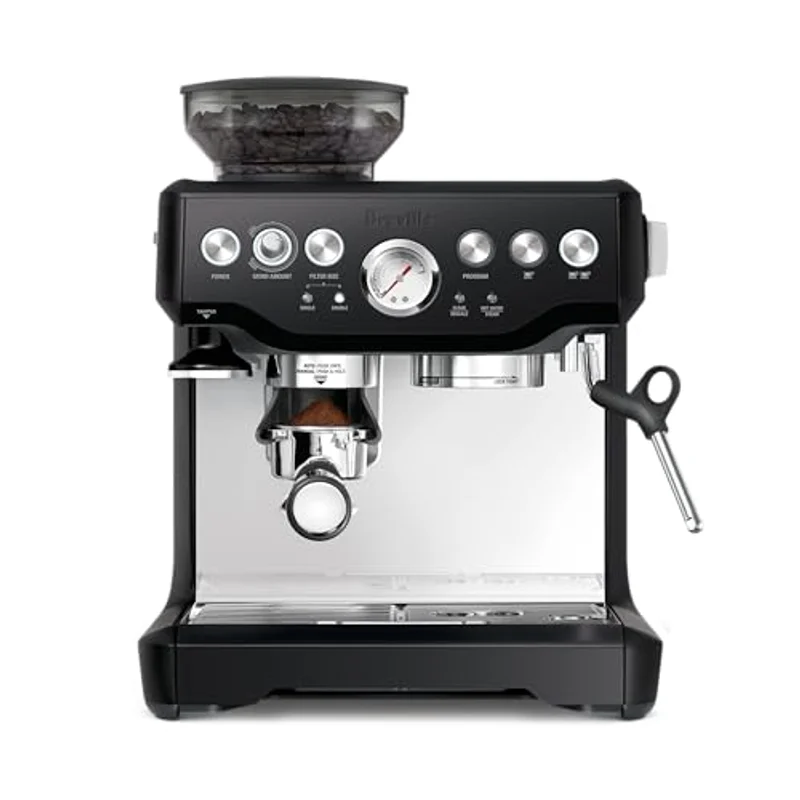
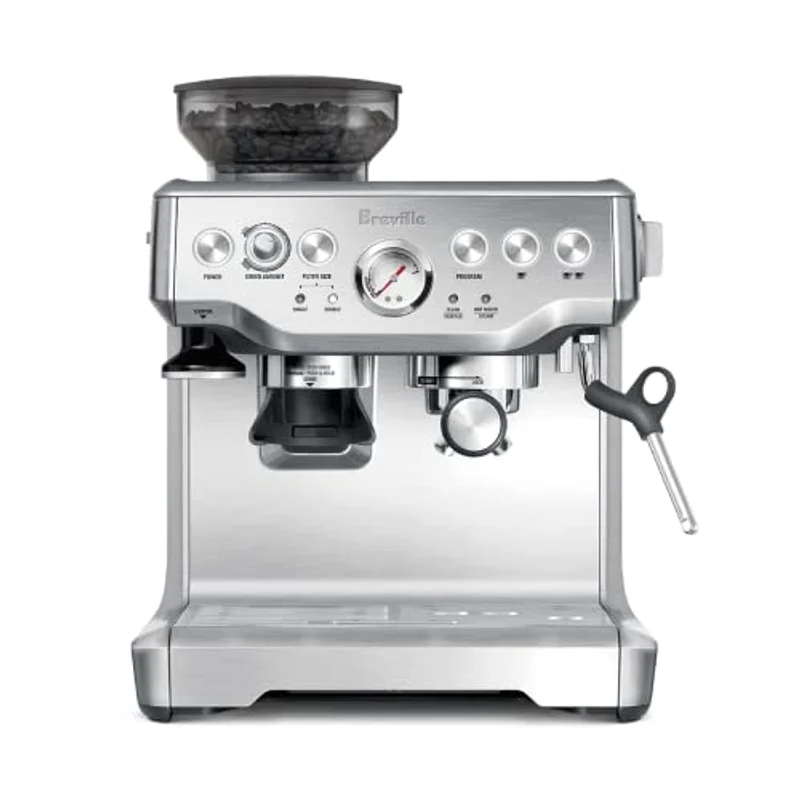
It's the machine this whole bracket is built around: a built-in conical burr grinder with dose control, a 54 mm portafilter, a manual steam wand and a 67 oz tank, all on one chassis for less than buying an equivalent grinder and machine separately.

Want the identical machine in a darker finish, the BES870BTR in Black Truffle at $699.95 is the same specification for $10 more. If you'd rather press one button and walk away, the De'Longhi Magnifica Start at $649.95 grinds, doses and brews on its own. And if your household drinks espresso, drip coffee and cold brew in the same week, the Ninja Luxe Café Premier 3-in-1 at $599.00 is the one machine that covers all three.

At a glance

The four, side by side

Ordered by our recommendation. Prices are what we recorded between September 1 and September 14, 2026, and Amazon prices move constantly — confirm the live price before you buy.

MachineBest forTypeGrinderMilkPrice
Breville Barista ExpressBest overallSemi-automaticBuilt-in conical burrManual wand$694.94Price
Barista Express, Black TruffleBest finishSemi-automaticBuilt-in conical burrManual wand$699.95Price
De'Longhi Magnifica StartBest one-touchSuper-automaticBuilt-in, 13 settingsManual frother$649.95Price
Ninja Luxe Café Premier 3-in-1Best all-rounder3-in-1Built-in burrDual auto froth$599.00Price
The picks

Four machines, and who each is for

01Best overall

Breville BES870XL Barista Express

For the person who wants to learn espresso properly, on one appliance
Semi-automatic · built-in conical burr grinder · 54 mm portafilter · 67 oz tank · 1,600 W

At $699.95 this is the machine that anchors the entire under-$1,000 bracket, and the reason is integration rather than any single headline number: a dose-controlled conical burr grinder dispenses straight into the 54 mm portafilter, a razor tool levels the bed to a repeatable dose, low-pressure pre-infusion starts the extraction gently, and a manual steam wand handles milk. Single and dual-wall baskets, a tamper and a milk jug ship in the box — assembling equivalent pieces separately usually costs more than $699.95, not less.

The trade-offIt asks something of you. There's a grind-and-dose routine to learn before the shots are consistent, and at 1,600 W with a 67 oz tank it's a genuine counter commitment. If you want espresso at the push of one button, the De'Longhi below is the better fit.

Breville BES870XL Barista Express espresso machine in brushed stainless steel
$694.94
Grinder includedCheck price →
02Best finish

Breville BES870BTR Barista Express, Black Truffle

The same machine, for the kitchen where brushed steel doesn't fit the palette
Semi-automatic · built-in conical burr grinder · same chassis as the BES870XL

There is no functional case for choosing between this and pick 01 — the BES870BTR is the Barista Express in a Black Truffle finish, and everything the standard model does, this one does too. Where a kitchen runs matte black or dark bronze appliances rather than brushed stainless, this is the way to get the grinder, the portafilter and the steam wand without the mismatched silver box on the counter.

The trade-offAt $699.95 it costs about $10 more than the stainless version for the same specification. Pay it for the finish, not because you expect a different machine — and if the color doesn't matter to you, buy pick 01 instead and save the difference.

Breville BES870BTR Barista Express espresso machine in Black Truffle finish
$699.95
Black Truffle finishCheck price →
03Best one-touch

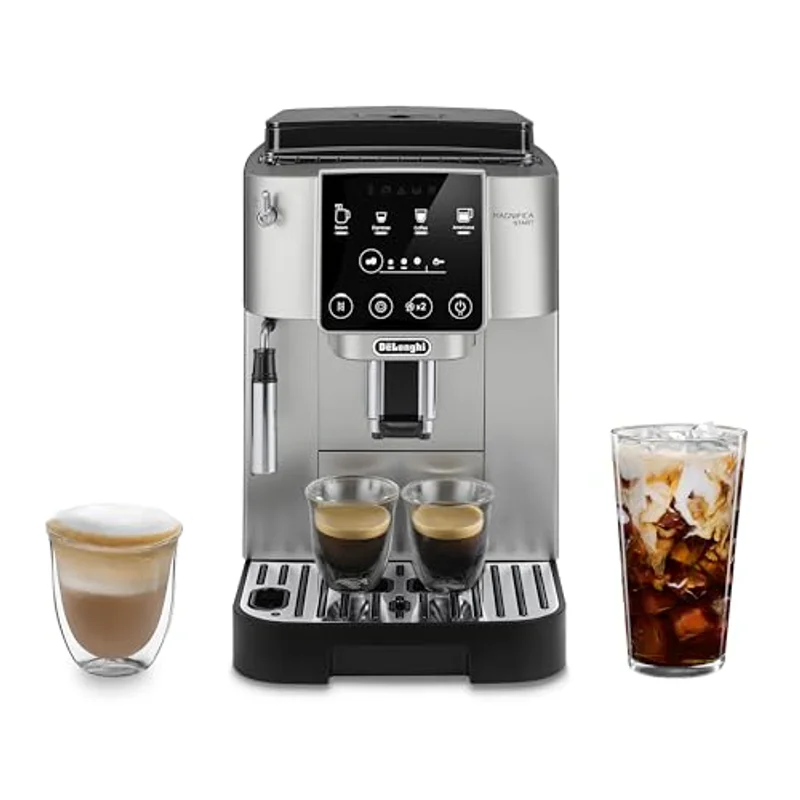
De'Longhi Magnifica Start

Push one button, walk away with espresso
Super-automatic · conical burr grinder, 13 settings · 3 one-touch recipes · manual milk frother

A super-automatic machine grinds, doses, tamps and brews on its own, and the Magnifica Start does it for three drinks — espresso, coffee or an americano — from a single press, with adjustable strength. At $649.95 it's the cheapest way into this bracket, and it's the category to buy if the goal is a genuinely good cup with zero technique and almost no cleanup on a weekday morning.

The trade-offYou give up control: no portafilter to dial in, no tamping, and a fixed 13-setting grinder rather than the finer adjustment a semi-automatic offers. Milk is also manual here — the frother on this model isn't automatic, so lattes still need a hand on the wand.

De'Longhi Magnifica Start automatic espresso machine with milk frother in silver
$649.95
Super-automaticCheck price →
04Best all-rounder

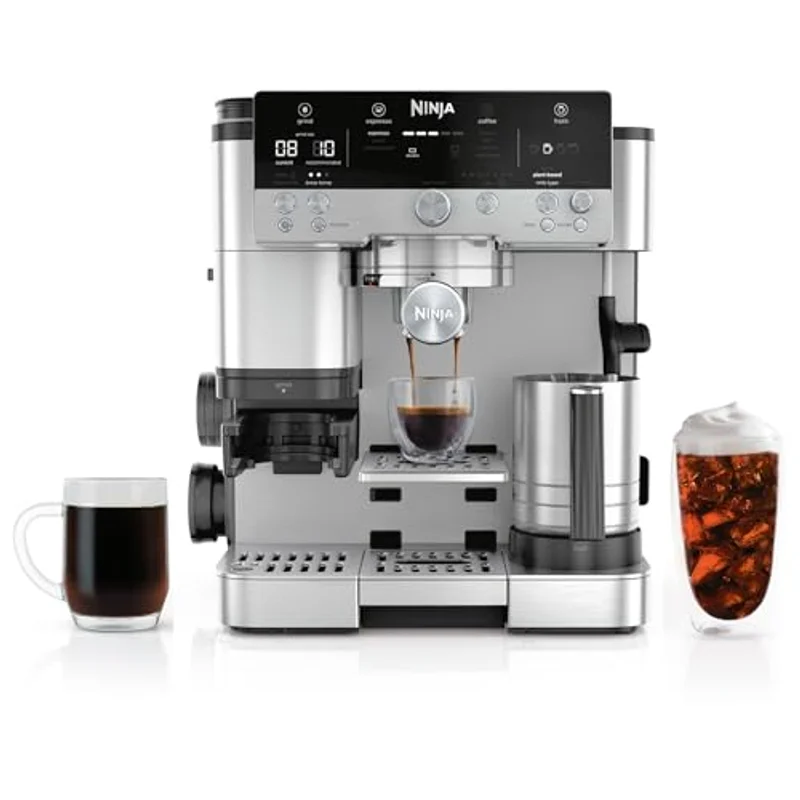
Ninja Luxe Café Premier 3-in-1

Households that drink espresso, drip coffee and cold brew in the same week
3-in-1 · built-in burr grinder · espresso, drip, cold brew · dual automatic froth system

At $599.00 the Luxe Café Premier is the least expensive machine here and the only one that replaces three separate appliances: two espresso styles, three drip styles across seven cup sizes, and two cold-brew modes, all fed by a built-in grinder. The dual froth system pairs a spinning whisk with an automatic steamer, handling hot microfoam and cold foam without a manual wand to learn.

The trade-offBreadth over depth — a dedicated semi-automatic like the Barista Express gives a higher espresso ceiling if espresso is the only thing you care about. It's also a large machine, with a footprint of roughly 13 by 13.4 by 14.6 inches, so measure your counter and cabinet clearance before ordering.

Ninja Luxe Cafe Premier 3-in-1 espresso machine, drip coffee and cold brew maker
$599.00
Espresso · drip · cold brewCheck price →
The upgrade that matters

What $1,000 buys that $300 does not

The jump from a $300 machine to one near this bracket's ceiling isn't a smooth curve of "slightly better." It's a handful of specific mechanical differences, and knowing what they are is more useful than comparing price tags alone.

A grinder that's actually built for espresso, not bolted on

Below $300, a built-in grinder is usually a cost-reduced unit with a narrow useful range and no dose control. The conical burr grinder on the Barista Express and its Black Truffle twin, and the 13-setting unit inside the Magnifica Start, are sized and tuned for the espresso window specifically — fine enough, consistent enough, and in the Barista Express's case, paired with a razor tool that trims the dose to a repeatable weight rather than leaving it to guesswork.

A steam wand or froth system that keeps up with more than one cup

Cheaper machines often have a single small boiler that needs to switch modes between brewing and steaming, so back-to-back milk drinks mean waiting. The machines in this guide are built around milk as a first-class feature rather than an afterthought — a real manual wand on the Breville and De'Longhi machines, and a dual automatic system on the Ninja that handles hot and cold foam without you standing over it. Our guide to warm-up time and shot consistency goes into why a machine's heat-up claim rarely tells the whole story.

Pre-infusion and temperature stability

Every machine here forces water through the coffee bed gently before full pressure, rather than slamming 9 bar into a dry, un-wetted puck — the Barista Express calls this low-pressure pre-infusion, and it's the kind of detail that separates a bitter, channeled shot from an even one. It matters because espresso is unforgiving about how water first meets the grounds; our guide to bitter espresso covers the usual causes, and inconsistent pre-infusion is one of them.

None of this makes a $300 machine worthless for what it is. It just means the $300 and $1,000 machines are answering different questions: "can I make espresso at home at all" versus "can I make it consistently, every day, without babying the machine."

Plain-language spec

Built-in grinder or not, at this price

At $300 a built-in grinder is rare and a good one rarer still. At $1,000 it's close to the default — three of the four machines in this guide have one, and the fourth, the Magnifica Start, has a grinder as part of its entire one-touch premise. That's worth pausing on, because it changes the buying question at this tier from "grinder or no grinder" to "how much control do you want over that grinder."

The Barista Express and its Black Truffle twin give you the most control: a conical burr grinder with dose timing you adjust, dispensing straight into the 54 mm portafilter you hold underneath it, followed by a razor tool that levels the bed to a fixed height. That's the semi-automatic route — you grind, you trim, you tamp, you pull. Espresso is brewed at roughly 9 bar and is unforgiving about particle size, so this level of control is what actually moves cup quality, not the pump's peak-pressure rating. Our portafilter and basket sizes guide covers what that 54 mm number means for accessories down the line.

The Magnifica Start's grinder sits behind the machine's automation: 13 settings, feeding directly into one of three one-touch recipes, with no portafilter to remove and no dose to trim by hand. You still get fresh-ground coffee — which is the entire point of a burr grinder, since pre-ground coffee is milled to one fixed size that's too coarse for espresso and stales within days — you just don't get to see or adjust the process the way you do on the Breville machines.

The Ninja Luxe Café Premier's grinder is the least visible of the three, because it's one input among several — it feeds the espresso side of a machine that also does drip coffee and cold brew. If espresso is the only thing you'll ever make, that's a grinder doing less specialized work than the Barista Express's. If your house actually drinks all three styles, it's the reason to buy one machine instead of three.

What none of these four machines require is a separate standalone grinder purchase — which is itself a value point worth stating plainly. At $300 and below, buying a machine plus a competent burr grinder often adds up to more than what a single $650–700 integrated machine costs here.
The other half of the drink

Milk: steam wand against automatic frother

Two of the four machines here — the Barista Express and its Black Truffle twin — put a manual steam wand in your hand. The De'Longhi gives you a manual frother of its own. The Ninja is the outlier, with a dual automatic froth system that pairs a spinning whisk with an automatic steamer for both hot microfoam and cold foam.

A manual wand rewards practice: purge it, angle the pitcher to draw air into the milk early, then submerge the tip to spin the surface into microfoam, and you can build the same latte art a café does. It also means every session is a small skill check — under-stretched milk is thin and flat, over-stretched milk is a stiff foam cap that pours badly. Our full how to froth milk at home guide walks through the technique, and our steam wand vs. automatic frother comparison goes deeper on this exact trade-off across price tiers.

An automatic system removes that skill check. The Ninja's dual froth system is built to hit a texture without you standing over the pitcher, which is the appeal for anyone who wants a consistent flat white on a weekday without practicing latte art first. The cost is control: you can't chase a specific microfoam texture the way a manual wand lets you, and you're trusting the machine's programmed cycle rather than your own hand.

At this price tier the honest framing is temperament, not quality. A manual wand on a $690 machine is meaningfully more capable than a manual wand on a $150 one — more steam pressure, faster recovery, finer control — so "manual" here doesn't mean "basic." Choose the wand if milk-texturing is something you want to get good at. Choose the automatic system if you want the same drink every morning with the least amount of standing at the counter.

Budget honestly

Running costs, and what you stop buying

The sticker price is the smallest number in a multi-year ownership story. All four machines run on whole beans rather than pre-portioned pods, and all four need periodic descaling to keep their boilers and grinders healthy — routine costs, not surprises, but worth stating before you buy.

  • Beans, not capsules. Whole-bean espresso is generally cheaper per cup than capsule or pod coffee once you're making more than an occasional drink, because you aren't paying for individual portioning and packaging on every shot. If you're weighing this bracket against a capsule machine instead, espresso machine vs. pod machine runs the real cost-per-cup math with assumptions stated.
  • Descaling supplies. Every machine with a boiler needs periodic descaling based on your local water hardness and the manufacturer's schedule — skipping it is the single most common way an otherwise good machine dies early. Budget for descaling solution as a recurring, small cost, not a one-time purchase.
  • Electricity. A 1,600 W machine like the Barista Express draws meaningfully more at peak heating than a low-wattage pod machine, but that peak only lasts through warm-up and brewing — a few minutes a day, not continuous draw.
  • What you stop buying. A $6 daily café latte is roughly $180 a month; any of these four machines, fed with decent beans and fresh milk, brings that down to well under a dollar a cup once you own it outright. You also stop buying capsule boxes if you were considering that route instead, and — because three of the four have a grinder built in — you stop needing to budget separately for one.

None of that is a promise that the machine pays for itself by a specific date; it depends entirely on how much you were spending before and whether the habit sticks after the novelty wears off. It's simply the honest shape of the ongoing cost, laid out so you can do the arithmetic with your own numbers.

The bottom line

Who should spend less, and who should wait and spend more

Spend less if you're not sure espresso will stick

If you drink one cup a day, aren't sure you'll keep it up past the first month, or don't care about grinding fresh, none of the specific advantages of this bracket — dose control, pre-infusion, a serious steam wand — will register as anything you use. Our best espresso machines under $100 guide is the honest starting line for finding out whether the habit is real before you commit four figures to it.

Wait and spend more if you want dual-boiler speed or PID-level temperature precision. Every machine in this guide heats and holds temperature well for its class, but none has a second, dedicated steam boiler running in parallel with the brew boiler, and none exposes the kind of programmable temperature curve a prosumer machine offers. If you already know you want to make back-to-back milk drinks for a full household without any wait, or you want to tune brew temperature to the degree for a specific roast, this bracket is not the ceiling of home espresso — it's a very capable middle, not the top.

How we picked

Four machines that bracket $1,000 from below

We pulled machines from our database priced under $1,000 and sorted them by what they physically are — semi-automatic with a manual wand, super-automatic one-touch, or a multi-drink 3-in-1 — then kept one per buying situation: learning espresso properly, the same machine in a different finish, one-touch convenience, and a household that wants espresso, drip and cold brew from one appliance.

How we compared

Research, not a lab

Plainly: we compare published specifications and prices, we don't run a testing lab, and we don't publish ratings we can't verify. Amazon's product data returns no rating or review-count figures for these machines, so there are no stars anywhere on this page. Where a call is a judgement rather than a spec — that integration wins for most buyers at this price, that the Black Truffle finish is worth $10 and nothing more — we've said so in our own voice, so you can weigh it yourself.

FAQ

Questions people actually ask

Is $1,000 enough for a genuinely good home espresso setup?

Yes, comfortably, and often with room to spare. The Breville Barista Express at $699.95 includes a built-in conical burr grinder, dose control, a 54 mm portafilter and a manual steam wand for meaningfully less than the ceiling of this guide, leaving budget for beans, a tamper upgrade or descaling supplies without going over $1,000.

Should I buy the De'Longhi Magnifica Start or a semi-automatic like the Barista Express?

It depends on how much control you want. The Magnifica Start grinds, doses and brews espresso, coffee or an americano from one button, with no portafilter to manage — the right choice if convenience matters more than technique. The Barista Express hands you a portafilter, a grinder with dose control and a razor tool, and a manual steam wand — the right choice if you want to actually learn espresso and adjust it over time.

Is the Black Truffle Barista Express any different from the standard stainless model?

Functionally, no. The BES870BTR at $699.95 is the same conical-burr-grinder, 54 mm-portafilter machine as the BES870XL at $699.95, in a Black Truffle finish instead of brushed stainless steel. The roughly $10 difference is for the color, not an additional feature.

Steam wand or automatic frother — which should I choose at this price?

Choose a manual steam wand, like the one on the Barista Express or the Magnifica Start's frother, if you want to develop the skill and control microfoam texture yourself. Choose an automatic system, like the Ninja Luxe Café Premier's dual froth setup, if you want a consistent result with the least effort. Our steam wand vs. automatic frother guide compares both in more depth.

Keep reading

Next steps, in order of usefulness

Ilane Tall

Ilane writes the espresso comparisons on this site, built from published specifications, machine class and live pricing — never from testing we haven't done, and never from ratings we can't verify. Get in touch, or read about this site and our privacy policy.