The quick answer
"Cold brew mode" is not one feature — it is three different things wearing the same marketing label, and which machine to buy depends entirely on which one you actually want. The Ninja Luxe Café Premier 3-in-1 at $599.00 is the only machine here that brews true steeped cold brew, sitting the grounds in cold water for hours the way a cold-brew pitcher would, and it is the pick if that slow, low-acid style is the point. The AIRMSEN Espresso Machine with Burr Grinder at $179.99 and the GeniCup Espresso Machine with Grinder at $179.99 both describe a cold-brew or cold-extraction function built around forcing cold or cool water through grounds under pressure — closer to cold-pressed espresso than to steeped cold brew, and considerably faster. The XIXUBX Espresso Machine with Grinder at $169.99 has no cold-brew setting at all, but its PID temperature control is relevant to this topic for a different reason covered below.
None of these four machines has a published rating or review count in our database, so nothing below is a star score or a paraphrase of buyer sentiment — it is what the spec sheets and product listings say, read carefully and compared honestly.
What a cold brew setting actually does versus steeping grounds overnight
Traditional cold brew is a patience method. Coarse grounds sit in room-temperature or cold water for 12 to 24 hours, and because there's no heat to accelerate extraction, the process pulls out different compounds than hot brewing does — less of the acid and bitterness that heat extracts quickly, more of the sweeter, rounder notes that take time to dissolve. The trade is time for a smoother, lower-acid cup, and it's why a pitcher of cold brew in the fridge is a batch project, not a single-serve one.
A machine's "cold brew mode" is an attempt to compress that overnight process into a button press, and the honest way to think about it is as a shortcut, not a replacement. Some machines do this by chilling the water going into the group head and running a longer, gentler cycle than a hot shot — still measured in a minute or two, not hours. Others push cold or cool water through the grounds under the same kind of pressure used for espresso, which extracts fast regardless of water temperature, producing something people call "cold brew" that is really a cold-pressed espresso concentrate. Neither is the 12-hour steep, and a machine that claims to replicate true cold brew in under a minute is compressing a chemistry-dependent process into a fraction of its usual time — worth knowing before you expect an identical cup.
What a true steeping mode changes, by contrast, is the machine's job: instead of forcing water through the puck the way it does for a hot shot, it has to hold grounds and water together for an extended period and then separate them, which is mechanically a different task from pulling espresso. That's the feature to look for if overnight-style cold brew, rather than a cold espresso variant, is what you're after.
The three approaches in this catalogue
Across the machines we cover on this site, "cold brew" resolves into three distinct mechanisms. Knowing which one a listing means before you buy saves a returned package.
01
Cold-pressed espresso
Cold or cool water forced through grounds at espresso-like pressure. Fast — closer to a minute than to hours — and the result is a concentrate meant to go over ice, not a steeped brew.
02
Dedicated cold temperature mode
A machine setting that runs the water at a lower temperature and a different cycle than its hot-brew mode, without necessarily changing the pressure mechanism underneath.
03
True steeped cold brew
Grounds and cold water held together for an extended steep, then separated — the closest a machine gets to overnight-pitcher cold brew, and mechanically the most different from pulling a hot shot.
The GeniCup and the AIRMSEN both list a cold-brew capability alongside a 20-bar pump and a built-in grinder, which is the profile of the first approach: a pressure-driven cold shot rather than a steep. The Ninja Luxe Café Premier is explicitly built as a 3-in-1 — espresso, drip and cold brew as three separate modes rather than one machine straining to do everything through the same espresso group head — which is the structural sign of the third approach. We don't have a manufacturer breakdown of exactly how each cycle times or chills its water beyond what's in the listings, so where a mechanism isn't spelled out, we say so rather than guess.
Why there's no rating on any of these picks
Amazon's product data returns no rating and no review count for any of the four machines named on this page. We won't invent one, and we won't paraphrase review sentiment we don't have access to. Every claim here is anchored in the product's published specs, its price, its machine class, and general facts about how brewing works.
The picks
Ordered by which cold-brew approach they represent, not by overall ranking — the right machine here depends on which style of cold coffee you're actually after.
01True steeped cold brew
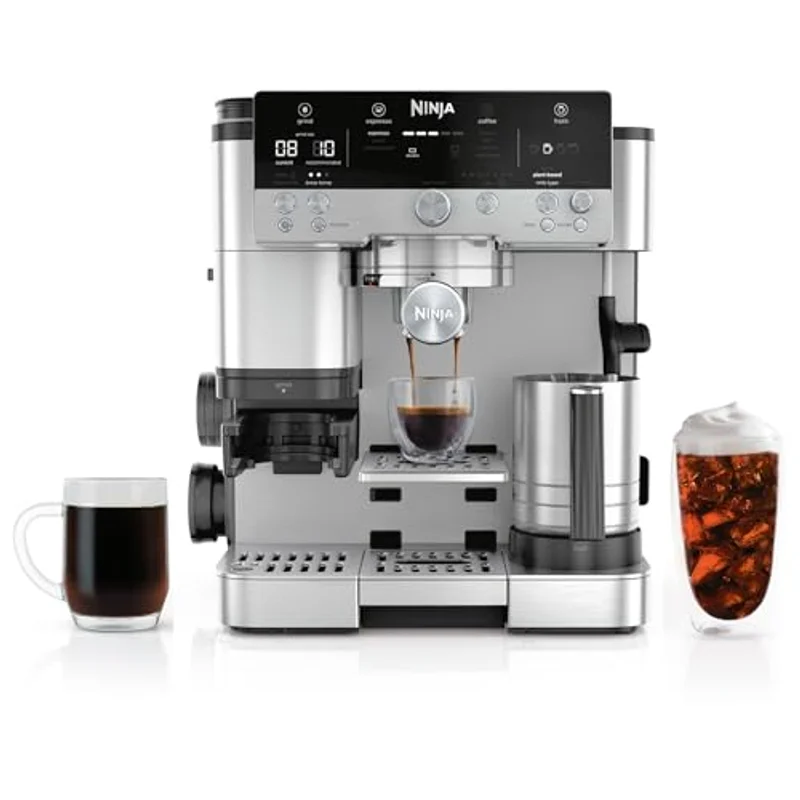
Ninja Luxe Café Premier 3-in-1
For households that want an actual overnight-style cold brew, not a cold espresso shot
3-in-1 · espresso, drip coffee, cold brew · built-in burr grinder · dual automatic froth system
This is the machine in this lineup built with a separate cold-brew mode rather than one setting bolted onto an espresso group head — espresso, drip and cold brew are listed as three distinct functions, each presumably running its own cycle. That structural separation is what points toward true steeped cold brew rather than a fast cold-pressed shot: a dedicated drip-and-steep path is the mechanism cold brew actually needs, unlike a pump forcing cold water through a puck in under a minute. The built-in grinder means you can go from whole beans to any of the three styles without a second appliance.
The trade-offIt's the most expensive machine on this page at $599.00, and it's a large 3-in-1 unit — measure your counter, since the width and depth for three brewing systems in one chassis add up. If all you want is cold brew and nothing else, this is more machine than the job requires.
02Cold-pressed espresso
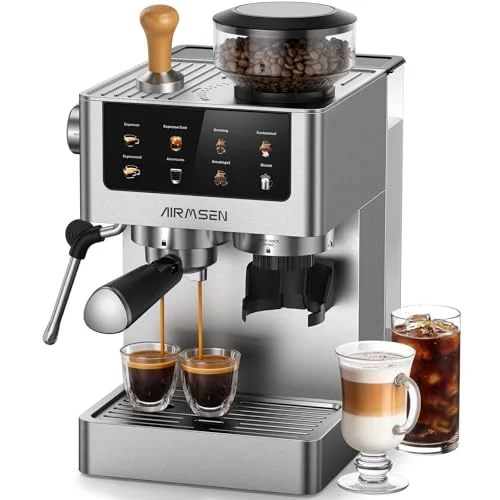
AIRMSEN Espresso Machine with Burr Grinder
For iced Americanos and cold-pressed espresso drinks, made fast
Semi-automatic · 20-bar pump · built-in burr grinder · milk frother steam wand · cold brew iced coffee & Americano
AIRMSEN's own listing frames the cold-brew capability around iced coffee and Americano drinks rather than a slow steeped batch, and pairs it with the same 20-bar pump and burr grinder used for hot espresso. Read together, that's the profile of a pressure-driven cold shot: quick, concentrated, and meant to be built into an iced drink rather than sipped as a pitcher-style cold brew. A steam wand is included for anyone who still wants hot milk drinks from the same machine.
The trade-offIf a genuine multi-hour steep is what "cold brew" means to you, this isn't that — it's a fast cold shot wearing the same name. The listing doesn't specify cycle time or water temperature for the cold-brew setting, so treat it as a cold-pressed espresso feature rather than a steeping one until you've confirmed otherwise on the current listing.
03Cold-pressed espresso, budget grinder bundle
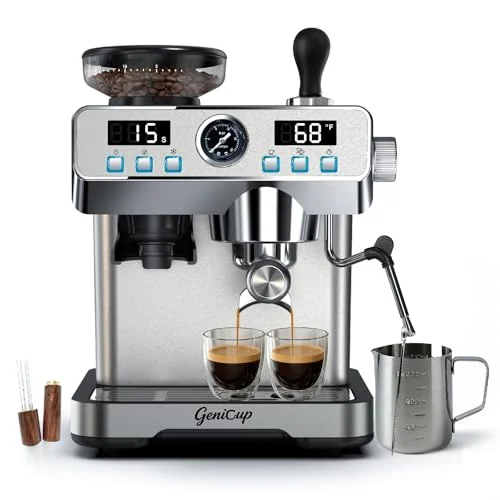
GeniCup Espresso Machine with Grinder
The lowest-cost route into a machine with a cold-brew button
20 bar · built-in grinder · 68 oz water tank · cold brew setting
The GeniCup's headline numbers are the 20-bar pump and the unusually large 68 oz tank — useful if more than one person in the house is pulling cold shots back to back without a refill. Its cold-brew feature sits on the same pressure-driven chassis as its hot espresso mode, so expect the same cold-pressed-espresso style of output as the AIRMSEN above rather than a steeped brew, at the same $179.99 price point.
The trade-offThe listing doesn't give a portafilter size or grind-range spec beyond "with grinder," so if either matters to you, check the current listing before ordering rather than assuming it matches a specific standard size.
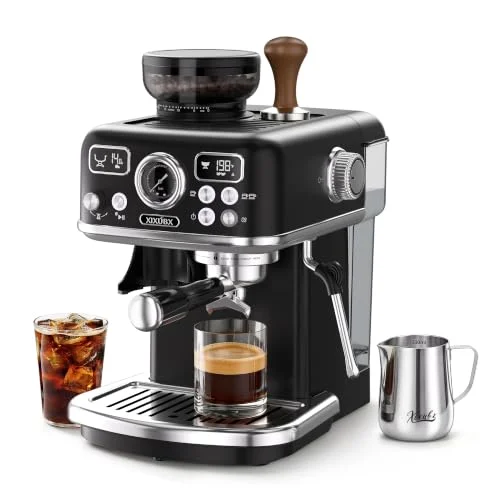
One machine we cover on this site is relevant here precisely because it doesn't have a cold-brew mode. The XIXUBX Espresso Machine with Grinder at $169.99 has PID temperature control and programmable settings, which matters for cold drinks in a roundabout way: a PID lets you dial brew temperature down for the hot shot you're about to pour over ice, rather than relying on a fixed default. It won't steep or cold-press anything, but it's the machine here to consider if your actual goal is a well-controlled iced espresso rather than a labeled cold-brew feature — more on that trade-off further down.
XIXUBX Espresso Machine with Grinder
No cold-brew mode, but PID temperature control and programmable settings give you a repeatable hot shot to pour over ice — the simplest route to a controlled iced espresso. Dimensions: 12.61"D x 9.5"W x 14.34"H.
$169.99 Check price →
Iced americano vs cold brew vs cold-pressed espresso: what each tastes like
These three drinks get used interchangeably in casual conversation and they shouldn't be, because the extraction method behind each one changes what lands in the glass.
An iced Americano starts as a normal hot espresso shot — pulled at roughly 9 bar of pressure the way any espresso is — poured or shot directly over ice. The heat-driven extraction pulls the same brightness and body a hot shot would; the ice just chills and dilutes it afterward. That means it carries more of the acidity and immediacy that heat extraction produces, softened by dilution rather than avoided.
Cold brew, the steeped version, never sees heat. Coarse grounds sit in cold water for hours, and the slow extraction favors different compounds than a fast hot pull does — typically read as smoother and less acidic, with a heavier, more syrup-like body once it's concentrated. It's also usually served over ice as a concentrate diluted with water or milk, similar in serving style to an Americano but arrived at by a completely different process.
Cold-pressed espresso — what the GeniCup and AIRMSEN cold-brew settings most likely produce — splits the difference mechanically: cold or cool water forced through grounds under pressure, in roughly the same timeframe as a hot shot rather than over hours. Because pressure rather than heat is doing the extracting, the result tends to land between the two: less of the sharp acidity that heat pulls fast, but without the hours-long mellowing of a true steep. It's a real style of its own, not a lesser version of either — but it is worth knowing that's what you're getting when a machine markets it simply as "cold brew."
None of this is a claim we can rate or score — we have no lab and no panel of tasters, just the mechanics of what each method does to water and coffee. If you want a fuller breakdown of why heat changes extraction in the first place, our guide on why your espresso tastes bitter covers the same underlying chemistry from the hot-brewing side.
Cleaning and switching back to hot brewing
A cold-brew setting adds a cleaning step that a hot-only machine doesn't have, and it's worth planning for before the first use rather than discovering it a week in.
On the two cold-pressed-espresso machines here — the GeniCup and the AIRMSEN — the water path for a cold shot is the same group head and lines used for hot espresso, so the cleaning routine doesn't fundamentally change: flush the group head, wipe the portafilter, and follow the manufacturer's descaling schedule based on your water hardness, same as any pump machine. The one thing worth double-checking on the current listing is whether the machine needs to fully cool down between a cold cycle and a hot one, or whether it can switch immediately — that detail isn't specified in what we have, so treat it as a question for the product page or manual rather than an assumption.
On a true steeping machine like the Ninja Luxe Café Premier, the cold-brew path is more separate from the espresso and drip paths, so there's more to keep clean: a steeping basket or reservoir that held wet grounds for an extended period needs to be emptied and rinsed promptly, since spent grounds left sitting are the kind of thing that encourages buildup and odor faster than a quick espresso puck would. Manufacturer cleaning instructions for the cold-brew basket specifically are the reference to follow rather than treating it like the espresso side of the machine.
Across all of them, limescale from tap water is still the long-term threat to any heating element or pump, cold-brew feature or not — our guide to what an espresso machine actually costs to run covers descaling frequency and supplies as part of the ongoing cost, separate from the machine's purchase price.
Who should just make iced espresso the simple way instead
A dedicated cold-brew button is solving a real problem for some people and adding an unnecessary decision for others, and it's worth being honest about which camp you're in before paying extra for the feature.
If what you actually want most mornings is an iced latte or an iced Americano, the simplest and cheapest path is a machine that pulls a good hot shot and a glass of ice — no cold-brew mode required. Pull the shot, pour it over ice, add milk if you want it; the dilution from the ice does most of the work a "cold" setting is trying to replicate anyway. Any semi-automatic with a burr grinder does this job, including the XIXUBX above, whose PID control is arguably more useful for this than a cold-brew button would be, since dialing in a slightly hotter or more concentrated shot before it hits ice is a real lever a fixed cold cycle doesn't give you.
Where a dedicated cold-brew feature earns its keep is if you specifically want the steeped style — smoother, less acidic, and genuinely different in character from an iced hot shot — without setting up a separate cold-brew pitcher and waiting overnight. That's a real use case, and it's the one the Ninja Luxe Café Premier is built for. It's a much weaker case for the cold-pressed-espresso machines here, where the honest comparison is: you're paying for a labeled "cold brew" button that produces something closer to a fast cold shot you could approximate by pulling espresso and pouring it over ice anyway. If your household already leans toward milk-forward iced drinks rather than black cold brew, our guide on steam wand versus automatic frother is probably the more useful spec to weigh than the cold-brew button.
How we compared these
We compare published specifications, listing descriptions, price and machine class — we do not physically test these machines and we do not run a testing lab. Where a listing states a feature (a cold-brew setting, a tank size, a pump rating) we report it as stated; where a listing doesn't specify a mechanism (exact cycle time, water temperature during a cold cycle), we say so rather than infer or guess. We show no star ratings and no review counts on this page because Amazon's product data does not supply verified figures for these machines, and we do not paraphrase review sentiment we have no access to. General coffee facts — espresso brewing at roughly 9 bar, cold brew's hours-long steep, heat's effect on extraction — are standard background rather than product-specific claims.
Frequently asked questions
Is a machine's cold brew mode the same as steeping grounds overnight?
Usually not. Traditional cold brew steeps coarse grounds in cold water for 12 to 24 hours with no heat and no pressure. Most machine "cold brew" settings that share a group head with the espresso function are pressure-driven cold-pressed espresso instead — fast, concentrated, and mechanically closer to a cold espresso shot than to an overnight steep. A machine like the Ninja Luxe Café Premier, which runs cold brew as a separate mode from its espresso and drip functions, is closer to the true steeped style.
What's the difference between an iced Americano and cold brew?
An iced Americano is a hot-extracted espresso shot poured over ice, so it carries the acidity and brightness that heat pulls out quickly, softened by dilution. Cold brew is steeped for hours with no heat, which favors different, generally smoother and less acidic compounds, and produces a heavier-bodied concentrate that's also usually diluted before drinking. Same serving style over ice, different extraction chemistry underneath.
Do I need to clean a cold-brew machine differently than a hot-only one?
If the cold-brew feature shares the espresso group head, as it does on pressure-driven machines like the GeniCup and AIRMSEN, the cleaning routine is largely the same as any pump espresso machine: flush the group, wipe the portafilter, descale on schedule. Machines with a separate steeping basket, like the Ninja Luxe Café Premier's cold-brew mode, need that basket emptied and rinsed promptly since wet spent grounds left sitting encourage buildup faster than a quick espresso puck.
Should I buy a machine with a cold-brew button, or just pour hot espresso over ice?
If you want an iced latte or Americano, pulling a normal hot shot over ice does the job without paying for an extra setting — any semi-automatic with a burr grinder handles this, and a PID-equipped machine like the XIXUBX arguably gives you more useful control over the shot going into the ice than a fixed cold cycle would. A dedicated cold-brew feature is worth paying for specifically if you want the smoother, steeped style of cold brew without setting up a separate pitcher overnight.
Keep reading