What an Espresso Machine Really Costs to Run
The sticker price is the smallest number in the whole relationship. Beans, electricity, descaler, filters and the one repair that ends a cheap machine's life all keep billing you long after checkout — here is the honest yearly figure, worked out from real specs and stated assumptions rather than a marketing footnote.
Reader-supported: we may earn a commission if you buy through our links, at no extra cost to you. Prices are the ones we recorded on September 6, 2026 and they move constantly — confirm the live price before buying.
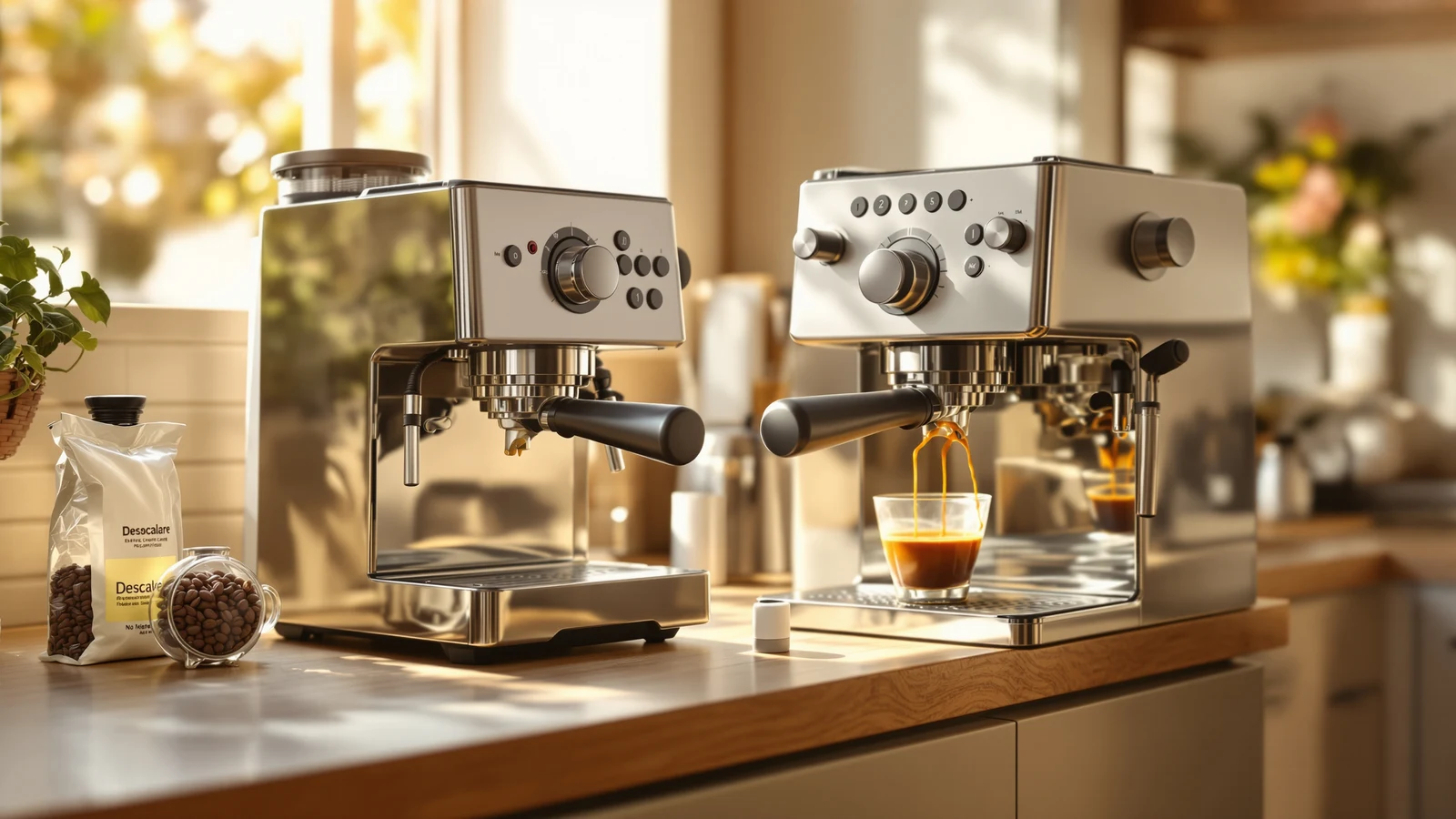
The honest yearly figure
Run the numbers for one person drinking two double shots a day, every day, for a year, and the total lands somewhere between $230 and $320 depending on bean spend and how conscientious you are about descaling — and roughly 85 to 90 percent of that is beans. Electricity is a rounding error. Descaler and filters are a once-or-twice-a-year line item measured in single dollars per month. The number nobody budgets for is the repair that shows up around year three or four on a machine that skipped its descaling schedule, and it can equal a full year of running costs in one bill.
None of that is a reason to avoid buying a machine — a $6 café latte times 730 doubles a year is well over $1,000, and even the honest home figure above beats that by a wide margin. It is a reason to budget for the machine's whole first year, not just the checkout price, and to pick a machine whose ongoing costs match your habits rather than the one with the lowest number on the box.
Beans: the cost that dwarfs the rest
Start with the one line item that decides almost the entire bill. A standard double shot uses about 18 grams of ground coffee. A 12-ounce bag of beans is roughly 340 grams, which works out to around 18 doubles per bag before you account for any waste in dialing in the grind.
Specialty beans generally run $14–20 per 12-ounce bag; call it $17 as a working midpoint. At 18 doubles per bag, that is roughly $0.94 per double shot in beans alone. Two doubles a day, 365 days a year, comes to 730 doubles — and at that rate, beans alone cost about $685 a year if you drink two doubles every single day without exception.
That figure is higher than most people's real spend, because most people don't drink espresso literally every day, and grocery-aisle beans at $9–12 a bag pull the average down considerably. Recalculating at a more typical $10 bag and one double a day (a milk drink most mornings, black coffee or nothing on weekends) brings bean cost to roughly $200 a year — which is why the $230–320 all-in estimate above assumes a moderate habit, not a daily double-shot ritual. The point holds regardless of where your own number lands: beans are the input you actually control, and they are the input worth spending time comparing, because a $3 difference per bag compounds into real money over a year in a way that a $50 difference in machine price does not.
This is also the strongest argument for a machine with a built-in grinder, since fresh-ground beans extract more efficiently than pre-ground coffee that has already lost aroma to the bag — you get more usable flavor per gram, which is a real (if hard to price precisely) saving layered on top of the sticker math. Our guide to machines with built-in grinders goes through the trade-offs of grinding at the machine versus buying pre-ground.
Electricity per cup, calculated honestly
Electricity is the easiest cost to overstate, because a machine's wattage rating describes its heating element at full draw, not what it actually consumes making one cup. Here is the honest version of the math, assumptions stated.
A typical semi-automatic espresso machine draws somewhere in the 1,200–1,600 W range while its boiler is actively heating, but that draw only happens for a fraction of the time it's plugged in — heating from cold takes roughly 60–90 seconds, and the thermostat then cycles the heating element on and off to hold temperature rather than running continuously. A conservative estimate for one shot, counting warm-up plus the brew cycle plus some idle cycling while you steam milk, is about 0.05–0.08 kWh — call it 0.06 kWh as a rounded middle figure.
At the U.S. average residential electricity rate of roughly $0.16–0.17 per kWh, one shot's worth of electricity costs approximately 1 cent. Two doubles a day, 365 days a year, is about 730 shots, which puts annual electricity cost at roughly $7–9 a year — genuinely a rounding error next to beans. Leaving a machine powered on standby all day adds a small amount on top (most modern machines auto-shut-off after 15–30 minutes of inactivity specifically to limit this), but even a household that never turns the machine off is unlikely to clear $20–25 a year in electricity.
The exception is super-automatic machines like the De'Longhi Magnifica Start, which run a grinder motor and sometimes a self-clean or rinse cycle on top of the boiler — still a small draw in absolute terms, but worth knowing it's a slightly higher number than a simple semi-automatic pulling shots from pre-ground coffee.
Descaler and filters on a real schedule
This is the maintenance category people actually skip, and it is also the cheapest one to do properly. Two separate things are being maintained here: the water itself, and the mineral scale that hard water leaves behind inside the boiler.
A water filter cartridge for a machine's tank — the kind that reduces chlorine taste and some hardness before water ever reaches the boiler — typically costs $8–15 and is rated for roughly two to three months of typical use before it needs replacing. Over a year that's three to four cartridges, or about $30–50 annually, and it is optional in the sense that a machine will run without one, but it slows the mineral buildup that descaling has to fight later.
Descaling solution is the non-optional part. Manufacturers generally recommend descaling every one to three months depending on your local water hardness — more often in hard-water regions, less in soft-water ones — using either a dedicated descaling solution (about $10–15 per bottle, good for one to a few cycles depending on concentration) or a food-safe citric acid mix, which is cheaper still. Budgeting for descaling four times a year at roughly $12 a bottle comes to about $48 a year. Combined with filters, a realistic total for water maintenance is $60–100 a year — a genuinely small number, and the one most owners skip anyway because nothing visibly breaks the week they miss it.
That's the trap. Skipping descaling doesn't cause a visible failure in month one; it causes a slow, invisible one that shows up as the next section. Our water quality and descaling guide covers how to read your local water hardness and set an actual schedule instead of guessing.
The repair that ends cheap machines
Here is the cost nobody puts in a comparison table, because it doesn't happen to everyone and it doesn't happen on a fixed schedule. It happens to machines that run hard water without descaling, and it happens on a timeline of roughly two to five years rather than months.
Mineral scale from hard water builds up inside the boiler, the internal tubing and the valves. A thin layer barely matters. A thick one restricts water flow, forces the heating element to work harder to reach temperature, and eventually clogs or jams a valve outright — which is when a machine that was pulling fine shots one week starts leaking, stalling mid-brew, or refusing to heat the next. On a machine with a simple boiler and few components, that failure is sometimes a $20–40 replacement descaling valve or a thorough manual descale that restores function. On a machine with a more complex thermoblock or a super-automatic's internal plumbing, the same failure is often a same-as-new repair quote, because the affected part isn't sold separately or the labor to reach it costs more than the machine did.
This is where machine price and repair risk actually connect, and not in the direction people assume. A $700 super-automatic and an $80 semi-automatic both scale up under hard water at the same rate — water doesn't know what the machine cost — but the cheap machine was never built with the expectation of being repaired. Manufacturers of budget machines price them to be replaced, not serviced: parts availability is limited, and a repair quote frequently exceeds the machine's own price, at which point "the repair that ends cheap machines" is really just the manufacturer declining to compete with its own replacement unit. On a more expensive, more established machine, a factory service center and available parts at least make the repair option real, even if it isn't cheap.
The fix costs $10 in citric acid and fifteen minutes, four times a year. It's the single highest-leverage line item in this entire article, and it's also the one with a $0 marketing budget behind it — nobody sells descaling the way they sell milk frothers.
The picks by cost of ownership
Ranking by cost of ownership rather than by feature list changes the order, because a machine's honest running cost is a function of its price bracket, its complexity, and how forgiving it is of a missed descaling cycle — not of how many settings are on the box.
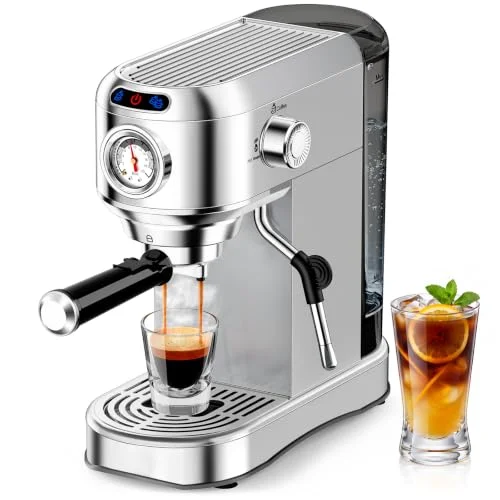
AERCANA Espresso Machine 20 Bar
Lowest cost of ownership on this list by simple mechanics: no grinder to fail, a small boiler that heats and descales fast, and a compact stainless build with a 34 oz removable tank. Fewer components sharing a chassis means fewer places for hard-water scale to concentrate its damage.
$99.99 Check price →The AERCANA above wins on ownership cost for the same reason budget semi-automatics generally do: a 20-bar pump, a milk frother and a 34-ounce tank are the whole feature set, so there's less plumbing for scale to attack and less to go wrong when it does. Its risk is the one described above — as a newer, simpler build, expect the manufacturer's repair option to be limited, so treat the descaling schedule as non-negotiable rather than optional on this class of machine.
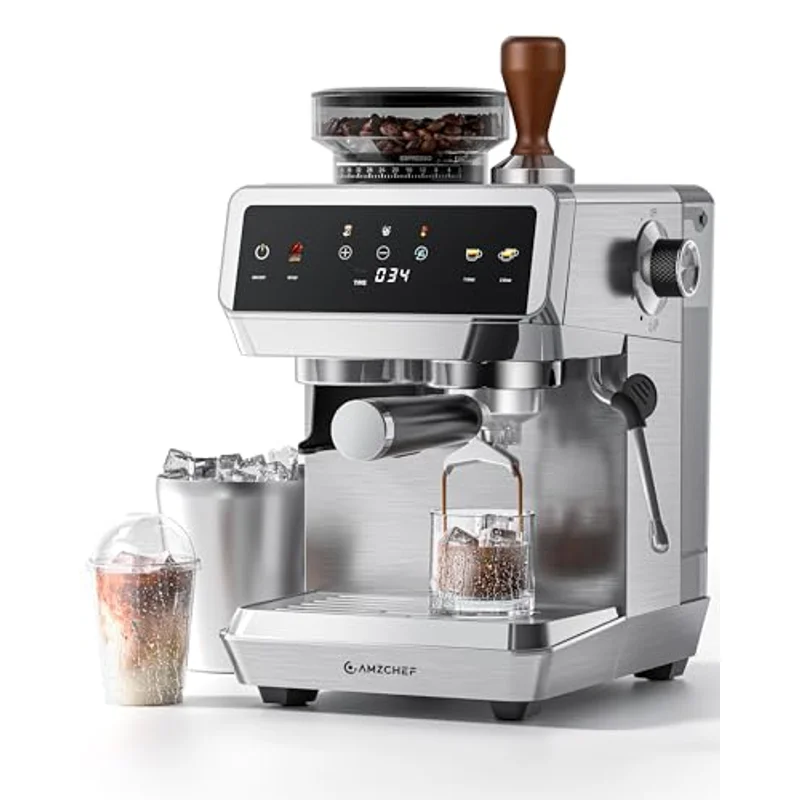
AMZCHEF Espresso Machine With Grinder
Middle of the pack on ownership cost: the built-in grinder with 44 settings adds a second motor that can eventually need service, but temperature control across a range means less strain forcing water through improperly heated boiler sections, which is one of the ways scale accumulates faster. Bean-to-cup also means no pre-ground coffee purchase, folding a small saving back into the beans line.
$189.99 Check price →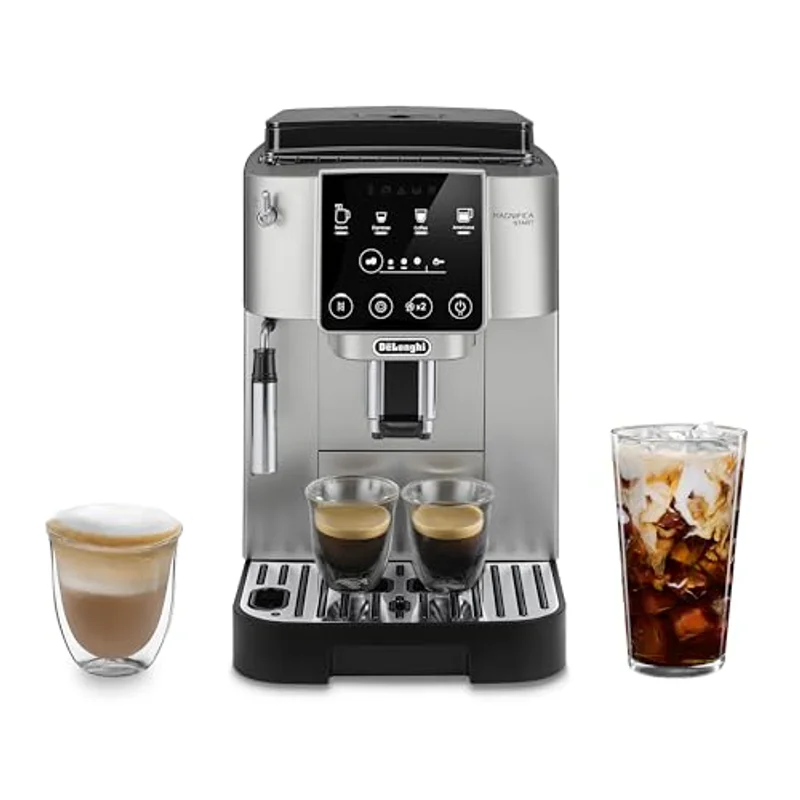
De'Longhi Magnifica Start
Highest sticker price and the most complex plumbing of the three — a super-automatic grinds, doses and brews behind one button, which is more internal machinery for scale to reach. It's also the machine most likely to have a real repair path if something does go wrong, because De'Longhi's service network and parts supply are established. Budget for descaling here more than anywhere else on this list; the internal complexity is exactly what a missed cycle punishes hardest.
$662.91 Check price →Put plainly: the cheapest machine to buy and the cheapest machine to run are often the same machine, provided you actually descale it — and the most expensive machine to buy has the deepest repair infrastructure behind it if you don't. Neither position is a free pass. If you're still deciding which of these fits your kitchen rather than your spreadsheet, our built-in grinder guide and the under-$100 guide cover the buying decision in more depth than cost of ownership alone.
Cost per cup over three years
Put the whole article into one table. Assumptions: one double shot a day (365/year, 1,095 over three years), a $12 average bag of beans at 18 doubles per bag, electricity at the $0.01/shot figure calculated above, descaler and filters at the moderate $80/year estimate, and the machine's own purchase price amortized over three years with no repair included — repairs are the variable nobody can price in advance, which is the entire point of the earlier section.
| Machine | Price | Beans (3 yr) | Power (3 yr) | Descaler/filters (3 yr) | Cost per cup (3 yr) |
|---|---|---|---|---|---|
| AERCANA 20 Bar | $99.99 | $730 | $11 | $240 | $1.03 |
| AMZCHEF with Grinder | $189.99 | $730 | $11 | $240 | $1.08 |
| De'Longhi Magnifica Start | $662.91 | $730 | $14 | $240 | $1.55 |
The spread between the cheapest and most expensive machine on this list is about 52 cents per cup over three years once running costs are included — far narrower than the roughly $557 gap in sticker price would suggest, because beans dominate all three rows equally. Compare any of those to a café double shot at $4–6 and the home numbers look the same regardless of which machine you buy: the decision to make espresso at home saves money before you've picked a specific model. The decision of which model to buy should be about grinder, milk system and counter space, with cost of ownership as a tiebreaker rather than the headline. Our espresso machine vs. pod machine cost comparison runs the same three-year math against capsule coffee, where the story is different because pods don't get cheaper per cup at scale the way beans do.
How we compared these
We compare published specifications, typical U.S. grocery and specialty coffee pricing, U.S. average residential electricity rates, and manufacturer-recommended descaling intervals — and we state every assumption inline rather than presenting a single number as gospel. We do not physically test these machines, we do not run a testing lab, and we do not publish ratings we cannot verify: Amazon's product data returns no rating and no review count for the machines on this site, so there are no stars and no invented scores anywhere on this page.
The bean, electricity and descaling costs here are general category math applied consistently across all three machines, not manufacturer-published operating-cost figures — none of these manufacturers publish one. Where we've made a judgment call, such as which descaling frequency to assume or which bean price to treat as a midpoint, we've said so in the text so you can substitute your own numbers. The general facts used throughout (residential electricity rates, coffee-to-water ratios, descaling chemistry) are standard background rather than product-specific claims. The rest of our method sits on our main espresso machine guide.
Frequently asked questions
How much does it cost to run an espresso machine per year?
For a moderate habit of about one double shot a day, expect roughly $230–320 a year in total, with beans making up 85–90 percent of that figure. A daily two-double-shot habit using specialty beans can push bean cost alone toward $685 a year. Electricity is around $7–9 a year for typical use; descaler and filters run $60–100 a year on a real schedule.
How much electricity does an espresso machine actually use?
Far less than the wattage rating on the box suggests, because that number describes the boiler's peak draw, not continuous use. One shot, including warm-up and brew cycle, uses roughly 0.05–0.08 kWh — about a penny at typical U.S. residential electricity rates. Two shots a day for a year comes to roughly $7–9 in electricity, making it the smallest line item in the whole running-cost picture.
How often do I really need to descale my espresso machine?
Manufacturers generally recommend every one to three months depending on your water hardness — more often with hard water, less with soft. Descaling solution costs about $10–15 a bottle, and budgeting for four cycles a year runs roughly $48 annually. Skipping it doesn't cause an immediate failure; it causes slow mineral buildup that shows up years later as a stalled valve or a boiler that won't heat, often as an expensive repair rather than a cheap one.
Is a cheaper espresso machine actually cheaper to own?
Often yes for running costs, since a simpler machine has fewer components for hard-water scale to damage and heats a smaller boiler for less electricity. The trade-off is repair infrastructure: budget machines are typically priced to be replaced rather than serviced, so a hard-water failure a few years in may cost more to repair than to replace, while an established brand's machine is more likely to have parts and service available at a real repair price.