Warm-Up Time: Why Your First Shot Is Never the Good One
A machine that says ready in 30 seconds is telling you about its heater, not about its group head. The gap between "the light turned green" and "the metal is actually hot enough" is where your first sour, thin shot comes from — and it is a gap most spec sheets never mention.
Reader-supported: we may earn a commission if you buy through our links, at no extra cost to you. Prices are the ones we recorded as of September 11, 2026 and they move constantly — confirm the live price before buying.
Heater ready is not brew ready
Almost every home espresso machine has a light, a beep or an icon that means "ready." What it actually measures is that the heating element has reached a target temperature — nothing more. It says nothing about the metal mass around the group head, the portafilter you just clipped in cold from the drawer, or the water sitting in the lines since last night.
That distinction matters because espresso extraction is unusually sensitive to temperature. A shot pulled through a group head that is 10 or 15 degrees below the water temperature will taste different from one pulled five minutes later on the same machine, same beans, same grind — and the "ready" light was on for both. The light is a heater checkpoint, not a brew-quality checkpoint.
This is not a defect specific to any one machine; it is how the ready indicator is built across the category, from a budget semi-automatic to a machine with a full PID controller. The controller can hold the boiler or thermoblock at a precise number and still hand you a group head, portafilter and basket that haven't caught up. Precision at the heater and stability at the coffee are two different jobs, and the ready light only reports on the first one.
The practical takeaway is simple: treat the ready light as "safe to start," not "safe to judge." The machine needs a few more minutes of running water and holding the portafilter in place before the whole brew path — not just the heater — is actually at temperature.
Thermoblock, thermocoil and boiler: how long each really takes
How long that gap lasts depends on which heating system is inside the machine, and the three common designs behave very differently.
Thermoblock heaters are small aluminum blocks that water passes through in a thin channel, heated on demand rather than held hot in a reservoir. They are cheap to build and genuinely fast to reach the "ready" temperature — often under a minute — which is why they show up in compact and budget-tier machines. The trade-off is thermal mass: a thermoblock has very little metal to hold heat, so it cools quickly once water starts flowing through it, and it recovers slowly between shots. The first shot through a thermoblock machine is the one most likely to drift cool partway through, because the block simply doesn't have the reserve to keep pace.
Thermocoil designs are a step up in mass — a coiled tube wrapped in a heating element, giving a bit more thermal buffer than a bare thermoblock while still heating faster than a full boiler. It's a middle ground: quicker to ready than a boiler, steadier through a shot than a plain thermoblock, though it still cannot match the stability of a large mass of hot water.
Boilers — the copper or stainless tanks used in prosumer and commercial-style machines — hold a reservoir of water at temperature continuously. They take longer to reach ready, sometimes several minutes from cold, because there's simply more mass to heat. But once that mass is hot, it stays hot: pulling a shot barely dents the temperature of a boiler holding many times the water volume of a thermoblock, which is why boiler machines are prized for back-to-back consistency in cafés and serious home setups.
None of the three products in this guide publish an exact seconds-to-ready figure, so treat "thermoblock is fast, boiler is stable" as the general shape of the trade-off rather than a number to hold any specific machine to. If a listing does state a warm-up time, remember it is describing the heater reaching temperature — not the group head, portafilter and basket catching up behind it, which is the gap the rest of this guide is about.
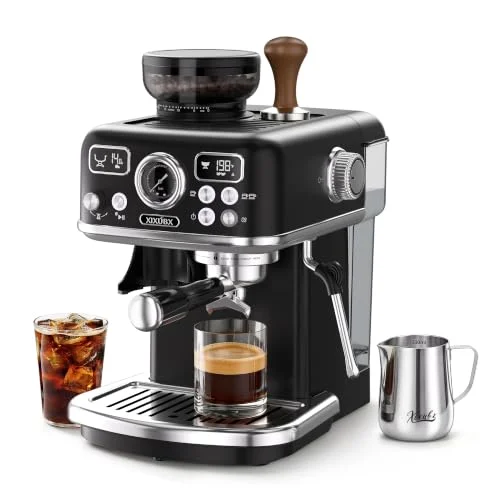
XIXUBX Espresso Machine with Grinder, PID & Programmable Settings
A compact semi-automatic with a built-in grinder and PID temperature control, sized at 12.61"D x 9.5"W x 14.34"H. PID control manages the heater's target temperature precisely; it does not by itself shorten how long the portafilter and basket need to sit in a hot group head before a shot is representative.
$169.99 Check price →Why the first shot runs sour or thin
Extraction is a chemistry problem before it is a barista problem. Hot water pulls sweetness and body out of ground coffee at one rate and pulls sharp, sour acids out at a faster rate early in the shot. Run water that is a few degrees under target through the puck, and the balance tips toward the fast-extracting sour compounds before the slower, rounder ones have had time to come through — the result reads as sour or thin, even with good beans and a correct grind.
A cold group head and portafilter make this worse in two ways at once. First, the metal itself pulls heat out of the water as it passes through — a chunk of aluminum or brass at room temperature will drop the temperature of the water flowing over it, and that drop is largest on the very first shot of the day, before the metal has absorbed any residual heat from prior use. Second, a cold basket chills the puck itself from the outside in during the shot, which is a second, separate temperature loss on top of the water's own drop.
Because both effects fade with use, this is why the second and third shots of a session routinely taste better than the first, on the same beans and the same grind setting, with nothing else changed. It is not the machine getting "warmed up to full power" in some vague sense — it is specific metal parts finally sitting at the same temperature as the water passing through them.
It also explains a case that seems paradoxical: a cool group head can make a shot taste thin (under-extracted, sour) even though the water hitting the boiler-side sensor reads exactly on target. The sensor is reporting one point in the system; the coffee experiences the whole path, cold spots included.
Flushing and pre-warming the cup and basket
The standard fix across the category — semi-automatic, thermoblock or boiler — is to run water through the group head with no portafilter locked in, right before pulling the actual shot. This is usually called a flush, and it does two things: it pushes out any water that has been sitting stagnant in the lines since the last use (which can be lukewarm or, on some machines, slightly overheated from residual boiler heat), and it brings a fresh pass of properly-heated water into direct contact with the group head's metal, warming it a little more than the idle "ready" state did.
The second step, locking the empty portafilter (with basket) into the group head for a minute or two before dosing it, does the harder part of the job: bringing the basket itself up near brew temperature, rather than starting the shot with a room-temperature disk of metal wrapped around the puck. Many home baristas do both back to back — flush, then hang the empty portafilter in place while grinding and dosing the next shot — so that by the time the basket has coffee in it, the metal touching that coffee is no longer the coldest part of the system.
Pre-warming the cup matters for a related but distinct reason: espresso is a small volume of liquid with a large surface-area-to-volume ratio, so it loses heat fast once it lands. A cold ceramic cup pulls heat out of the shot in the seconds between the pour and the first sip, which changes how sweetness and bitterness read on the tongue even when the extraction itself was fine. Rinsing the cup with hot water from the machine (or a kettle) right before pulling the shot removes that variable, and it costs nothing but a few seconds.
None of this requires a specific machine feature — it's a routine, not a spec — but it matters more on smaller-mass heaters like a thermoblock, where the group head has less stored heat to begin with, and matters somewhat less (though not zero) on a larger boiler machine that already runs hotter through more metal.
What PID changes, and what it does not
A PID (proportional-integral-derivative) controller is a more precise thermostat. Rather than simple on/off heating that lets the boiler or thermoblock temperature swing a few degrees above and below target, a PID continuously adjusts the heating element's power to hold temperature within a tighter band — often within a degree or so, compared with a wider swing on a basic thermostat. Our guide to what PID actually does to your shot goes through this in more depth; the short version here is that PID is a heater-precision upgrade, not a warm-up-time upgrade and not a group-head-mass upgrade.
Concretely: a PID controller can hold the water hitting the group at, say, a consistent 200°F shot after shot, rather than letting it drift between 195°F and 205°F as an on/off thermostat cycles. That is a real, useful improvement for repeatability across many shots in a session, because it removes one source of shot-to-shot variation. What it does not do is heat the group head, portafilter or basket any faster than the machine's underlying heater design allows, and it does not eliminate the first-shot gap described above — that gap is about metal mass catching up to water temperature, and a PID only controls the water side of that equation.
The XIXUBX above is a useful example of this distinction in practice: it ships with PID and programmable settings, which is a genuine step up for shot-to-shot temperature consistency once the machine has been running a few minutes, but the same flush-and-pre-warm routine still applies to its very first shot of the day, exactly as it would on a machine without PID. A PID controller and a cold group head are not mutually exclusive.
So when comparing machines, treat "has PID" as answering the question "will shot five taste like shot two," and treat warm-up routine as answering the separate question "will shot one taste like shot two." They are different problems with different fixes.
Building a morning routine around it
None of the fixes above require special equipment, but they do require sequencing your morning so the machine isn't the last step before you drink. A workable order looks like this: turn the machine on and let the "ready" light or indicator come on as normal; while it finishes its internal heat-up, grind your dose so the coffee is ready the moment the machine is; then run a flush with the portafilter out, followed by locking the empty, basket-loaded portafilter into the group head while you weigh and tamp; finally, rinse the cup with hot water from the machine or a kettle, dose and tamp the portafilter, and pull the shot.
The total extra time this adds is typically a couple of minutes beyond what the ready light alone would suggest — not a dramatic change to a morning, but enough to matter for a shot that otherwise reads sour or thin for no obvious reason. If you only have time for one step, prioritize the flush-and-hold-the-portafilter step over the cup rinse; the group head and basket temperature affects the extraction itself, while the cup temperature affects only how the finished shot tastes once it's in front of you.
Machine choice interacts with this routine but doesn't replace it. A larger-mass boiler machine holds its heat better between the first and second shot of a session, so the routine matters most on its very first use of the day and less on subsequent shots. A compact thermoblock or thermocoil machine — including both machines featured in this guide — benefits from the same routine every single time, because the group head has less stored heat to fall back on between cups. Either way, the fix is the same three steps, just with slightly different stakes.
If milk drinks are part of your routine, note that steam-wand warm-up is a related but separate timer: on most semi-automatic machines the boiler or thermoblock needs an extra stretch to build steam pressure after it's ready to brew, which is one more reason the "ready" light marks the start of your prep, not the finish. Our guide to frothing milk at home covers getting the steam side consistent as well.
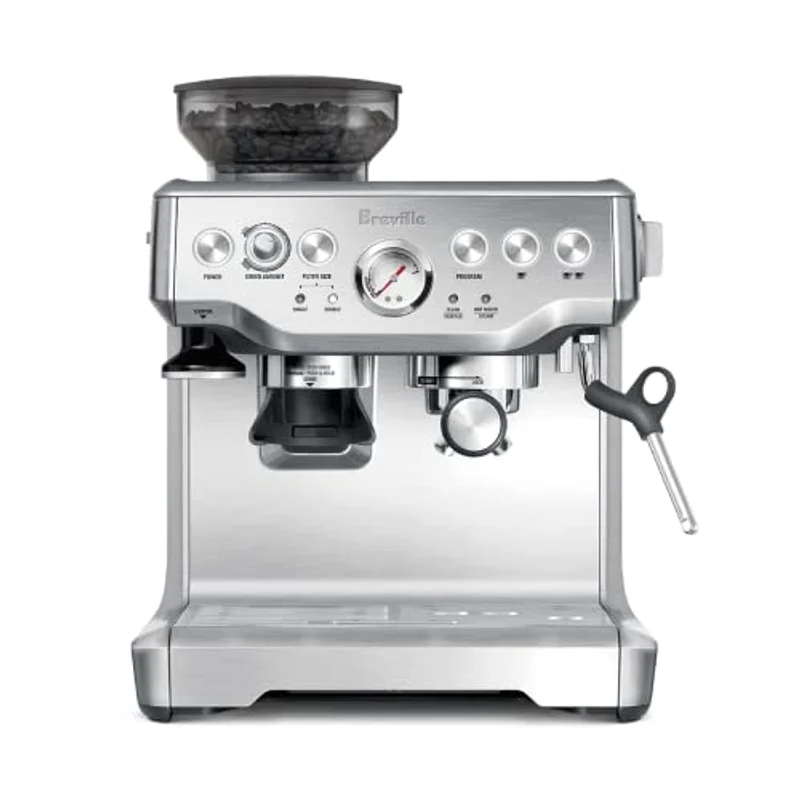
Breville BES870XL Barista Express
A larger semi-automatic with a built-in conical burr grinder and low-pressure pre-infusion, sized for a full-size counter footprint (12.61"D-class machines are noticeably smaller than this one). More thermal mass in the brew path generally means the first-shot gap is less dramatic than on a compact thermoblock unit, though the same flush-and-pre-warm routine still applies.
$694.94 Check price →The two machines featured, side by side
Two of the three machines named in this guide, compared on what's relevant to warm-up and heat retention. Prices are what we recorded as of September 11, 2026.
| Machine | Grinder | Temperature control | Size | Price | |
|---|---|---|---|---|---|
| XIXUBX with Grinder | Built-in | PID, programmable | 12.61"D x 9.5"W x 14.34"H | $169.99 | Price |
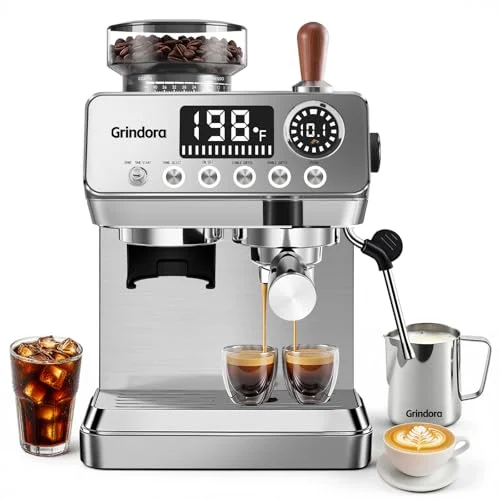 Grindora with Grinder Grindora with Grinder | Built-in, 44 settings | 20-bar pump | See listing | $199.99 | Price |
| Breville BES870XL Barista Express | Built-in, conical burr | Low-pressure pre-infusion | Large | $694.94 | Price |
The Grindora's listing does not give us a size figure, so we won't guess at its footprint or how it compares dimensionally to the other two — check the current listing if counter space is a concern. Its 20-bar pump rating, like most pump-max numbers in this category, describes the pump's ceiling rather than brew pressure at the puck; our guide to why 9 bar matters covers that separately from the warm-up question here.
How we compared these
We compare published specifications, listed dimensions, machine class and live pricing, and we explain general espresso mechanics — heat transfer, extraction chemistry, thermoblock versus boiler design — using standard, non-product-specific coffee science. We do not physically test these machines, we do not run a testing lab, and we do not publish ratings we cannot verify. Amazon's product data returns no rating and no review count for the machines on this site, so there are no stars and no invented scores anywhere on this page, and we have not measured any specific machine's seconds-to-ready time ourselves — where a listing doesn't state one, we say so rather than estimate on its behalf.
Where a claim here is general domain knowledge rather than a product-specific spec — that boilers hold heat better than thermoblocks, that cold metal drops water temperature, that PID tightens temperature swings — we've said so in the text rather than attaching it to one machine's marketing copy. The size figure for the XIXUBX and the Barista Express come directly from their listings; where a size or spec isn't published, as with the Grindora's dimensions, we tell you to check the listing rather than assume a number.
Frequently asked questions
Does a machine's advertised warm-up time tell me anything useful?
It tells you how long the heating element takes to reach its target temperature — a real and useful number, but only part of the story. The group head, portafilter and basket typically take longer to catch up, especially on the very first shot of the day, which is why a "ready in 30 seconds" claim describes the heater, not the whole brew path.
Why does my second shot always taste better than my first?
Usually because the group head, portafilter and basket start each session at room temperature and gradually absorb heat as water passes through them. The first shot loses some heat to that cold metal, which can push extraction toward sour, thin-tasting results; by the second or third shot the metal has caught up and the water temperature reaching the coffee is more stable.
Does PID temperature control fix the cold first-shot problem?
Not by itself. A PID controller holds the heater at a more precise, stable temperature than a basic on/off thermostat, which helps shot-to-shot consistency later in a session. It does not heat the group head, portafilter or basket any faster, so the same flush-and-pre-warm routine is still worth doing even on a machine with PID.
How long should I flush and pre-warm before pulling a shot?
A short flush through the empty group head, followed by locking the empty portafilter and basket in place for a minute or two while you grind and dose, is the common approach across the category. There's no universal exact timing published for it — it depends on your specific machine's heater type — but even a couple of minutes noticeably reduces the gap between a machine's "ready" light and a group head that's actually caught up.