What Actually Comes in the Box With an Espresso Machine
A tamper, a basket and a scoop is the bare minimum most listings promise. A scale, a knock box and a jug for milk are missing from nearly every box at every price point — and the gap between "includes accessories" and "ready to make espresso" is wider than the product photos suggest.
Reader-supported: we may earn a commission if you buy through our links, at no extra cost to you. Prices are the ones we recorded in September 2026 and they move constantly — confirm the live price before buying.
The short answer
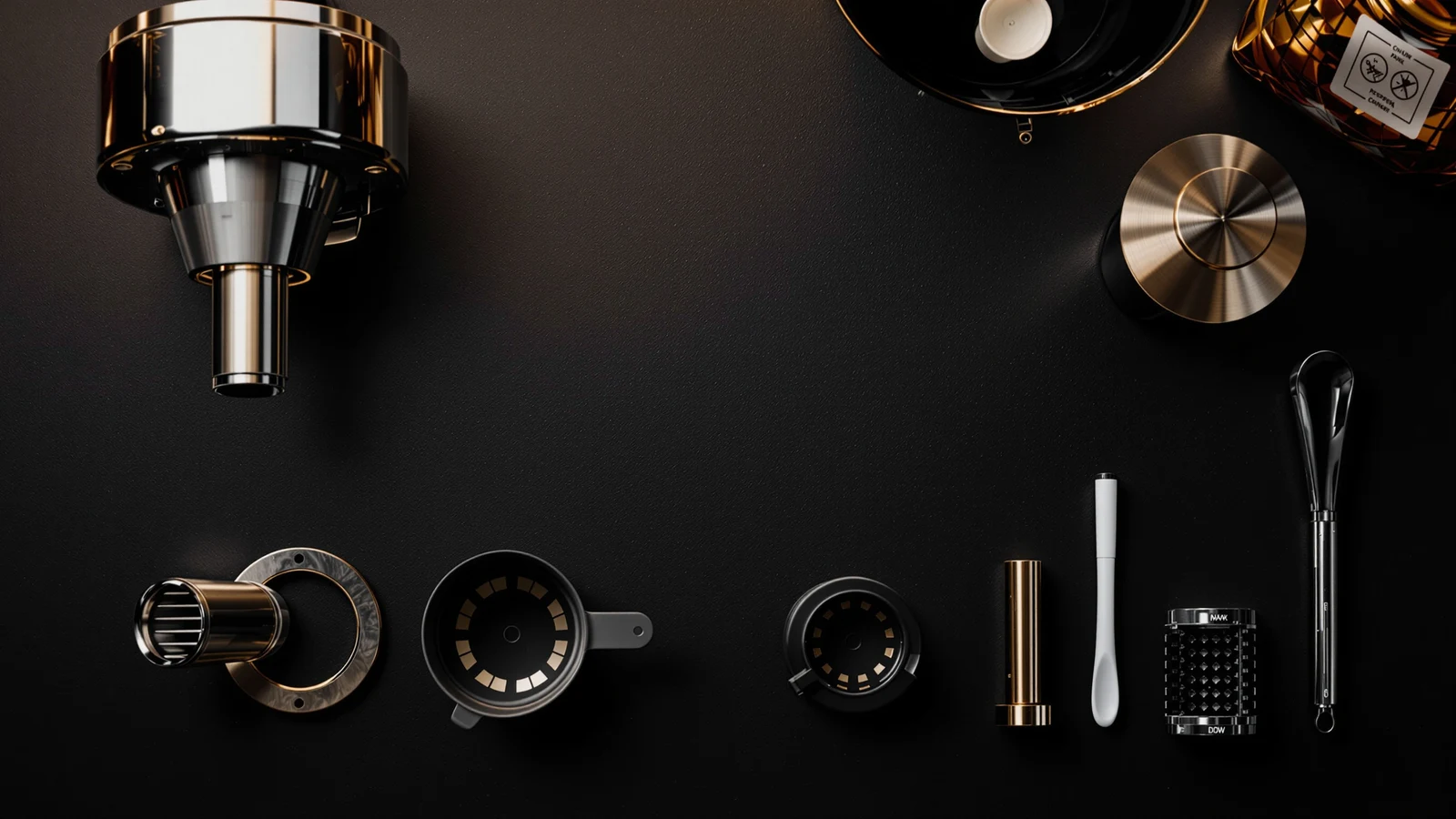
Every espresso machine in this guide ships with a portafilter and at least one filter basket, because the machine isn't usable without them. Past that baseline, what the box actually contains depends on the listing title more than the price: a machine titled "with Steam Wand" commits to a steam wand and nothing else beyond the basics; a machine titled "with Grinder" commits to a grinder, a hopper and a grind dial. Almost none of them commit to a scale, a knock box, or — with one exception in this guide — a jug for steaming milk.
That exception is the Breville BES870XL Barista Express at $499.95, whose listing and documentation spell out a genuinely complete box: grinder, dose-trimming tool, integrated tamper, two baskets and a stainless milk jug. At $93.49, $189.04 and $275.49, the listings for the other three machines here name fewer accessories, which doesn't necessarily mean a thinner box — it means the seller has told you less about what's inside, and you should check the listing's own photos before you buy rather than assume. Either way, plan to spend another $55 to $95 beyond the machine's price to actually make good espresso at home, mostly on a scale, a jug and a better tamper than whatever ships. All four machines also show up in our main guide to the best espresso machines, compared against four others on more than just box contents.
The baseline every box includes
A portafilter is the one part no espresso machine box lacks, because without it there's no way to lock a basket under the group head and pull a shot — it's as core to the machine as the boiler. Expect at least one filter basket inside it already, usually sized for a double shot, and on several machines a second basket sized for a single shot or for pre-ground coffee, which behaves differently under pressure than fresh-ground.
A tamper and a small measuring scoop are the next most common inclusions, even though three of the four machines here don't name either one in their title. The CASABREWS 3700 ($93.49) is listed "with Steam Wand," and the Grindora ($189.04) and Gevi ($275.49) are both listed "with Grinder" — none of those three titles mention a tamper or scoop specifically, which is normal for this price range rather than a red flag. Most semi-automatic machines under $350 include some kind of tamper and scoop even when the title doesn't call them out, because the machine is effectively unusable for fresh grounds without one; just don't expect either to be especially good.
The water tank, the drip tray and the power cord are part of the machine itself rather than a separate accessory, but they're worth checking regardless — tank capacity varies enormously across this category, and running out mid-morning is a daily annoyance rather than a one-time one. Our guide to water tank size and refill frequency breaks down what the ounce figures on a spec sheet actually mean for a one-person kitchen versus a household of four.
What's usually missing from that baseline
What's missing is far more consistent than what's included. No machine in this price range — ours or otherwise — ships with a scale, a knock box, a milk frothing pitcher as standard unless the listing explicitly says so, or enough descaling solution to matter past the first cycle. A self-clean or auto-descale button on the machine is not the same thing as a bottle of descaling solution in the box; the cycle automates the schedule and the flush, not sourcing the chemical that runs through it. Our guide to self-clean and auto-descale cycles covers exactly where that automation starts and stops.
Instruction manuals and warranty cards are universal and easy to lose track of during the unboxing — keep them, because a warranty claim on a machine with a grinder or a boiler inside it is the one place you'll want the paperwork later. A cleaning brush or a small hex key for the shower screen shows up on some listings and not others; it's cheap enough to replace on its own that it shouldn't move your decision either way.
What a built-in grinder changes about the box
A built-in grinder changes the shape of the box more than anything else on this list, because it replaces a second purchase with a hopper and a dial. The Grindora at $189.04 and the Gevi at $275.49 both advertise a grinder directly in the listing title, which means the bean hopper, the grind-adjustment mechanism, and — on the Grindora specifically — 44 grind settings, are part of what you're buying, not an accessory to source afterward.
What that buys you is one fewer thing to shop for and one fewer cord on the counter. What it doesn't change is the baseline: a machine with a grinder still needs the same portafilter, basket and tamper as one without, and the grinder adds its own upkeep — beans need to stay reasonably fresh, the hopper needs occasional cleaning, and the grind-adjustment dial needs to be set correctly for the basket you're using, which is a learning curve at any price.
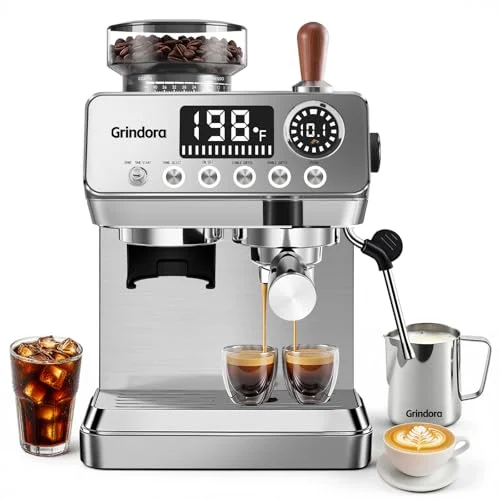
Grindora Espresso Machine with Grinder
Listed with a built-in grinder offering 44 grind settings, a 20-bar pump and a milk frother — three features the title commits to, for well under the price of buying a machine and a standalone grinder separately.
$189.04 Check price →Both grinder-equipped machines in this guide pair the grinder with milk equipment too: the Grindora's listing names a milk frother, and the Gevi's names a steam wand, so in both cases the box is doing three jobs — grind, brew and texture milk — in one footprint. That's a lot of machine for $200 to $310, and it's also a lot of machine to keep clean; a wand or frother that isn't purged after each use is one of the more common sources of clogged, off-tasting milk on any machine, regardless of price. If you buy the CASABREWS specifically because it has no grinder and plan to add a standalone one later, remember that's a second appliance drawing power from the same outlet as the machine — our guide to wattage and circuit draw covers how much headroom a shared kitchen circuit actually has.
Four machines, four boxes
Put the four machines side by side and the pattern holds: price tracks how much the listing is willing to tell you about the box, not necessarily how much is inside it.
At $93.49, the CASABREWS 3700 Essential is listed "with Steam Wand" — a compact stainless steel semi-automatic, 12.6 by 5.7 by 12.2 inches, committing to the steam wand and the baseline without naming a tamper, scoop or jug. At $189.04, the Grindora adds a built-in grinder with 44 grind settings, a 20-bar pump and a milk frother — unusually generous documentation for the price. At $275.49, the Gevi adds its own built-in grinder and a steam wand on a 20-bar pump, in an 11.5 by 12.01 by 16.53-inch footprint aimed explicitly at milk drinks. At $499.95, the Breville Barista Express is the best-documented box of the four: a conical burr grinder, a razor dose-trimming tool, an integrated tamper, two baskets and a stainless milk jug, on a 54mm portafilter and a 67-ounce tank.
| Machine | Price | Grinder | Milk | Named extras | |
|---|---|---|---|---|---|
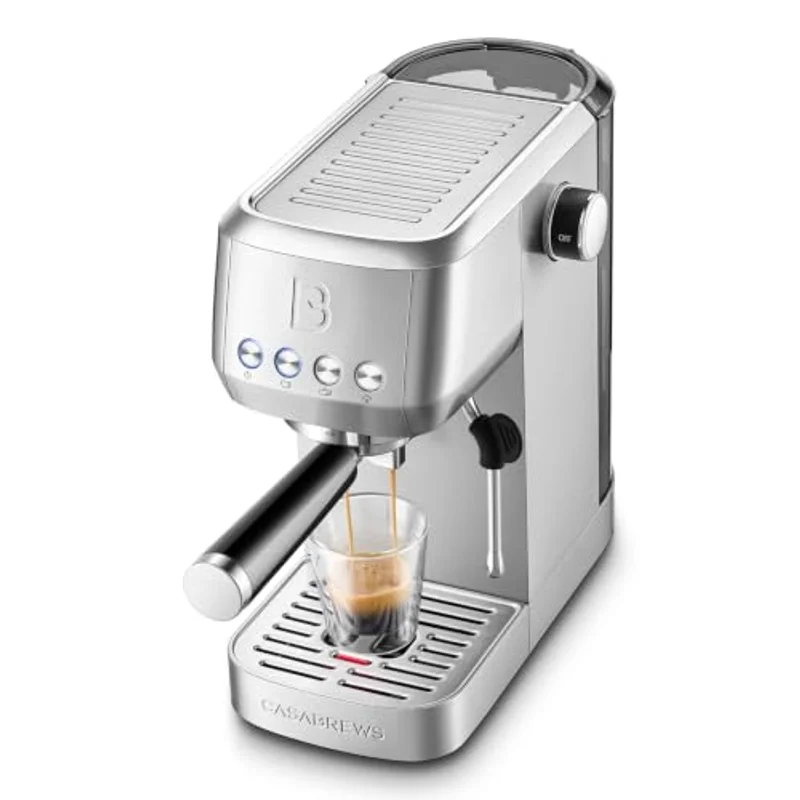 CASABREWS 3700 Essential CASABREWS 3700 Essential | $93.49 | None | Steam wand | Steam wand (listing name) | Price |
| Grindora with Grinder | $189.04 | Built-in, 44 settings | Milk frother | Grinder, frother, 20-bar pump | Price |
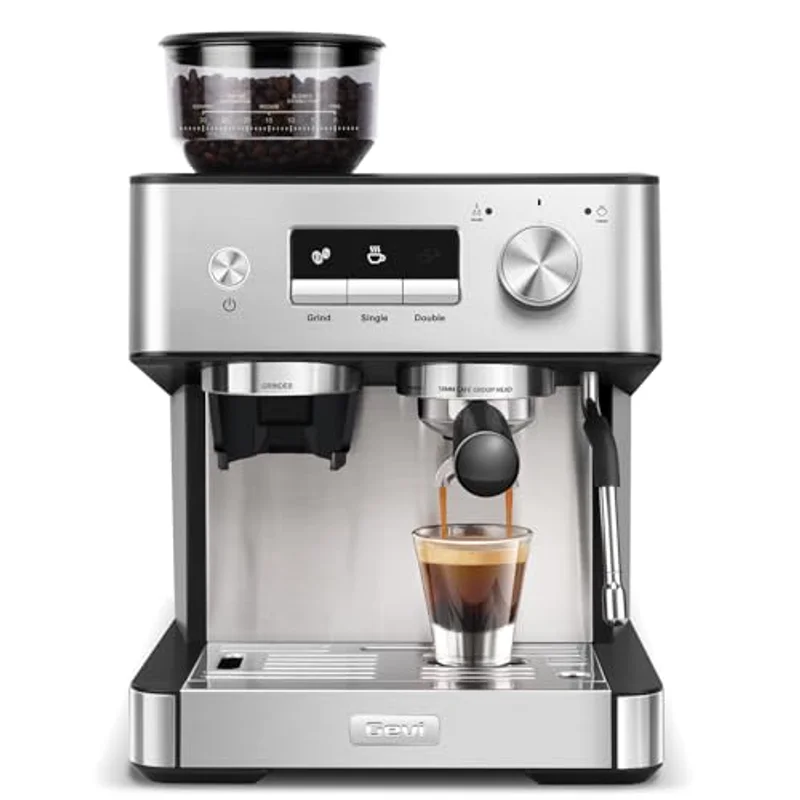 Gevi 20 Bar with Grinder Gevi 20 Bar with Grinder | $275.49 | Built-in | Steam wand | Grinder, steam wand, 20-bar pump | Price |
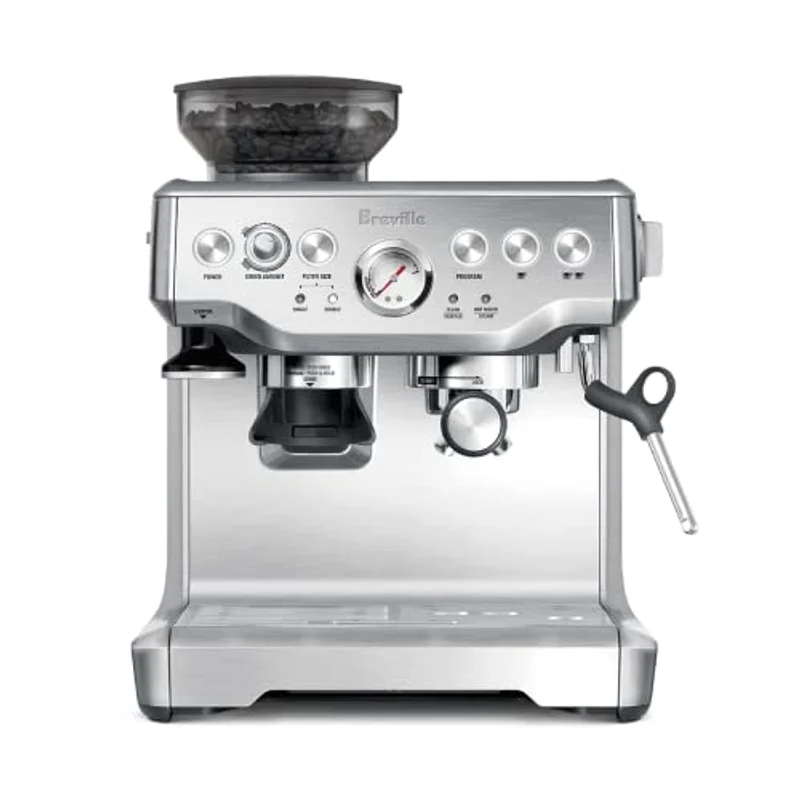 Breville Barista Express Breville Barista Express | $499.95 | Built-in conical burr | Manual steam wand | Grinder, razor tool, tamper, 2 baskets, milk jug | Price |
Breville BES870XL Barista Express
The most completely documented box in this guide: conical burr grinder, razor dose-trimming tool, integrated tamper, single and dual-wall baskets, a stainless milk jug, a 54mm portafilter and a 67-ounce tank.
$499.95 Check price →The honest reading of that spread is that the Breville's documentation is unusually complete for the category, not that the cheaper machines are necessarily missing more. Amazon listings vary enormously in how much detail a seller puts in the title and bullet points, and a $93.49 machine can ship with a perfectly adequate tamper that its listing simply doesn't mention. Treat every box-contents claim in this guide as what the listing tells you, not as an exhaustive inventory — check the listing's own photos and Q&A section before you buy, since that's the most current and specific record of what actually ships.
The accessories almost nobody's box includes
Three accessories are missing often enough, across enough price points, that they're worth budgeting for before the machine arrives rather than after a disappointing first week.
A scale is the biggest jump in consistency for the least money. Espresso recipes are expressed as a ratio — roughly 18 grams of dry coffee to about 36 grams of liquid out, as a starting point — and eyeballing either number means the shot changes for reasons that have nothing to do with your grind or your tamp. None of the four machines here ship with one.
A knock box solves a problem none of the listings mention, because it isn't about the machine, it's about the puck of spent coffee that comes out of the basket after every shot. Without one, that puck goes into the trash, a paper towel, or — more than once, for most people — the sink, where coffee grounds are a bad idea for a drain. A knock box is a padded bin with a bar to rap the inverted portafilter against: small and unglamorous, and almost everybody ends up buying one eventually.
A milk jug is the one accessory that's inconsistent rather than universally absent — Breville includes one with the Barista Express, and the other three machines in this guide don't name one in their listings. If you're going to steam milk on the Gevi's wand, the Grindora's frother or the CASABREWS's wand, you'll want a stainless steaming pitcher sized to how much milk you make at once; the right size also matters for how milk textures, which our guide to the best machines for oat and plant milk covers in more depth, since plant milks foam differently than dairy regardless of pitcher.
A realistic first-order accessory list
Here's a realistic shopping list for whichever of these four machines you buy, with a price range rather than a single number, since accessory pricing moves the way machine pricing does.
A digital kitchen scale that reads to 0.1 gram runs about $12 to $20, and it's the single highest-value add-on on this list for the money. A stainless steaming pitcher, sized 12 to 20 ounces depending on how much milk you steam at once, runs $10 to $18 — skip it only if you bought the Breville and plan to use its included jug. A knock box runs $15 to $30 depending on size and material. A bottle of descaling solution sized for a couple of uses runs $8 to $14, and you'll need it on a schedule regardless of which machine you own — see our guide to self-clean and auto-descale cycles for how often. A cleaning brush and a handful of cleaning tablets add another $8 to $15.
Add that up and you're looking at roughly $55 to $95 beyond the machine's sticker price, before a tamper upgrade, which the next section makes the case for separately. On the $93.49 CASABREWS, that's close to doubling your total spend; on the $499.95 Breville, it's under a fifth more — worth factoring into which machine actually fits your budget, since the cheapest machine on the shelf is rarely the cheapest to actually use well. If the Breville's price is the sticking point, our comparison of Breville's current lineup covers less expensive models in the same family that still bundle most of this accessory list.
Buy the scale before anything else
If you can only buy one accessory this week, make it the scale. A tamper upgrade, a knock box and a milk jug all improve a workflow that's already roughly correct; a scale fixes a dose that's wrong by an unknown amount every single shot, which is a bigger and more basic problem to solve first.
Where bundled tampers and scoops fall short
The tamper and scoop that ship in most boxes are the first things worth replacing, and $15 is roughly what it costs to fix both problems at once.
A bundled tamper is usually a hollow aluminum or plastic handle over a flat base sized to fit the machine's own portafilter — which sounds like an advantage until you notice the base is often slightly convex, undersized, or simply too light to tell whether you've applied even pressure. An uneven tamp creates channels in the coffee bed, and water finds those channels first, which is one of the most common causes of a shot that runs fast on one side and chokes on the other even when the grind is right.
A bundled scoop has a different problem: it's a volume measure in a process that should be measured by weight. A level scoop of light-roast coffee and a level scoop of dark-roast coffee aren't the same number of grams, because the beans have different density after roasting, and a recipe built around "18 grams in" silently drifts if you're scooping instead of weighing.
A $15 to $20 flat-base tamper calibrated precisely to your portafilter's basket diameter — 54mm on the Breville, and worth checking against the listing or the basket itself on the other three — fixes the pressure problem outright. Paired with the scale from the accessory list above, it also makes the scoop largely irrelevant: you weigh the dose instead of counting scoops, and the bundled scoop becomes a spare for pre-ground coffee or travel rather than your daily tool.
How we compared these
We compare published specifications, listing titles, product photos and live pricing to put this guide together, and we read every claim about what ships in a box with some skepticism, because sellers describe contents inconsistently even within the same product category. We do not physically test these machines, we do not run a testing lab, and we do not publish ratings we cannot verify — Amazon's product data returns no rating or review count for the machines in this guide, so you won't find stars or an invented score anywhere on this page.
Where we've made a judgment rather than stated a fact — that a $15 tamper upgrade beats most bundled ones, that a scale is the highest-value accessory on this list — we've said so in our own voice and shown the price ranges behind the reasoning, so you can weigh it yourself. The box-contents claims for each specific machine are drawn from its own listing title and documentation; where a listing doesn't name an item, we've said that plainly rather than guessing.
Frequently asked questions
Does every espresso machine come with a tamper?
Most do, even when the listing title doesn't mention one by name — a machine is difficult to use with fresh grounds without some kind of tamper, so manufacturers tend to include a basic one regardless of price. What varies is quality: bundled tampers are frequently undersized, light or slightly uneven, which is why a $15-$20 replacement calibrated to your basket is one of the first upgrades worth making.
Do I need to buy a milk frothing pitcher separately?
On three of the four machines in this guide, yes. The Breville BES870XL Barista Express is the exception — its listing includes a stainless milk jug. The CASABREWS 3700, Grindora and Gevi all include a steam wand or frother for texturing milk, but none of their listings name a pitcher, so budget $10-$18 for one sized to how much milk you steam at once.
What's the difference in box contents between a machine with a grinder and one without?
A machine with a built-in grinder, like the Grindora or Gevi, adds a bean hopper and a grind-adjustment mechanism to the same baseline every machine ships with: portafilter, basket, tamper. It doesn't add a scale, a knock box or necessarily a milk jug — those stay missing regardless of whether the grinder is built in. A grinder mainly removes the need to buy and plug in a separate appliance.
Is the bundled tamper good enough to use long-term?
It's good enough to get a shot out of the machine on day one, which is about all it's designed for. Most bundled tampers are light, and some have a base that isn't perfectly flat or isn't matched precisely to the basket diameter, both of which make an even tamp harder than it needs to be. A $15-$20 flat-base tamper sized to your specific portafilter is a small, one-time fix.