Watts and Amps: What an Espresso Machine Actually Draws From Your Outlet
A "20 bar" badge on the box tells you nothing about what happens to your breaker panel. Wattage does — it is the number that decides whether an espresso machine shares a circuit peacefully with your toaster, or trips the breaker the first time they run together.
Reader-supported: we may earn a commission if you buy through our links, at no extra cost to you. Wattage figures are the ones published on each listing as of September 29, 2026; confirm the label on the unit you receive, since manufacturers do revise specs between production runs.
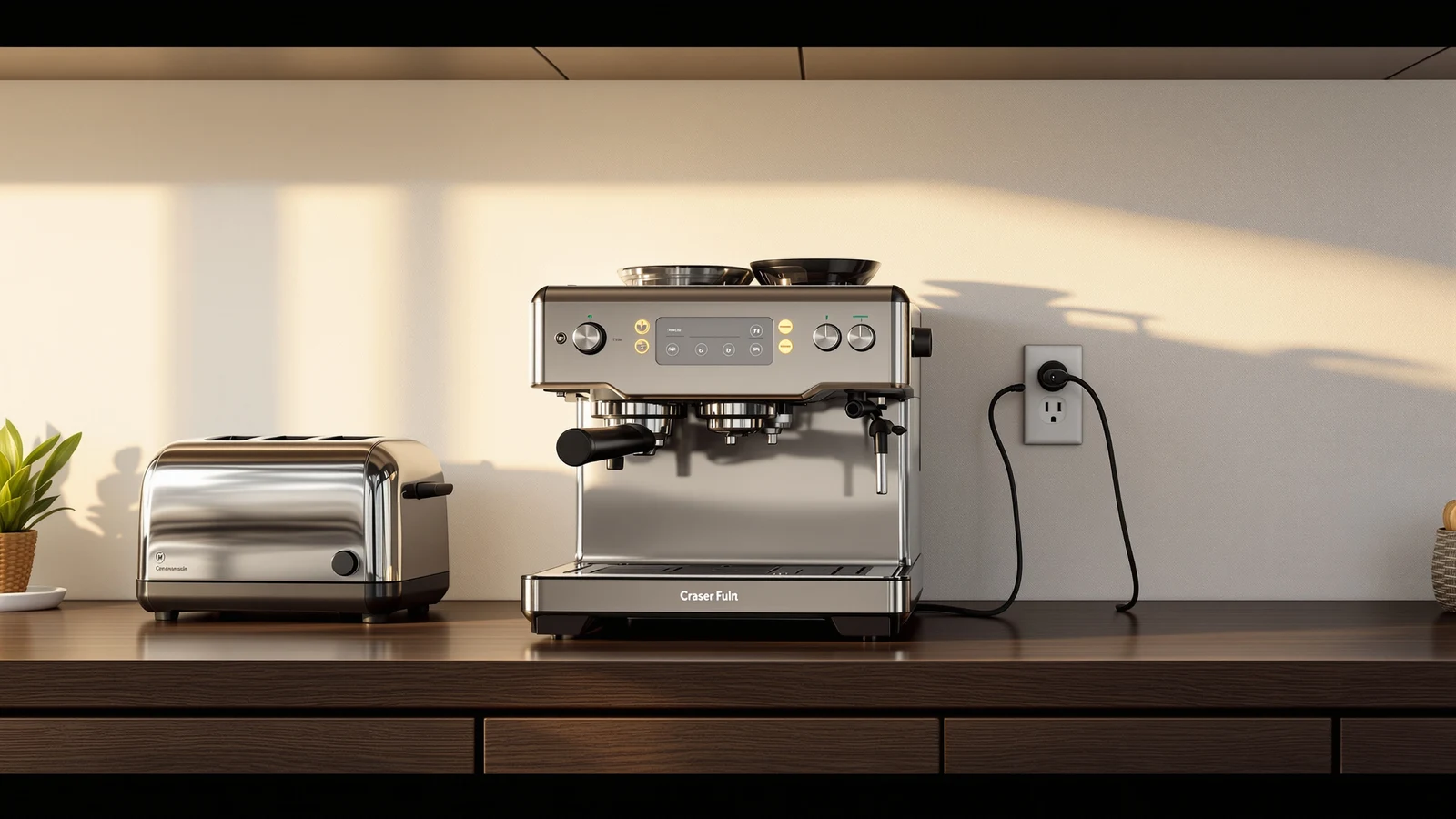
Why watts, not bar pressure, is the number that trips a breaker
Every espresso machine listing leads with the pump's bar rating, because a bigger number looks like a better machine. It isn't the number your electrical panel cares about. A breaker doesn't know or measure pressure — it measures current, in amps, and current is a function of wattage and voltage, not pump strength.
The relationship is simple: amps = watts ÷ volts. A standard US wall outlet supplies roughly 120 volts, so a machine rated at 1,500 watts draws about 12.5 amps the moment its heating element is fully on (1,500 ÷ 120 = 12.5). A machine rated at 20 bar and one rated at 9 bar can draw the exact same current, because bar pressure comes from the pump motor's mechanical design, while current draw comes from the heating element that brings water to brew temperature. The two specs are unrelated, and conflating them is how people end up surprised in their own kitchen.
Across this catalogue, published wattage runs from 1,350W on the compact end to 1,650W for a dual-boiler unit that keeps two heating elements ready at once. That 300-watt spread is roughly 2.5 amps at 120 volts — enough, on a circuit that's already carrying other appliances, to be the difference between a normal morning and a dark kitchen.
The heating element is the one component in an espresso machine that draws serious current. The pump motor that pressurizes water and the pipes and solenoid valves that route it use comparatively little power; it's the resistive heater bringing water to roughly 195–205°F that dominates the wattage figure. That's also why steam-capable machines and dual-boiler machines tend to sit at the higher end of the range — heating water for both brewing and steaming, whether sequentially or in two boilers at once, asks more of that heating element.
The 80% rule: what a 15-amp circuit can actually carry
Most US kitchen outlets sit on a 15-amp or 20-amp circuit, and the number stamped on the breaker is not the number you should plan around continuously. The National Electrical Code treats any load running 3 hours or more as a "continuous load" and caps it at 80% of the breaker's rating — the other 20% is headroom, not a hidden bonus you're meant to use.
On a 15-amp circuit, 80% is 12 amps. On a 20-amp circuit, it's 16 amps. An espresso machine isn't typically running for three straight hours, so this isn't a hard legal ceiling for a five-minute brew cycle the way it would be for, say, a baseboard heater — but it's the right number to plan against, because a kitchen circuit rarely carries just one thing, and the loads that push a breaker over the edge are usually simultaneous rather than sequential.
Converting the watts on this catalogue's spec sheets into amps at 120 volts:
| Wattage | Amps drawn | Share of a 15A circuit's 12A continuous budget |
|---|---|---|
| 1,350W | 11.25 A | 94% |
| 1,500W | 12.5 A | 104% |
| 1,650W | 13.75 A | 115% |
Read that table plainly: at the top of this catalogue's range, the machine alone is already past the 80% continuous-load budget of a 15-amp circuit, before anything else on that circuit draws a single watt. That doesn't mean the machine is unsafe to plug in — a five-minute brew is not a three-hour continuous load, and the breaker is rated to interrupt current well above 15 amps before it trips. It does mean there is very little room left on that circuit for a microwave, a toaster, or a second heat-producing appliance to run at the same time without tripping the breaker.
The picks, by wattage
Three machines, three points on the wattage spectrum this catalogue covers. None of these figures come from a rating we invented — they're the wattage published on each listing.
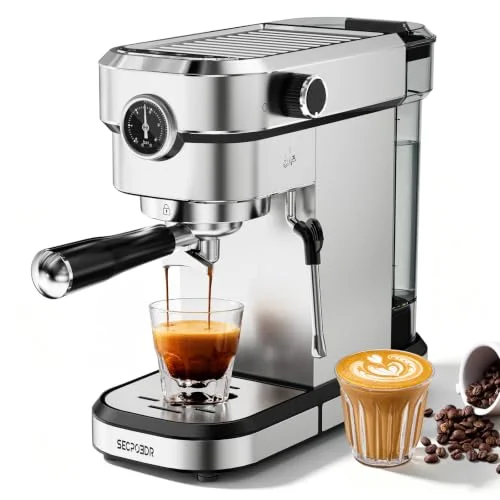
SECPOEDR 20 Bar Semi-Automatic Espresso Machine
13.2"D x 6.7"W x 12"H, pressure gauge, removable water tank, built-in milk frother. A single-boiler design like this one is the shape most likely to land near the lower end of the wattage range in this catalogue, since it heats water for one job at a time rather than keeping two elements standing by.
$105.99 Check price →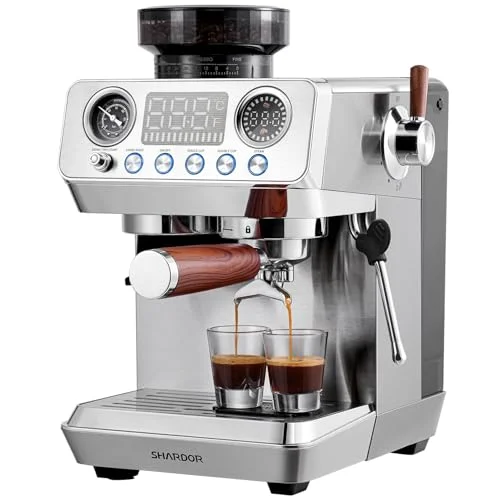
SHARDOR 20 Bar Espresso Machine with Built-In Grinder
Stainless steel, built-in grinder. Adding a grinder motor to the appliance doesn't meaningfully change its electrical draw — the grinder motor pulls a small fraction of what the heating element does — so a machine in this class sits in the same middle band as an equivalent grinder-free semi-automatic.
$199.99 Check price →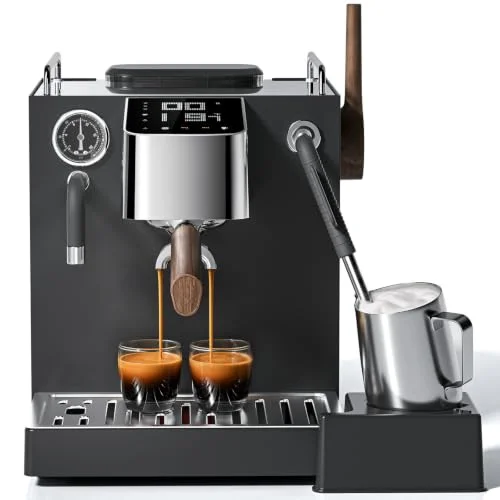
AMZCHEF 9 Bar OPV Espresso Machine with Dual Boiler
61 oz tank, automatic milk frother, dual boiler, adjustable OPV pressure valve. This is the design most likely to sit at the top of this catalogue's wattage range: a dual-boiler machine keeps a brew boiler and a steam boiler both at temperature, which is the point of the layout — brewing and steaming without waiting on one shared element — and it's also why dual-boiler machines are the ones worth checking against your circuit before you buy. We cover the rest of that trade-off in double boiler vs single boiler.
$499.99 Check price →The adjustable OPV on the AMZCHEF is a pressure control, not a power control — turning it down changes how hard the pump works against the puck, not how many watts the heating elements draw. If you want the detail on what that valve actually changes, we walk through it separately in adjustable pressure valves.
What else is already on that kitchen circuit
Kitchen circuits are rarely dedicated to one outlet, and the National Electrical Code doesn't require them to be — a single 15-amp or 20-amp circuit commonly feeds every countertop outlet on one wall, sometimes two. That means the real question isn't "can this machine's circuit handle it" in isolation, it's "what turns on with it."
The classic collision is a toaster and a coffee machine on the same run of counter, both plugged in because that's where the outlets are. A typical toaster draws 800–1,500 watts, or roughly 7–12.5 amps. Add that to a 1,500W espresso machine already drawing 12.5 amps, and the combined load is 20–25 amps against a 15-amp breaker — a trip, not a close call. A microwave is worse: most draw 1,000–1,500 watts running, and some spike higher at startup.
The fix costs nothing: know what's on the circuit before you brew. Circuits in older homes are often labeled vaguely or not at all in the panel, so the practical test is to run the espresso machine and one other countertop appliance at the same time and see what happens, at a moment when a tripped breaker is an inconvenience and not a disaster — not while something else in the house genuinely needs continuous power. If it trips, that's useful information, not bad luck: it means that pairing doesn't belong on the same circuit, and the fix is moving one appliance to a different outlet run, not returning the machine.
This is also where a machine's control panel matters more than it seems to. A touchscreen or a dial doesn't change wattage, but a machine with a visible pressure gauge and clear settings — like the SECPOEDR above — makes it easier to notice when a machine is drawing hard during warm-up, simply because you're watching the display rather than guessing.
Dedicated circuits: when it's worth an electrician's visit
Most single espresso machines never need a dedicated circuit. If the machine sits alone, or shares a circuit with low-draw items like a phone charger or a radio, a standard 15-amp kitchen circuit has margin to spare even at 1,650W. The case for calling an electrician is narrower and more specific than most buying guides admit.
It's worth considering a dedicated 20-amp circuit when any of these apply: the kitchen has a known history of nuisance trips on that particular outlet; the machine will routinely run alongside another heat-producing appliance — a second espresso machine, a toaster oven, a countertop convection oven — on the same wall; or the home's panel is old enough that circuits weren't planned around the number of countertop appliances a modern kitchen actually runs (a common gap in houses built before small kitchen appliances multiplied). A dual-boiler machine at the top of this catalogue's wattage range, run daily alongside other countertop appliances, is the profile most likely to justify the conversation.
A licensed electrician, not a spec sheet, is the right authority on whether your specific panel and wiring support an additional dedicated run — panel capacity, wire gauge already in the wall, and local code all factor in, and those vary by house in ways no general guide can assess for you. What a spec sheet can tell you is whether you're a candidate for that conversation at all: if your machine's listed wattage divided by 120 volts already eats most of a circuit's 80% continuous budget, and it shares outlets with other heat-producing appliances, that's the profile worth a phone call rather than a guess.
Warm-up power spikes versus steady steaming draw
Not every moment in a brew cycle draws the same current, and this is the part a single wattage number on a spec sheet can't show. An espresso machine's heating element works hardest at two points: the first few minutes after power-on, when it's bringing water from room temperature up to brew or steam temperature from a cold start, and the moment it switches into steam mode, when the boiler needs to climb further to produce dry steam rather than just hot water.
Warm-up is typically the highest sustained draw a machine produces, because the heating element runs continuously and at full output until the thermostat or PID controller is satisfied that the water has reached target temperature. Once the machine reaches brew temperature and holds it, the element cycles on and off rather than running flat out — so the wattage rating on the box is closer to "how hard it works when it's working hardest" than "how much it draws on average across a session."
This has a practical consequence for the shared-circuit problem above: the worst moment to also run a toaster is in the first two or three minutes after you switch the machine on, not five minutes in once it's holding temperature. On a dual-boiler machine, that risk compounds slightly, because both boilers can be heating from cold at once if the machine was fully powered off rather than left in standby — one more reason the dual-boiler class sits at the upper end of this catalogue's wattage figures, and one more reason it's the class worth being deliberate about which circuit it lives on.
None of this is a reason to avoid a higher-wattage machine. It's a reason to time your kitchen, not just size your circuit: if a machine needs a few minutes to warm up, that's a natural window to avoid starting the toaster, and it costs nothing but a moment's attention.
One thing not to do
Don't use an extension cord or a cheap power strip to run an espresso machine, regardless of its wattage. Thin-gauge extension cord wire heats up under sustained current in a way a properly rated wall outlet doesn't, and a machine drawing 12–14 amps continuously is exactly the load that makes an undersized cord a fire risk rather than a convenience. Plug directly into the wall.
How we compared these
We compare published specifications — wattage, voltage assumptions, boiler configuration — against general electrical facts that apply regardless of brand: the NEC's 80% continuous-load rule, the amps-equals-watts-divided-by-volts relationship, and how resistive heating elements behave during warm-up. We do not physically test these machines, we do not run a testing lab, and we do not publish ratings we cannot verify: Amazon's product data returns no rating and no review count for the machines on this site, so there are no stars and no invented scores anywhere on this page.
Where a recommendation here is a judgment rather than a published spec — that a dual-boiler machine is the class most worth checking against your circuit, that warm-up is the riskiest window for a shared circuit — we've said so in our own voice and shown the reasoning, so you can weigh it against your own kitchen. Whether any given house needs a dedicated circuit is a question for a licensed electrician who can see your panel, not for a product review.
Frequently asked questions
Will a 1,500W espresso machine trip a 15-amp breaker?
Not by itself under normal use. A 1,500W machine at 120 volts draws about 12.5 amps, which is close to a 15-amp circuit's 80% continuous-load budget of 12 amps but a brew cycle is a matter of minutes, not the 3-hour continuous load the code provision is written around. The real risk is running it alongside another heat-producing appliance — a toaster or microwave — on the same circuit at the same time, which can push the combined draw well past 15 amps.
Does a higher bar rating mean an espresso machine uses more power?
No. Bar pressure comes from the pump motor, which draws comparatively little current; the heating element that brings water to brew and steam temperature is what dominates a machine's wattage. A 9-bar machine and a 20-bar machine can have identical, higher, or lower wattage than each other — the two specs aren't related, and reading a bar number as a proxy for power draw is a common mistake.
Can I plug my espresso machine into the same outlet as my toaster?
You can, but check the combined load first. A typical toaster draws 800–1,500 watts (roughly 7–12.5 amps); added to an espresso machine in the 1,350–1,650W range (11.25–13.75 amps), the total commonly exceeds a 15-amp circuit's capacity. If both appliances share a circuit, avoid running them at the same time, and especially avoid starting a second appliance during the espresso machine's first few minutes of warm-up, when its draw is highest.
Do I need a dedicated circuit for a dual-boiler espresso machine?
Most homes don't, but it's worth considering if the machine runs daily alongside other heat-producing countertop appliances on the same wall, if that outlet has a history of nuisance trips, or if the house's electrical panel predates modern kitchen appliance loads. A dual-boiler machine sits at the higher end of this catalogue's wattage range because it keeps two heating elements ready at once, which is exactly the profile worth a conversation with a licensed electrician about your specific panel and wiring.