Water Tank Size and Refill Frequency: What the Ounces Actually Mean
Tanks in this catalogue run from a 4-cup reservoir to 68 ounces. That six-fold spread looks like a quality gap on a spec sheet, but it is mostly a capacity question — how many shots before you walk back to the sink, not how good the shot is.
Reader-supported: we may earn a commission if you buy through our links, at no extra cost to you. Prices are the ones we recorded between August 26 and September 30, 2026 and they move constantly — confirm the live price before buying.
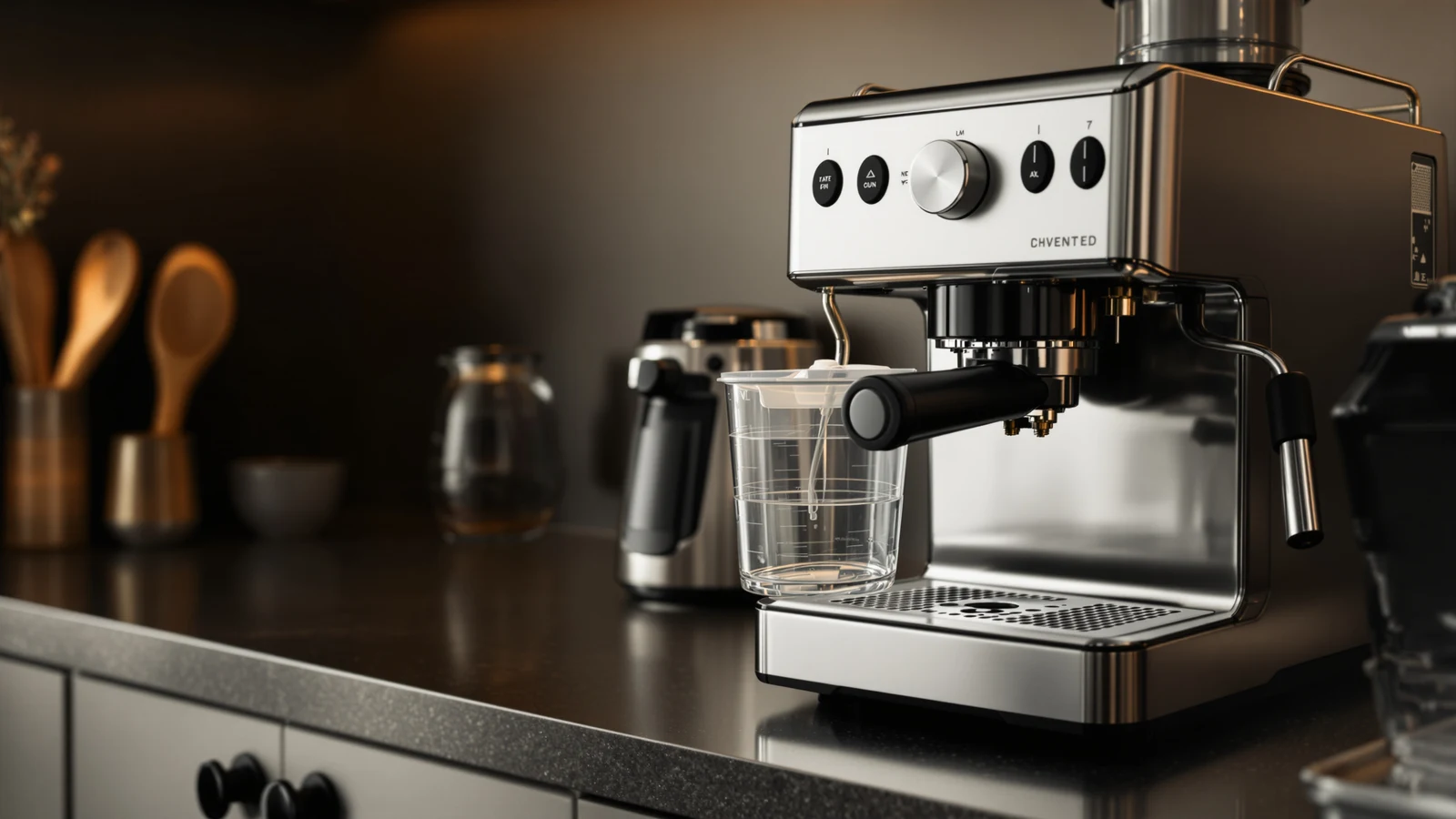
A capacity question, not a quality one
It is tempting to read a 68-ounce water tank as a sign of a more serious machine, and a 4-cup reservoir as a sign of a toy. The spec sheets in front of us do not support that. Tank size tracks the job a machine is built for — one person's morning double versus a household running shots and steamed milk back to back — far more than it tracks brew quality, boiler type or build material.
The IMUSA 4 Cup Electric Espresso Cappuccino Coffee Maker at $46.98 and the GeniCup Espresso Machine with Grinder at $199.99 with its 68-ounce tank sit at opposite ends of this catalogue's capacity range, and the gap between them is almost entirely about how often you refill, not about whether either one makes a drinkable shot. A small tank on a steam-driven machine and a small tank on a pump machine are different machines for different reasons; capacity alone will not tell you which.
What capacity does change, reliably, is a chore: how many times a week you carry a tank to the sink. That is worth sizing correctly before you buy, because it is one of the few specs on a machine that you feel every single day, long after the novelty of a new appliance wears off.
Converting ounces to cups of espresso, honestly
Espresso portions are small, which is easy to forget when a tank is marketed in ounces. A single shot runs roughly 1 to 1.5 fluid ounces of liquid out of the spout, and a double — the more common home pour — runs roughly 2 to 3 ounces. Those are brew-recipe ranges, not a spec for any one machine here, and they describe what lands in the cup, not what the machine draws from the tank; some water is used for pre-infusion, heating cycles and, on machines with one, a steam wand, so a tank's ounce rating is a ceiling on what's available, not a precise shot counter.
With that caveat, the arithmetic is still useful for comparing tanks to each other. The IMUSA's reservoir is sized in cups rather than ounces — 4 cups, which converts to 32 fluid ounces at the standard 8-ounce cup measure — a deliberately different unit from the ounce-rated machines below it, and worth noting before you compare the two head to head. The AYCHIRO 20 Bar Espresso Machine's 37-ounce tank, at roughly 2.5 ounces per double, has enough water on paper for close to a dozen doubles between refills before steam or heating draw is counted. The AIRMSEN's 60-ounce tank and the GeniCup's 68-ounce tank push that notional count higher still, into the high teens.
Treat all of these as back-of-envelope numbers, not promises. The honest version of this section is that nobody — not us, not the manufacturer listing — can tell you exactly how many shots a tank holds, because that number moves with drink size, how long you run the steam wand, and how much water a given heating cycle uses. What the ounce rating reliably tells you is relative capacity: the AIRMSEN and the GeniCup hold roughly twice what the AYCHIRO holds, and the AYCHIRO holds a bit more than the IMUSA's 32-ounce equivalent. That ordering is the useful part.
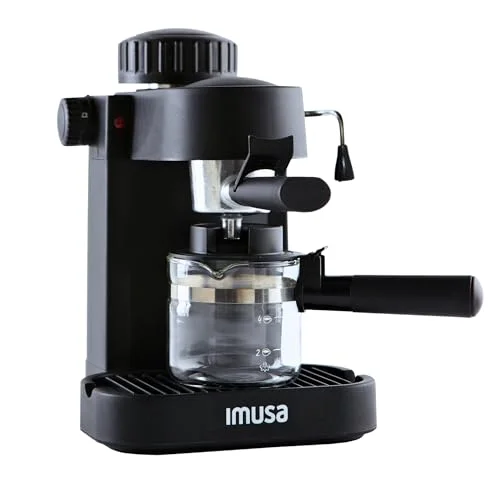
IMUSA 4 Cup Electric Espresso Cappuccino Coffee Maker
The smallest reservoir in this guide: a 4-cup tank (32 oz equivalent), electric steam-driven brewing, and a compact footprint built for one or two cups at a time rather than a full carafe.
$46.98 Check price →The picks, from smallest to largest
Sorted purely by stated tank capacity, smallest first, because that is the variable this guide is about. None of these machines is "the winner" — each one fits a different refill tolerance.
| Machine | Tank size | Tank type | Price | |
|---|---|---|---|---|
| IMUSA 4 Cup Electric Espresso Maker | 4 cups (32 oz equiv.) | Fixed, see listing | $46.98 | Price |
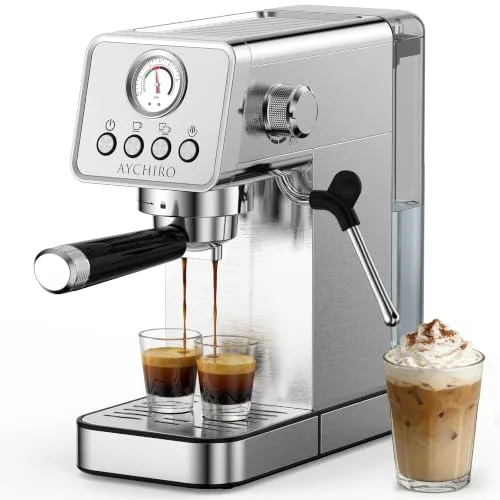 AYCHIRO 20 Bar Espresso Machine AYCHIRO 20 Bar Espresso Machine | 37 oz | Removable | $79.99 | Price |
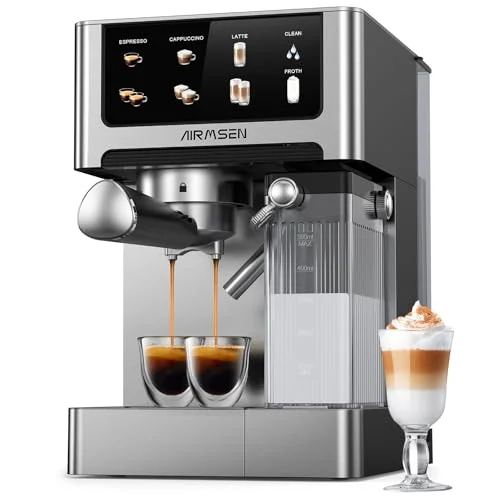 AIRMSEN 20 Bar Espresso Machine AIRMSEN 20 Bar Espresso Machine | 60 oz | See listing | $179.99 | Price |
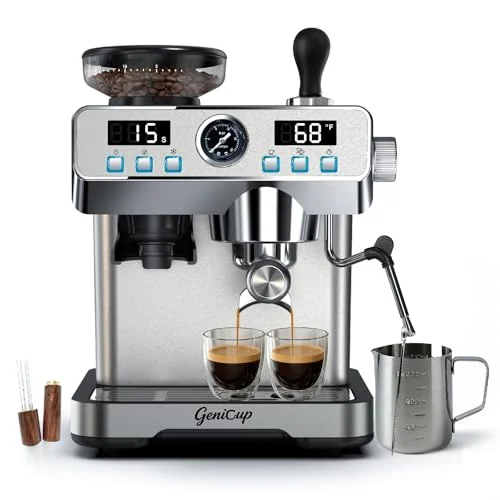 GeniCup Espresso Machine with Grinder GeniCup Espresso Machine with Grinder | 68 oz | See listing | $199.99 | Price |
IMUSA 4 Cup Electric Espresso Cappuccino Coffee Maker — $46.98
At the floor of this range sits a steam-driven machine with a 4-cup reservoir, the smallest capacity we carry. It is also the cheapest machine in the guide, and the two facts are related: a small boiler needs a small tank, and a small tank keeps the whole unit light enough to store in a cabinet between uses rather than leave permanently on the counter. For a single-cup habit, refilling before each use is not a burden; it is closer to how a kettle gets used.
AYCHIRO 20 Bar Espresso Machine with Pressure Gauge — $79.99
The AYCHIRO steps up to a 37-ounce reservoir and, notably, a removable one — the listing specifies a removable 37 oz tank, which changes how you refill it as much as how much it holds. At 1,350 W with a pressure gauge and steam wand, this is a compact semi-automatic built for a home office or a small kitchen, and the mid-size tank matches that: enough for a morning round without becoming heavy to lift out and carry to the tap.
AIRMSEN 20 Bar Espresso Machine with Automatic Milk Frother — $179.99
At 60 ounces, the AIRMSEN's tank is nearly double the AYCHIRO's, which fits its spec sheet: a dual boiler (1,350 W plus 1,000 W) and an automatic milk frother draw more water per session than a single-boiler machine with a manual wand, because the frother runs its own cycle on top of the brew. A touchscreen-controlled dual-boiler machine making cappuccinos for more than one person benefits from the larger reservoir simply because it is doing more per session, not because bigger is categorically better.
GeniCup Espresso Machine with Grinder — $199.99
The largest tank here, at 68 ounces, belongs to the machine built to do the most between refills: a built-in grinder for fresh dosing and a cold brew function, in addition to standard 20-bar espresso. A grind-and-brew-and-cold-brew machine that a family actually uses across a day benefits most from capacity, because it is the one machine on this list likely to be run more than a handful of times before anyone thinks about the tank at all.
GeniCup Espresso Machine with Grinder, 68oz Tank
20-bar pump, built-in grinder, cold brew mode, and the largest reservoir in this guide — sized for a household running more than one drink a day rather than a single morning cup.
$199.99 Check price →Removable versus fixed tanks, and why it matters for cleaning
Capacity is the number on the box; whether the tank comes out is the detail that decides how annoying refilling actually feels, and it is a separate spec entirely — a large tank that is awkward to remove can be worse to live with than a small one that lifts out cleanly.
A removable tank — the AYCHIRO's listing is explicit about this, calling out a "removable 37oz water tank" — can go straight under a kitchen faucet, which means filling with cold, fresh tap water every time rather than carrying a jug to a fixed opening on top of the machine. It also means the tank can be scrubbed on its own, which matters because standing water left in any reservoir for days can pick up mineral deposits and, eventually, a stale taste; a tank you can pull out, rinse and dry inverted is far easier to keep clean than one that's sealed into the chassis.
A fixed tank is not necessarily a flaw — some fixed designs use a top-loading funnel or a flip-open lid that is nearly as convenient — but it does mean cleaning happens in place, with a bottle brush or a cloth-wrapped utensil rather than under a running tap. Where we have a specific removable-tank spec, as with the AYCHIRO, we have called it out above. Where the listing does not state whether a tank is removable, we have not guessed: check the current Amazon listing and product images before assuming either way.
Where a small tank is actually an advantage
It is easy to treat tank size as a one-directional spec — bigger always better — and that is wrong in at least three ways worth naming.
First, weight. A full 68-ounce tank holds about 4.25 pounds of water before the machine's own weight is added, and every one of those pounds has to be lifted out, carried to a sink and lifted back in on a removable design. A 32-ounce equivalent tank like the IMUSA's is roughly half that load — a real difference if the machine lives on a high shelf or if lifting a brimming tank one-handed isn't comfortable.
Second, freshness. Water that sits in a tank for days between uses is more likely to pick up a flat or faintly plastic taste than water drawn fresh each morning. A small tank all but forces frequent refills, which means the water in it is rarely more than a day or two old; a large tank on a machine used only once a day can sit mostly full for a week without anyone noticing, which is worse for taste, not better.
Third, footprint and storage. Tank size and machine size are not perfectly correlated, but they trend together, and the IMUSA's small reservoir is part of why it is small enough to keep in a cabinet rather than permanently on the counter. If counter space is the binding constraint in your kitchen rather than refill frequency, the smallest tank in this guide is the one that solves your actual problem.
None of this is an argument that small is better in general — a family running four drinks a morning will be annoyed by a 32-ounce tank regardless of how fresh the water stays. It is an argument that "biggest tank available" is the wrong default question. The right one is how often you actually want to be at the sink.
How refill frequency changes with steam use on top of brewing
Brewing is not the only thing drawing from the tank. Any machine with a steam wand or an automatic milk frother pulls additional water to generate steam, separately from the water that becomes your shot, and that second draw is easy to underestimate when you're only thinking about how many "cups" a tank is rated for.
This is where the AIRMSEN's dual-boiler layout and automatic frother are worth reading as a pair with its 60-ounce tank. A dual-boiler design lets the machine brew and steam at the same time rather than switching between a single boiler's two jobs, which is faster for a cappuccino run — but faster does not mean less water used, it means the same total draw compressed into less time. An automatic frother that runs its own cycle on a timer, rather than a manual wand you control by feel, also tends to use a consistent amount of water per drink rather than letting you stop early, so count milk drinks as closer in tank impact to a double shot than to a quick espresso.
The practical rule: if steam or milk drinks are a regular part of your routine, size your tank expectations up from whatever the "shots per tank" math suggests from brewing alone. A household that drinks straight espresso can trust the ounce-to-shot math in the earlier section fairly closely; a household that drinks lattes and cappuccinos daily should expect real-world refills more often than that math implies, on any of the four machines here. Our guide to machines for oat and plant milk covers frother behavior in more depth if milk drinks are the main use case.
Machines with higher wattage, like the AIRMSEN's 1,350 W plus 1,000 W dual-boiler combination, also reach brew and steam temperature faster, which shortens the whole session without changing the water drawn — see our guide to wattage and circuit draw for how that wattage interacts with your kitchen's electrical circuit, a related but separate constraint from tank size.
One thing not to do
Don't size a tank purely off the headline ounce number and ignore how you'll actually use the machine. A 60 or 68-ounce tank sounds like it solves refilling for good, but a household running the steam wand or an automatic frother every time will still be back at the sink sooner than the ounce rating implies. Size for your actual drink mix, not the biggest number on the spec sheet.
How we compared these
We compare published specifications, what's stated in each product listing, and live pricing — we do not physically test these machines, we do not run a testing lab, and we do not publish ratings we cannot verify. Amazon's product data returns no rating and no review count for the machines on this site, so there are no stars and no invented scores on this page. Where a tank's removability or exact water routing is not stated in the listing, we have said so rather than guessing at a spec we don't have.
The shot-size and water-weight figures used to size these tanks (roughly 1–1.5 oz for a single, 2–3 oz for a double, 8 oz to the standard cup, and water at about 8.3 lb per gallon) are standard reference figures rather than claims about any specific machine. Where a conclusion here is a judgment rather than a published spec — that a removable tank is easier to keep fresh, that steam use compounds refill frequency — we've said so in our own voice so you can weigh it yourself. If you're also comparing how often these same machines need descaling rather than refilling, our guide to self-clean and auto-descale cycles covers that separate maintenance question, and our guide to adjustable pressure valves covers the one machine in our wider catalogue you can tune by hand.
Frequently asked questions
How many espresso shots does a 60-ounce water tank actually hold?
As a rough guide only: a double shot uses about 2–3 ounces of water for the pour itself, so a 60-ounce tank has enough on paper for somewhere in the high teens of doubles before accounting for pre-infusion, heating cycles or steam-wand use. Treat that as a ceiling, not a precise count — actual usage varies by machine and by how much steam or milk-frothing you run between refills.
Does a bigger water tank mean a better espresso machine?
Not directly. Tank size tracks how many drinks a machine is built to make before a refill, not the quality of what comes out of the portafilter. The 4-cup IMUSA and the 68-ounce GeniCup are built for different households, not different tiers of brew quality — the GeniCup's larger tank matches its grinder and cold-brew functions, which draw more water per session, not a better basic shot.
Is a removable water tank better than a fixed one?
For most people, yes, mainly for cleaning and refilling convenience. A removable tank, like the AYCHIRO's 37-ounce reservoir, can go straight under a tap for a fresh fill and can be scrubbed separately from the machine, which helps avoid stale or mineral-affected water sitting for days. A fixed tank isn't necessarily worse if it has an easy top-loading funnel, but it does mean cleaning and filling both happen in place rather than at the sink.
Does using the steam wand drain the water tank faster?
Yes. Steaming milk or running an automatic frother draws water separately from the espresso pour itself, so a household making lattes or cappuccinos regularly will refill more often than the tank's rated capacity suggests if you only count shots. Machines with an automatic frother and a dual boiler, like the AIRMSEN here, are built to handle that extra draw, but the water still has to come from the same tank.