Semi-Commercial 58mm Espresso Machines for Home: Is the Extra Power Worth It?
A handful of home machines now borrow the 58mm portafilter and dual-boiler layout cafes use, at a price that would have bought a single-boiler machine a few years ago. Here's what the wider group and the second boiler actually change, and what still separates these from the machines they're borrowing from.
Reader-supported: we may earn a commission if you buy through our links, at no extra cost to you. Prices are the ones we recorded on September 24, 2026 and they move constantly — confirm the live price before buying.
The short answer
For most of the last decade, a home espresso machine meant a 51mm or 54mm portafilter and a single boiler that made you choose between brewing and steaming. A 58mm group with two independent boilers — the layout cafes have used for decades — lived on machines that started well north of $1,000. That gap has narrowed. The Tuni E2 Gen3 at $329.00, the AMZCHEF 9 Bar OPV at $499.99, and the Kismile 20 Bar Dual Boiler at $589.99 all pair a 58mm group with dual boilers for less than a decent single-boiler prosumer machine used to cost on its own.
The short version: the wider basket and the second boiler are real, measurable upgrades if you steam milk right after pulling a shot, or if you've noticed a shot taste thin and sour in the middle of an otherwise good bag of coffee. They are not a shortcut to commercial-grade construction. The savings on these three machines come out of the pump type, the group material, and the absence of a service network that a real commercial machine leans on — not out of the numbers printed on the box. If you make one cup a day and never touch the steam wand, skip ahead to who this size is wasted on before you spend the extra money.
What 58mm actually changes versus 51mm and 54mm baskets
The 58mm portafilter is not a marketing number. It's the diameter cafes settled on generations ago, and most prosumer and beginner-oriented home machines use a smaller 51mm or 54mm basket instead, mainly because a smaller basket lets the rest of the machine — pump, group, boiler — shrink and cost less to build.
The physical difference is surface area. Pack the same roughly 18 grams of coffee into a wider basket and the puck sits shallower and spreads across more area, which is exactly the case the Tuni E2 Gen3's listing makes for its own group: a "commercial-grade 58mm all-metal brew head" intended to give "even water distribution over a larger puck surface" and avoid the uneven extraction that shows up as sour or hollow-tasting shots. The AMZCHEF 9 Bar OPV makes the same argument from the other side, pairing its OPV pressure system with what it calls a "58mm commercial portafilter" specifically to "promote even extraction for rich crema" across the wider bed.
A wider basket by itself doesn't guarantee a better shot — grind size, dose and tamp still do most of the work, which is why the number of grind settings on a machine matters as much as its group diameter; our grind settings guide goes through how many you actually need. What 58mm buys is headroom: more room for water to spread evenly before it reaches the coffee, and a shallower puck that's less prone to channeling — water finding one weak spot and rushing through it while the rest of the puck barely gets wet. The Kismile 20 Bar Dual Boiler ties the two together directly: its built-in conical burr grinder, with 30 settings, grinds straight into the machine's own 58mm portafilter, so the basket size and the grind adjustment are matched on one machine rather than left for you to reconcile.
Dual boilers at semi-commercial prices: what makes it possible under $600
A dual-boiler machine keeps one boiler dedicated to brew water and a second to steam, so you can pull a shot and froth milk back to back without waiting for the machine to swing between temperatures. A single boiler has to do both jobs with one heating element, which is the whole trade-off our double boiler versus single boiler guide walks through in more detail. Dual boilers used to be the line that separated a serious home setup from a genuinely commercial one, largely because building and insulating two boilers into one chassis wasn't cheap.
These three machines get there under $600 by spending the savings somewhere other than the boilers. The Tuni E2 Gen3 pairs its dual-boiler system with a "powerful 20-bar ULKA pump" — a vibration pump, the compact and inexpensive pump type used across almost every machine at this price point, rather than the quieter, more durable rotary pump that shows up on true commercial units. It controls water temperature with what the listing calls "PID + NTC Dual Temp Control," which is a cheaper way to hold a stable brew temperature electronically than by building a heavier, more thermally stable boiler shell. The AMZCHEF 9 Bar OPV takes a related shortcut on pressure: instead of a precision pump and flow control, it uses an Over Pressure Valve system that regulates extraction "within the ideal 9–12 bar range," a mechanical fix that gets pressure into a sane window without the tighter tolerances a commercial pump holds.
The Kismile 20 Bar Dual Boiler shows where the rest of the savings usually go: into how you interact with the machine. Its dual LED screens and single/double-cup buttons "adjust extraction, grind, and pre-infusion," letting you "easily customize timing and pre-brew amounts" — a digital, menu-driven way of controlling pre-infusion that a commercial machine would typically build into the group mechanically. If pre-infusion is a new term, our guide to what pre-infusion actually does explains the low-pressure soak these controls are adjusting.
The picks
Three machines, each taking a different route to the same 58mm-and-dual-boiler formula. Prices are what we recorded on September 24, 2026.
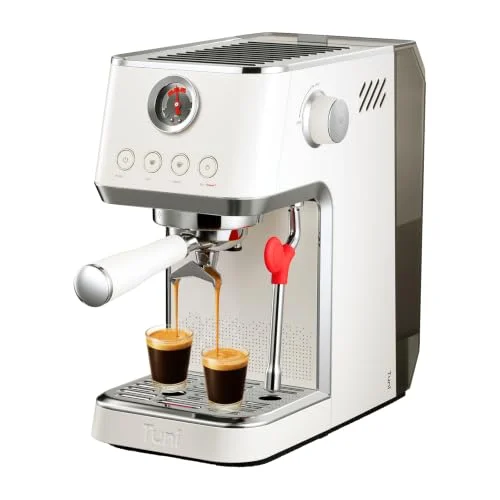
Tuni E2 Gen3 Dual Boiler, Ivory
The cheapest way into this category on our list. 58mm all-metal brew head with a visible pressure gauge, dual-boiler heating so you can froth immediately after extracting, a 20-bar ULKA pump, PID + NTC dual temperature control, and an auto pressure-release function that vents residual pressure after a shot instead of leaving it to escape through the portafilter.
$329.00 Check price →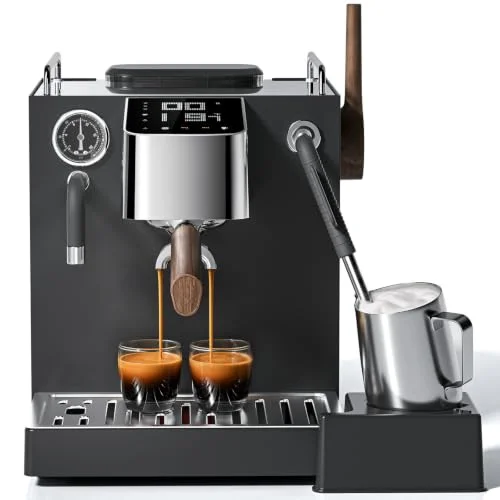
AMZCHEF 9 Bar OPV, Automatic Milk Frother
The milk-focused pick. An angled automatic frothing station paired with a 1,650 W steam system and dual-hole nozzle is built to form a consistent microfoam vortex without a manual wand. On the espresso side, a 58mm commercial portafilter and an OPV system holding pressure in the 9–12 bar range work with a "Thermal Balance Group Head" — an active heater plus PID control keeping the group warm through the shot. Listed at a 61-oz size.
$499.99 Check price →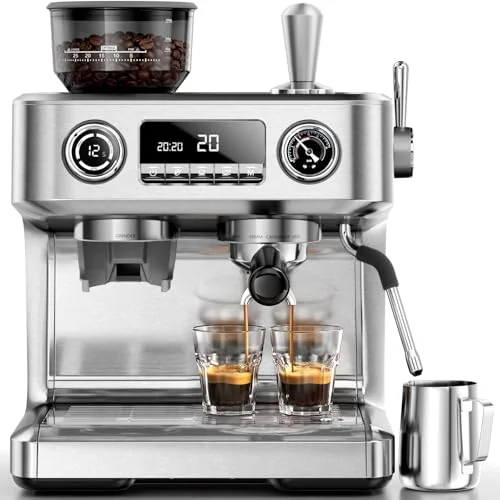
Kismile 20 Bar Dual Boiler with Grinder
The most complete package, and the priciest of the three. Dual boilers with PID control holding temperature within a stated ±2°C, dual LED screens and a pressure gauge showing grind time, brew status and pressure, single/double-cup buttons for customizing extraction and pre-infusion timing, and a built-in conical burr grinder with 30 settings that grinds straight into the machine's own 58mm portafilter.
$589.99 Check price →| Machine | Boilers | Portafilter | Grinder | Price | |
|---|---|---|---|---|---|
| Tuni E2 Gen3 | Dual, PID + NTC | 58mm all-metal | None | $329.00 | Price |
| AMZCHEF 9 Bar OPV | Dual, thermal balance group | 58mm commercial | None | $499.99 | Price |
| Kismile 20 Bar | Dual, PID ±2°C | 58mm, grinds direct | Built-in burr, 30 settings | $589.99 | Price |
Heat stability and puck evenness: the real argument for a wider group head
Bigger metal holds heat better and loses it slower — that's just physics, not a marketing claim, and it's the actual reason a wider group matters more than the basket diameter alone suggests. A 58mm brew head has more mass than a 51mm or 54mm one, so it recovers faster from the heat it loses each time cold water and a room-temperature portafilter pass through it, and it swings less when you steam milk immediately afterward.
All three machines here layer electronics on top of that extra mass rather than relying on it alone. The Tuni's PID + NTC system is built to "deliver water at precisely the right temperature" for extraction, correcting drift a passive group alone wouldn't catch. The AMZCHEF pushes further with its Thermal Balance Group Head, described as an active PTC heater working alongside PID control to "help minimize heat loss and temperature fluctuations during extraction" — in effect, actively reheating the group rather than just insulating it. The Kismile states the tightest number of the three, holding temperature within a claimed ±2°C via its own PID system, and surfaces that stability on its dual LED screens and pressure gauge so you can watch pressure and brew status rather than guess at them.
Puck evenness is the payoff of all of that: a group that holds temperature and spreads water evenly across a wider bed is what keeps a shot from tasting sour on one side and bitter on the other. It's also where the controls layered on top matter — the Kismile's single/double-cup buttons that adjust pre-infusion timing, or a manual dial on the other two, decide how gently water first meets the puck before full pressure arrives. For more on why that first, gentler stage of a shot matters, see our pre-infusion guide; for how these machines put that control in front of you, see our touchscreen versus manual controls comparison.
What "commercial-grade" doesn't tell you
Two of these listings describe their group heads as "all-metal" or "commercial" without naming the alloy. That's a real spec gap, not an oversight on our part: a true commercial group is almost always brass or chromed brass specifically because brass holds and releases heat more evenly than most other metals available at this price. "All-metal" could mean that, or it could mean a lighter alloy that's still a real improvement over plastic — we don't have that detail from the listing, so we won't guess at it. If group material matters to you specifically, check the current listing before buying rather than assuming brass.
What you give up versus a true commercial machine three times the price
Multiply the priciest machine here by three and you land around $1,750 — roughly where genuine single-group commercial espresso machines start, a general market range and not a price tied to any product we carry. What that extra money buys isn't a bigger number on the box; it's a different set of components built for hours of continuous volume rather than a few shots a morning.
The first difference is the pump. All three machines here use vibration-style pumps — the Tuni names its ULKA pump directly — which are compact, inexpensive and perfectly adequate for a handful of shots at a time, but noisier and shorter-lived under continuous use than the rotary pumps commercial machines run. The second is plumbing: these machines all draw from an onboard reservoir rather than a direct water line, which is fine at home but is exactly the kind of manual refilling a plumbed-in café machine is built to avoid. The third is the group and boiler construction itself — as the callout above covers, "commercial-grade" branding on a home machine doesn't confirm the brass construction a genuine commercial group almost always uses, and these dual boilers are sized for a household, not for a bar pulling hundreds of shots a shift.
The last difference is support. A true commercial machine typically comes with a manufacturer or distributor service network built around keeping a café running; these three are general consumer appliances with standard retail warranties. None of that makes them a bad buy — it explains why the price gap exists, and it's worth knowing before you assume "semi-commercial" on a listing means the same construction standard as the machine at your local café. If your budget stretches toward that next tier, our guide to espresso machines at $1,000 and up covers where dual boilers and precise dosing become the baseline rather than the upsell.
Who this size is wasted on
The 58mm-and-dual-boiler formula solves a specific problem: making espresso and steaming milk back to back, repeatedly, without a temperature penalty. If that isn't your actual routine, the extra size and cost buy you very little.
If you drink one cup a day and never touch a steam wand, a second boiler is doing nothing for you — it's solving a milk-timing problem you don't have. If your kitchen counter is tight, a dual-boiler machine is generally a larger, heavier appliance than a single-boiler one, since it's physically carrying two heating systems instead of one; that's real counter and cabinet space you're trading for a milk workflow you may not use daily. And if you're still learning to dial in grind and dose, the Kismile's built-in grinder aside, a wider 58mm basket doesn't fix inconsistent technique — it just gives an uneven pour more room to spread unevenly. Our guide to weight-based dosing versus a timer covers the more foundational upgrade for anyone still chasing consistency shot to shot.
Put plainly: this size makes the most sense for a household making two or more milk drinks close together, more than once a day. Below that, a single-boiler machine with a smaller basket will get you a very similar cup for less money and less counter space.
How we compared these
We compare published specifications, what ships in the listing, machine class and live pricing, and we read marketing language carefully — a "58mm all-metal brew head" and a "58mm commercial portafilter" are real, verifiable dimensions, while terms like "commercial-grade" describe a positioning, not a material spec, which is why we've flagged that gap rather than filled it in. We do not physically test these machines, we do not run a testing lab, and we do not publish ratings we cannot verify: Amazon's product data returns no rating and no review count for any machine on this site, so there are no stars and no invented sentiment anywhere on this page.
Where a claim here is a judgement rather than a specification — that the size is wasted on a one-cup-a-day drinker, that the pump and plumbing are where the real savings come from — we've said so in our own voice and shown the reasoning. General facts used throughout (bigger metal retains heat better and loses it slower, brass is the standard commercial group material, vibration pumps are cheaper and shorter-lived than rotary pumps, espresso brews at roughly 9 bar at the puck) are standard background rather than claims about any specific product. The rest of our method sits on our main espresso machine guide.
Frequently asked questions
Is a 58mm portafilter actually better than 51mm or 54mm?
It spreads the same dose across more surface area and shallower depth, which can mean more even water distribution and less risk of channeling — the effect the Tuni E2 Gen3 and AMZCHEF 9 Bar OPV both design their brew heads around. It isn't automatically a better shot on its own; grind size, dose and tamp still do most of the work, and a wider basket only helps if the rest of your technique is dialed in.
What does a dual boiler actually let you do that a single boiler can't?
Brew and steam back to back without waiting for the machine to swing temperature between the two jobs. A single boiler has to serve both functions with one heating element, so you typically wait between pulling a shot and frothing milk. A dual boiler, like the ones in the Tuni, AMZCHEF and Kismile here, keeps a separate boiler for each so both are ready at once.
Are these semi-commercial machines as durable as a true commercial espresso machine?
Not by construction. All three run compact vibration pumps rather than the rotary pumps commercial machines use, draw from an onboard reservoir instead of a direct water line, and don't confirm brass group construction the way a genuine commercial unit typically does. They're built for household volume with a standard retail warranty, not for continuous café use with a distributor service network behind them.
Do I need a 58mm dual-boiler machine if I only make one cup a day?
Probably not. The dual boiler solves a milk-timing problem — brewing and steaming without a wait — that doesn't come up if you're not steaming milk daily, and the wider basket doesn't correct for inconsistent grind or dose on its own. A single-boiler machine with a smaller basket will likely get you a very similar cup for less money and less counter space.