Best Espresso Machines
Buying guide · $1,000 and up

The best espresso machines at $1,000 and up — where the second boiler stops being a splurge.

Below four figures, a dual boiler and gram-accurate dosing are still rare extras bolted onto a semi-automatic chassis. Above $1,000, they're close to the default, and the real decision moves to whether the grinder is bundled, built in, or your own — and whether you actually need any of it.

By Ilane Tall · Updated September 21, 2026 · Research-based.4 machines compared, $799.95 to $1,999.00

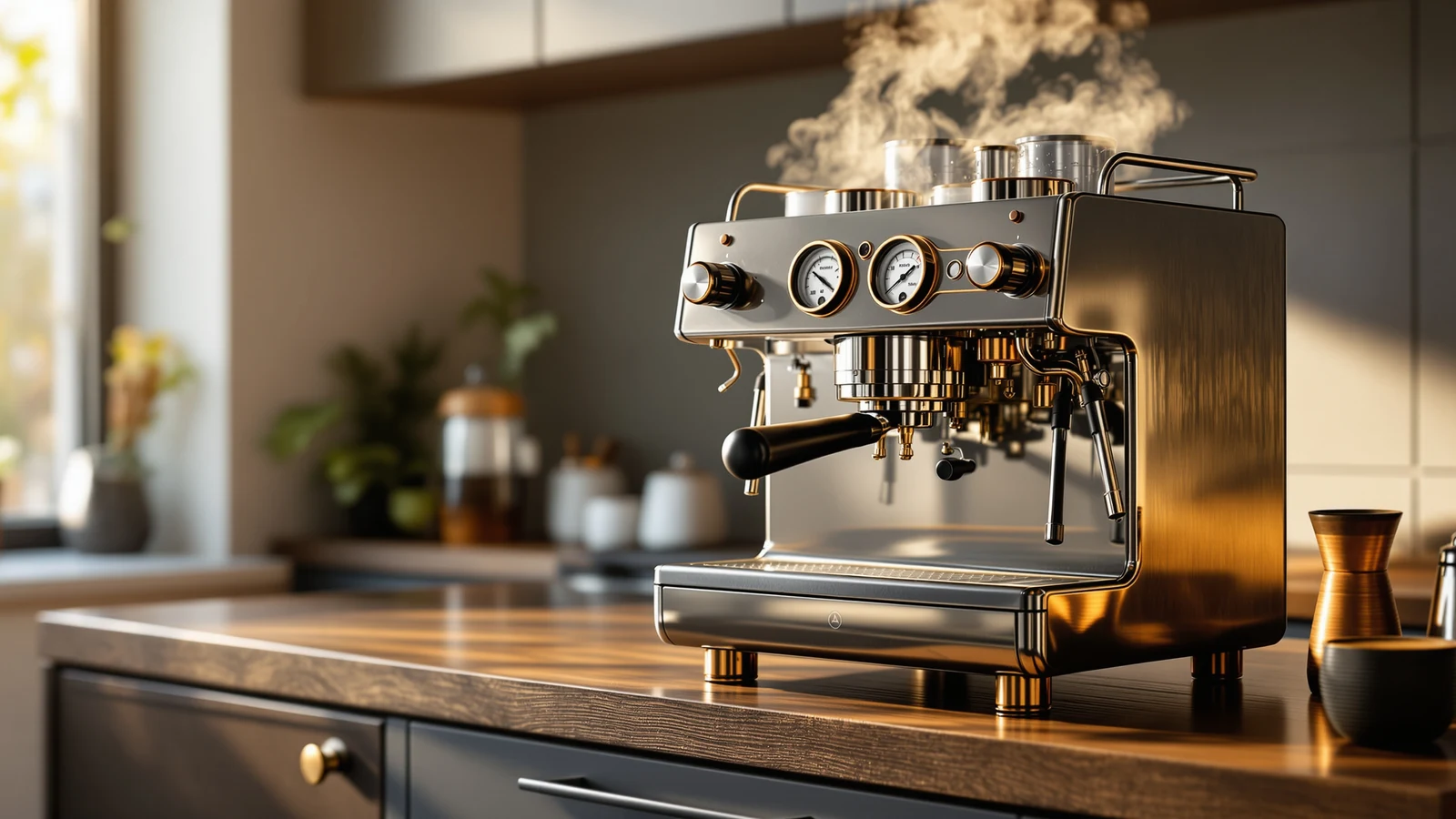
A stainless steel dual-boiler espresso machine with a portafilter and steam wand on a kitchen counter, representing the $1,000-and-up buying bracket

Reader-supported: if you buy through the Amazon links here we may earn a commission at no extra cost to you. It never changes which machine we recommend.

A thousand dollars buys the same 9-bar espresso physics a $300 machine claims to deliver — that part of the equation doesn't move with price. What does move is everything around the shot: whether the machine can brew and steam at the same time instead of making you wait, whether it doses by weight instead of by guesswork, and whether the grinder arrives already matched to the machine or is left entirely up to you. Those are the differences this bracket is actually selling.

We pulled four machines from our database that sit either just under this tier's floor or comfortably inside it, from a $799.95 automatic to a $1,999.00 dual boiler with its own built-in scales, and compared them on what changes in daily use: boiler architecture, how the grinder is handled, and how the shot gets measured. None of them carry a rating or review count in our data — Amazon's product API doesn't return that figure for these listings — so nothing here is a star score. It's published specifications, machine class and live price, compared honestly. If four figures is more than you're ready to spend, our best espresso machines under $1,000 guide covers the bracket just below this one.

The short answer

If you only read one paragraph

Buy the Breville BES920XL Dual Boiler at $1,599.95 if you want the standard dual-boiler chassis and already have a grinder in mind

It's the machine this bracket is built around: an independent brew boiler and steam boiler in a brushed stainless chassis, sold on its own so you can pair it with whichever grinder actually fits your counter and your budget.

Want the grinder decision made for you? The Breville Dynamic Duo Bundle (BEP920BSS) at $1,699.95 pairs the same dual-boiler platform with Breville's Smart Grinder Pro in one checkout. Want the whole dosing chain — grind, dose and shot — captured in grams automatically? The Meraki Dual Boiler with Grinder and Built-In Dual Scales at $1,999.00 is built around exactly that. And if you're genuinely unsure the dual-boiler premium is worth it, the De'Longhi Magnifica Duo at $799.95 is the honest one-touch off-ramp, priced just under this tier's floor.

At a glance

The four, side by side

Ordered by our recommendation. Amazon prices move constantly — confirm the live price before you buy.

MachineBest forClassGrinderPrice
Breville BES920XL Dual BoilerBest overallDual boilerBring your own$1,599.95Price
Breville Dynamic Duo BundleBest bundleDual boilerIncluded: Smart Grinder Pro$1,699.95Price
Meraki Dual Boiler with Grinder & Dual ScalesBest for gram-accurate dosingDual boilerBuilt-in + dual scales$1,999.00Price
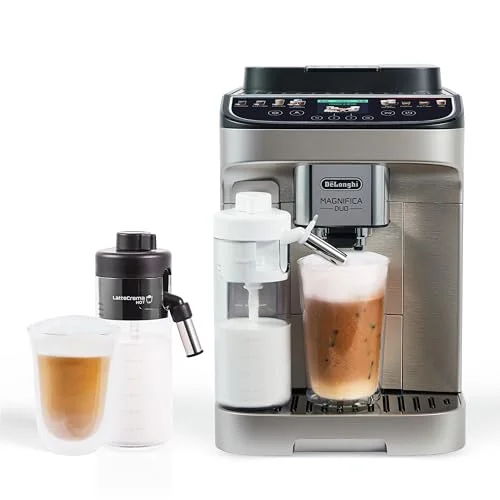
De'Longhi Magnifica DuoBest if you stop lowerAutomaticNot stated — check listing$799.95Price
The picks

Four machines, and who each is for

01Best overall

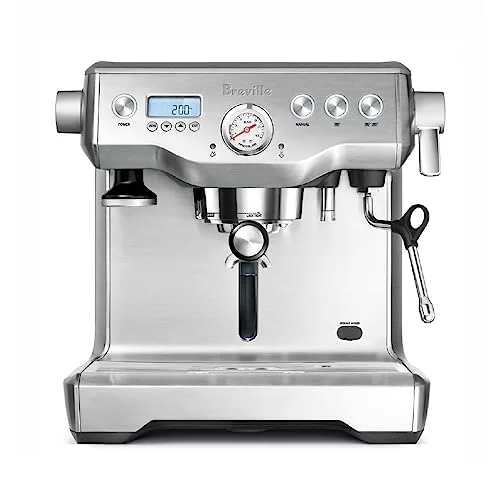
Breville BES920XL Dual Boiler Espresso Machine

For buyers who want the standard dual-boiler chassis and will choose their own grinder
Dual boiler · brushed stainless steel · one size

At $1,599.95, this is the platform the rest of this bracket gets measured against: a dedicated brew boiler and a dedicated steam boiler, running independently instead of one boiler switching modes and making you wait for it to recover. That's the mechanical fact a dual boiler buys you, and it's the reason this class of machine shows up in cafés that need to pull a shot and steam milk in the same ten seconds. It's sold as the machine alone, in brushed stainless steel, in one size.

The trade-offNo grinder in the box. Budget separately for a burr grinder you trust — our grind settings guide is a reasonable place to start — or look at the bundle below if you'd rather Breville make that call for you.

Breville BES920XL Dual Boiler Espresso Machine in brushed stainless steel
$1,599.95
Dual boilerCheck price →
02Best bundle

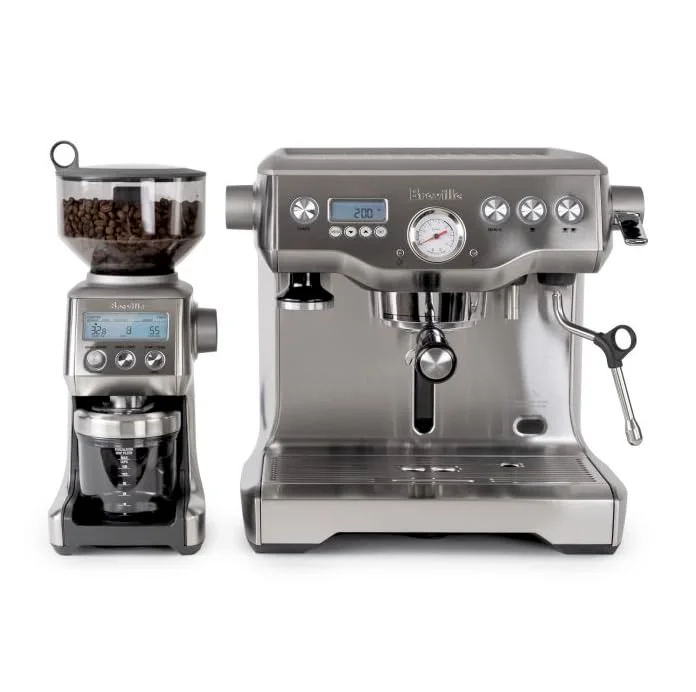
Breville Dynamic Duo Bundle (BEP920BSS)

For buyers who want the dual-boiler chassis and a matched grinder in one order
Dual boiler · bundled Smart Grinder Pro · stainless steel

This is the same dual-boiler idea as pick 01, sold with Breville's standalone Smart Grinder Pro included in the box — the model number, BEP920BSS, echoes the 920 chassis above it. Instead of researching grinder compatibility, dose range and burr size on your own, you get a pairing Breville has already put together, for $1,699.95. If the appeal of this bracket is skipping homework rather than doing more of it, this is the version to buy.

The trade-offIt costs $100 more than the machine alone, and you're accepting Breville's grinder choice rather than shopping the wider market. If you already have strong opinions about grind range or hopper size, that premium may buy you a grinder you'd have picked differently.

Breville Dynamic Duo Espresso Machine Bundle with Dual Boiler and Smart Grinder Pro
$1,699.95
Machine + grinderCheck price →
03Best for gram-accurate dosing

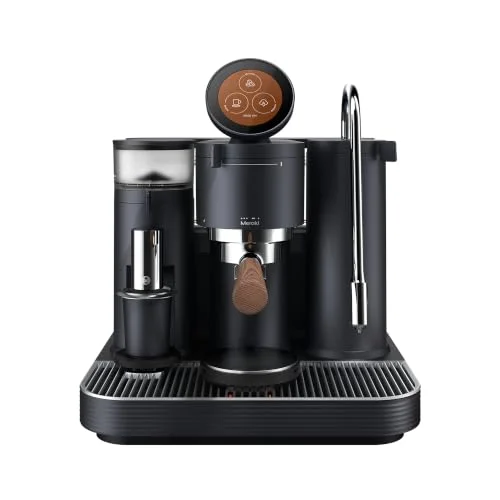
Meraki Dual Boiler Espresso Machine with Grinder and Built-In Dual Scales

For buyers who want the whole dosing chain captured in grams, not guessed at
Dual boiler · built-in grinder · built-in dual scales · Large size variant

At $1,999.00, this is the priciest machine here and the one built most explicitly around weighing rather than timing: a dual boiler, a grinder built into the same chassis, and dual scales integrated into the machine itself. That combination is the mechanical embodiment of gram-accurate dosing — the dose going into the portafilter and the shot coming out of it both get weighed by the machine, not eyeballed against a clock. The listing is for the Large size variant, so confirm that's the configuration you're ordering before it ships.

The trade-offIt's the most expensive machine in this guide, and a newer name in the category next to a chassis line like Breville's that's been in dual-boiler production for years — parts availability and long-term support are unproven by comparison. It also doesn't publish full dimensions in our data, and "Large" is the only size cue we have, so measure against the listing photos and specs before you commit counter space.

Meraki Dual Boiler Espresso Machine with built-in grinder and dual scales
$1,999.00
Grinder + dual scalesCheck price →
04Best if you stop lower

De'Longhi Magnifica Duo Automatic Espresso Machine

For buyers who decide the dual-boiler premium isn't worth it and want one-touch convenience instead
Automatic · milk frother included · silver

At $799.95 — just under the floor of this bracket — the Magnifica Duo is the honest off-ramp from everything above it. It's sold as an automatic espresso machine with a milk frother built in, not a manual dual-boiler platform: no portafilter to dial in, no second boiler to justify, no grinder decision to make on top of the machine itself. We list it here specifically because deciding against this bracket is a legitimate outcome of reading this guide, not a consolation prize.

The trade-offNo dual boiler, no built-in scales, no manual control over dose or shot — you're trading the entire prosumer feature set above for automation, at roughly 40% less than the cheapest dual boiler here. That's the right trade for plenty of people; see how it compares to the tier below in our under-$1,000 guide.

De'Longhi Magnifica Duo Automatic Espresso Machine with milk frother in silver
$799.95
AutomaticCheck price →
The real upgrade

What actually changes above $1,000 — and what doesn't

Espresso itself doesn't get better with price. It's still water forced through a compressed bed of finely ground coffee at roughly 9 bar, still most sensitive to grind size and dose, still built around the same 1:2 ratio of coffee to liquid that a $300 machine and a $2,000 one both work from. No amount of spending changes the physics of extraction, and any machine that implies otherwise is selling marketing, not chemistry.

What changes is consistency and capacity. Below $1,000, a single boiler has to do two jobs — brewing and steaming — and switching between them costs time and temperature stability, which is exactly what our warm-up time and shot consistency guide covers in more depth. Above $1,000, three of the four machines here run two boilers instead, so brewing and steaming stop competing with each other. Above $1,000, dosing also starts moving from "adjust the grinder and hope" toward "weigh the input and the output," which is the subject of its own section below. And above $1,000, whether a grinder is included, bundled or entirely your own becomes a real fork in the road rather than a single obvious default.

None of that means a $1,600–$2,000 machine makes a categorically different cup than a well-run $700 one. It means the $1,000-and-up machine is built to make that same good cup more repeatably, with less babying, and — depending on the model — with less guesswork in the dosing itself.

The headline spec

Dual boilers and PID control: standard here, optional everywhere else

A dual-boiler machine runs one boiler dedicated to brewing and a second dedicated to steaming, each heated and held independently. The practical effect is that you can pull a shot and texture milk for a latte at the same time, without one process waiting on the other to reach temperature — the exact scenario a single-boiler machine handles by making you choose an order and accept a pause. Our double boiler vs single boiler guide goes deep on that trade-off across price tiers; this bracket is where the "dual boiler" answer starts showing up by default rather than as a rare upsell.

Three of the four machines in this guide say so directly in their own names: the Breville BES920XL Dual Boiler, the Breville Dynamic Duo Bundle built around that same dual-boiler platform, and the Meraki Dual Boiler with Grinder and Built-In Dual Scales. That's not a coincidence of naming — at this price, a second boiler is close to table stakes among machines built for people who make more than one drink at a time. Worth noting: the De'Longhi Magnifica Duo's name refers to the machine-plus-frother pairing, not a second boiler — nothing in its listing describes dual-boiler architecture, which is one more reason it sits below this tier rather than in it.

PID control is the companion feature that tends to travel with a second boiler at this level: a controller that holds brew temperature within a narrow band instead of letting a simple thermostat cycle it wider, which matters because espresso extraction is sensitive to water temperature the same way it's sensitive to grind size. It's common enough in dual-boiler prosumer machines that the two features are frequently mentioned together in marketing copy — but none of the four listings we're working from specifically calls out PID by name for these exact models, so if precise temperature control is the reason you're spending this much, verify it on the specific listing before you check out rather than assuming it from the boiler count alone.

The other prosumer habit

Gram-accurate dosing: why these machines weigh instead of time the shot

Timing a shot by the clock assumes flow rate is constant, and it isn't. Two shots pulled for the same 27 seconds can yield noticeably different amounts of liquid if the grind, the dose or the tamp shifted even slightly between them — which means a stopwatch is measuring time, not the thing you actually care about, which is how much coffee ended up in the cup relative to how much dry coffee went in. Weighing both sides of that equation — dose in, shot out — removes the guesswork a timer can't.

That's the exact idea behind the Meraki Dual Boiler with Grinder and Built-In Dual Scales: one scale to weigh the dose going into the portafilter, another built into the machine to weigh the shot as it pulls, so the ratio you're chasing is measured rather than estimated. It's the most direct expression of gram-accurate dosing among the four machines here, and it's also why the Meraki carries the highest price in this guide — that pair of built-in scales is doing a job that, on the Breville BES920XL Dual Boiler or the Dynamic Duo Bundle, would otherwise mean buying a separate portafilter scale and timing the pour by eye or by a phone stopwatch.

None of that makes the Breville machines' approach wrong — a dual boiler solves the waiting problem regardless of how you measure the shot, and plenty of people are perfectly consistent with a $30 scale sitting next to the machine rather than built into it. What built-in scales buy you is one less accessory on the counter and one less step to remember before every shot. Our grind settings guide covers the other half of that precision — how many clicks of adjustment actually matter once you're dosing by weight.

The honest cost

Footprint and weight: what a serious machine costs you in counter space

A dual boiler is, mechanically, two boilers instead of one, plus the plumbing and insulation to keep them from interfering with each other, inside a chassis usually built from thicker steel than a $300 semi-automatic. That's not a styling choice — it's what it takes to run two heating systems reliably in one unit — and the direct consequence is that dual-boiler machines are heavier and larger than the single-boiler and capsule machines that dominate the sub-$500 shelf. A grinder built into the same body, as on the Meraki, adds to that footprint further, since a hopper and burr set need their own clearance on top of the boiler housing.

We're not going to hand you invented dimensions to make this section feel more concrete than it is. None of the four listings we're working from publish full width, depth, height and weight figures in the data available to us — the Meraki's listing does flag a "Large" size variant, which is a real signal worth checking against the seller's own measurements before you order, but it isn't a number we can print as a fact. The honest version of this advice is the same one we'd give for any appliance this size: measure your counter depth and the clearance under your cabinets with the water tank pulled out and any lid open, and check the current listing's dimensions and weight directly, because those figures are the seller's to state accurately, not ours to guess at.

What we can say without a tape measure is the practical shape of ownership: a machine built around two boilers and, in some cases, a grinder, tends to be something you set up once and leave in place rather than move for storage between uses. Budget the space accordingly, not just for the machine's footprint on delivery day, but for the fact that it's likely to live there permanently.

The bottom line

Who should stop at $500–$700 instead, honestly

If you drink one drink at a time, a second boiler is solving a problem you don't have

The entire case for a dual boiler rests on brewing and steaming at once — a household or a home café pulling back-to-back drinks for more than one person. If it's just you, one cup at a time, a single-boiler machine that briefly switches modes between shot and steam costs you a short wait, not a ruined drink. That wait is the whole premium you'd be paying to eliminate.

The same logic applies to gram-accurate dosing. Built-in scales, like the pair on the Meraki, remove a specific kind of guesswork — but a $10 kitchen scale next to a $700 semi-automatic gets you most of the same information for the price of an accessory, not an appliance upgrade. If neither the simultaneous-brew-and-steam problem nor the weigh-every-shot habit describes how you actually make coffee, none of the four machines in this guide will feel like a daily-use upgrade over something cheaper — they'll just be a bigger, pricier machine doing the same job. Our best espresso machines under $1,000 guide is the honest next stop, and it names machines in the $599–$700 range built around exactly that single-boiler, one-drink-at-a-time reality.

How we picked

Four machines that bracket $1,000 from both sides

We pulled machines from our database priced from just under $1,000 to just under $2,000 and sorted them by boiler architecture and how the grinder is handled — standalone dual boiler, dual boiler bundled with a matched grinder, dual boiler with a grinder and scales built in, and an automatic alternative for readers still deciding whether this bracket is worth entering at all.

How we compared

Research, not a lab

Plainly: we compare published specifications and prices, we don't run a testing lab, and we don't publish ratings we can't verify. Amazon's product data returns no rating or review-count figures for these machines, so there are no stars anywhere on this page. Where a call is a judgement rather than a spec — that most single-drink households should stop lower, that the Meraki's dual scales are worth its premium for gram-accurate dosing — we've said so in our own voice, so you can weigh it yourself.

FAQ

Questions people actually ask

What does a dual boiler actually let you do that a single boiler doesn't?

It lets you brew a shot and steam milk for that same drink at the same time, because each process has its own independently heated boiler instead of one boiler switching between modes. On a single-boiler machine you either wait for the machine to change over or accept a temperature dip; on a dual boiler like the Breville BES920XL, the Dynamic Duo Bundle or the Meraki, both happen in parallel.

Is PID temperature control worth paying for?

PID control holds brew temperature in a narrow band instead of the wider swing a basic thermostat allows, which matters because extraction is sensitive to water temperature. It's commonly paired with dual boilers at this price tier, but none of the four listings we compared specifically states PID as a named feature for these exact models — confirm it on the current listing rather than assuming it comes automatically with a second boiler.

Why do some espresso machines have built-in scales?

Timing a shot with a stopwatch assumes the flow rate never changes, but grind, dose and tamp all shift it — so two shots at the same number of seconds can pour out different amounts of coffee. Built-in scales, like the pair on the Meraki Dual Boiler with Grinder and Built-In Dual Scales, weigh the dry dose going in and the liquid shot coming out, replacing that assumption with a measurement.

Should I buy a machine with a bundled grinder, or the machine plus a separate grinder?

A bundle like the Breville Dynamic Duo removes the research of matching a grinder to your machine, since Breville has already paired the Smart Grinder Pro with the same dual-boiler platform sold alone as the BES920XL. Buying the machine alone and choosing your own grinder costs the same $1,599.95 starting point but gives you the freedom to pick a grinder with a different dose range, hopper size or price than the one in the bundle.

Keep reading

Next steps, in order of usefulness

Ilane Tall

Ilane writes the espresso comparisons on this site, built from published specifications, machine class and live pricing — never from testing we haven't done, and never from ratings we can't verify. Get in touch, or read about this site and our privacy policy.