Weight-Based Dosing vs a Timer: How the Best Machines Measure a Shot
One listing in this catalogue puts a pair of scales inside the machine itself, accurate to a stated 0.2 grams. Most of the rest hand you a scoop, a portafilter and a countdown. Here's what a scale is actually measuring that a clock isn't — and the $15 workaround that closes most of the gap on a machine that has neither.
Reader-supported: we may earn a commission if you buy through our links, at no extra cost to you. Prices are the ones we recorded on September 22, 2026 and they move constantly — confirm the live price before buying.
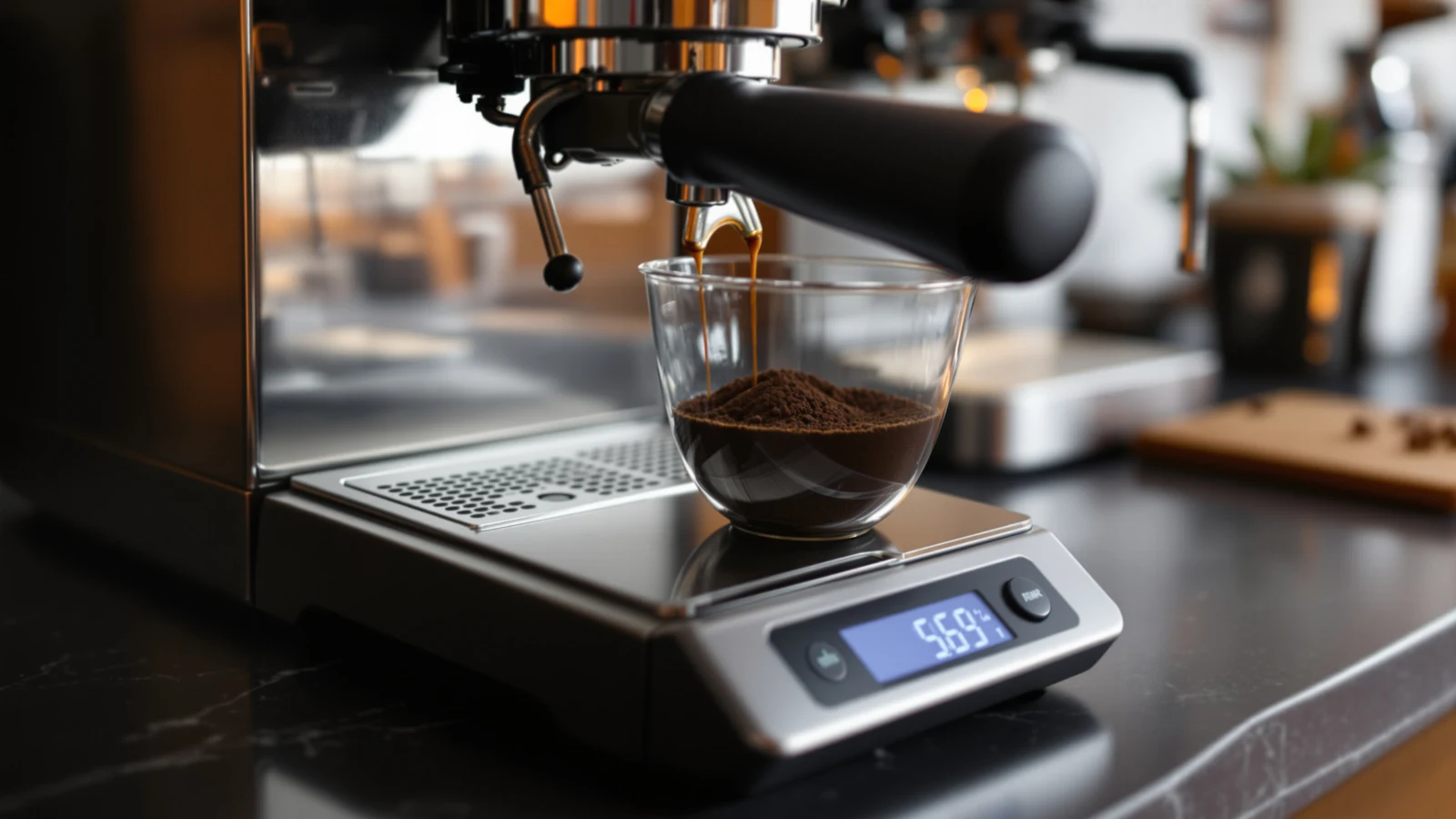
The short answer
A scale measures mass — the one variable that actually determines how much coffee is in the basket and how much espresso lands in the cup. A timer measures how long the pump has been running, which is a proxy for volume, which is itself a proxy for mass. Every layer of proxy is a place error can creep in.
For most people, that chain of proxies is fine. Espresso only gets genuinely fussy about it once you're chasing repeatability shot to shot, bean to bean — which is exactly the buyer the Meraki Dual Boiler Espresso Machine with Grinder and Dual Built-In Scales is built for: it puts a scale under the grinder and another under the cup, stated accurate to within 0.2 grams, so the machine is weighing what you'd otherwise be guessing. At the other end, a machine like the CHULUX Slim gives you no scale and no grinder at all — you add already-ground coffee by eye and start a pump on a timer. Neither approach is wrong. They're built for different relationships with the process, and a $15 accessory can move a timer-based setup most of the way toward a weight-based one anyway.
What weight measures that time doesn't
Start with what actually happens inside a portafilter. A double shot conventionally starts around 18 grams of dry ground coffee in and roughly 36 grams of liquid espresso out, brewed in about 25 to 30 seconds — a rough 1:2 ratio that you then adjust to taste. Every number in that sentence is a mass or a time, and only one of them is what you actually care about: the ratio of coffee to water that ends up in the cup, by weight.
A timer never measures that ratio. It measures elapsed seconds, and assumes that seconds-of-flow reliably correlates to grams-of-liquid. That assumption holds only if the flow rate is constant — and flow rate depends on grind size, tamp pressure, how evenly the grounds are distributed in the basket, and how worn the pump and group seals are. Change any of those and the same 28 seconds can pour a different weight of espresso than it did last week, with no way to know it happened until the shot tastes off. A scale under the cup catches that immediately, because it's reading the actual output, not a proxy for it.
The same logic applies on the dose side. A volumetric dose — a scoop, a pre-set grind timer, a hopper dial — assumes a fixed volume of coffee always weighs the same amount. It doesn't: bean density changes with roast level, since darker roasts are more brittle and less dense, and with freshness. Grind a lighter, denser roast for the same seconds you used on a dark roast and the dose creeps up without the grinder doing anything different. Our guide to how many grind settings you actually need covers the adjacent half of this problem — particle size matters too, but it's a separate variable from getting the mass right.
Why 0.2 g accuracy matters for espresso specifically, not just coffee
Drip coffee tolerates dose error that espresso can't. A pour-over brewing 1 part coffee to 16 parts water over four minutes barely notices if the dose is off by a gram — the ratio moves by about 6%, spread across a long, gentle extraction. Espresso compresses the same sensitivity into 18 grams and 25 seconds, and the math is much less forgiving.
Do the arithmetic on a standard 18 g double shot. A stated 0.2 g accuracy is an error of about 1.1% of the dose — small enough to be functionally invisible in the cup. A hand that's off by a gram, which is easy to be when scooping or eyeballing a grind timer, is an error of roughly 5.6%. Off by two grams — plausible with an inconsistent scoop or a grinder whose dial has drifted — and the error is over 11%, on the same variable that decides whether a shot runs sour and fast or bitter and slow.
That's what the Meraki's built-in scales are actually solving for. The listing states independent 350 ml brew and 550 ml steam boilers with PID control and a heated grouphead — the thermal-stability half of shot consistency — paired with scales under both the dose and the yield, stated accurate within 0.2 g, so the recipe you dial in on Monday reads the same on Friday. That's a meaningfully different proposition from a machine that grinds for a fixed time and brews for a fixed time and calls both "18 grams" and "a double" without ever weighing either one.
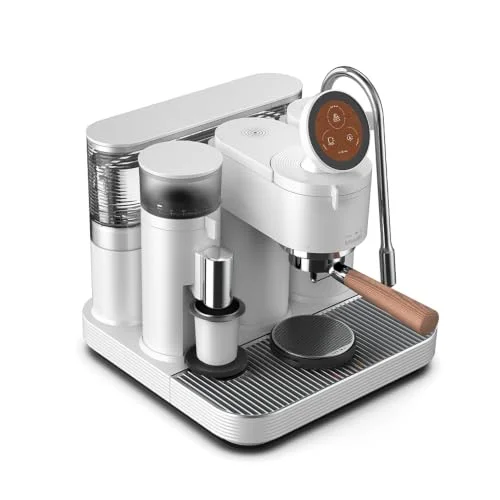
Meraki Dual Boiler with Grinder and Dual Built-In Scales
Independent 350 ml brew and 550 ml steam boilers with PID control and a heated grouphead, a built-in grinder, and scales under both the dose and the yield stated accurate within 0.2 g — the closest thing on this list to a café-style weight-based workflow you don't have to assemble yourself.
$1,999.00 Check price →A machine this deliberately built around weight is also, unsurprisingly, a dual-boiler design — brewing and steaming from separate independent boilers rather than sharing one, which is its own trade covered in double boiler vs single boiler. And at $1,999 it sits well inside the territory we map in the best espresso machines at $1,000 and up, where gram-level dosing tends to stop being a novelty and start being the expected spec.
The picks
Rather than one winner, this is three answers to the same question — how much precision do you actually want to manage — at three very different prices.
If you want the machine to weigh it for you: the Meraki Dual Boiler, above, with scales built into both ends of the shot. If you want the machine to stay out of the way entirely: the CHULUX Slim below, no grinder and no scale, just a pump and a clock. If you want something that automates the dose without weighing it: the Breville Barista Express Impress, further down, which recalculates and self-corrects its dose from shot to shot on a volumetric basis rather than a weight-based one — a genuinely different approach from either end of this list.
What a $110 machine with no scale asks you to do instead
The CHULUX Slim is the plainest version of the timer-based approach, because it doesn't even offer a volumetric shortcut — there's no built-in grinder to set a dial on. The listing is explicit about the workflow: add ground coffee, then press the button. Every measurement in that sentence happens in your kitchen before the machine is involved at all.
Concretely, that means: you're choosing your own grind (bought pre-ground or from a separate grinder), scooping or weighing your own dose into the portafilter by hand, tamping it yourself, and then letting the machine's 20-bar Italian pump and 1,350 W boiler — which the listing says preheats in about 30 seconds — run for however long you decide to let it run. Nothing about the machine measures whether that dose was 16 grams or 20; nothing measures whether the shot that comes out is 30 grams or 45. It brews espresso pressure through whatever bed of grounds you built, for however long you hold the button or set the timer, and it trusts you to have gotten the dose right beforehand.
That's not a flaw specific to this machine — it's the default condition of most semi-automatic machines at this price, on this site and elsewhere, and it's exactly the gap a kitchen scale is built to close.
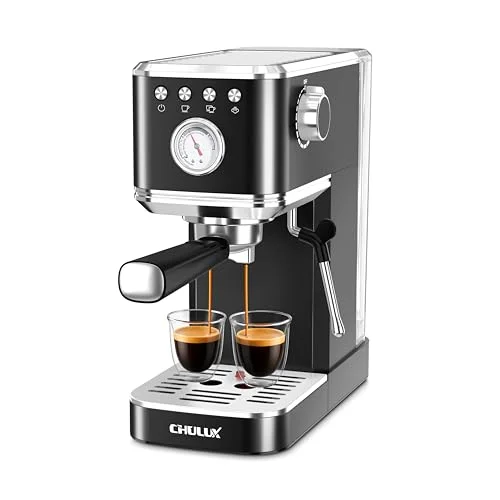
CHULUX Slim Espresso Machine with Milk Frother
A 20-bar Italian pump, a 1,350 W boiler the listing says preheats in about 30 seconds, and a steam wand for milk — with no built-in grinder and no scale. You supply the dose; the machine supplies the pressure. At $109.99, that trade is most of what keeps the price this low.
$109.99 Check price →Where a kitchen scale under the portafilter closes most of the gap
This is the part most buyers of a no-scale machine never do, and it's the single cheapest upgrade available on any espresso setup: put a $15–30 kitchen scale — anything that reads to 0.1 g increments — under the portafilter before you grind, tare it, and weigh the dose going in. Weigh the cup again during the pull and stop the shot at your target yield instead of at a guessed time. You now have the same dose-and-yield data the Meraki is generating automatically; you're just reading it off a separate device and acting on it by hand instead of having the machine do both jobs itself.
What the scale doesn't replicate is the automation and the thermal engineering — a standalone scale won't hold brew temperature steady through a PID loop, and it won't grind for you. But for the specific problem this article is about, knowing the actual mass of coffee in and espresso out instead of guessing from a scoop and a clock, a $20 scale on a $110 machine gets you most of the way to what a built-in scale is doing on a $1,999 one. It's usually the first accessory a budget pump-machine setup should add, ahead of a better tamper or a bottomless portafilter.
The one thing a bolt-on scale can't fix is grind consistency — if the particle size is drifting shot to shot, weighing the dose tells you the mass was right while the extraction still goes wrong. That's a grinder problem, not a scale problem, and it's covered separately in our guide to grind settings.
When timer-based dosing is genuinely good enough
Not every machine that skips a built-in scale is asking you to guess blind. The Breville Barista Express Impress sits in an interesting middle position: its listing describes an intelligent dosing system that automatically calculates and adjusts the level of fresh coffee for a precise dose, and auto-corrects the next dose based on the previous one. That's dose automation — but on the evidence of the listing, it's a volumetric and self-correcting system, not a stated-accuracy weight measurement the way the Meraki's built-in scales are. It's a third category: not a bare timer, not a scale, but a machine trying to hit a consistent dose without weighing it.
And for a lot of people, even a plain timer is genuinely fine — not a compromise, just a match for how they actually drink coffee. If you use the same beans for weeks, the same grind setting, and the same tamp, your dose is already repeatable without a scale telling you so; a timer is measuring a flow rate that isn't changing. Timing stops being good enough the moment any of those variables move — new beans, a different roast level, a grinder that's been bumped — because a clock has no way to tell you the ratio shifted. It keeps timing the same 28 seconds regardless of what's happening in the basket.
So the honest dividing line isn't "scale good, timer bad." It's whether your routine holds still. A single-origin creature of habit can run a timer-based machine indefinitely and never miss a scale. Someone rotating through three bags of beans a month is the person a scale — built in or bought separately — earns its keep for.
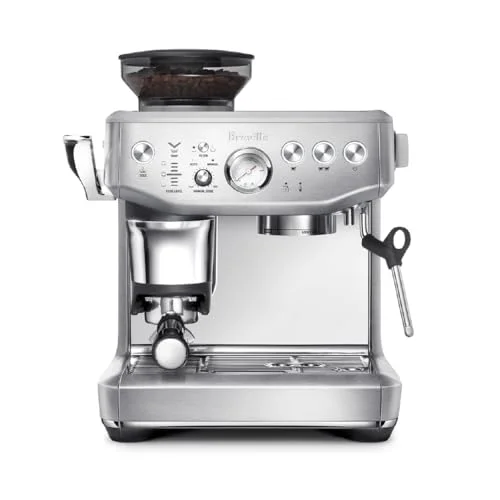
Breville BES876BSS Barista Express Impress
A bean-to-cup machine with an intelligent dosing system the listing says automatically calculates and adjusts the coffee dose and auto-corrects the next one, plus a manual steam wand for hand-textured microfoam. Dose automation without a stated weight figure — a different answer to the same problem the Meraki solves with scales.
$799.95 Check price →At $799.95, the Impress also lands squarely inside the range we cover in the best espresso machines under $1,000, which is worth a look if dose automation matters to you more than a built-in scale specifically.
The three, side by side
Same question — how is the dose actually being measured — answered three different ways. Prices are what we recorded on September 22, 2026.
| Machine | Dosing method | Grinder | Milk | Price | |
|---|---|---|---|---|---|
| Meraki Dual Boiler | Weight-based — dual built-in scales, 0.2 g stated accuracy | Built-in | Steam boiler | $1,999.00 | Price |
| Breville Barista Express Impress | Auto-calculated, self-correcting — not a stated weight figure | Built-in (bean-to-cup) | Manual steam wand | $799.95 | Price |
| CHULUX Slim | Manual — no grinder, no scale; add ground coffee, run on a timer | None | Steam wand | $109.99 | Price |
The verdict
If dose repeatability is the thing you're actually buying for — you rotate beans, you chase a specific ratio, you want the machine itself to catch drift before you taste it — the Meraki's built-in scales are doing a job that otherwise takes a separate accessory and manual habit to replicate, and $1,999 buys that plus the dual-boiler thermal stability that goes with it.
If you want dose consistency without the price of a scale-equipped dual-boiler machine, the Breville Barista Express Impress's self-correcting dosing is a reasonable middle answer at under half the cost — you give up a stated weight figure but keep an integrated grinder and a system explicitly built to adjust itself shot to shot.
And if $110 is the budget, don't treat the CHULUX Slim's lack of a scale as a problem to solve by spending more on the machine. Solve it for $15–30 with a kitchen scale under the portafilter instead, and put the rest of the budget toward a decent grinder — the variable that actually decides whether the dose you so carefully weighed extracts well in the first place.
How we compared these
We compare published specifications, what's stated on the listing, machine class and live pricing — we do not physically test these machines and we do not run a testing lab. The dosing figures in this guide come directly from each product's listing: the Meraki's "0.2 g" and dual-scale claim, the CHULUX's "add ground coffee then press button" instruction, and the Breville Impress's description of automatic, self-correcting dosing are all stated by the manufacturer, not measured by us. We show no star ratings and no review counts anywhere on this page, because Amazon's product data returns none for these machines, and we do not invent or paraphrase sentiment we don't have.
The general coffee facts in this guide — the roughly 18 g in / 36 g out double-shot ratio, the 25–30 second brew window, and the arithmetic on percentage dose error — are standard background rather than claims about any specific product. Where a conclusion here is a judgement rather than a spec, such as which route suits which buyer, we've said so in our own voice. The rest of our method sits on our main espresso machine guide.
Frequently asked questions
How accurate does a kitchen scale need to be for espresso?
Look for one that reads to 0.1 g increments. A typical double-shot dose is around 18 g, and even a 1 g swing moves the brew ratio enough to taste — a scale reading to 0.1 g lets you hit a target dose and yield by hand to within a fraction of a gram, which is close to what a built-in scale stated accurate to 0.2 g, like the Meraki's, is doing automatically.
Can I just use a timer instead of weighing my dose?
Yes, once your grinder and technique are already consistent. A timer measures how long water has been running, not how much coffee or liquid you actually have — a reasonable stand-in as long as your dose and flow rate aren't changing. It stops being reliable the moment you switch beans, roast level, or grind setting, because a clock has no way to tell you the ratio moved.
Does a sub-$150 espresso machine need a built-in scale to make good espresso?
No, but it needs you to supply the discipline a scale would otherwise provide. A machine like the CHULUX Slim has no grinder and no scale — you add already-ground coffee by eye and start the pump on a timer. A $15–30 kitchen scale placed under the portafilter turns that same machine into a dose-and-yield setup nearly as repeatable as one with a scale built in.
What's the actual difference between dosing by weight and dosing by volume or time?
Weight measures the thing that determines extraction directly: the mass of dry coffee going in and the mass of liquid espresso coming out. Volume and time are both stand-ins for weight — a scoop assumes every scoop packs to the same density, and a timer assumes flow rate never changes. Bean density varies with roast and freshness, and flow rate drifts with grind, tamp, and puck condition, so both proxies carry error that a scale simply doesn't.