Pre-Infusion: What It Actually Does to a Shot
A handful of machines add a low-pressure soak before the real extraction starts. It sounds like a marketing bullet point next to "20 bar" and "PID control" — but it solves a specific, physical problem in the puck, and its absence asks something of you that most spec sheets never mention.
Reader-supported: we may earn a commission if you buy through our links, at no extra cost to you. Prices are the ones we recorded as of September 18, 2026 and they move constantly — confirm the live price before buying. We compare published specifications and pricing; we do not physically test these machines and we do not run a testing lab.
What pre-infusion actually is
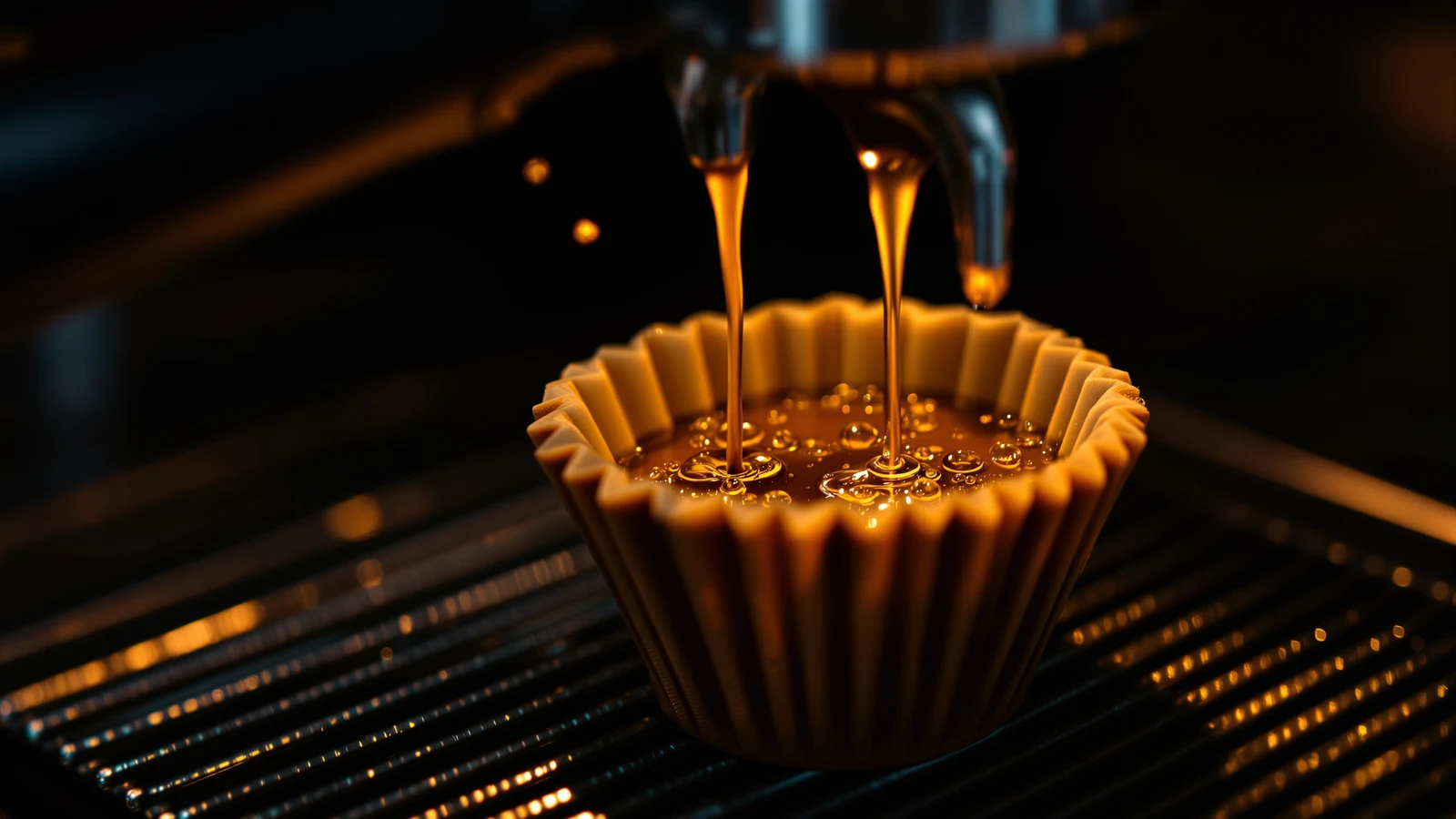
Pre-infusion is a brief pause between "the pump turns on" and "the shot really starts": water is pushed into the puck at low pressure for a few seconds, allowed to sit and saturate the grounds, and only then does the machine ramp up to full brewing pressure — roughly 9 bar at the coffee — for the extraction itself.
The mechanism behind it is dry coffee. A tamped puck fresh out of the portafilter is not evenly packed; it has pockets of looser and denser grounds no matter how careful the tamp, and dry coffee resists water unevenly until it has had a moment to absorb some. Hit a bone-dry, unevenly packed puck with full 9-bar pressure immediately and the water takes the path of least resistance through the loosest spots, rather than moving through the whole bed at once.
A low-pressure soak first — typically somewhere in the range of 1 to 10 seconds, depending on the machine — lets the grounds swell and settle before the real pressure arrives. Coffee expands slightly as it wets, which tightens up some of those loose pockets on its own, so by the time full pressure kicks in, the bed is closer to uniformly saturated than it was at the start. That is the entire mechanism: not a flavor additive, not a separate brewing stage with its own chemistry, just a gentler on-ramp into the same shot.
It is worth being precise about what pre-infusion is not, because the category is full of imprecise marketing. It is not the same as a long pre-wetting soak on some manual lever machines, which can run well past ten seconds by design. It is not a substitute for a good tamp or an even distribution of grounds — no amount of low-pressure soak fixes a puck that was unevenly loaded into the basket in the first place. And it has nothing to do with pump bar rating: a machine can advertise 20 bar and still have no pre-infusion stage at all, because the two specs describe different things — one is the pump's maximum output, the other is how gently that output is introduced.
Channeling: the problem it exists to prevent
The failure mode pre-infusion is trying to head off has a name: channeling. It happens when water finds one or two easy routes through the puck instead of moving through the whole bed evenly, carving a literal channel through the loosest coffee while the denser coffee around it barely sees any water at all.
The result in the cup is a shot that tastes both under- and over-extracted at once, because it effectively is. The coffee along the channel gets blasted with far more water than it should, over-extracting into bitterness and hollow, papery notes. The coffee everywhere else gets starved, staying under-extracted and sour. You can often see it happening: instead of a shot that starts dark and slows into a steady, syrupy stream, a channeled pour spurts, sputters, or runs unevenly thin and fast in patches.
Channeling is more likely exactly where pre-infusion is most useful — in a dry, freshly tamped puck that has not had a chance to settle. A gentle low-pressure phase reduces the odds of a channel forming in the first place, because the puck is no longer bone dry and unevenly resistant when full pressure arrives. It does not eliminate channeling; a badly distributed or badly tamped puck can still channel under pre-infused pressure. It lowers the odds of it happening from a puck that is otherwise reasonably well prepared.
Fixed versus adjustable, and why the range matters
Machines that include pre-infusion split into two camps: a fixed soak baked into the brew cycle with no user control, or an adjustable one where you set the duration yourself. Both do the same underlying thing; the difference is whether you can tune it to your coffee.
A fixed pre-infusion typically runs somewhere in a short window — commonly in the neighborhood of 1 to 5 seconds — before the machine ramps to full pressure automatically. You get the benefit of the gentler on-ramp without having to think about it, but you cannot lengthen it for a finer grind or a denser puck that might benefit from more soak time, nor shorten it if your setup already extracts evenly and a longer pause just delays your shot.
An adjustable pre-infusion widens that window, often into a range like 3 to 10 seconds, and lets you set where in that range you land. That matters because the ideal soak length is not fixed across every setup: a finer grind packs more densely and can benefit from a longer soak to saturate evenly, while a coarser grind or a lighter tamp may need less. Being able to move the duration is a way of tuning the machine to your specific grind and dose rather than accepting whatever soak time the manufacturer picked as a general-purpose default. It is a dial for people who are already dialing in grind size and dose and want one more variable to match to their beans — not something a first-time buyer needs to touch on day one.
Either version is doing useful work. The distinction matters mainly to people who plan to fine-tune their setup rather than run it on factory defaults, and it is one of the clearer, genuinely functional differences between machines in this price range — unlike a pump's peak bar rating, which mostly is not.
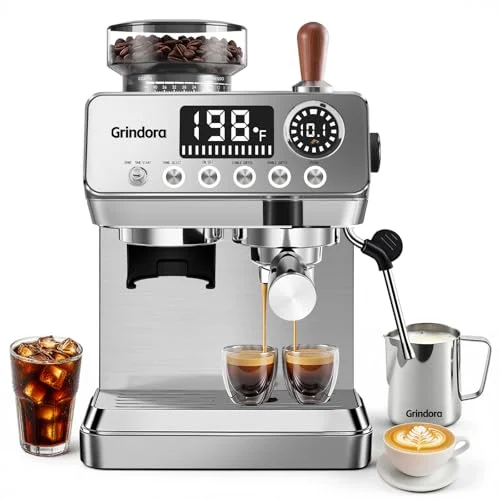
Grindora Espresso Machine with Grinder
20 bar pump, a built-in grinder with 44 grind settings, and a milk frother — the kind of machine where an adjustable pre-infusion window pairs naturally with the grind adjustment you're already using to dial in a fresh bean.
$199.99 Check price →Which machines here have it
Not every machine in our database publishes pre-infusion as a named feature, and we only claim it for the ones that do. Below are the four we track that are built around pump-driven espresso extraction, where a pre-infusion stage is the kind of spec that shows up on the box.
| Machine | Grinder | Pump | Price | |
|---|---|---|---|---|
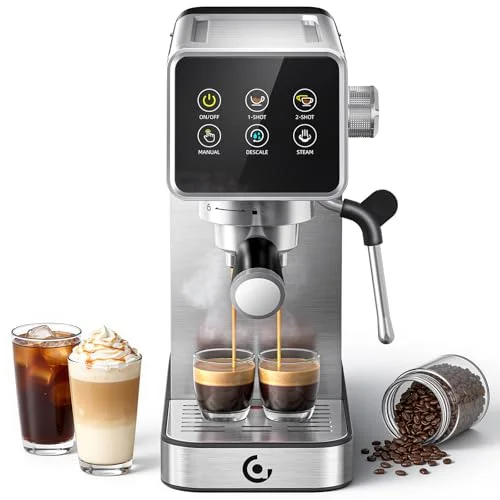 AMZCHEF 20 Bar Home Espresso Machine AMZCHEF 20 Bar Home Espresso Machine | None | 20 bar | $89.99 | Price |
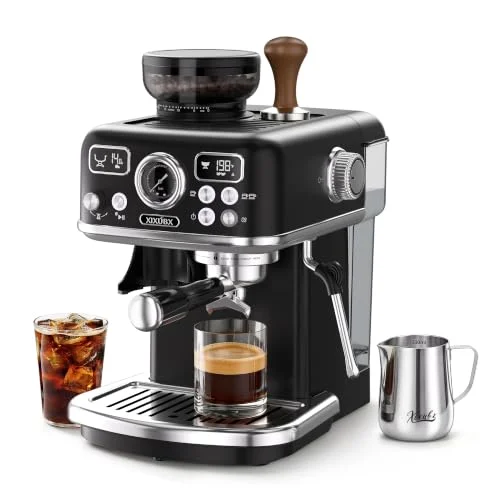 XIXUBX Espresso Machine with Grinder XIXUBX Espresso Machine with Grinder | Built-in, with PID | — | $169.99 | Price |
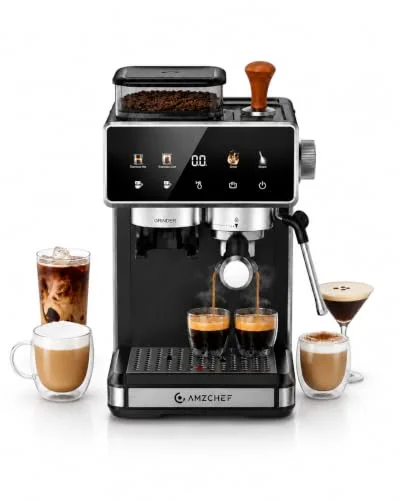 AMZCHEF Espresso Machine with Grinder AMZCHEF Espresso Machine with Grinder | Built-in | — | $179.99 | Price |
| Grindora Espresso Machine with Grinder | Built-in, 44 settings | 20 bar | $199.99 | Price |
A note on how to read that table: our product data for these listings gives pump bar rating and grinder specifications, but does not itemize whether each one names an adjustable pre-infusion window versus a fixed one, or what that window is in seconds. Where a listing does not spell out the duration, the honest move is to point you to the listing rather than invent a number — check the current Amazon page for the exact pre-infusion figures before you buy if that spec is a deciding factor for you. What we can say from the specs we do have: all four are pump-driven machines in the class where a pre-infusion stage is a meaningful, plausible feature, unlike a steam-driven machine, where the brewing physics are different enough that the concept does not really apply.
The AMZCHEF 20 Bar at $89.99 is the simplest of the four — a 41 oz tank, a 20-bar pump, no grinder — and sits at the entry end where pre-infusion, if present, is doing the most relative work, since there is no grinder here to help you dial in an even, well-matched grind in the first place. The XIXUBX at $169.99 adds a built-in grinder and PID temperature control, both of which pair naturally with a gentler pressure ramp: PID keeps brew temperature steady shot to shot, and a controlled temperature plus a controlled pressure ramp are the two levers that most directly affect extraction evenness. The AMZCHEF with Grinder at $179.99 pairs a built-in grinder with a 61 oz tank, useful if more than one person in the house is pulling shots back to back. The Grindora at $199.99 tops the group with 44 grind settings and a 20-bar pump — the most grind adjustability of the four, which matters because grind size and pre-infusion duration are two variables that interact: a finer grind resists water more, and a machine that lets you tune both the grind and the pressure ramp gives you more room to correct a channeling shot without buying new gear.
What a machine without pre-infusion asks you to do instead
A machine with no pre-infusion stage simply ramps straight to full brewing pressure the moment you start the shot. That is not automatically a worse cup — plenty of good espresso has been pulled on machines with no such feature for decades — but it does shift more of the responsibility for an even extraction onto your prep, since the machine is not smoothing over an unevenly saturated puck for you.
Concretely, that means the basics matter more, not less, without it. An even distribution of grounds across the basket before tamping — breaking up clumps rather than just leveling the top — reduces the density variation that channeling exploits. A firm, level tamp reduces it further, since a tilted or inconsistent tamp creates exactly the loose-and-dense pockets a pre-infusion soak would otherwise help settle. And a grind that is neither too fine (which packs unevenly and resists water hard enough to invite channeling around any weak spot) nor too coarse (which lets water race through with no resistance at all) gives you less to correct for in the first place.
Some people also manually approximate a soak on a machine that lacks one: starting the pump, pausing it a few seconds in, then resuming once the puck looks wetted. That is a workaround, not a built-in feature, and it depends on the machine allowing a pause-and-resume mid-shot at all — check the listing rather than assume. The honest summary is that pre-infusion removes one variable you would otherwise have to manage by hand through good prep technique. It is a convenience layered on top of correct technique, not a replacement for it.
Is the difference noticeable in a home kitchen, honestly
This is where we will not oversell it. Pre-infusion solves a real, physical problem, but how much that problem shows up in your actual cup depends heavily on everything else you are doing — grind, dose, tamp, freshness of the beans — and on how forgiving your palate is for the specific flavor signature of a mild channel.
If your prep is already solid — an even distribution, a level tamp, a grind that is dialed in for your machine — you may be starting from a puck that was never especially prone to channeling, and a pre-infusion stage on top of that prep may be hard to taste as a distinct improvement shot to shot. Where it is more likely to matter is at the edges: a slightly too-fine grind, a slightly uneven tamp, or a puck that was distributed a little carelessly on a rushed weekday morning — the situations where channeling actually has a foothold to begin with. In those cases a gentler ramp into full pressure is doing real, if invisible, work, and its absence is more likely to produce the spurting, uneven pour and the sour-and-bitter-at-once cup described above.
We have no controlled side-by-side data on these four machines with and without pre-infusion — we compare published specs, not a testing lab, and nobody in this category publishes that kind of comparison honestly either. What we can say is that the physics behind pre-infusion is well established and the failure mode it addresses is real, not manufactured for a spec sheet. Whether it is worth prioritizing over other specs — a burr grinder, PID temperature control, tank size — depends on how close to dialed-in your technique already is. For a first machine, the grinder and a decent tamp will move your cup further than a pre-infusion window will. For someone already fussing over grind size, it is a legitimate lever to reach for next, and our guide to bitter espresso covers the other usual suspects if a shot is coming out wrong.
One thing not to do
Do not buy a machine for its pre-infusion spec alone and ignore everything else. It is one input into an even extraction, not the whole extraction. A machine with no pre-infusion stage but a good burr grinder and a temperature-stable boiler will usually out-pull a machine with pre-infusion, a mediocre grinder, and an unstable heater.
How we compared these
We compare published specifications, what ships in the box, machine class, footprint and live pricing, and we read manufacturer claims sceptically — a "20 bar" pump is a maximum rating, not the pressure at the coffee, which sits at roughly 9 bar regardless of what the pump can theoretically hit. We do not physically test these machines, we do not run a testing lab, and we do not publish ratings we cannot verify: our product data returns no rating and no review count for the machines on this site, so there are no stars and no invented buyer sentiment anywhere on this page.
Where a claim here is a judgement rather than a specification — that pre-infusion matters more at the edges of a good extraction than in the middle of one, that a grinder does more for a first-time buyer than a pre-infusion window — we have said so in our own voice and shown the reasoning. The general coffee facts (9 bar at the puck, the mechanics of channeling, dry coffee's resistance to water) are standard background rather than product claims. Our guide to grind settings and our piece on what a machine actually costs to run use the same approach.
Frequently asked questions
Does pre-infusion make espresso taste better?
Not directly — it does not add flavor. What it does is reduce the odds of channeling, the failure mode where water rushes through weak spots in an unevenly saturated puck instead of moving through the whole bed. Less channeling generally means a more even extraction, which is what most people actually mean when they say a shot "tastes better." How much it shows up in your cup depends on how solid your grind, dose and tamp already are.
Is a higher bar pump the same thing as pre-infusion?
No, and this is a common point of confusion. A pump's bar rating describes its maximum possible pressure output; espresso itself brews at roughly 9 bar at the coffee regardless of whether the pump is rated for 15 or 20. Pre-infusion describes how gently the machine ramps up to that brewing pressure at the start of the shot. A machine can have a high bar rating and no pre-infusion stage at all — the two specs are unrelated.
Should I buy a machine with adjustable pre-infusion over one with a fixed setting?
Only if you already plan to fine-tune your setup. Adjustable pre-infusion lets you match the soak duration to your grind and dose — useful once you're dialing in a specific bean. A fixed pre-infusion still does the core job of easing into full pressure; it just does not let you lengthen or shorten that window. For a first machine, a burr grinder and a stable boiler matter more than which type of pre-infusion it has.
What is channeling, and how do I know if it's happening to me?
Channeling is when water carves an easy path through the loosest part of the coffee bed instead of moving through it evenly, over-extracting that spot while starving the rest. Signs include a shot that spurts or sputters rather than flowing in a steady stream, or one that finishes much faster than expected and tastes sour and bitter at the same time. A more even distribution of grounds, a level tamp and a matched grind size all reduce the odds of it; a pre-infusion stage reduces it further by softening the puck before full pressure hits.