Double Boiler vs Single Boiler: Is Brewing and Steaming at Once Worth It?
A double boiler machine can pull a shot and steam milk in the same minute. A single boiler machine can't — it has to pick one job, finish it, then switch. Here's what that switch actually costs you every morning, and whether the machine that skips it is worth what it charges for the privilege.
Reader-supported: we may earn a commission if you buy through our links, at no extra cost to you. Prices below are what we recorded between September 7 and September 18, 2026, and they move constantly on Amazon — confirm the live price before buying.
The short answer
Of the four machines in this comparison, exactly one — the Chefman Crema Deluxe at $299.99 — is built and marketed around a second, independent boiler, specifically so it can brew espresso and steam milk in the same stretch of counter time rather than one after the other. The other three, the AYCHIRO 20 Bar at $79.99, the Gevi 20 Bar with Grinder at $309.99 and the Breville BES870BTR Barista Express at $699.95, do not advertise a second boiler anywhere in their listings, which means brewing and steaming share one heat source and, on most machines built this way, happen in sequence.
That single fact — one machine here removes the wait, three do not — is the whole comparison. Everything below is about what removing that wait is actually worth: how long the wait is in the first place, what a second boiler adds to the price and the footprint, and the households for whom the wait was never a real problem.
What a second boiler actually changes
Brewing and steaming want different temperatures. Espresso extracts well somewhere around 195–205°F at the coffee, while a steam wand needs water hot enough to generate real pressure and superheated steam — well above brewing temperature. A machine with one boiler, or one thermoblock, is heating the same body of water for both jobs, so it can only be at one of those temperatures at a time. Ask it to pull a shot and steam milk together and it has to compromise on both, or simply refuse to let you try.
A true double boiler machine sidesteps the compromise by not sharing the water in the first place. It runs two separate heating elements sized for their own job — one dedicated to brew temperature, one dedicated to steam temperature — so each stays where it needs to be regardless of what the other is doing. The Chefman Crema Deluxe's listing calls this out directly: it names the second boiler as the reason you can brew and froth simultaneously, not just quickly. That is a structural difference in the machine, not a marketing description of how fast it recovers.
It is worth separating this from a claim that sounds similar but is not: pressure rating. The AYCHIRO and the Gevi both advertise a 20-bar pump, and a 20-bar number tells you nothing about boiler count or simultaneous brewing — it is a statement about the pump's maximum output, unrelated to whether the machine can hold two temperatures at once. Two entirely different systems get conflated in marketing copy constantly, and it is worth knowing which one you are actually paying for.
None of this means a single-boiler machine reheats badly. Manufacturers spend real engineering effort on recovery time within a single boiler design — that's a separate, legitimate lever, and it's the subject of our guide to warm-up time and shot consistency. But recovering faster between two sequential jobs is not the same feature as doing both jobs at once, and only one machine in this lineup claims the latter.
The queue problem on a single boiler, and how long it really adds
Here is the queue in practice, for a machine that shares one boiler between brewing and steaming and has no way to hold both temperatures simultaneously. You pull the shot first, because espresso cools faster than milk holds its texture. Then you switch the machine into steam mode, which — on this class of machine — commonly means a short wait while the shared boiler heats past brew temperature to the higher temperature steam requires. Only then can you froth. If you steam first instead, you flip the wait: the boiler has to cool back down to brew temperature before it will pull a clean shot, and machines are typically slower to cool than to heat, so that order tends to cost more time, not less.
None of the three single-heat-source machines here publish an exact switch-over time, and we are not going to invent one and attach it to a specific product. What we can say, as a general mechanical fact about how single-boiler and single-thermoblock machines work rather than as a spec for any one listing, is that the temperature swing between brew and steam is large enough that the wait is measured in tens of seconds rather than being instant — commonly landing somewhere in the range of half a minute to a minute and a half, depending on the machine's boiler size and insulation. On a single cappuccino that is an inconvenience. Multiply it by a household making two or three milk drinks back to back on a Sunday morning, and it becomes actual queueing: person two is standing at the machine waiting for it to swing between modes for person one's second cup.
A double boiler machine removes that wait by design rather than by being faster at any one step. The brew boiler is already sitting at brew temperature and the steam boiler is already sitting at steam temperature, so the sequence collapses: start the shot, start steaming, and both finish close together instead of one queued behind the other. That is the entire value proposition of the Chefman Crema Deluxe in one sentence, and it is also the only place in this comparison where "double boiler" changes daily routine rather than just changing a spec sheet.
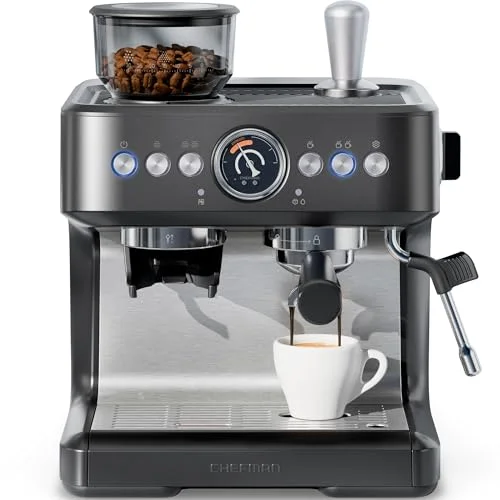
Chefman Crema Deluxe
The one machine in this lineup built around a second boiler, so brewing and frothing can happen at the same time rather than one after the other. Also carries a built-in grinder with 30 grind settings and a steam wand.
$299.99 Check price →The picks
Four machines, four different answers to the boiler question. Here is what each one is actually for.
Simultaneous brew and steam: Chefman Crema Deluxe — $299.99
This is the machine the whole comparison exists to explain. The listing's own headline feature is the double boiler and the ability to use the milk frother and brew espresso simultaneously, and it backs that up with a built-in grinder offering 30 grind settings plus a steam wand — so the grind, the shot and the milk are all handled by one appliance with no queue between the last two steps. For a household of two or more people who each want a milk drink most mornings, this is the only one of the four that actually removes the wait rather than just shortening it.
The budget single-boiler entry: AYCHIRO 20 Bar — $79.99
At $79.99 this is the cheapest way into a real pump machine here — 20-bar pump, a pressure gauge you can actually watch, a steam wand, 1350W of heating, and a 37oz removable water tank, in a compact semi-automatic body. Nothing in the listing claims a second boiler or simultaneous brewing, which is exactly what you'd expect at this price: one heat source doing both jobs, in sequence. For one person pulling one shot and steaming one small pitcher of milk at a time, the sequence rarely matters. It starts to matter the moment a second person wants a drink right after the first.
Built-in grinder, single heat source: Gevi 20 Bar with Grinder — $309.99
The Gevi sits at almost the same price as the Chefman but spends that money differently: a 20-bar pump, a built-in grinder and a steam wand, in a machine measuring 11.5"W by 12.01"D by 16.53"H. Nowhere in its listing does it claim a second boiler or simultaneous operation, so functionally it queues brewing and steaming the same way the AYCHIRO does — it simply adds the convenience of an integrated grinder on top. If the built-in grinder matters more to your routine than the simultaneous-steam feature does, this is the machine that trades one convenience for the other at a comparable price to the Chefman.
The premium single-boiler machine: Breville BES870BTR Barista Express (Black Truffle) — $699.95
At $699.95 this is by far the most expensive machine in the lineup, and it is worth being precise about what that price buys: the Barista Express name and the Black Truffle finish, at a cost more than double the Chefman's. Its listing does not describe a second boiler or simultaneous brew-and-steam capability, so on the specific question this article is about, it sits in the same camp as the AYCHIRO and the Gevi — one heat source, used sequentially. Anyone buying it for the simultaneous-brew-and-steam feature specifically would be paying a large premium for a capability none of its marketing claims it has; anyone buying it for other reasons should treat that premium as buying something else entirely, not this feature.
Price and footprint: what a second boiler costs you
Line the four prices up and the double-boiler machine is not the most expensive one — it sits in the middle. The AYCHIRO undercuts it by $230, the Gevi costs $10 more for a machine that swaps the second boiler for a grinder, and the Breville costs $400 more than the Chefman while, per its own listing, not offering the double-boiler feature at all. So the honest framing is not "a second boiler costs $230" — it's that $230 also happens to be roughly what separates a bare-bones compact machine from one with a grinder, 30 grind settings and a steam wand attached to that second boiler. You are not buying the second boiler in isolation; you're buying the whole package around it.
Footprint is a separate cost, and here the data is genuinely uneven across these four listings. Only the Gevi publishes a full footprint — 11.5"W by 12.01"D by 16.53"H — and only the AYCHIRO publishes a capacity figure relevant to footprint, its 37oz removable tank. Neither the Chefman nor the Breville listing in this dataset gives us a footprint we can quote, so we won't guess one for either; if counter space is tight, check the current listing's dimensions before you buy; that's the only figure that will still be accurate by the time you order. What we can say generally, without attaching it to a specific product, is that two independent boilers are two heating elements' worth of extra hardware that has to live somewhere inside the chassis, which is one of the reasons true double-boiler machines are not typically the smallest option in a given price bracket — though whether that holds for the Crema Deluxe specifically is a question for the current listing's measurements, not for us to assert.
Where a single boiler is genuinely the better trade
The double boiler is not a strictly-better feature that everyone is simply underpaying for — there are real situations where a single-boiler machine is the smarter buy, and it's worth naming them plainly rather than treating this as one machine "winning."
If you live alone, or you're the only one in the house who drinks milk-based espresso drinks, the queue this article describes mostly doesn't happen to you. You pull one shot, you steam one pitcher, nobody is standing behind you waiting for the machine to switch modes. In that case the AYCHIRO's $79.99 gets you a working 20-bar pump machine with a steam wand and a pressure gauge for a fraction of the Chefman's price, and the simultaneous-brew feature you're not using is money you didn't need to spend.
If a built-in grinder matters more to your daily routine than shaving the queue does, the Gevi is the more honest trade at essentially the same price as the Chefman — you're choosing which convenience to pay for, not paying less for convenience overall. Our guide to grind settings is a useful read before deciding how much a built-in grinder's adjustment range is actually worth to you.
And if what you actually want is the Breville name, its build quality reputation, or the Black Truffle finish, that's a legitimate reason to spend $699.95 — just go in knowing you are not buying the double-boiler feature at that price, because its listing doesn't claim it. Simplicity also has its own value that a spec sheet doesn't capture: a single boiler is one fewer heating element to eventually service, and for a lot of households "reliable and slightly slower" beats "faster but with twice the internal plumbing." If you're still narrowing down a budget more broadly, our picks under $1,000 cover this same set of trade-offs at more price points.
Morning routine, timed both ways
Picture the same household, one adult making a cappuccino before work, on each type of machine.
On a single-boiler machine, the sequence runs: grind and dose, lock in the portafilter, pull the shot while the boiler sits at brew temperature, then switch the machine to steam mode and wait for the shared boiler to climb to steaming temperature before the wand will produce real pressure. Only then does the milk get frothed, and only then does the drink get assembled. Every step happens, but they happen one at a time, gated by a single heat source that can only be in one state.
On the Chefman's double-boiler design, the brew boiler and the steam boiler are already both sitting at their working temperatures before you start, because they don't share hardware. Start the shot, and the steam wand is available to start frothing milk in the same window rather than after the shot boiler finishes and reheats — the two jobs run in parallel instead of queued. The espresso and the microfoam finish close together, and the drink gets assembled sooner, not because any single step is faster, but because the wait between steps is gone.
For one drink, that gap is a matter of well under a minute either way — not nothing, but not dramatic. Where it compounds is repetition: a household making three or four milk drinks in a row on a weekend morning experiences that per-drink wait three or four times on a single-boiler machine, while a double-boiler machine's advantage doesn't multiply the same way, because the queue it removes was never there to begin with. Our guide to steam wands versus automatic frothers covers the other big variable in that same morning routine — how the milk itself gets textured, independent of which boiler design is doing the heating.
The four, side by side
Prices are what we recorded between September 7 and September 18, 2026.
| Machine | Boiler | Grinder | Milk | Price | |
|---|---|---|---|---|---|
| Chefman Crema Deluxe | Double boiler, simultaneous brew + steam | Built-in, 30 settings | Steam wand | $299.99 | Price |
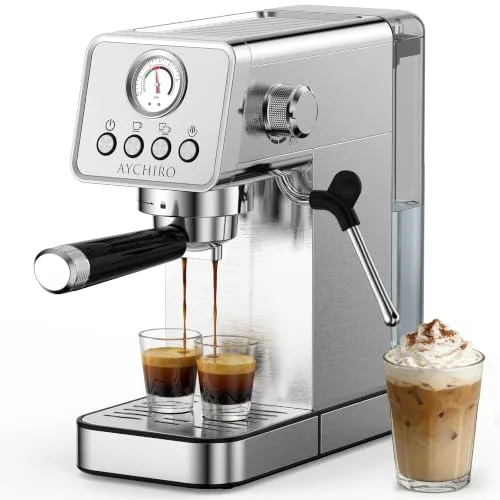 AYCHIRO 20 Bar AYCHIRO 20 Bar | Single heat source (not advertised as dual) | None | Steam wand | $79.99 | Price |
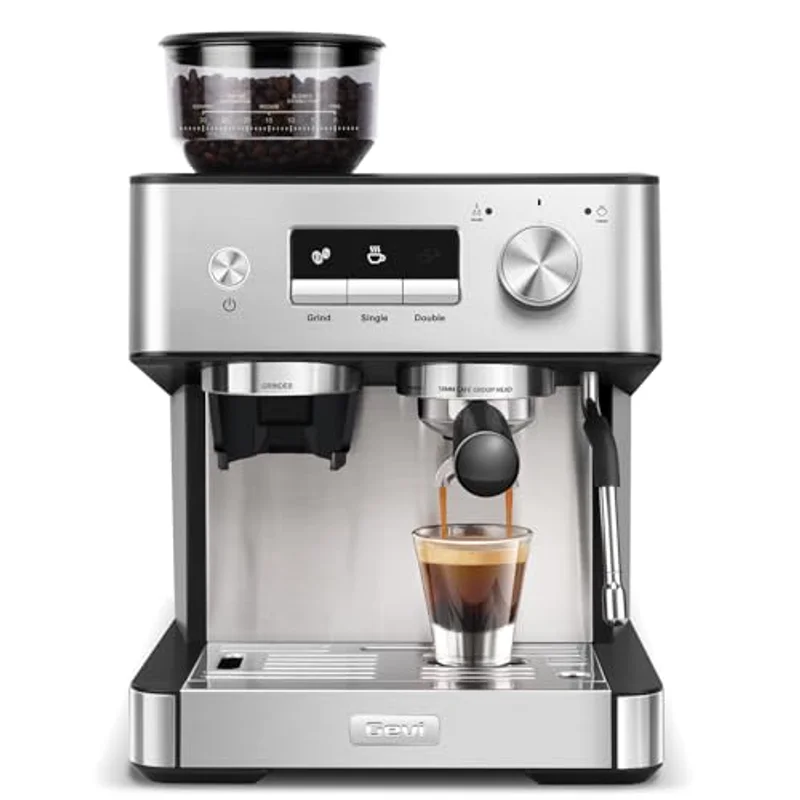 Gevi 20 Bar with Grinder Gevi 20 Bar with Grinder | Single heat source (not advertised as dual) | Built-in | Steam wand | $309.99 | Price |
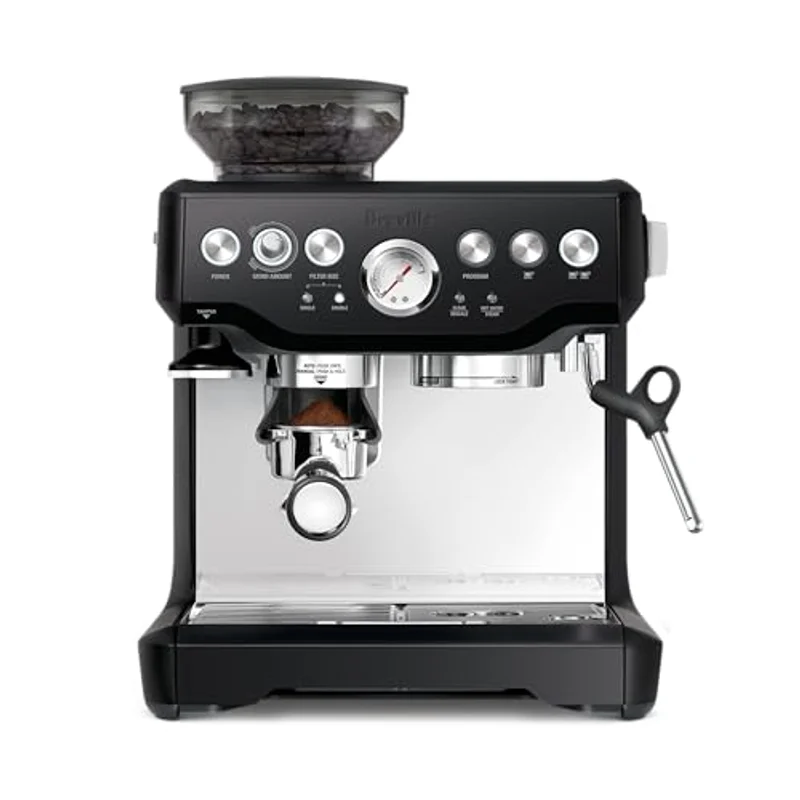 Breville Barista Express (Black Truffle) Breville Barista Express (Black Truffle) | Single heat source (not advertised as dual) | Not stated in this listing | Not stated in this listing | $699.95 | Price |
One thing not to assume
A machine not advertising a second boiler is not the same as a machine advertising a single boiler — most listings simply don't describe their internal heating architecture at all. We've treated "no dual-boiler or simultaneous-brew claim in the listing" as the signal it is: an absence of that specific claim, not confirmation of a specific alternative design. If knowing the exact heating architecture matters to your decision, check the current listing or the manufacturer's own spec page before buying.
How we compared these
We do not physically test these machines and we do not run a testing lab. We compare what's published in each listing — stated features like a double boiler and simultaneous brewing, pump pressure ratings, grinder presence and settings, tank size, wattage and price — against general, well-established coffee-machine mechanics: that brewing and steaming want different temperatures, that a shared heat source can only hold one of those temperatures at a time, and that a "bar" rating describes pump pressure rather than boiler count. Where a listing is silent on a spec, including footprint for two of the four machines here and grinder or milk-system details for the Breville, we've said so rather than filling the gap with an assumption. We show no star ratings anywhere on this page because Amazon's product data returns no rating or review count for the machines on this site, and we don't publish numbers we can't verify.
Frequently asked questions
Does a double boiler machine really brew and steam milk at the same time?
On a machine actually built with two independent boilers, yes — that's the mechanical point of the second boiler. The Chefman Crema Deluxe in this comparison names simultaneous brewing and frothing as a feature specifically because it runs a dedicated boiler for each job rather than sharing one heat source between them. A single-boiler or single-thermoblock machine cannot do this regardless of how it's marketed, because it only has one body of water to bring to one temperature at a time.
How much time does a single boiler actually add to a milk drink?
It depends on the specific machine's boiler size and insulation, and none of the single-heat-source machines in this comparison publish an exact switch-over time, so we won't attach one to a specific product. As a general mechanical fact about this style of machine, the temperature swing between brew and steam is large enough that switching between them commonly takes somewhere on the order of half a minute to a minute and a half. For one drink that's a minor wait; for several milk drinks made back to back, it repeats each time.
Is a double boiler worth the extra money for one or two people?
It depends on whether you're actually queuing. A single person making one espresso and steaming one pitcher of milk rarely experiences the wait a double boiler removes, so a cheaper single-heat-source machine like the AYCHIRO at $79.99 may deliver everything they need. The value shows up when two or more people want milk drinks close together, where a shared-boiler machine forces one person to wait through a mode switch that a double-boiler machine skips entirely.
Does a "20 bar" rating tell me anything about boiler type?
No. A bar rating describes the espresso pump's maximum pressure output, not the machine's heating architecture. Both the AYCHIRO and the Gevi in this comparison advertise 20-bar pumps, and neither claims a second boiler; the Chefman's double-boiler claim is a separate, unrelated feature from its pump rating. Judge boiler count and pump pressure as two different specs, because they answer two different questions.