Espresso Machines With a Visible Pressure Gauge, Under $130
Three budget machines put an analog pressure gauge on the front panel instead of hiding the pump behind a plastic shell: a $79.77 CHULUX, a $79.99 AYCHIRO, both rated to 20 bar, and a $123.48 Neretva rated to 15. The dial is the most eye-catching spec on any of their listings. It is also the easiest one to misread.
Reader-supported: we may earn a commission if you buy through our links, at no extra cost to you. Prices are the ones we recorded on November 19, 2026 and they move constantly — confirm the live price before buying.
The short answer
A visible pressure gauge on a sub-$130 machine tells you the pump is making pressure. It does not tell you the shot is dialed in, that the temperature is stable, or that the number on the dial has anything calibrated and precise behind it. Treat it as a feedback light, not a diagnostic tool, and the rest of this comparison gets much simpler.
Of the three machines here, the CHULUX at $79.77 is the one worth a second look past the gauge: it pairs the dial with PID and NTC temperature control, a combination that actually changes what lands in the cup. The AYCHIRO at $79.99 is nearly the same price with the same 20-bar pump and gauge, but a different emphasis — compact, steam-wand-equipped, aimed at a desk or small kitchen. The Neretva at $123.48 costs roughly 55% more than either and runs a lower-rated 15-bar pump, which, as we'll get into, is not the downgrade it sounds like.
What a visible pressure gauge actually measures
The gauge on these machines is a mechanical dial plumbed into the water line somewhere between the pump and the group head. While the pump runs, it shows line pressure — essentially, how hard the pump is pushing against whatever is resisting it downstream. That resistance comes from the portafilter, the basket, and the compressed coffee inside it.
That is a genuinely useful thing to see. It confirms the pump is working, it gives you a number that moves when you change dose or tamp, and on a machine with no other feedback — no shot timer, no scale, no temperature readout — it is the only instrumentation you get. Espresso brews at roughly 9 bar at the puck, and watching a needle settle somewhere in that neighborhood is a reasonable sanity check.
What it doesn't show is anything about the quality of the shot. A gauge can't tell you whether the extraction is even, whether the water is at the right temperature, or whether 9 bar on the dial is really 9 bar where the coffee is, rather than 9 bar measured at a point in the plumbing that only loosely correlates with it. It is also an analog instrument on a machine priced under $130 — fine for a rough read, not something to treat as lab-grade.
Why 9 bar on the dial isn't 9 bar at the puck
Here is the part the marketing photo never explains: the pressure a gauge reads depends on where in the line it's plumbed, and on a machine without an independently adjustable over-pressure relief valve, the number you see is a mix of the pump's own output and whatever resistance the puck happens to be creating at that instant.
That means two different pucks can produce two different needle positions on the same machine, and neither position tells you which shot tasted better. Grind a touch too coarse and the water races through with less resistance — the needle sits lower, and the shot runs fast and thin. Grind too fine, or tamp too hard, and resistance spikes — the needle climbs, and the shot chokes and drips bitterness. A high reading looks more "serious" on a gauge than a low one, but a high reading from an over-tight puck is a worse shot, not a better one.
The honest way to use the gauge on any of these three machines is as a secondary signal, after taste and shot time, not before them. If your espresso runs out in 15 seconds and tastes sour, a low gauge reading confirms what the stopwatch already told you — it doesn't diagnose anything the clock couldn't. The gauge is a nice-to-have at this price, not a replacement for weighing your dose and timing your shot.
There's also a calibration question none of these listings address, because none of them need to for the price. A $1,200 commercial group head gauge is checked against a reference and expected to hold its accuracy for years. A gauge bundled into a $79–$123 home machine is a mass-produced mechanical part doing a rough job, and a needle that reads a bar or two off true is not a defect worth returning the machine over — it's the kind of tolerance that comes with the category. If you want a number you can actually trust for dialing in, a shot timer and a kitchen scale under the portafilter will tell you more than the needle ever will, for a fraction of what any of these three machines cost.
CHULUX and AYCHIRO: two 20-bar pumps with the gauge built in
At $79.77 and $79.99 respectively, the CHULUX and AYCHIRO are close enough in price that the decision comes down to what each listing actually adds around the shared 20-bar pump and front-panel gauge.
The CHULUX 20 Bar Stainless Steel Espresso Machine is built around a 1350W instant-heating element, a 40oz water tank, food-grade stainless materials, and a milk frother aimed at lattes. Its listing leads with PID and NTC temperature control sitting alongside the pressure gauge on the front panel — which we'll come back to, because it's the more consequential of the two specs. Its listed build is a slim-profile chassis.
The AYCHIRO 20 Bar Espresso Machine is positioned as a compact semi-automatic with a steam wand and a 1350W fast-heating system, built around a removable 37oz tank. Where CHULUX's listing talks about temperature control, AYCHIRO's talks about footprint and speed — it's explicitly marketed for a home office or a small kitchen, and the removable tank is the detail that matters if the machine lives somewhere refilling it in place is awkward. Its listing size is M.
Both machines share the headline 20-bar pump rating and the visible gauge, and on both of them that rating means the same thing: more pump capacity than a shot will ever use, since brewing happens around 9 bar regardless of what the pump could theoretically produce. If you want a sense of what else shows up at this exact price tier, our AYCHIRO comparison and what you actually get under $80 both cover adjacent listings in this bracket.
The practical way to choose between them has little to do with the shared pump number and everything to do with how you'll actually use the machine. A 40oz fixed tank versus a 37oz removable one sounds like a rounding error on a spec sheet, but a removable tank matters a lot if the machine sits against a wall or under a cabinet where lifting the whole unit to the sink isn't realistic — you pull the tank, fill it at the tap, and slot it back in. A frother built for lattes and a steam wand built around a wand technique are also different workflows, not just different words for "milk": a frother is closer to a fixed attachment you dip in and switch on, while a wand gives you more manual control over texture at the cost of a slightly steeper learning curve. Neither is objectively better; they suit different mornings.
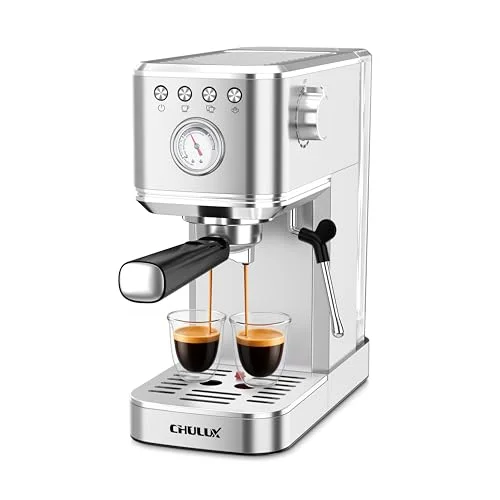
CHULUX 20 Bar Espresso Machine
20-bar pump, built-in pressure gauge, PID and NTC temperature control, 1350W instant heating, 40oz water tank, milk frother, stainless steel, food-grade materials, slim profile.
$79.77 Check price →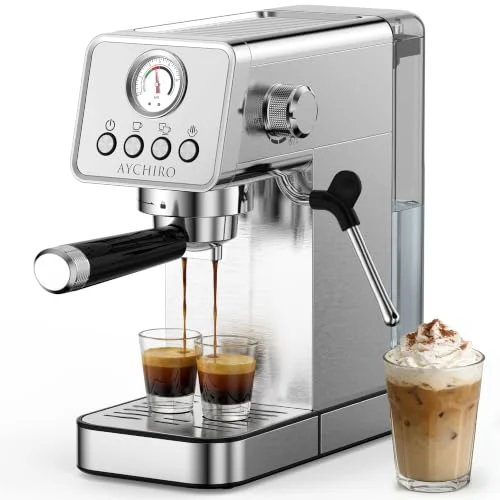
AYCHIRO 20 Bar Espresso Machine
20-bar pump, visible pressure gauge, compact semi-automatic build, steam wand, 1350W fast heating, removable 37oz water tank, marketed for home or office use.
$79.99 Check price →Neretva's 15-bar approach, and whether lower pump pressure matters here
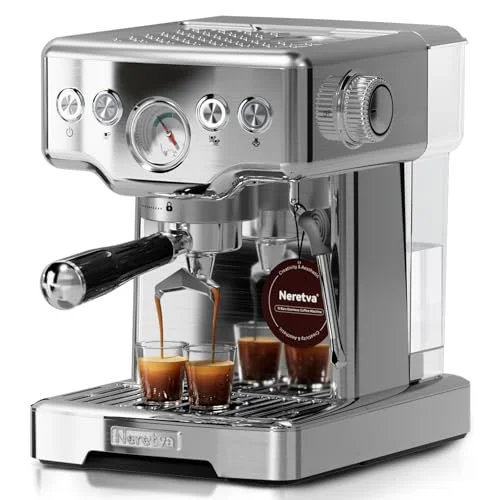
The Neretva Espresso Machine is the outlier in this trio on two counts: it costs $123.48, well above the other two, and it caps its pump at 15 bar rather than 20. Its listing describes a visible pressure gauge, a milk frother, a stainless steel build, and positions itself toward a "home barista" buyer rather than a grab-and-go desk machine — a medium-size listing.
On the number alone, 15 bar reads like a step down from 20. In practice it almost never is. Espresso extraction happens around 9 bar at the puck, and both 15-bar and 20-bar pumps have headroom well past that target — the extra bars above 9 are pressure the pump is capable of producing if nothing resisted it, not pressure that gets delivered to the coffee. A 15-bar pump reaches brewing pressure exactly as easily as a 20-bar one; the bar rating above the target you actually need is marketing math, not a functional ceiling.
So the $43–$44 gap between the Neretva and either 20-bar machine isn't buying brewing pressure Neretva lacks. Based on the specs we have, it most plausibly reflects the milk frother, the stainless build, and the "professional" positioning of the listing — we don't have deeper teardown or build-quality data to say more precisely where the extra cost sits, and we won't guess beyond what's published. What we can say with confidence is that the bar number itself is not the reason to pay more or less here.
The picks
All three machines solve the same basic problem — a visible, readable pump pressure indicator on a machine under $130 — but they solve it for different buyers.
| Machine | Best for | Pump rating | Temp control | Milk | Price | |
|---|---|---|---|---|---|---|
| CHULUX 20 Bar | Stable brew temperature | 20 bar | PID + NTC | Frother | $79.77 | Price |
| AYCHIRO 20 Bar | Compact desk or small kitchen | 20 bar | Not stated | Steam wand | $79.99 | Price |
 Neretva 15 Bar | Milk drinks, "home barista" build | 15 bar | Not stated | Frother | $123.48 | Price |
Neretva Espresso Machine, 15 Bar
15-bar pump, visible pressure gauge, milk frother, stainless steel build, positioned for home-barista use, latte and cappuccino capable, medium-size listing.
$123.48 Check price →If you only read one row of that table: buy the CHULUX if you want the one spec on this page that actually affects taste shot to shot. Buy the AYCHIRO if footprint and a removable tank matter more to you than temperature stability. Buy the Neretva only if its specific milk-frother setup or finish is what you're after — not because 15 bar needs compensating for, since it doesn't.
PID and NTC temperature control alongside the gauge, on the CHULUX model
The gauge gets the visual attention, but the CHULUX's more meaningful spec is the one next to it: PID temperature control paired with an NTC sensor.
A basic espresso machine heats water with a simple thermostat: heat until a cutoff temperature, stop, let it drift down, heat again. That cycle swings several degrees around the target, and since espresso extraction is sensitive to brew temperature, a shot pulled at the top of that swing tastes different from one pulled at the bottom — even with identical grind, dose, and tamp. A PID (proportional-integral-derivative) controller replaces the on/off cutoff with a continuous adjustment loop, holding the heating element much closer to a single target temperature instead of letting it swing.
NTC stands for negative temperature coefficient — it describes the type of thermistor sensor feeding temperature data back into that control loop. It's a common, inexpensive way to get a real-time reading the PID can act on, rather than relying on a coarser mechanical thermostat.
Put together, PID plus NTC is the rarer and more consequential of the two headline specs across this trio. A pressure gauge mostly confirms the pump works; stable brew temperature changes whether the shot tastes the same on Tuesday as it did on Monday. Neither the AYCHIRO nor the Neretva listing states PID or NTC control — that doesn't mean those machines definitely lack any temperature management, only that it isn't a stated spec, so we won't claim one way or the other beyond what's published.
Is a gauge worth paying for under $130, or just a dial that moves?
Here's the honest version: at this price tier, a visible pressure gauge is mostly a feedback feature, not a precision instrument. It gives a new espresso drinker something to watch while the shot pulls, and watching a needle move toward a familiar number is a reasonable, low-stakes way to build a sense of what "normal" looks like on your machine. That has real value for someone learning.
What it isn't worth paying extra for is the bar number itself. Twenty bar versus fifteen bar makes no difference to the cup, because both numbers sit well above the roughly 9 bar a shot actually needs, and the gauge reads a mix of pump output and puck resistance rather than something as clean as "pressure delivered to the coffee." If two machines are priced close together and one has a gauge while the other doesn't, the gauge is a reasonable tiebreaker for a beginner who wants the visual feedback. If a gauge-equipped machine costs meaningfully more than a comparable one without it, you're paying for a dial, not for better espresso.
Put a number on it with these three machines specifically. CHULUX and AYCHIRO both have the gauge and both cost within two cents of $80 — so between them, the gauge is a wash and the decision should come down to tank style, milk workflow, and the PID/NTC pairing covered below. Neretva also has the gauge, but at $123.48 it costs $43.49–$43.71 more than the other two while running a lower pump rating, and nothing in that gap traces back to the gauge or the bar number; whatever you're paying the extra $40-plus for, it isn't pressure capability.
The spec actually worth paying for in this price range is temperature stability — which is why the CHULUX's PID and NTC combination stands out more, on paper, than either competing gauge. For more on what else separates machines at this exact budget, see our picks under $100.
How we compared these
We compare published specifications, what's stated in each listing, machine class, and live pricing — we read pump-pressure claims skeptically across the board, since a "20 bar" rating is a pump maximum, not a brewing-pressure claim, and espresso itself brews at roughly 9 bar at the puck. We do not physically test these machines, we do not run a testing lab, and we do not publish ratings we cannot verify. Amazon's product data returns no rating and no review count for the machines covered here, so there are no stars and no invented sentiment anywhere on this page: nothing paraphrased from reviews, nothing we can't trace back to a published spec or a general, non-product-specific coffee fact.
Where a claim here is a judgment rather than a spec — that the Neretva's 15 bar isn't a functional downgrade, that PID and NTC matter more than the gauge itself — we've said so in our own voice and explained the reasoning, so you can weigh it yourself. The general facts used throughout (9 bar at the puck as the brewing target, what PID and NTC describe, how an over-pressure relief valve interacts with a line gauge) are standard background rather than claims about any one of these three products specifically.
Frequently asked questions
Does a higher bar rating mean a better espresso machine?
No. Espresso brews at roughly 9 bar of pressure at the coffee puck, and every pump in this comparison — 15 bar or 20 — can reach that target with room to spare. The bar number on the box is the pump's maximum rated output, not the pressure delivered to the coffee, so a 20-bar machine is not inherently better than a 15-bar one for brewing espresso.
What does the pressure gauge on these machines actually show?
It shows line pressure where the gauge is plumbed into the water path, which reflects a mix of the pump's output and the resistance created by the portafilter and the compressed coffee inside it. It confirms the pump is working and gives a rough visual reference, but on a sub-$130 machine it is not a calibrated, lab-grade reading, and it can't tell you whether a shot tastes good.
Is a 15-bar pump enough for espresso?
Yes. The target for brewing is about 9 bar at the puck, and a 15-bar pump reaches that threshold just as easily as a 20-bar one — the additional bars above the brewing target are headroom the pump could theoretically produce, not pressure that changes the shot. The Neretva's 15-bar rating is not a functional downgrade from the 20-bar CHULUX or AYCHIRO.
What's the difference between PID and NTC temperature control?
PID (proportional-integral-derivative) is the control method: it continuously adjusts heating to hold a target temperature, instead of the wider swings of a basic on/off thermostat. NTC (negative temperature coefficient) describes the thermistor sensor that feeds real-time temperature data into that control loop. Together they keep brew temperature more consistent shot to shot, which affects taste more directly than the pressure gauge does.