Best AYCHIRO Espresso Machines Compared (2026)
AYCHIRO sells two espresso machines on Amazon right now, and the gap between them is the smallest we've covered on this site: $10. The AYCHIRO 20 Bar Espresso Machine with Milk Frother Wand (B0HGF6GRZ8) runs $69.99. The AYCHIRO 20 Bar Espresso Machine with Pressure Gauge (B0HB9F3LCG) runs $79.99 and adds, by its own title, exactly two things: a pressure gauge, and a stated 1350W "Fast Heating" claim. Here's whether that's worth the price of a large coffee.
Reader-supported: we may earn a commission if you buy through our links, at no extra cost to you. Prices below are what we recorded for each model — $69.99 for the milk-frother model on October 8, 2026, and $79.99 for the pressure-gauge model on September 23, 2026 — and both move constantly on Amazon; confirm the live price before buying.
The short answer
Both current AYCHIRO espresso machines state a 20-bar pump, both are described as "Compact," and both ship with a removable water tank sized within two-tenths of an ounce of each other — 37.2 oz on the cheaper model, 37 oz on the pricier one, a gap small enough to read as rounding in the listing copy rather than a real capacity difference. Past those shared basics, the two titles diverge in three specific places. The $69.99 model names a "Milk Frother Wand," states "Stainless Steel" construction, and targets "Latte & Cappuccino" by name. The $79.99 model names a pressure gauge, states a specific 1350 W wattage under a "Fast Heating" claim, swaps the wand language to "Steam Wand," and frames itself "for Home Office" instead of naming specific drinks.
That's a narrower gap than most of the brand comparisons we run on this site — $10 total, not $90 or several hundred dollars — so the decision rides on a small number of specific, checkable differences rather than a wholesale change in machine class. Here's what each of those three differences actually buys, and whether $10 is enough to care.
What a pressure gauge adds for $10
A pressure gauge on a home espresso machine is a dial on the front panel, usually with a needle moving against a printed scale, that shows the pump's output pressure while a shot is running. Espresso itself extracts at roughly 9 bar at the coffee puck; the 20-bar figure both AYCHIRO machines state describes the pump's rated maximum, not the pressure you actually taste. A gauge is what turns that otherwise invisible number into something you can watch in real time instead of only reading on a spec sheet.
That matters most when a shot isn't behaving. Grind too fine and the puck chokes, resisting the water and pushing pressure up past where it should sit; grind too coarse and the water finds the path of least resistance, so pressure sags because nothing is holding it back. A gauge gives you a concrete signal to act on in the moment — tighten the grind here, open it there — rather than only tasting the result afterward and guessing at the cause. Without one, that guesswork is the whole process: you're adjusting on taste and the clock alone, shot after shot, until something tastes right.
What B0HB9F3LCG's own title doesn't tell us is whether the gauge marks a specific "ideal" zone on its face, or what unit it's printed in. We won't guess at a dial we haven't seen — if a marked zone matters to your decision, check the listing's photos before ordering. What the titles do confirm is that the cheaper model, B0HGF6GRZ8, has no stated gauge at all: pulling a shot on it means working from timing and taste alone, the same way most machines under $80 on this site do, as we cover in our look at what espresso machines under $80 actually get you.
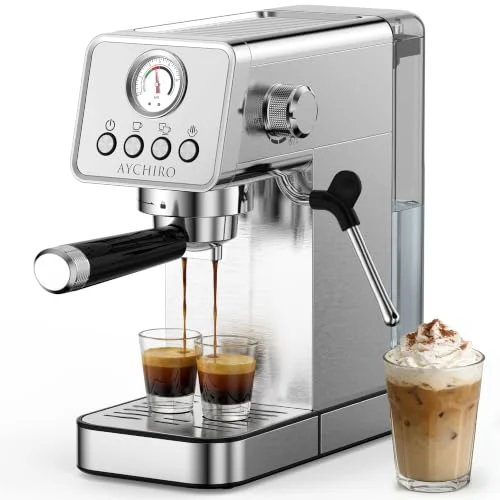
AYCHIRO 20 Bar Espresso Machine with Pressure Gauge
A stated 20-bar pump plus a front-mounted pressure gauge, a steam wand, a removable 37 oz tank, and a specific 1350 W "Fast Heating" claim. AYCHIRO's own listing frames it "for Home Office" rather than naming milk drinks by name.
$79.99 Check price →Heating time and wattage, compared
The pricier model's title states "1350W Fast Heating" explicitly — a specific number, not a vague marketing phrase, and a meaningfully high wattage for a compact home espresso machine. Given a similar boiler or thermoblock volume, a higher-wattage heating element delivers more energy per second, which means it brings water to brewing temperature faster and recovers faster between back-to-back shots. That's a basic property of resistive heating, not a claim specific to this brand — but it's the mechanism behind why 1350 W, printed on a box, is a real and checkable number rather than filler.
The cheaper model's title states no wattage figure in either direction. That's a gap we won't fill with a guess: we can't say B0HGF6GRZ8 is slower to heat than 1350 W, because its listing simply doesn't publish a wattage, and assuming it under-performs a spec it never claimed would be the same mistake as inventing one. What we can say plainly is that only one of these two machines puts a number behind its heating speed — the $79.99 model — and if a fast warm-up before your first cup is a genuine deciding factor for you, it's the one with a figure attached to back the claim up rather than a promise with nothing behind it.
We've seen this same stated-versus-unstated pattern before on this site. In our SHARDOR comparison, the pricier model dropped several stated specs from its own title without telling us what, if anything, replaced them — a reminder that a brand's cheaper model isn't necessarily its slower one, it's just the one that didn't put a number on the box.
Tank size and the wand, matched or not
The water tank is the easiest comparison on this page, because the two numbers are nearly identical: 37.2 oz, removable, on the cheaper model; 37 oz, removable, on the pricier one. A two-tenths-of-an-ounce gap is well within the kind of rounding you'd expect between two listings for machines built around the same reservoir footprint, not a meaningful capacity difference. Neither machine holds a real edge here worth weighing against the $10 price gap.
The wand is where the wording gets more interesting than the hardware. The cheaper model's title calls its attachment a "Milk Frother Wand" and pairs it with "for Latte & Cappuccino" — language aimed squarely at milk drinks. The pricier model's title calls what sounds like the same kind of attachment a "Steam Wand" and pairs it with "for Home Office," a different use-case framing entirely. In home espresso equipment generally, a steam wand is the component that produces the steam used to texture milk in the first place, so the two terms commonly describe the same functional part under different listing language rather than two different features. We read this as a wording difference in how each model is marketed, not confirmed proof that one froths milk and the other doesn't — but we also won't promise the two wands perform identically, since neither title gives us tip or nozzle detail. If milk texture is central to your decision, the listing photos for each model are worth a look before you order.
One more stated-versus-unstated gap sits in the same spot: the cheaper model's title says "Compact Stainless Steel," naming its construction material outright. The pricier model's title just says "Compact...Coffee Machine," with no material named at all. We won't assume the $79.99 model is or isn't stainless based on a word its own title leaves out — it's one more spec the two listings don't match on in wording, which is different from one machine actually lacking it.
Where the cheaper model is honestly fine
For most people, the $69.99 model is the sensible default, and it's worth saying plainly rather than hedging around it. It names a milk frother wand, states stainless steel construction, and targets latte and cappuccino drinks directly — three specifics in writing, for $10 less, with no pressure gauge and no stated wattage to weigh against them. If you want milk drinks and don't plan to watch a needle while a shot runs, nothing the pricier model adds changes your morning.
It's also the lower-risk way to find out whether an espresso habit sticks at all, the same logic we lay out in our guide to the honest floor under $80: spend less to confirm the habit, spend more once you know it's real. A gauge you never watch and a wattage figure you never needed are $10 you'd rather have kept.
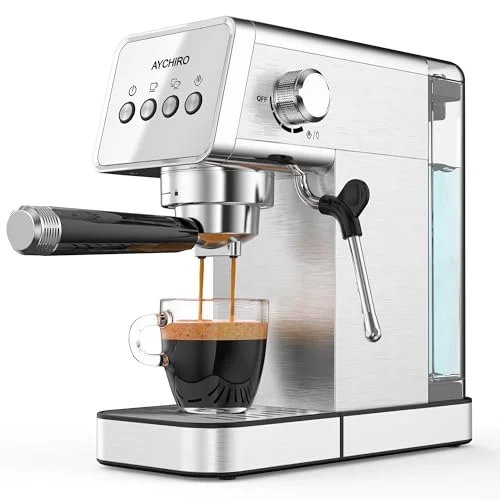
AYCHIRO 20 Bar Espresso Machine with Milk Frother Wand
A stated 20-bar pump, compact stainless steel body, milk frother wand, and a removable 37.2 oz tank, built around latte and cappuccino drinks by name. No stated pressure gauge and no stated wattage figure.
$69.99 Check price →Who should pay the extra $10
The $10 gap buys two stated things: a pressure gauge, and a specific 1350 W heating claim. That's a real, if modest, upgrade for a narrower group than "anyone buying their first AYCHIRO." It fits someone who wants visual feedback while dialing in a shot rather than adjusting on taste alone, or whose morning routine is genuinely slowed by waiting on a machine to heat — the kind of buyer the "Home Office" framing in the pricier listing seems aimed at, someone fitting a shot into a short break rather than a leisurely weekend routine.
It's a smaller, more specific ask than the upgrades we've covered elsewhere on this site, like the built-in grinder in our Kismile single-boiler versus dual-boiler comparison or the touchscreen-and-frother bundle in the SHARDOR piece above. Here, $10 doesn't buy a new category of feature — it buys a readout and a number. If neither of those changes how you'd actually use the machine, the extra $10 is better spent on beans.
Both machines side by side
Prices are what we recorded on the dates noted at the top of this page. Where a listing doesn't state a spec, we've marked it rather than guessed.
| Machine | Pump | Pressure gauge | Wattage | Wand | Tank | Price | |
|---|---|---|---|---|---|---|---|
| 20 Bar Espresso Machine with Milk Frother Wand | 20 bar | Not stated | Not stated | Milk frother wand | 37.2 oz | $69.99 | Price |
| 20 Bar Espresso Machine with Pressure Gauge | 20 bar | Yes | 1350 W | Steam wand | 37 oz | $79.99 | Price |
Our picks
If you want milk drinks and the most for the least money, the $69.99 model is the one to buy — it names a frother wand and stainless steel construction in writing, for $10 less than the alternative. Check price →
If you want a visual read on shot pressure and a stated fast-heating figure, and you're fine with the listing's "Home Office" framing over named milk drinks, the $79.99 model is AYCHIRO's answer — at a real $10 premium for two stated things. Check price →
How we compared these
We compare published specifications, what each listing states in its own title, and live pricing — we do not physically test these machines and we do not run a testing lab. Where a feature isn't published, as with the pricier model's construction material or either model's exact wand design, we've said so rather than estimating. We show no star ratings or review counts because Amazon's product data returns neither for these machines, and we never paraphrase review sentiment we haven't verified.
Where we've made a judgment call — that the cheaper model is the sensible default, or that the gauge and wattage claim only pay off for a buyer who'd actually use them — we've said so in our own voice, so you can weigh it against your own routine. The general coffee facts referenced along the way (9 bar at the puck versus a pump's rated maximum, higher wattage meaning faster recovery for a similar boiler volume, a steam wand being what textures milk) are standard background, not claims about these two specific products.
Frequently asked questions
What does the AYCHIRO pressure gauge actually show?
It shows the pump's output pressure in real time while a shot is running, typically via a needle against a printed scale on the machine's front. Espresso itself extracts at roughly 9 bar at the puck; the 20-bar figure both AYCHIRO machines state is the pump's rated maximum, not the number you'd see during a normal shot. The listing doesn't say whether the gauge marks a specific ideal zone, so we haven't assumed one.
Is the pricier AYCHIRO machine actually faster to heat up?
Its listing states a specific 1350W wattage under a "Fast Heating" claim, which is a real, checkable number. The cheaper model's listing states no wattage figure at all, so we can't confirm it's slower — only that one machine put a number behind its heating speed and the other didn't.
Do both AYCHIRO machines froth milk?
Both titles name a wand — "Milk Frother Wand" on the cheaper model, "Steam Wand" on the pricier one — and a steam wand is generally the component that produces the steam used to texture milk, so the two likely describe the same kind of attachment under different wording. Neither listing gives us tip or nozzle detail, so if milk texture matters to your decision, check the listing photos on both before ordering.
Which AYCHIRO espresso machine should I buy?
For most buyers, the $69.99 model is the stronger default: it names a milk frother wand and stainless steel construction for $10 less. The $79.99 model is worth the difference only if a visible pressure gauge and a stated fast-heating wattage are features you'd actually use, since those are the two things its title adds over the cheaper machine.