Quick answer
Ignore the bar number on the box. Every pump espresso machine sold today, whether it says 15 bar or 20 bar, can reach the roughly 9 bar at which espresso actually brews — the number on the box is what the pump can do wide open, not what happens at the coffee. What separates a good machine from a mediocre one is how it gets down to 9 bar and holds it there: a spring-loaded over-pressure relief valve (OPV), the basket the water passes through, and whether the machine gives you any way to see or shape that pressure at all. Shop the OPV, the basket type and a visible gauge if you want one — not the marketing number.
Things to know before you buy
- 9 bar is a convention, not a law. It was popularized by the classic Italian lever and pump machines of the mid-20th century and has stuck as the reference point the whole industry designs around.
- Every advertised "bar" figure above about 9 is a pump spec, not a brew spec. A 15-bar pump and a 20-bar pump both get regulated down to the same brewing range by the machine's plumbing.
- A pressurized basket is doing work a relief valve alone can't. It restricts the outlet so an entry machine can produce believable crema from coarser, less consistent grind — useful for beginners, a ceiling once you're dialing in your own grind.
- A gauge tells you about the machine's plumbing, not your shot's flavor. It's diagnostic, not a quality score — a shot can look right on the gauge and still taste sour or bitter for reasons the needle can't see.
- Machines with no gauge and no pressurized basket aren't lesser. Plenty of well-regarded semi-automatics brew unpressurized on a fixed OPV and simply don't expose the number, which is a design choice, not a shortcoming.
What pressure actually does to the puck
Espresso starts as a puck: 18 to 20 grams of ground coffee, tamped level and firm into a metal basket, dense enough that water cannot simply pour through it. Pressure is what forces water through that resistance in the first place, and how much of it there is changes what the water pulls out of the coffee on the way through.
At the low end, a moka pot or a stovetop percolator works at roughly 1 to 2 bar — barely above atmospheric pressure — and extracts slowly enough that you get a strong, dense coffee but nothing resembling crema, the reddish-brown foam that sits on top of a real shot. Push much past roughly 9 to 10 bar and the opposite problem shows up: water moves so fast through the puck that contact time collapses, and you start pulling harsh, bitter compounds out of the coffee faster than you extract the sweet ones, while also risking channeling — water punching a narrow path through the puck instead of moving through it evenly.
Nine bar sits in the middle of that range for a reason. At that pressure, water has enough force to emulsify the coffee's oils into the water — which is what produces crema — while moving slowly enough, over roughly 25 to 30 seconds for a double shot, that the extraction stays balanced between sour underextraction and bitter overextraction. It is not a magic number so much as a workable compromise between two failure modes, and it is the number every recipe, grinder setting and machine spec in this category is built around.
Grind size interacts with pressure directly. A finer grind packs the puck tighter and resists water more, so at a fixed 9 bar the shot runs slower; a coarser grind runs faster. That relationship is also why chasing a higher brew pressure doesn't obviously help: you can always compensate for a faster machine by grinding finer, but you're fighting the pressure rather than working with it, and channeling risk goes up as you push either variable to its edge.
Why 20 bar is a pump maximum, not a brew pressure
The pump inside a home espresso machine is a small vibratory or rotary pump rated for a maximum pressure it can generate against resistance — that rating is the number printed on the box. A "20 bar" machine has a pump capable of producing up to 20 bar if you dead-headed it against a fully sealed line with nowhere for the water to go. Nothing in a real espresso machine ever asks the pump to actually do that, because a puck of ground coffee is not a sealed line — it's a porous bed that water moves through, and the plumbing between the pump and the portafilter is built specifically to keep the pressure the coffee experiences well below the pump's ceiling.
This is also why the bar number tells you almost nothing about how good a machine is. A 20-bar pump and a 15-bar pump both get bled down to roughly the same brewing pressure by the components downstream of them, so in practice a 15-bar machine and a 20-bar machine at the same price point brew espresso in the same pressure range. The number is a pump spec that made it onto packaging because it's a bigger, more impressive-sounding figure than "9 bar" — not because a higher pump rating produces a better shot. Treat "20 bar" the way you'd treat a car's advertised top speed: real, measurable, and almost entirely irrelevant to how it drives around town.
Where pump rating does matter, marginally, is headroom and consistency under load — a pump with more capacity in reserve may hold pressure more steadily as line resistance changes through a shot, or recover faster between back-to-back shots. That's a real but secondary effect, and it shows up in build quality and duty cycle, not in the bar number itself.
How machines regulate down to 9 bar
Two mechanisms do the actual work of turning a 15-to-20-bar pump into a roughly 9-bar shot, and most machines in this category use one or both.
The over-pressure relief valve (OPV). This is a spring-loaded valve plumbed into the water line between the pump and the group head. It's set at the factory to open once pressure climbs past a threshold — typically around 9 bar — and once it opens, excess water bypasses the portafilter and routes back to the reservoir instead of adding more pressure to the puck. In effect, the OPV caps brew pressure regardless of what the pump could theoretically produce: a 20-bar pump behind a 9-bar OPV brews at roughly 9 bar, full stop. Some higher-end machines expose the OPV as a user-adjustable dial; on nearly everything at consumer prices, including every machine in this guide, it's fixed at the factory and not something you're meant to touch.
The pressurized basket. This is a filter basket with a small secondary restriction — a tiny second hole or a narrowed single exit — behind the main perforations, instead of the fully open holes in a standard basket. Restricting the exit builds resistance after the coffee bed itself, which does two things: it makes the shot more forgiving of an inconsistent or overly coarse grind, because the basket compensates for the puck not doing its share of the resisting, and it whips crema-like foam even out of pre-ground or stale coffee. That's why pressurized baskets ship standard on many budget and entry machines — they hide grinder and grind-size shortcomings that would otherwise ruin a shot.
The trade-off is real: a pressurized basket caps how much of the shot's character comes from your actual grind and dose, because the basket's own restriction dominates. As you get more serious about dialing in — buying a burr grinder, weighing doses, adjusting grind size shot to shot — an unpressurized basket lets those changes actually show up in the cup instead of being smoothed over by the basket. Several machines ship both basket types for exactly this reason: pressurized to get started, unpressurized once you're ready to control your own variables. Our grinder guide goes deeper into what a consistent grind buys you once the basket stops compensating for it.
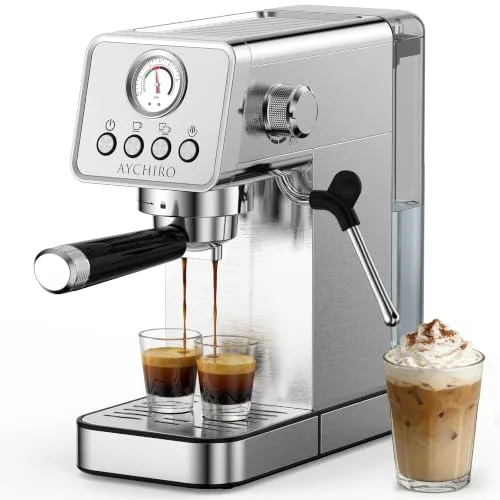
AYCHIRO 20 Bar Espresso Machine with Pressure Gauge
A compact semi-automatic built around a 20-bar pump, a steam wand and a visible pressure gauge on the front panel — useful precisely because it lets you watch the needle settle into the brewing zone instead of taking the "20 bar" on faith. 1,350 W, 37 oz removable tank.
$79.99 Check price →
Reading a pressure gauge, and what a good shot looks like on one
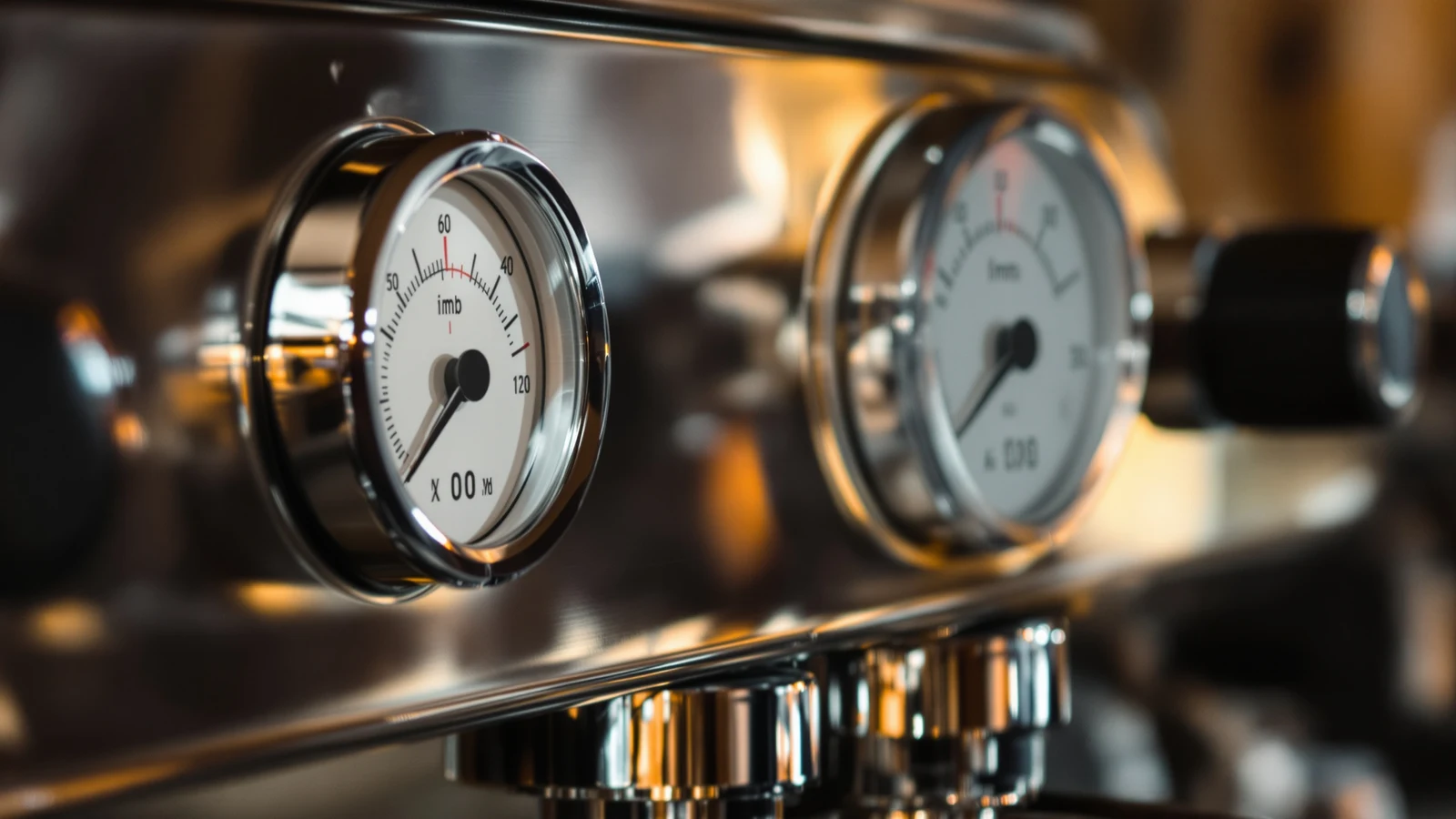
Not every machine has a gauge — plenty of well-built semi-automatics rely on a fixed OPV and simply don't expose the number to the user, which is a legitimate design choice, not a missing feature. But on a machine that does have one, like the AYCHIRO above, the gauge is a genuinely useful diagnostic once you know what you're looking at.
During a shot, the needle should climb quickly as the pump engages, then settle and hold in a band that most gauges mark visually — often shaded or labeled as the "espresso" range, corresponding to roughly 8 to 10 bar. A needle that spikes into the red past that zone and stays there usually means the grind is too fine or the puck is tamped too hard, choking the flow; the OPV may be venting continuously to keep the number from climbing further, which is the valve doing its job. A needle that never climbs out of the low range, or that flutters instead of holding steady, usually points the other way — grind too coarse, too little coffee in the basket, or a puck with an uneven surface that's letting water channel through a weak spot instead of moving through evenly.
The gauge is diagnostic, not a scoreboard. A shot that holds a picture-perfect 9 bar for the full pull can still taste sour if the grind is stale, and a shot that spikes slightly high can still taste excellent. Use the needle to catch obvious grind and dose problems, not as a goal in itself.
On machines with a pressurized basket, the gauge reading is less informative, because the basket's own restriction is doing a share of the pressure-building regardless of grind. The gauge is most useful as a tuning tool once you've moved to an unpressurized basket and a burr grinder, where the number on the dial is actually responding to what you changed.
The picks
All four of the machines below are pump-driven with pressure ratings in the 15-to-20-bar range on the box, which — per everything above — tells you almost nothing by itself. What differentiates them is wattage, tank size, whether a gauge is included, and price. None of these figures are ratings or review sentiment; they're the published specs and the prices we recorded on September 1, 2026.
01Gauge included
AYCHIRO 20 Bar Espresso Machine with Pressure Gauge
For watching the needle settle into the brewing zone
20-bar pump · front-panel pressure gauge · steam wand · 37 oz removable tank · 1,350 W
Compact semi-automatic, and the only one of the four with a built-in gauge — which makes it the pick if you want to see, rather than take on faith, that a "20 bar" machine is actually settling near 9 bar during a pull. Fast-heating 1,350 W boiler and a 37 oz tank sized for a small kitchen or office counter.
02Digital control
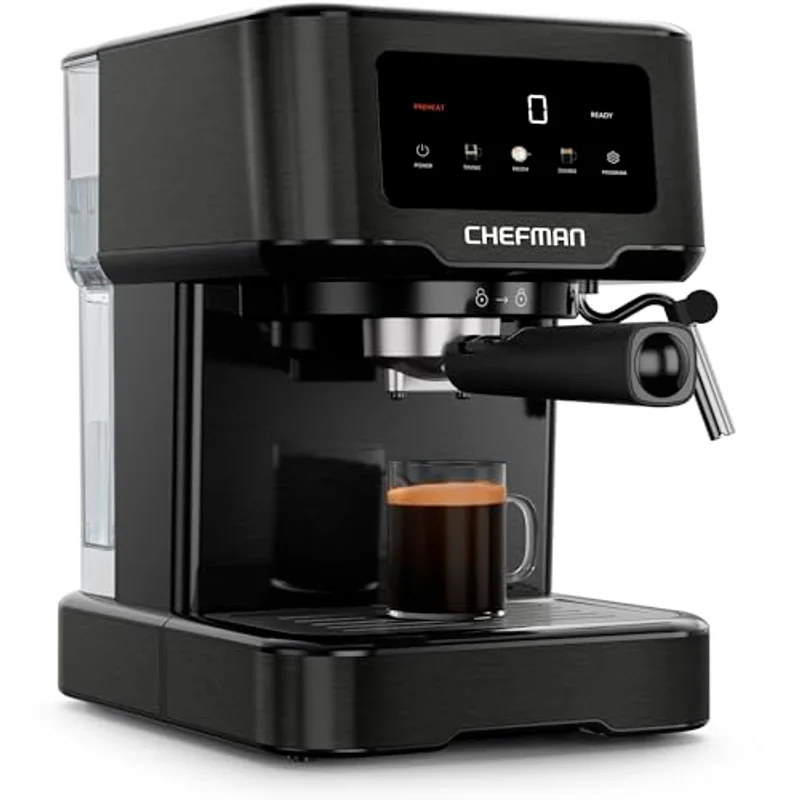
Chefman CraftBrew Espresso Machine
A 15-bar pump with a digital panel instead of a gauge
15-bar pump · digital controls · steam wand · 1.5 L removable reservoir
No gauge, but a lower advertised bar figure than the others here — a good illustration that the number on the box doesn't track machine quality one way or the other, since a 15-bar pump and a 20-bar pump both get regulated to the same brewing range downstream. Digital shot controls and a steam wand for milk drinks.
03Milk frother
atatix Espresso Machine with Milk Frother
20-bar pump paired with a built-in frother instead of a manual wand
20-bar pump · built-in milk frother · compact footprint
Same 20-bar pump-maximum story as the AYCHIRO, without the gauge, but with a milk frother built into the unit rather than a manual steam wand — worth weighing if you want milk drinks with less technique than a wand requires. Compact size for a smaller counter.
04Largest tank
AMZCHEF 20 Bar Home Espresso Coffee Machine
The biggest reservoir of the four, for back-to-back cups
20-bar pump · 41 oz tank
Another 20-bar-pump machine at the same regulated brewing pressure as the rest of this list, differentiated mainly by a 41 oz tank — the largest here — which matters more for a household pulling several shots in a row than for anything about pressure or shot quality.
The specs to compare instead of the bar number
Once you accept that 15 bar and 20 bar brew in the same range, the bar figure drops out as a useful comparison point almost entirely. Here's what to look at instead, roughly in order of how much it changes the cup.
Whether the basket is pressurized, unpressurized, or both
Check the listing or manual for basket type, not the box's headline pressure figure. A machine that ships both a pressurized and an unpressurized basket — as many mid-range semi-automatics do — gives you a forgiving starting point and a real upgrade path once you own a burr grinder. A machine that ships only a pressurized basket will always mask some of what your grinder is doing.
Whether there's a manual steam wand, an automatic frother, or neither
This has nothing to do with brew pressure but changes daily use more than almost any other spec. A manual wand takes practice and gives you full control over milk texture; a built-in frother is closer to walk-away convenience with less range. If milk drinks are the daily habit, weigh this spec more heavily than pressure entirely.
Wattage and boiler recovery
Higher wattage generally means faster heat-up and faster recovery between a shot and steaming milk, which matters if you're making more than one drink in a sitting. The AYCHIRO's 1,350 W is a mid-range figure for this category; check the listing for any machine you're comparing rather than assuming higher bar correlates with higher wattage — the two specs are unrelated.
Tank size
A bigger reservoir means fewer refills, plainly, and matters more for a household than for a single-cup morning routine. The 41 oz AMZCHEF tank versus the 37 oz AYCHIRO tank is a small but real difference if you're pulling several shots back to back.
Whether a gauge is included at all
A gauge doesn't change the shot; it changes whether you can see what's happening. If you want to eventually dial in your own grind and watch the pressure respond, a gauge is genuinely useful. If you're happy pulling shots on a fixed recipe, its absence costs you nothing.
Every one of these specs is verifiable on the product listing. The bar number, by contrast, is verifiable but close to meaningless once you know it's a pump maximum rather than a brew pressure — which is the entire point of this guide.
A note on cheap machines and "high bar" claims
Some very low-cost steam-driven machines — the kind that brew with steam pressure rather than a true pump — advertise bar figures too, and those numbers deserve extra skepticism. A steam-driven unit typically can't reach anywhere near 9 bar at the puck regardless of what's printed on the box, and what comes out is closer to strong coffee than to espresso. All four machines in this guide are pump-driven, which is the baseline requirement for anything resembling a real shot; steam-driven units are a different category entirely and outside the scope of this page.
How we compared these
We compare published specifications, what's stated in the listing, and live pricing — we do not physically test these machines, we do not run a testing lab, and we do not publish ratings we cannot verify. Amazon's product data returns no rating and no review count for the machines on this site, so there are no stars and no invented review sentiment anywhere on this page. The pressure figures discussed above — that espresso brews at roughly 9 bar, that pump ratings describe a maximum rather than a brew pressure, and that OPVs and pressurized baskets are the mechanisms that close that gap — are standard, well-documented espresso engineering, not claims about any specific product's performance.
Where we describe a trade-off as our own judgment rather than a manufacturer spec — that a pressurized basket is worth moving past once you own a grinder, or that a gauge matters more once you're dialing in your own recipe — we've said so in our own voice rather than presenting it as fact. Prices were recorded September 1, 2026 and move constantly on Amazon; confirm the live price before buying. For how to put a good grind behind any of these machines, see our guide to beans and grind size.
Our top picks
 Editor's Pick
AYCHIRO with Pressure Gauge
The only one of the four that lets you actually watch pressure settle into the brewing zone.
Check price →
 Best Value
Chefman CraftBrew
A 15-bar pump and digital controls for the same price as the 20-bar AYCHIRO — proof the number on the box isn't the differentiator.
Check price →
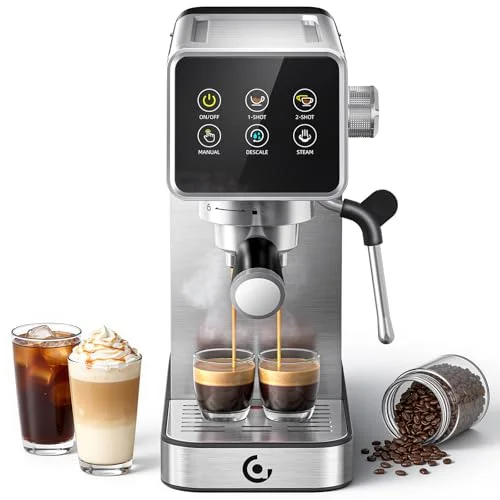 Premium Choice
AMZCHEF 20 Bar
The largest tank of the four, at 41 oz, for households pulling several shots in a row.
Check price →
Frequently asked questions
Is a 20-bar espresso machine better than a 9-bar or 15-bar one?
No. Espresso brews at roughly 9 bar at the coffee puck no matter what the machine's pump is rated for. A "20 bar" or "15 bar" figure describes the pump's maximum output, and every pump machine gets regulated down to roughly the same brewing range by an over-pressure relief valve and, on some models, a pressurized basket. Compare the basket type, steam system, wattage and tank size instead — those specs actually differ between machines and change what lands in the cup.
What does an over-pressure relief valve actually do?
It's a spring-loaded valve plumbed between the pump and the group head, set to open once pressure climbs past roughly 9 bar. Once open, it routes excess water back to the reservoir instead of letting it add more pressure to the puck, which caps brew pressure regardless of how much more the pump could theoretically produce. It's fixed at the factory on nearly every consumer machine, including the four in this guide.
What's the difference between a pressurized and an unpressurized basket?
A pressurized basket adds a small secondary restriction behind the main holes, which builds extra resistance after the coffee bed and makes the shot more forgiving of an inconsistent or coarse grind — useful for a beginner, but it caps how much of the shot's flavor comes from your own grind and dose. An unpressurized basket relies entirely on the puck itself to create resistance, which rewards a consistent burr-ground dose once you're ready to dial in your own recipe.
What should the needle on a pressure gauge show during a good shot?
It should climb quickly as the pump engages, then settle and hold in the gauge's marked brewing zone, typically corresponding to roughly 8 to 10 bar, for most of the pull. A needle that spikes past that zone and stays high usually means the grind is too fine or the puck is tamped too hard; a needle that stays low or flutters usually means the grind is too coarse or the dose is too light. The gauge is a diagnostic for grind and dose problems, not a score for the shot's flavor.
Keep reading