The short answer
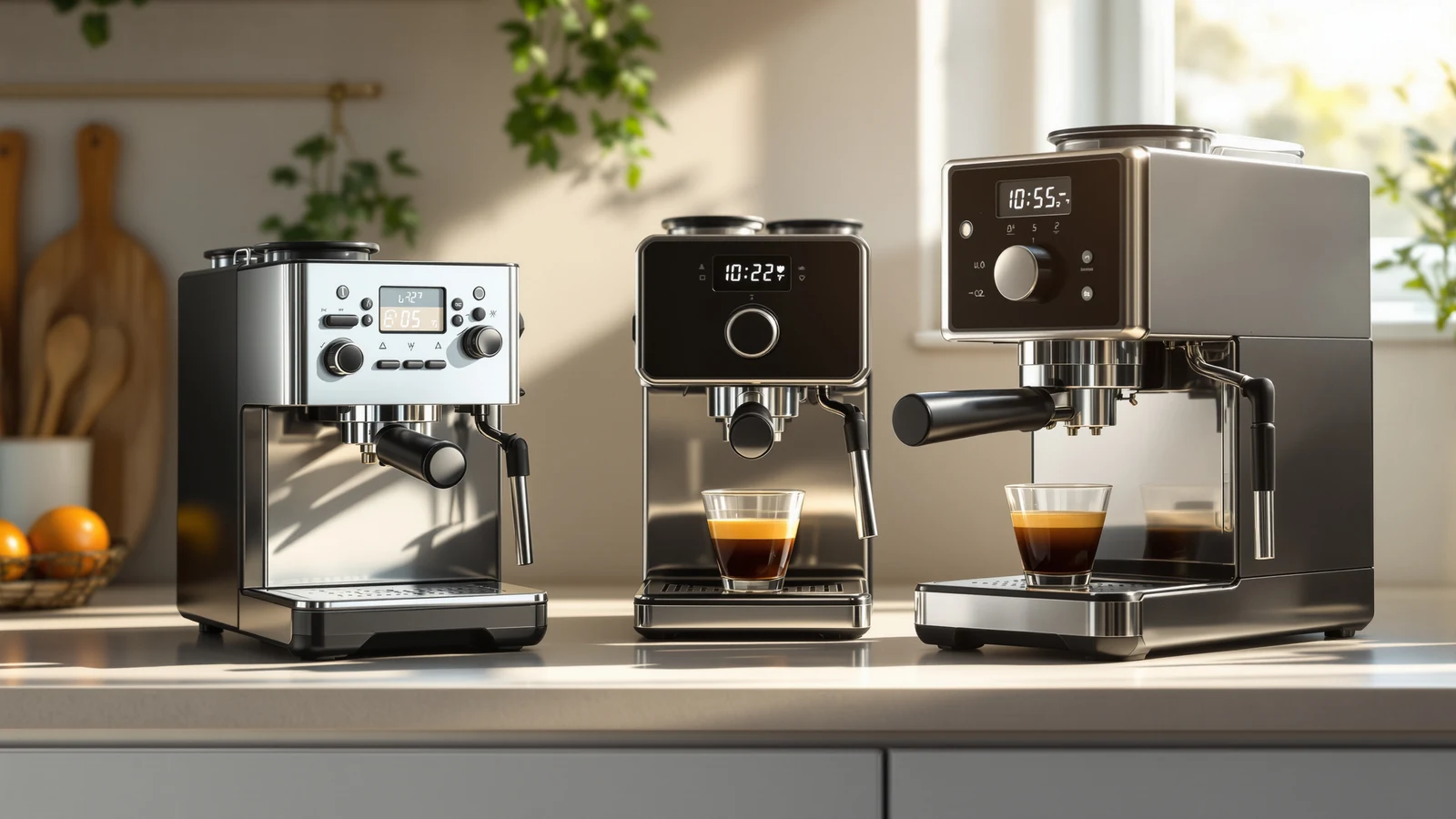
Three machines in our database price under $80: the NEWBULIG Compact Expresso Coffee Machine at $64.97, the Arecovas Espresso Machine at $65.87, and the Reemix 6 Bar Espresso Machine with Built-in Conical Burr Grinder at $79.99. All three are real pump or steam machines with real steam wands or frothers, not toys, and none of them is a scam listing. What they are not is equivalent to the machines fifteen or twenty dollars above them.
The honest framing is this: at $65, you are buying a 20-bar pump machine with a manual steam wand and nothing else — no grinder, no gauge, no screen. At $80, the Reemix adds a grinder to that same basic formula, but the grinder has no adjustment dial, and the machine itself brews at 6 bar rather than 20. Three different trade-offs, three different reasons to pick one over the other, and none of them the trade-off you'd expect from the price tag alone.
What separates these three from the catalogue's $90-99 tier
The jump from $65-80 to $90-99 in this catalogue is not about pressure numbers — plenty of machines at both tiers advertise 15 to 20 bar, and as we've written before, that number is the pump's ceiling, not the pressure at the coffee puck, which sits around 9 bar regardless of what's printed on the box. The real difference is how many control features land on a single unit. Once you cross into the $90-99 range, it becomes common to find one machine that combines a pressure gauge and a touchscreen and a dedicated milk frother, all on the same body. Below $80, those features exist, but they're split up: one machine here has a gauge, a different one has a screen, and no single machine under $80 in this catalogue has both.
None of the three is incomplete in a way that stops it from making espresso — each has a working pump (or, in one case, a lower-pressure system) and a way to froth milk. They just ask you to pick which single extra you care about, rather than getting the full set some $90-99 machines bundle.
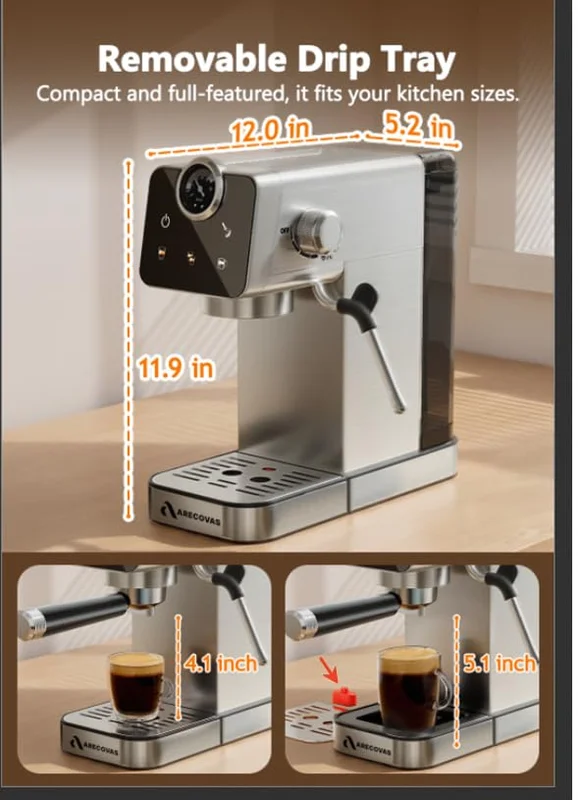
Size isn't really the separator. The NEWBULIG at 11.74 by 6.01 by 11.23 inches and the Arecovas at roughly 12.0 by 5.2 by 11.9 inches are both compact, and compact footprints are the norm at every price point here, not a budget-tier trait.
NEWBULIG Compact Expresso Coffee Machine
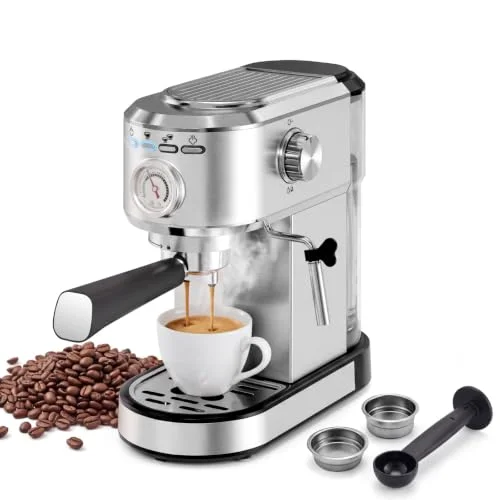
20-bar pump, steam wand, 11.74 by 6.01 by 11.23 inches. No grinder, no gauge, no screen — the plainest machine in this group and the one with the smallest footprint.
$64.97 Check price →
The one 6-bar steam machine here, and what a fixed-setting grinder means in practice
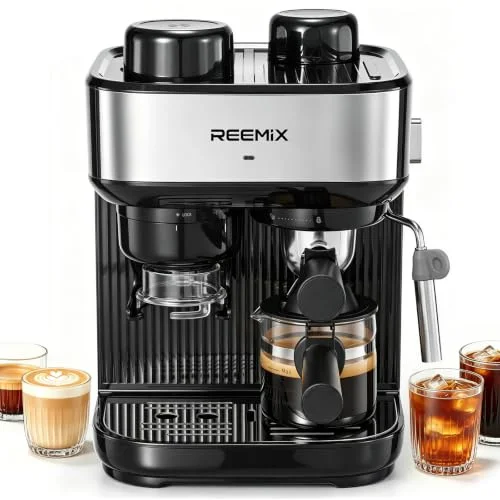
The Reemix is the odd machine of the three. Its listing specifies 6 bar of stable brewing pressure — not 15, not 20 — which puts it below the roughly 9 bar that espresso extraction calls for and closer to a steam-driven system than to the pump machines that dominate this price band. The manufacturer pairs that figure with a recommendation to use dark-roasted beans, which it says deliver more oil and a thicker golden crema at that pressure. We have no independent data on this unit's actual pressure at the puck, only the figure in its own listing.
What makes the Reemix notable despite the pressure figure is the built-in conical burr grinder paired with a dedicated bean hopper — the same basic grinder architecture used in machines costing several times as much. A conical burr grinder beats a blade grinder categorically, because burrs crush beans to a consistent size between two fixed surfaces instead of chopping randomly, and inconsistent grounds are one of the fastest ways to ruin an espresso-style shot. That's a genuine feature at $79.99.
The catch is in how "built-in" is implemented here. According to the listing, both the grind quantity and the grind fineness are factory pre-set and cannot be modified — not one fixed setting with room to adjust dose, but both locked. Fill the hopper once, and the machine grinds enough for exactly two espresso shots and stops. That removes guesswork, which is the manufacturer's stated selling point, but it also removes the two usual levers for fixing a bad-tasting shot: on an adjustable grinder, sour or bitter espresso gets fixed by changing the grind size or the dose. Here, neither is yours to change. If the fixed grind and dose suit your beans, you're set. If not, there's no dial to turn, and the honest fallback is to grind elsewhere and feed the machine's basket instead of relying on the built-in hopper.
A touchscreen and a pressure gauge at under $70: what that actually buys
Between the two cheapest machines here, each one has a different premium-feeling feature, and neither has both. The Arecovas, at $65.87, has the touch screen: a 20-bar pump, a 1,300 W boiler, and — per its listing — a PID algorithm paired with dual NTC sensors that hold brew and steam temperature within about ±2°C, plus a low-pressure pre-infusion stage that ramps pressure up gradually at the start of a shot rather than hitting the puck at full force immediately. The NEWBULIG, at $64.97, has the gauge instead: a 1,350 W boiler that preheats in 30 seconds, NTC temperature regulation holding steady around 203°F, a cup-warming zone, four brew modes (single shot, double shot, hot water, steam) with adjustable extraction timing and a memory function for saved settings, and — per its listing — a built-in pressure gauge that tracks brewing pressure in real time.
Neither feature changes the fundamental water pressure ceiling of its machine; both are control-and-feedback upgrades layered onto the same basic 20-bar pump formula most machines in this price band use. A touch panel changes how you start a shot and how settings are displayed and saved; a pressure gauge gives you a live read on whether a shot is running too fast or choking, which the manufacturer frames as a way to "guide grind and tamp" toward a better extraction — a marketing claim, not an outcome we've independently tested, but a visual pressure indicator is still more feedback than a plain on/off switch gives you.
So the choice between these two isn't about raw brewing power — both list the same 20-bar maximum — it's which single piece of feedback you'd rather have for a $1 difference: a touchscreen with PID temperature stability and pre-infusion, or a mechanical gauge with more brew modes and a memory function. Neither includes a grinder, so the same rule applies to both — pre-ground coffee works to start, and a separate burr grinder is the upgrade that matters most once the habit sticks.
The picks
01Lowest price
NEWBULIG Compact Expresso Coffee Machine
The cheapest machine here, with a built-in pressure gauge
20-bar pump · pressure gauge · 4 brew modes + memory · steam wand · no grinder · 11.74 × 6.01 × 11.23 in
At $64.97 this is the floor of the entire catalogue, and it's more equipped than the price suggests: a 1,350 W boiler that preheats in 30 seconds, NTC regulation holding around 203°F, a cup-warming zone, four brew modes (single shot, double shot, hot water, steam) with adjustable extraction timing, a memory function for saved settings, and a built-in pressure gauge the manufacturer says helps guide grind and tamp toward a better shot. Treat the "20 bar" figure as the pump's ceiling rating, not the brewing pressure, which is standard across this entire price class.
The trade-offNo grinder, so budget separately for one. The pressure gauge is a genuinely useful feedback tool at this price, but it's a manufacturer claim about what it helps you do, not something we've independently verified.
02Best interface
Arecovas Espresso Machine
A touch screen, PID temperature control, and a frother, under $70
20-bar pump · touch screen · PID + dual NTC sensors, ±2°C · pre-infusion · milk frother included · no grinder · 12.0 × 5.2 × 11.9 in
At $65.87, the Arecovas pairs a touch control panel with a 1,300 W boiler, a PID algorithm and dual NTC sensors that the listing says hold brew and steam temperature within about ±2°C, and a low-pressure pre-infusion stage that ramps pressure up gradually at the start of a shot rather than hitting the puck at full force. None of that changes the water pressure ceiling — it's a temperature-stability and interface upgrade layered on the same 20-bar pump formula — but tighter temperature control is a real, specific claim, not a vague one, and the included frother means you're not shopping for a separate milk accessory on day one.
The trade-offNo grinder, so this is a pre-ground or bring-your-own-grinder machine like the NEWBULIG. The temperature-stability figure and the pre-infusion feature both come from the listing, not from our own measurement.
03Has a grinder
Reemix 6 Bar Espresso Machine with Built-in Conical Burr Grinder
The only one of the three with a grinder built in
6-bar · built-in conical burr grinder · fixed dose + fixed grind · steam wand · Standard size
At $79.99 — right at the edge of this tier — the Reemix is the one machine of the three that includes a grinder, and a conical burr one at that, which is a real upgrade over pre-ground coffee regardless of price. Fill the dedicated hopper once and it automatically grinds enough for exactly two espresso shots and stops. The 6-bar brewing pressure puts it below the roughly 9 bar that espresso extraction typically calls for and well below the 20-bar pump ceiling the other two machines here advertise; the manufacturer pairs that figure with a recommendation to use dark-roasted beans for more oil and a thicker crema at that pressure.
The trade-offPer its listing, both the grind fineness and the dose are factory pre-set and cannot be changed — not one adjustable setting, but two fixed ones. If that fixed combination happens to suit your beans, this is the only $80-and-under machine here that grinds its own coffee. If it doesn't, there's no dial to fix it.
| Machine | Pressure | Grinder | Notable control | Price | |
|---|
 NEWBULIG Compact Expresso Coffee Machine | 20 bar (pump max) | None | Pressure gauge, 4 brew modes | $64.97 | Price |
 Arecovas Espresso Machine | 20 bar (pump max) | None | Touch screen, PID temp control | $65.87 | Price |
 Reemix with Built-in Burr Grinder | 6 bar | Built-in conical burr, fixed dose + grind | Dedicated bean hopper | $79.99 | Price |
What all three skip that even a $90 machine includes
In this catalogue, the $90-99 tier is where it becomes common to find a single machine that bundles a pressure gauge and a touchscreen and a dedicated milk frother together, often alongside a larger water tank. Below $80, those features exist but are split up: the NEWBULIG has the gauge and a steam wand, the Arecovas has the screen, PID temperature control and a frother, and the Reemix skips all of them for the grinder. Spending $90-99 tends to buy the full combination on one unit rather than a choice between partial sets.
The clearer absence is an adjustable grinder. Of the three, only the Reemix grinds at all, and per its listing both the grind fineness and the dose are factory-fixed — not a dial you can nudge, but a setting you can't touch. That means no machine under $80 here gives you both a grinder and the ability to tune it — a combination we've seen matter a great deal on the bean-to-cup machines we've compared elsewhere, where dose control and grind adjustment are the main reason to pay for an integrated grinder at all. If dialing in your grind matters to you, that's the biggest thing separating this tier from the one above it.
Water tank size is the other quiet gap. None of the three listings here states a tank capacity, where several machines just above $80 in this catalogue specify one in the 30+ ounce range — useful for back-to-back drinks without a refill trip, more relevant for a household than for one cup a day.
Why 6 bar and 20 bar aren't the same kind of claim
Two of these three machines advertise 20 bar, matching most of the catalogue. The Reemix advertises 6 bar. That's not the Reemix being modest about a similar machine — 6 bar is a meaningfully lower number that puts it in steam-driven territory rather than pump-driven territory, closer to the pressure a stovetop or steam wand alone can generate. Espresso by convention brews at roughly 9 bar at the coffee puck; a 20-bar pump can comfortably hit that number and then some, while a 6-bar system is working below it. That distinction matters more for what to expect in the cup than the grinder does.
When to spend the extra $20 to $30 instead
If an adjustable grind matters to you — and for anyone planning to drink espresso daily, it generally does, since grind size is the main lever for fixing a sour or bitter shot — none of these three gives you that. The Reemix grinds, but both settings are fixed; the other two don't grind at all. The next tier up is where adjustable built-in grinders start appearing more consistently, and that's really what the extra $20 to $30 buys: a dial, not just a motor.
If you want both the gauge and the screen on one machine, rather than choosing between the NEWBULIG's pressure feedback and the Arecovas's touch panel and temperature stability, that combination is more common once you're spending $90 and up in this catalogue.
If 9-bar-class pump pressure specifically matters — and it should, since reaching that range is what separates espresso from drip coffee or a steam-brewed approximation of it — skip the Reemix's 6-bar design and choose between the NEWBULIG and the Arecovas, both listed at 20-bar pump maximum. Whether you also want the grinder badly enough to accept two fixed settings, or would rather keep full control of your grind, is the real fork here, not the fifteen dollars separating the three prices.
Finally, if this is a first machine bought to find out whether espresso at home is a habit worth keeping, the lowest price in the group — the NEWBULIG at $64.97 — carries the least financial risk. Our look at legacy brand versus direct-to-consumer pricing covers what you're paying for once you're ready to move past that first machine, and our piece on grinder bundles covers the decision after that: whether a factory-matched machine-and-grinder pair is worth the premium over assembling the pieces yourself.
How we compared these
We compare published specifications, listed prices and product class — pump versus steam-driven, grinder versus no grinder, adjustable versus fixed — against general, verifiable coffee facts: espresso brews at roughly 9 bar at the puck regardless of a pump's rated maximum, and conical burr grinders produce more consistent particle size than blade grinders. We do not physically test these machines, we do not run a testing lab, and we do not publish ratings we cannot verify. Amazon's product data returns no rating and no review count for the machines on this site, so there are no stars, no review-count claims, and no paraphrased buyer sentiment anywhere on this page.
Where a listing doesn't give us a spec — the Reemix's exact milk-frothing hardware, or any of the three machines' water tank size — we say so rather than filling the gap with a guess. The size/variant line quoted for each product is the only dimension data we have; where a product has none, we don't claim one. More of our method sits on our main espresso machine guide.
Frequently asked questions
Is a 6-bar espresso machine actually an espresso machine?
It brews with less pressure than true espresso needs. Espresso is conventionally pulled at roughly 9 bar at the coffee puck, and a 20-bar pump machine can comfortably reach that; a 6-bar design like the Reemix sits below it, closer to a steam-driven brewing method. It will still produce a strong, concentrated shot, but expect a different result from what a pump machine advertised at 15-20 bar produces — we have the 6 bar figure from its listing, not independent lab data on its actual output.
Why does the Reemix have a grinder but the two cheaper machines don't?
It's a trade-off, not a free upgrade. The Reemix spends its slightly higher $79.99 price on a built-in conical burr grinder with a dedicated bean hopper, which the NEWBULIG at $64.97 and the Arecovas at $65.87 don't include. In exchange, the Reemix brews at 6 bar instead of the 20-bar pump rating the other two carry, and per its listing both the grind fineness and the dose are factory-fixed, not adjustable. Which trade-off is better depends on whether you value grinding your own coffee or a stronger pump more.
What does a "fixed-setting" grinder actually mean for the coffee I get?
It means the machine grinds to one particle size chosen by the manufacturer, with no dial to make it finer or coarser. On an adjustable grinder, a shot that runs too fast and tastes sour gets fixed by grinding finer; a shot that chokes and tastes bitter gets fixed by grinding coarser. On the Reemix specifically, the dose is also factory-fixed at enough for two shots per hopper fill, so even dose isn't a lever you control — tamp pressure is about the only adjustment left, and it's a weaker tool than grind size.
Should I buy a machine under $80, or spend the extra $20 to $30?
It depends on what you're optimizing for. All three machines under $80 are legitimate pump or steam machines, not toys, so there's no safety reason to spend more. The reasons to spend more are specific: an adjustable grinder (none of these three offers one), both a pressure gauge and a touch screen on the same unit (here you get one or the other), or full 20-bar pump pressure if you want to skip the Reemix's 6-bar design entirely. If none of those matter to you yet, the cheapest option here is a reasonable place to start.
Keep reading