Adjustable Pressure Valves: The One Machine Here You Can Actually Tune
Most machines set their over-pressure valve at the factory and never let you touch it. One in this catalogue lets you turn it by hand. What that changes, honestly.
Reader-supported: we may earn a commission if you buy through our links, at no extra cost to you. Prices are the ones we recorded on September 23-27, 2026 and they move constantly — confirm the live price before buying.
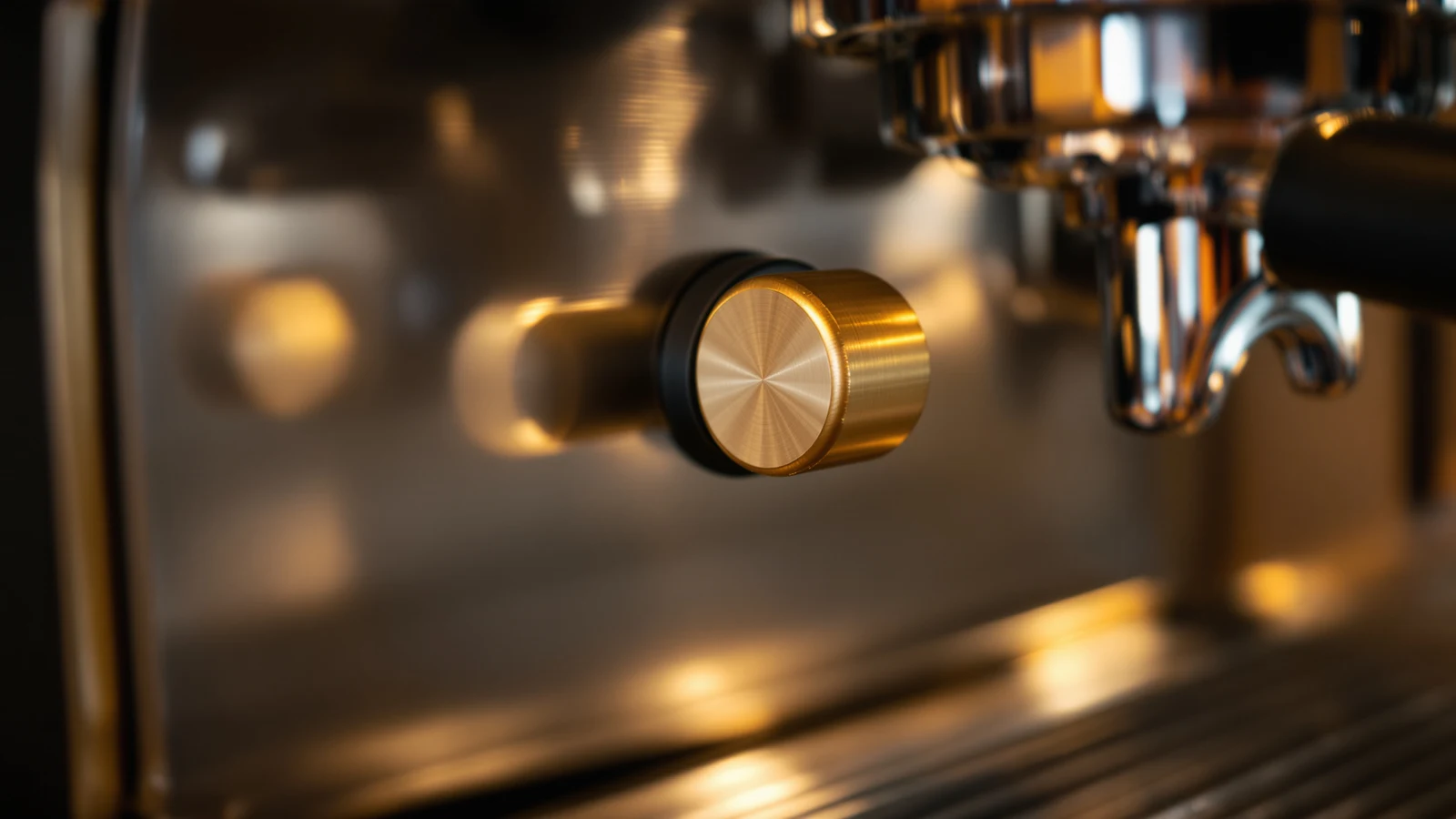
What an over-pressure valve actually does during a shot
Every pump espresso machine has a valve somewhere between the pump and the group head whose only job is to cap pressure. It is usually called an over-pressure valve, or OPV, and sometimes an expansion valve. When the pressure building against the coffee puck exceeds a set point, the valve opens and bleeds the excess water back to the reservoir instead of forcing it through the grounds.
The reason this exists at all is that a portafilter basket is not a fixed piece of plumbing — it is packed with ground coffee, and how tightly that bed resists water changes with every dose, tamp and grind setting. Without a ceiling, a pump rated well above 9 bar would keep pushing against a fine, dense puck until something gave: a stalled shot, a stressed gasket, or water finding the one weak seal in the group. The OPV is what stops that, by simply refusing to let pressure climb past its setting no matter how hard the puck resists.
That set point is also, not coincidentally, where the "roughly 9 bar" figure you read on every espresso machine spec sheet actually comes from. A pump might be capable of far more — that is the "15 bar" or "20 bar" number printed on the box — but the OPV clamps the water that actually reaches the coffee down near the pressure that produces balanced extraction. The pump's maximum rating and the brew pressure at the puck are two different numbers, and the OPV is the component that keeps them different.
On almost every home machine, that valve is a small spring-loaded assembly set once on the factory line and never exposed to the person making coffee. It sits inside the pump housing or plumbed into the group, under a cover, doing its job invisibly for the life of the machine.
Fixed OPV versus adjustable: the difference the spec sheet rarely explains
A fixed OPV is calibrated once, at the factory, to a target — commonly cited across the industry as somewhere near 9 bar — and stays there. You cannot see it, reach it, or change it without disassembling the machine, and on most consumer machines it is not designed to be user-serviced at all. That is by far the more common design, and for good reason: it removes a variable that most buyers would never touch anyway, and it guarantees every shot on that machine starts from the same pressure ceiling.
An adjustable OPV moves that same valve to somewhere you can reach with a hand or a small tool, usually a knob or a screw with a lock nut, and lets you raise or lower the pressure ceiling yourself. Turn it down and the pump backs off sooner, capping brew pressure lower than 9 bar. Turn it up — within the pump's real ceiling — and you extend how much pressure the puck can see before the valve bleeds it away.
The spec sheet rarely explains what this is actually for, because "adjustable OPV" reads like a bullet point rather than a workflow. It is not a dial you set once and forget, and it is not the same thing as a PID temperature controller or a pressure gauge, both of which just display or hold a number. An adjustable OPV is a mechanical control you turn, watch the result of in the cup, and turn again — closer to adjusting grind size than to setting a thermostat. Among the three machines in this guide, that distinction matters: two of them cap pressure at the factory and leave it there, and one puts the dial in your hand.
The picks
Three dual-boiler machines, and only one of them makes the valve a feature rather than an internal part.
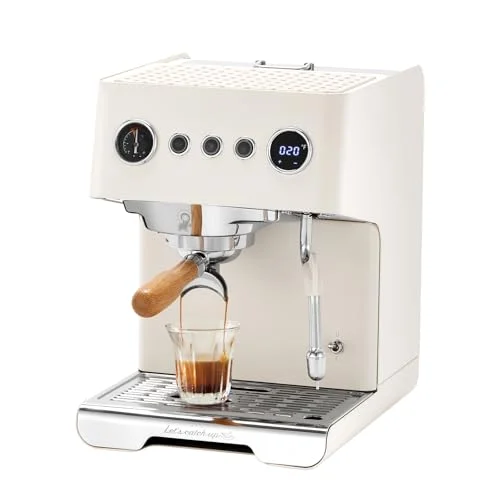
Gemilai G3028A — the adjustable one
15-bar pump with an adjustable pressure valve, dual PID temperature control, 550 ml dedicated brew boiler, 57 oz tank, automatic milk frother. The Lagre size/variant listed is the only size data we have for this unit — check the listing for others.
$759.99 Check price →The Gemilai G3028A is the machine this article is actually about: a dual-PID, dual-boiler design where the pressure valve is exposed as an adjustable control rather than buried in the pump housing. Paired with independent boiler-temperature control on brew and steam sides, it is built for someone who wants to change more than one variable in the shot — not just grind and dose, but the pressure ceiling and the water temperature too.
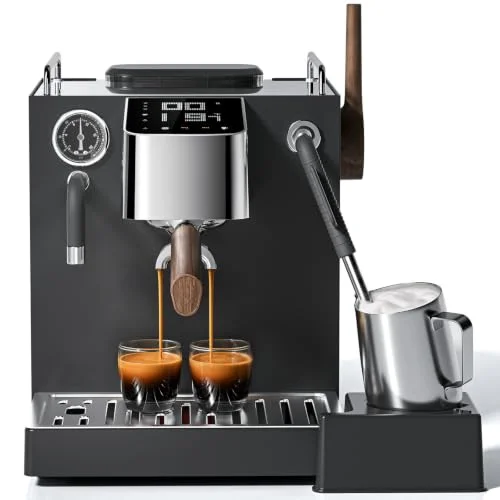
AMZCHEF 9 Bar OPV — fixed, and named for it
Dual boiler, automatic milk frother, 61 oz tank. The "9 Bar OPV" in the name is the fixed factory setting, not a control you can move — a useful contrast to the Gemilai above, and a reminder that "OPV" appearing in a listing does not by itself mean adjustable.
$499.99 Check price →The AMZCHEF's name is worth pausing on, because it illustrates exactly the confusion this whole topic invites. "9 Bar OPV" is a marketing phrase confirming the machine has a pressure-limiting valve set to roughly 9 bar — the same component every pump machine has, fixed, at the factory. It is not a claim that the valve is adjustable. Nothing in its listed specs mentions a user control for it, so treat the pressure ceiling on this machine as set and done.
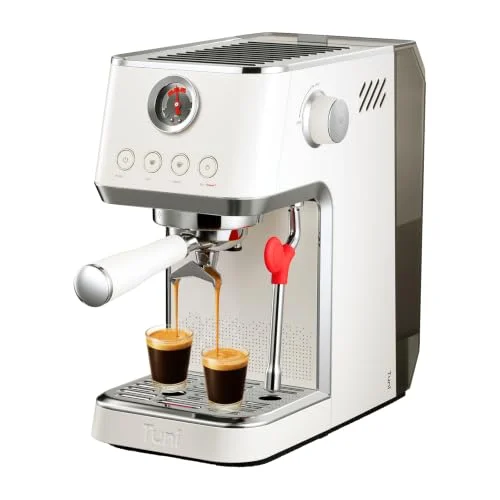
Tuni E2 Gen3 — fixed, and the budget end of the three
Dual boiler with Super+ steam power, ivory finish, E2 Gen3 size/variant. Nothing in its listed specs indicates a user-adjustable pressure valve, so treat brew pressure here as factory-set as well.
$299.00 Check price →The Tuni E2 Gen3 rounds out the trio at the lowest price point, and it makes the same trade as the AMZCHEF: dual boilers so you can brew and steam without waiting on one heating element, but no user access to the pressure ceiling. For most people that is not a compromise — it is one fewer thing to think about, at a price several hundred dollars under the Gemilai.
Why most home baristas never need to touch it
A fixed OPV set near 9 bar is not a limitation to work around — it is the industry's converged answer to what produces balanced extraction across a huge range of roasts, grinds and doses. That is why the number appears, unprompted, on nearly every espresso machine's spec sheet and in nearly every home-brewing guide. Espresso as a category was defined around that pressure, not the other way around.
Everything that actually separates a good shot from a bad one on a fixed-OPV machine — the AMZCHEF or the Tuni here, or the vast majority of machines on the market — lives upstream of the valve: grind size, dose weight, tamp consistency, water temperature, how fresh the beans are. Chasing a better shot means adjusting those first, in that order, long before pressure becomes the limiting factor. Someone who has never dialed in grind size to the day's beans has no use yet for a pressure dial, because they have not exhausted the variables that matter more.
There is also a practical case for leaving it alone even if you own the one machine here that lets you: a dual PID and a pressure dial both being adjustable at once means two variables can drift out of a good range simultaneously, and diagnosing which one caused a bad shot gets harder, not easier. The Gemilai's control is a genuine capability, not a mandate to use it — plenty of owners will set it once near the factory default and never revisit it, and that is a reasonable way to own this machine.
Who a manual pressure profile actually helps: darker roasts, unusual grinds
The case for actually turning the dial is narrower than the spec sheet implies, but it is real. Darker roasts lose structural density in the bean during roasting — the cell walls are more broken down — and a fine grind on a dark roast at full 9-bar pressure can choke a shot: slow flow, harsh bitterness, a puck that resists water more than a lighter roast at the same grind would. Backing the OPV down a notch and coarsening the grind slightly can pull that back into balance faster than grind adjustment alone, because it addresses the resistance directly instead of only the particle size feeding it.
The same logic runs the other way for unusually coarse or unevenly distributed grinds — a cheaper or older grinder that produces more fines and boulders together than a good conical burr does. Slightly lower pressure gives that uneven bed more tolerance before it either channels (water finding a fast path through the coarse particles) or chokes (fines packing too tight). It is a compensation tool for a grinder that is not giving you a clean, uniform particle size, not a fix that makes a bad grinder into a good one.
Beyond roast and grind, an adjustable OPV is genuinely useful to anyone deliberately exploring pressure profiling — the practice, borrowed from prosumer and commercial machines, of varying pressure across the shot rather than holding one number throughout. That is a hobbyist pursuit more than a daily-driver one, and it is the audience the Gemilai's dial is actually built for: someone who already has grind and dose under control and wants the next variable to play with.
The risk of turning a dial you don't understand yet
The honest caution here is not that turning the OPV will damage the machine — within its adjustment range, that is what the control is designed to do. The risk is turning it before you have ruled out the variables that matter more, and mistaking a pressure change for a grind or dose problem you never actually fixed.
Because pressure interacts with grind size, dose and tamp all at once, a change made to the OPV without changing anything else can look like it fixed a shot when it only masked the real issue — a slightly-off grind setting, a light or heavy dose — under a different pressure ceiling. Change one variable at a time, and note it, the same discipline that applies to grind adjustment on any machine. Turning the dial and the grind knob in the same session makes it impossible to know which change did what.
There is also a more literal risk worth naming plainly and once: turning any pressure-related control past the range the manufacturer designed for risks stressing seals and gaskets not built for it. We have no service or reliability data on the Gemilai specifically, so the sensible approach is the manufacturer's own documented range, nothing past it, and small moves rather than large ones between shots. This is general mechanical caution, not a claim about how this particular unit performs over time.
How we compared these
We compare published specifications, what ships in the box, machine class and live pricing, and we read pressure-related marketing sceptically — a "9 Bar OPV" name and a "15 Bar" pump rating describe two different things, and neither tells you whether the valve is adjustable. We do not physically test these machines, we do not run a testing lab, and we do not publish ratings we cannot verify: we have no rating or review data for these three products, so there are no stars and no invented scores anywhere on this page.
Where a claim here is a judgement rather than a specification — that most buyers never need the dial, that darker roasts are where it earns its keep — we have said so in our own voice and shown the reasoning behind it. The general espresso facts referenced (roughly 9 bar as the conventional brew-pressure target, the effect of roast level on bean density, pump-maximum ratings versus brew pressure at the puck) are standard background rather than claims about any specific product. For more on how bar ratings are marketed, see our guide to machines at $1,000 and up, and for the other factory-set variable on these machines, see our piece on double boiler versus single boiler designs.
Frequently asked questions
What does OPV stand for on an espresso machine?
Over-pressure valve, sometimes called an expansion valve. It is the component that caps how much pressure the pump can push toward the coffee puck, bleeding excess water back to the reservoir once a set point — commonly near 9 bar — is reached. Every pump espresso machine has one; the difference is whether it is fixed at the factory or adjustable by the owner.
Is a higher bar rating better for espresso?
No. The bar number printed on a machine's box or name — 15 bar, 20 bar — is the pump's maximum rating, not the pressure that reaches the coffee. The OPV is what actually sets brew pressure, and on nearly every machine that lands near 9 bar regardless of the pump's stated maximum. A "9 Bar OPV" name, like on the AMZCHEF here, is describing that capped brew pressure, not an upgrade over machines with higher pump ratings.
Should a beginner buy a machine with an adjustable pressure valve?
Not as a priority. Grind size, dose and tamp consistency change a shot far more than pressure does, and a fixed-OPV machine set near the conventional 9-bar target — like the AMZCHEF or the Tuni E2 Gen3 in this guide — already gives a beginner a balanced starting point. An adjustable valve, like the one on the Gemilai G3028A, is more useful once those other variables are already under control.
Can adjusting the OPV damage an espresso machine?
Within the range a manufacturer designs the control for, no — that is what it is built to do. The risk is adjusting past the documented range, which can stress seals and gaskets not designed for it, or changing pressure and grind at the same time, which makes it hard to know which change actually fixed or worsened a shot. We have no long-term reliability data on any specific unit, so the sensible approach is small changes, one variable at a time, within the manufacturer's stated range.