PID Temperature Control: What It Actually Does to Your Shot
Three letters on a spec sheet, and they change how repeatable your espresso is from one cup to the next. Here's what a thermostat is actually doing wrong, what a PID does instead, and the two other ways manufacturers solve the same problem.
Reader-supported: we may earn a commission if you buy through our links, at no extra cost to you. Prices are the ones we recorded on the dates noted below and they move constantly — confirm the live price before buying.
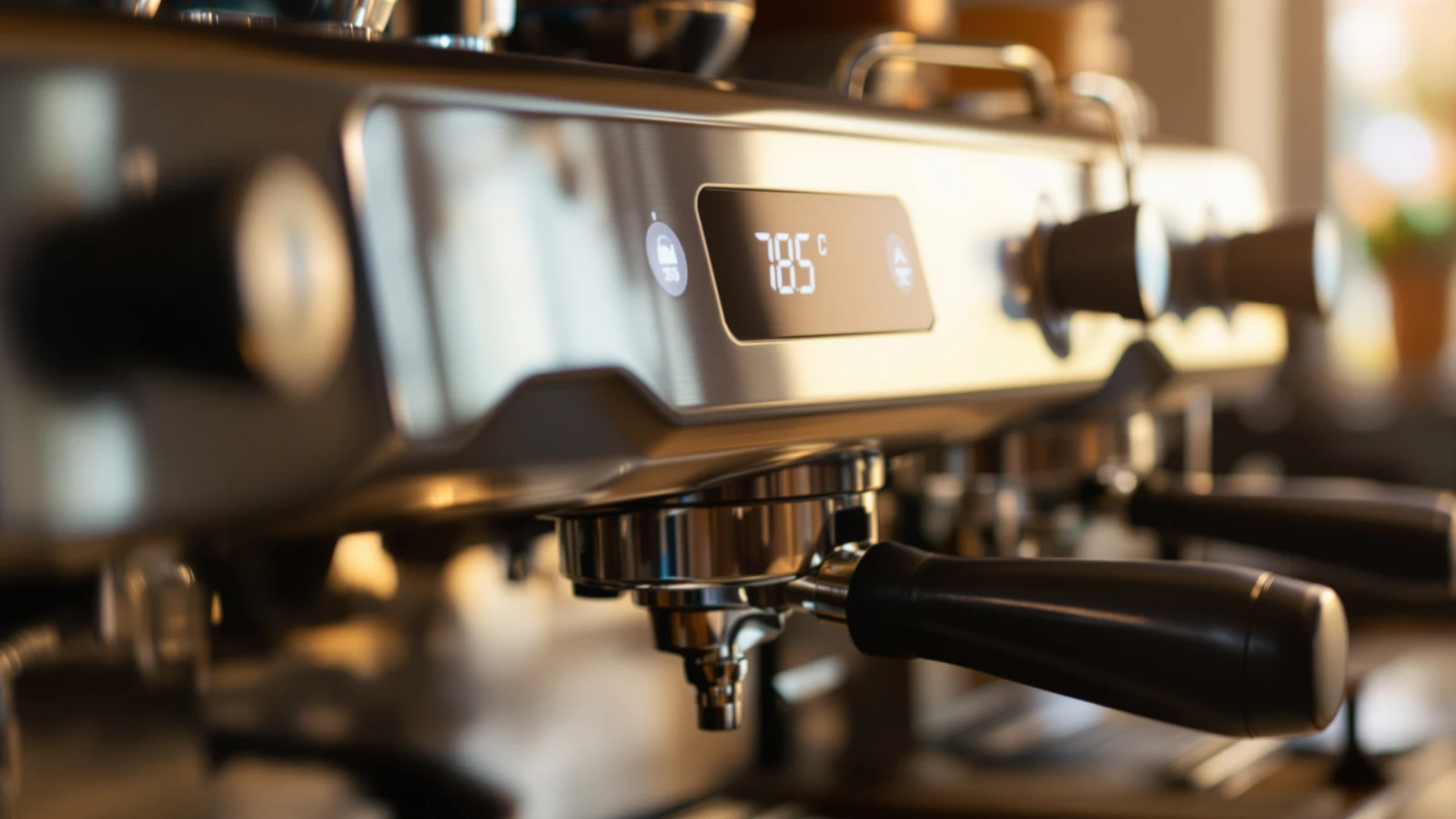
Why brew temperature moves at all
Espresso extracts within a narrow band, generally cited as roughly 195–205°F at the point the water meets the coffee. Outside that band the result skews in a predictable direction: too cool and the shot tends toward sour and underdeveloped, because the acids in the coffee dissolve faster than the sugars; too hot and it tends toward bitter and flat, because you're pulling out compounds that were better left behind. A home machine does not hold one number here — it swings through a range, and the size of that swing is exactly what separates a $150 machine from a $700 one.
The swing happens because a single-boiler espresso machine is heating water and making steam with the same small tank. Pulling a shot draws hot water out of the boiler and pulls in cooler water from the reservoir to replace it, which drops the boiler's temperature. The heating element then has to catch back up, and depending on how the machine is controlled, it can overshoot past the target before settling — so the first ounce of one shot might brew notably cooler or hotter than the first ounce of the next, even with identical grind, dose and tamp.
Two other things compound the swing on cheaper machines. First, thin-walled boilers and short heat-up cycles mean less thermal mass to buffer the drop — a heavier boiler releases heat more evenly, but it's also more metal, which costs more and heats up slower. Second, a lot of home machines use a single heating element for both brewing and steaming, so if you've just texture milk, the boiler is sitting well above brew temperature and needs time to fall back down before the next shot — the reverse of the mid-session cooldown.
None of this is a defect exactly — it's a consequence of doing two jobs (brewing near 200°F, steaming well above 250°F) with one small heating system. What differs between machines is how tightly the control electronics manage that swing, and that's where PID comes in.
What a thermostat does
The simplest and cheapest way to hold a boiler near a target temperature is a mechanical thermostat: a switch, usually built from a bimetallic strip or a similar temperature-sensitive component, that closes to turn the heating element on and opens to turn it off. It has one job — stay under a ceiling — and it does that job with a wide margin, because mechanical switches can't react instantly and shouldn't cycle on and off too rapidly or they wear out fast.
That margin is the problem for espresso. A thermostat is typically rated to switch somewhere around a target point, but the actual boiler temperature drifts several degrees above and below that point before the switch reacts — a swing of 10–15°F within a single brew cycle is common on thermostat-controlled machines, and that's before accounting for the draw-down described above. The thermostat isn't malfunctioning; it's doing exactly what a cheap on/off switch is built to do. It just was never designed for the tolerance espresso actually needs.
This is why thermostat-controlled machines are not automatically bad — they're the standard in most machines under roughly $150, including the ones in this guide with no grinder and no digital display — but it's also why the same model can pull a noticeably different-tasting shot depending on exactly when in the heating cycle you pull the lever, and why the workaround culture (see temperature surfing, below) exists at all.
What a PID does instead
PID stands for proportional-integral-derivative, which describes the type of control loop rather than a brand or a single component. Instead of a mechanical switch that's fully on or fully off, a PID is a small digital controller reading a temperature sensor many times a second and adjusting how much power goes to the heating element — not just when it fires, but how hard. As the boiler approaches the target, the PID tapers the power down in advance rather than waiting to overshoot and correct after the fact, and it factors in how the temperature has been trending (the "derivative" term) and any small persistent error (the "integral" term) to keep correcting toward the exact setpoint rather than oscillating around it.
The practical result is a boiler that holds within roughly 1–2°F of the target instead of swinging 10-15°F, and that number is precisely why a PID-equipped machine ends up marketed on "consistency" rather than on any single dramatic feature — it's not that any one shot tastes wildly different, it's that shot five tastes like shot one. Two things follow from that: dialling in a grind actually means something, because you're not simultaneously fighting a temperature swing you can't see, and adjusting the number itself becomes useful, since a PID with a programmable setpoint lets you brew a lighter, more delicate roast a few degrees hotter and a darker roast a few degrees cooler without touching the grinder.
The XIXUBX Espresso Machine with Grinder is a straightforward example of what PID buys you at the low end of the machines with it: a built-in grinder and programmable settings on top of PID temperature control, at a price much closer to the thermostat-controlled machines below it than to the double-boiler machines further down this page.
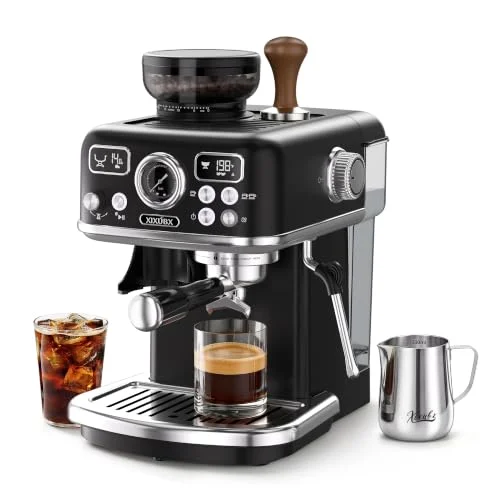
XIXUBX Espresso Machine with Grinder, PID & Programmable Settings
Built-in grinder paired with PID temperature control and programmable brew settings, in a 12.61"D x 9.5"W x 14.34"H footprint. The combination — grinder plus PID — at this price is the headline: you're not paying a large premium over a thermostat-controlled machine to get a materially steadier boiler.
$179.99 Check price →Temperature surfing: the workaround PID replaces
Before PID controllers became common and affordable on home machines, the home-espresso community's answer to thermostat swing was a manual technique nicknamed temperature surfing. The idea: run a shot's worth of water through the group head into a cup or a drip tray immediately before locking in the portafilter, which briefly triggers the heating element and lets you judge, by feel and by trial, roughly where in its swing the boiler currently sits. Do this consistently — often timed against when the thermostat last clicked on — and you can land closer to a repeatable temperature shot to shot, purely through manual timing.
It works, in the sense that experienced home baristas built entire routines around it and got real consistency gains. It also asks a lot: you have to learn your specific machine's cycle, you waste water and time on every shot, and you're still working within the same wide thermostat swing rather than removing it. A PID controller is, functionally, an automated and far more precise version of the same goal — instead of you guessing where the boiler sits by feel, the controller measures it continuously and corrects the power output before you ever pull the lever. Surfing is a workaround for a specific piece of hardware; PID changes the hardware's behavior directly.
You'll still find temperature surfing recommended for machines that use a thermostat, because it costs nothing and it does help. But it's a technique for managing a limitation, not a substitute for removing it — and it's worth knowing the origin of the practice if you read older forum advice that assumes every home machine needs it.
Double boilers and heat exchangers: the other answers
PID solves temperature stability by controlling one boiler more precisely. The other two established approaches solve it by changing how many boilers there are — and each has a different trade-off against cost and footprint.
A heat exchanger machine uses one boiler, kept hot at steam temperature, with a separate thin tube (the heat exchanger) running through it that brew water passes through on its way to the group head. The water is heated by proximity to the boiler rather than sitting in it, which means you can brew and produce steam pressure at effectively the same time without waiting for the boiler to switch modes — useful for milk drinks back to back. The trade-off is a phenomenon called a "temperature spike": water sitting in the heat exchanger tube between shots picks up more heat than intended from the surrounding boiler, so the first few seconds of a shot after the machine has been idle can run hotter than the rest of it. Machines that use this design usually manage it with either a cooling flush (running some water through before brewing, much like temperature surfing) or a secondary temperature-management circuit.
A double boiler machine dedicates one small boiler entirely to brewing and a separate one entirely to steam, each independently controlled — often, though not necessarily, each with its own PID. Because the brew boiler is never asked to also produce steam, it doesn't have to swing between two very different target temperatures, and because it's a dedicated smaller boiler it can be regulated tightly. This is generally considered the most stable of the three approaches, and it's also the most expensive to build, since you're paying for two heating systems and two sets of controls instead of one.
The Chefman Crema Deluxe Espresso Machine with Double Boiler is the double-boiler option among the machines here, and its marketed ability to froth milk and brew espresso at the same time is the direct, practical payoff of having two independently heated boilers rather than one boiler doing both jobs in sequence.
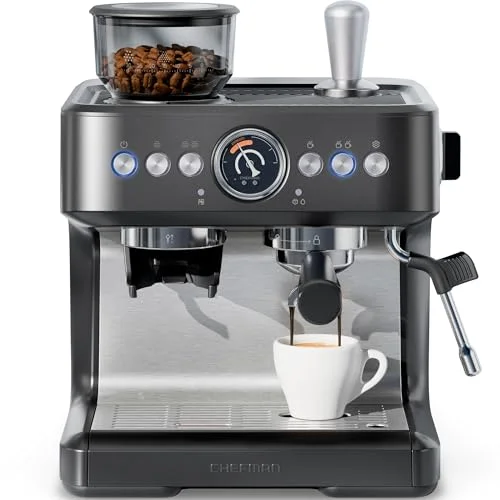
Chefman Crema Deluxe Espresso Machine with Double Boiler
A dedicated brew boiler and a dedicated steam boiler, built to froth milk and brew espresso simultaneously rather than in sequence — the structural advantage of splitting the two jobs instead of asking one boiler to do both. Built-in grinder with 30 grind settings, size Large.
$270.10 Check price →The picks
None of these four machines are directly interchangeable — they sit at different points on the price-versus-temperature-control ladder, and which one makes sense depends on how much of your $20-a-month savings you want to put toward shot consistency versus other features.
| Machine | Temperature approach | Grinder | Price | |
|---|---|---|---|---|
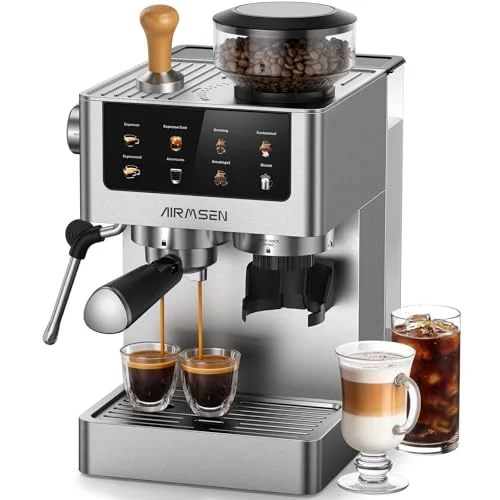 AIRMSEN with Burr Grinder AIRMSEN with Burr Grinder | Thermostat (standard single-boiler) | Built-in burr | $179.99 | Price |
| XIXUBX with Grinder, PID | PID, single boiler | Built-in | $179.99 | Price |
| Chefman Crema Deluxe | Double boiler | Built-in, 30 settings | $270.10 | Price |
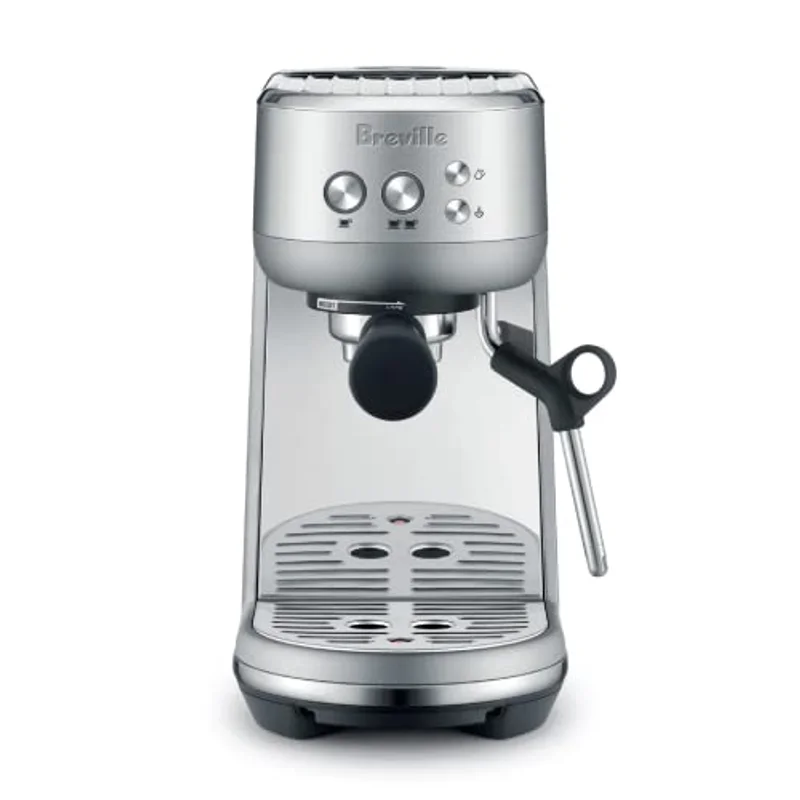 Breville Bambino Breville Bambino | Thermostat (fast-heat single boiler) | None | $299.95 | Price |
Best entry point with a grinder: AIRMSEN Espresso Machine with Burr Grinder
At $179.99 this is a standard single-boiler machine with a thermostat rather than a PID, paired with a built-in burr grinder, a milk frother steam wand and a 20-bar pump (a pump rating, not brew pressure — espresso brews at roughly 9 bar regardless of the number on the box). It's a reasonable place to start if you're not yet sure espresso will stick as a habit: you get a real grinder and a real steam wand, and the temperature swing that comes with a thermostat is the same trade-off most machines under $200 make.
Best value for temperature stability: XIXUBX Espresso Machine with Grinder, PID & Programmable Settings
At $179.99, ten dollars above the AIRMSEN, you get PID temperature control and programmable settings instead of a thermostat, on top of a built-in grinder. If the whole point of reading this guide is "does PID matter enough to pay for," this is the machine that answers it most directly, because it isolates the difference: similar price tier, similar class of machine, but a materially tighter temperature band.
Best for milk-and-espresso households: Chefman Crema Deluxe Espresso Machine with Double Boiler
At $270.10, the Crema Deluxe's case is less about hitting one number precisely and more about not having to choose between a hot steam boiler and a brew-temperature boiler — dedicated boilers for each job, built-in grinder with 30 grind settings, and simultaneous milk frothing and espresso brewing. If your mornings involve lattes for two people and you're tired of waiting for the machine to cycle between jobs, the double-boiler design solves a different problem than PID does, even though both are usually filed under "temperature control."
Best if you already have a grinder: Breville BES450BSS Bambino
At $299.95 the Bambino has no built-in grinder and no PID readout on the spec sheet, but it's built around a fast-heating thermostat-controlled single boiler specifically engineered to reach brew temperature quickly and recover between drinks — a different strategy for managing the same swing described earlier, by minimizing how long the boiler spends drifting rather than by controlling it with a digital loop. Its automatic microfoam steam wand is the other half of the pitch: if you already own a standalone grinder and milk texture matters more to you than a programmable brew temperature, this is worth weighing against the PID machines above it.
When temperature stability stops being your limiting factor
PID and double boilers both address a real problem, but they address it in a specific order of operations, and it's worth being honest about where temperature sits in that order. If your grind is inconsistent — too coarse in one dose and too fine in the next, which is common with blade grinders and even with cheap burr grinders that don't hold their setting — no amount of temperature precision fixes the shot, because a wildly uneven bed of grounds extracts unevenly no matter what temperature the water arrives at. Grind consistency is upstream of temperature consistency in the list of things that determine whether a shot tastes good.
The same is true of dose and tamp. If you're eyeballing 18 grams instead of weighing it, or tamping unevenly so the water channels through a soft spot in the puck, a PID-controlled boiler is holding a precise temperature that's being delivered unevenly through the coffee bed anyway. Water quality matters too — heavily scaled machines lose the ability to reach and hold target temperature at all, regardless of the control electronics, which is one reason regular descaling matters more than most people assume; our water quality and descaling guide covers that in more detail.
In practical terms: a beginner with a $180 thermostat-controlled machine, a decent grinder, an accurate scale and a habit of dialling in grind size will likely notice grind and dose problems in their cup before they notice a 10°F temperature swing. Someone who has already nailed grind, dose and tamp — and is now chasing the difference between a good shot and a great one — is exactly the person for whom PID or a double boiler starts to matter. Our broader buying guide walks through how to weigh that against grinder quality and milk-frothing needs across a full budget, and if this is your first machine, our beginner picks are built around exactly this ordering — grinder and technique before boiler architecture.
The honest version
PID and double boilers are real engineering solutions to a real, measurable problem — the temperature swing in a single thermostat-controlled boiler is well documented and not a myth. But they solve the second or third thing that goes wrong with a bad shot, not the first. If you're deciding between spending an extra $100 on a PID machine or spending that same $100 on a proper burr grinder for a cheaper machine, the grinder is very likely the better first purchase.
How we compared these
We compare published specifications, what's included in the box, boiler architecture as described by the manufacturer, and live pricing — we do not physically test these machines, we do not run a testing lab, and we do not publish ratings we cannot verify. Amazon's product data returns no rating and no review count for the machines on this site, so there are no stars and no invented sentiment anywhere on this page. Where a claim here is general coffee or thermodynamics background — the 195–205°F brew window, how thermostats and PID loops function, why heat exchangers spike, why 9 bar is the actual brew pressure regardless of a pump's rated maximum — it's standard, publicly documented information rather than a claim about any one product.
Where we say a design "usually" behaves a certain way (a heat exchanger spiking after idle time, a double boiler holding tighter than a single thermostat), that's a description of how the architecture is generally understood to work, not a measurement we personally took on these specific units. Prices shown were recorded on the dates noted next to each product and move constantly on Amazon — confirm the current price before buying.
Frequently asked questions
Does PID temperature control actually change how espresso tastes?
It changes how repeatable the taste is, more than it changes any single shot dramatically. A PID-controlled boiler holds within roughly 1–2°F of its target instead of swinging 10–15°F the way a thermostat-controlled boiler typically does. That means shot five of the morning brews closer to the same temperature as shot one, which is what lets grind and dose adjustments actually mean something instead of fighting an invisible temperature variable.
Is a machine without PID a bad choice?
No. Thermostat control is the standard on most machines under roughly $150–200, including several in this guide, and it's a perfectly reasonable way to make good espresso — especially while you're still dialling in grind, dose and tamp, which affect the cup more than a 10°F swing does. PID becomes more valuable once those other variables are already under control.
What's the difference between a heat exchanger and a double boiler?
A heat exchanger uses one boiler kept at steam temperature, with brew water passed through a tube inside it — letting you brew and steam at nearly the same time, but with a risk of a temperature spike right after the machine has sat idle. A double boiler uses two separate, independently controlled boilers, one for brewing and one for steam, which avoids that spike and is generally considered the more stable design, at a higher cost to build.
What is temperature surfing?
Temperature surfing is a manual technique used on thermostat-controlled machines: running water through the group head just before locking in the portafilter, timed against the thermostat's on/off cycle, to land closer to a consistent brew temperature by feel. It predates affordable PID controllers and is, functionally, a manual workaround for the same swing that PID corrects automatically and more precisely.