Espresso Machines With a Built-In Hot Water Spout: Americanos Without a Kettle
Not every machine that skips the kettle does it the same way. Some carry a completely separate hot water outlet, some hide a "hot water" option in a one-touch menu, and some just repurpose the steam wand. The mechanism changes what you can actually do at 7am, and it's a spec worth checking before you buy a $15 kettle you didn't need.
Reader-supported: we may earn a commission if you buy through our links, at no extra cost to you. Prices are the ones we recorded on September 23, 2026 and they move constantly — confirm the live price before buying.
The short answer
A hot water function is worth having, but it isn't one feature — it's three different ones wearing the same name on a spec sheet. A dedicated hot water outlet, like the separate spout on the HIBREW H10 ($219.99), is the closest thing to a built-in kettle: a distinct path plumbed apart from the brew group. A menu preset, like the "hot water" option on the PHILIPS 2300 Series ($549.99), is a one-touch selection on a super-automatic that routes water through the same internal plumbing as everything else. And a dual-function wand, like the steam wand on the Gevi 20 Bar with Grinder ($309.99), simply switches the wand's job with a twist of a knob.
All three get you hot water without filling a kettle. None of them are identical in speed, mess or how much you have to think about it. The rest of this guide is about telling them apart before you buy, not after.
Why check for a hot water function before you buy a separate kettle
Most espresso machine shopping is done entirely around the shot: pump pressure, grinder settings, portafilter size. The hot water spout rarely makes the headline spec list, and that's exactly why it's worth a deliberate look — it's easy to buy a machine, get it home, and only then realize that making an Americano means pulling a shot and then reaching for the kettle anyway.
The case for checking is simple counter-space arithmetic. A kettle is another appliance, another cord, another few inches of counter, and another thing to fill and empty. If the machine you're already buying can produce plain hot water on demand, that's an appliance you don't need to own. It matters most for anyone who drinks more tea, instant coffee or Americanos than straight espresso — for that person, the hot water function isn't a bonus, it's the main way the machine gets used most days.
It also matters for households that split preferences. One person wants a shot, another wants a mug of tea, and a machine that can do both from one footprint settles that argument before it starts. Where the machine also has a super-automatic touch panel, our guide to touchscreen versus manual controls covers how much of the daily routine ends up living on that display instead of on a dial.
Three designs, three different machines
"Has a hot water function" covers a lot of ground. Here's what each of the three actually looks like in practice, using a real machine from our database for each.
Design one: the dedicated spout
The HIBREW H10 is built around a 58 mm commercial-style group head, and its listing describes what it calls an "independent hot water outlet" — a separate spout, apart from the group head and apart from the steam wand, that the manufacturer says outputs steady hot water on demand for Americanos, tea and instant drinks. Independent, in this context, means its own path rather than a mode switch on an existing one.
That's the closest a machine gets to a built-in kettle: a tap you turn on, without touching the settings that control your espresso shot or your steam wand. The H10 pairs it with adjustable extraction temperature (190°F to 206°F in 1.8°F steps) and an adjustable pre-infusion mode, which our pre-infusion guide covers in more depth — features aimed squarely at the espresso side, sitting alongside a hot water spout aimed at everything else.
Design two: the menu preset
The PHILIPS 2300 Series is a fully automatic, super-automatic machine, and its control panel lists four presets: espresso, coffee, latte, and hot water. Tapping "hot water" runs the same internal plumbing that also feeds the espresso and coffee presets, just without sending water through the ground coffee.
The advantage of a preset is that it's a single button rather than a separate mechanical part, and it lives on the same one-touch interface as the machine's other functions — the same "push a button, walk away" logic Philips applies to grinding, tamping and brewing an espresso. The trade-off is that a preset shares the machine's internal water path rather than bypassing it, which is the distinction the next section is built around.
Design three: the dual-function wand
The Gevi 20 Bar with Grinder ships with a steam wand that, per its listing, is explicitly dual-function: it froths milk for lattes and cappuccinos, and turning the same knob switches it to dispense hot water instead — described for Americanos or for flushing the wand clean. One physical part does both jobs.
This is the design most likely to already exist on a machine you're considering for entirely different reasons — plenty of semi-automatic machines with a steam wand can be turned to plain water this way, whether or not "hot water function" appears anywhere in the marketing. It's also, mechanically, the closest of the three to your existing intuition about a steam wand: same nozzle, same knob, different mode. The Gevi's grinder — 30 adjustable settings — is covered in more depth in our grind settings guide, if that's the deciding spec on the rest of the machine.
The picks
One machine per design, so you can match the mechanism to how you'd actually use it.
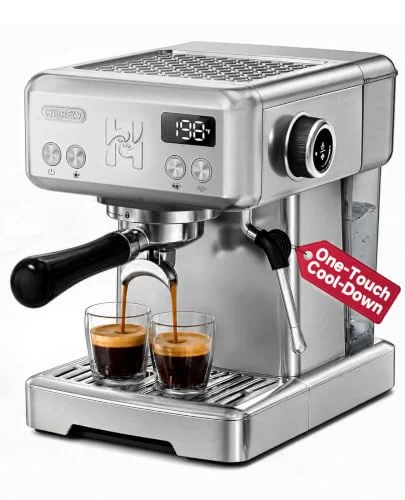
HIBREW H10 — the dedicated spout
58 mm group head, one-touch pressure release, backflush capability, adjustable extraction temperature (190°F–206°F) and extraction time (up to 100 seconds), pre-infusion mode, and a separate hot water outlet apart from the group head and steam wand.
$219.99 Check price →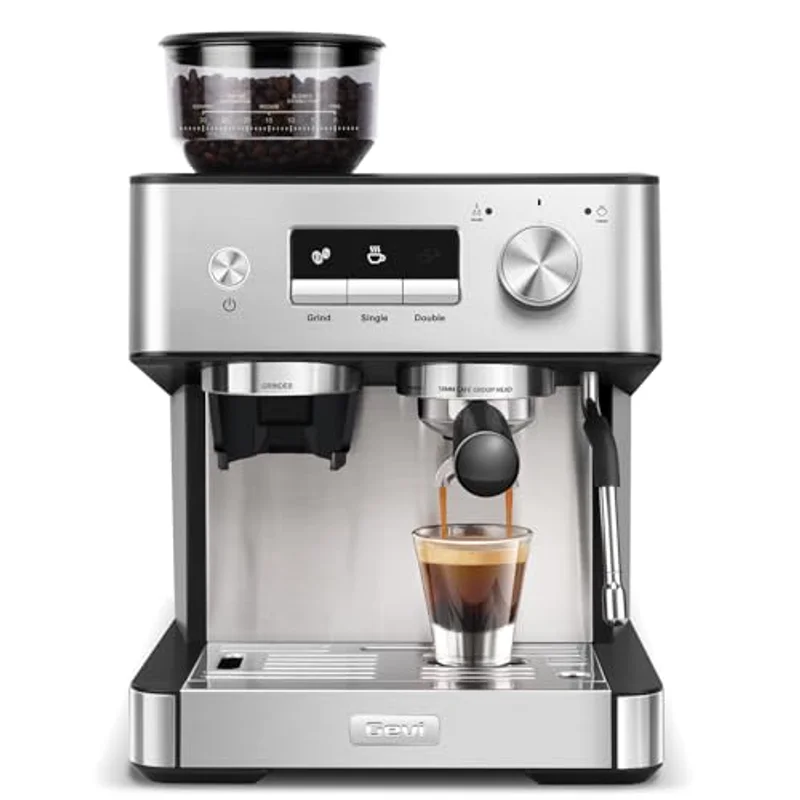
Gevi 20 Bar with Grinder — the dual-function wand
Built-in conical burr grinder with 30 adjustable settings, 20-bar pump, adjustable grind, strength and temperature, and a steam wand that switches by knob between milk frothing and hot water dispensing. 11.5"W × 12.01"D × 16.53"H.
$309.99 Check price →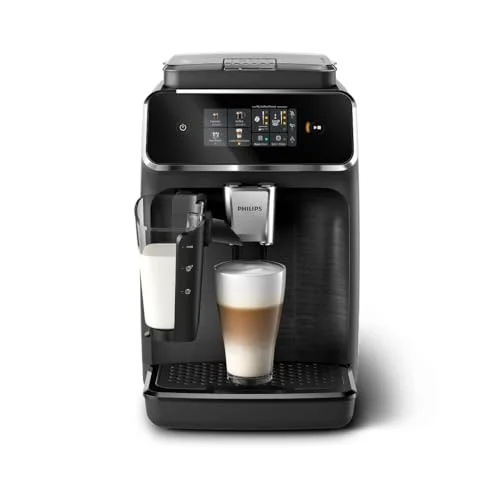
PHILIPS 2300 Series — the menu preset
Fully automatic, one-touch operation with four presets — espresso, coffee, latte and hot water — adjustable strength and volume, and the LatteGo milk system, which Philips says comes apart into three parts with no internal tubes and can be rinsed in about 10 seconds.
$549.99 Check price →Americano versus long black: which one a hot water spout actually makes
Here's a distinction that has nothing to do with any particular machine and everything to do with the order you combine two liquids. An Americano is espresso first, hot water added on top afterward — pull the shot into the cup, then top it up from the spout. A long black is the reverse: hot water into the cup first, espresso poured on top last.
The difference isn't just sequencing trivia. Espresso carries crema, the tan foam layer that forms under pressure during extraction, and crema is fragile — it breaks up when hot water is poured directly onto it. Pour the water in first and let the shot land on top, and more of the crema survives sitting visibly on the surface, which is the reasoning behind the long black method used in a lot of Australian and New Zealand coffee shops.
A hot water spout, wand or preset doesn't force either technique on you — it just supplies the water. Whichever of the three designs above you're using, the cup you get depends on which liquid you pour first, not on which machine dispensed the water. If preserving crema matters to you, pour the water in before the shot; if it doesn't, either order gets you a diluted espresso that most people in the US would simply call an Americano regardless of the technical distinction.
The downside: shared boilers and the wait between functions
This is the part the marketing copy tends to skip. Steaming milk, brewing espresso and dispensing hot water each want water at a different temperature, or at least a different thermal state, and on a lot of home machines all three draw from the same boiler or thermoblock. Steam wants water hotter than brewing does; switch from one to the other on a shared heating element and the machine typically needs a few moments — sometimes described as a "cooling flush" — to settle at the new target temperature before it will reliably deliver it.
That's the structural argument for a genuinely separate hot water path like the one HIBREW describes on the H10: a dedicated outlet, apart from the group head, has less reason to force a temperature-mode switch before it can dispense. We haven't run these three machines side by side with a thermometer and a stopwatch, so we won't hand you a number of seconds for any of them — that would be inventing test data we don't have. What we can say from the mechanics is this: the more a hot water function shares hardware with steaming or brewing, the more plausible it is that you'll notice a short wait when you switch between them, and the more a function has its own dedicated path, the less that applies. Machines that solve this most completely tend to run two boilers rather than one; our double boiler versus single boiler guide goes through what a second boiler buys you and where the extra cost stops being worth it.
The dual-function wand design carries this trade-off most directly, since the same physical wand and the same heating path serve both milk and water. A menu preset on a super-automatic sits in between: it's a single button, but it's still one internal plumbing system doing several jobs on request. Neither is a defect — both are simply built to a lower parts count than a fully separate outlet, and a lower parts count is also a lower price and less to eventually repair.
When a kettle is still the better $15 answer
None of this makes an electric kettle obsolete, and there are real situations where it's still the better tool.
Volume is the first one. An espresso machine's hot water function is built to fill a cup or two, not a teapot — if you're making tea for four people, or filling a French press, a kettle that boils a liter in a couple of minutes will beat waiting through several rounds from a machine's spout. Machines in this category typically top out with a tank in the one-to-two-liter range shared across every function, where a dedicated kettle can be sized for exactly the volume you need.
Temperature is the second. A kettle boils, full stop, and many electric kettles let you dial in a lower target for green tea or delicate infusions. An espresso machine's hot water output is generally tuned around what suits coffee-adjacent drinks, and none of the three machines above publish a separately adjustable hot-water temperature setting distinct from their brew or steam temperature — so if your tea genuinely needs 175°F rather than near-boiling, don't assume the machine's spout will get you there without checking the manual first.
And then there's plain redundancy. If the machine is off, warming up, or mid-descale, a $15 kettle still works. For anyone whose day starts with tea before espresso, or who wants hot water without waking up the whole machine, keeping a cheap kettle around isn't a failure to research the right espresso machine — it's just the more efficient tool for that specific job. The two aren't mutually exclusive; plenty of the households best served by a hot water spout still keep a kettle in the cupboard for exactly these cases.
The three designs, side by side
Same three machines, sorted by hot water mechanism. Prices are what we recorded on September 23, 2026.
| Machine | Hot water design | Machine type | Grinder | Price | |
|---|---|---|---|---|---|
| HIBREW H10 | Dedicated separate spout | Semi-automatic, 58 mm | None (uses pre-ground or a separate grinder) | $219.99 | Price |
| Gevi 20 Bar with Grinder | Dual-function steam wand | Semi-automatic | Built-in conical burr, 30 settings | $309.99 | Price |
| PHILIPS 2300 Series | One-touch menu preset | Fully automatic | Built-in (super-automatic) | $549.99 | Price |
All three sit comfortably inside a sub-$1,000 budget; our best espresso machines under $1,000 roundup lines them up against the rest of that price band if the hot water function ends up being one factor among several.
How we compared these
We compare published specifications, what the manufacturer's own listing describes, machine class and live pricing — we do not physically test these machines and we do not run a testing lab. The mechanical description of each hot water design (separate outlet, menu preset, dual-function wand) comes directly from each product's own listing copy; we have not measured dispense speed, temperature accuracy or wait times between functions on any of them, and we've said so explicitly rather than estimate a number we can't verify.
We do not publish star ratings or review counts on this site: Amazon's product data returns no rating or review count for the machines covered here, so there are no stars and no invented scores anywhere on this page. Where we've made a judgment call — that a genuinely separate outlet is structurally less likely to need a temperature-switch wait, that a kettle still wins on volume — we've said so in our own voice and shown the reasoning, so you can weigh it against your own kitchen.
Frequently asked questions
Does a hot water spout on an espresso machine replace a kettle?
For a cup or two of tea or an Americano, yes, for most people. For boiling a full teapot's worth of water, or getting a kettle-style rolling boil, a dedicated electric kettle is still faster and better suited to volume — espresso machine tanks are shared across every function and generally sized for one to two cups at a time.
What's the difference between an Americano and a long black?
It's the order you combine espresso and hot water. An Americano is hot water added on top of an already-pulled shot. A long black is hot water poured into the cup first, with the espresso poured on top last, which preserves more of the crema layer since it isn't broken up by water landing directly on it.
Why does a machine make me wait before dispensing hot water after steaming milk?
On machines where steaming, brewing and hot water dispensing share one boiler or thermoblock, each function wants a different temperature, and switching between them can require a brief adjustment period sometimes called a cooling flush. A genuinely separate hot water outlet, apart from the steam and brew path, has less reason to force that wait — though we haven't timed any specific machine's switch-over ourselves.
Can any espresso machine with a steam wand make hot water?
Many can, since a steam wand is just releasing pressurized hot water through a nozzle — turning the control to a non-steaming setting on plenty of machines yields plain hot water, whether or not the listing calls this out as a "hot water function." Always check the specific machine's manual, since not every wand is designed or rated for that use.