The Pump Brand on the Box: What 'ULKA Pump' Actually Tells You
One listing in this catalogue names its pump maker outright. Most others just state a bar number and stay quiet about the motor behind it. Here is what naming the pump brand does and doesn't prove about the machine you're about to buy.
Reader-supported: we may earn a commission if you buy through our links, at no extra cost to you. Prices are the ones we recorded in late October 2026 and they move constantly — confirm the live price before buying.
The short answer
Seeing "ULKA Pump" on a listing means the machine uses a vibration pump built by a specific, identifiable Italian manufacturer rather than an unnamed generic part. That's a real, checkable fact — ULKA is a company, not an adjective someone invented for the bullet points. What it does not mean is that the machine is more reliable, quieter, or better built than one that simply prints a bar number and says nothing about who made the pump.
Of the three machines we're looking at here, only the Hanrose Espresso Machine with Grinder and Milk Frother at $319.79 names its pump maker in the title: "20 Bar ULKA Pump." The Espresso Machine with Grinder and Frother, 30 Grind Settings, 20 Bar at $299.99 states the same 20-bar figure but says nothing about whose pump produces it. The MAttinata 1833L at $111.99 doesn't even list a bar number in its title. None of that ranks the three machines against each other — it tells you how much each listing chose to disclose about one component, and disclosure is not the same thing as quality.
What a vibration pump actually does
Almost every home espresso machine under roughly $500 — regardless of brand, color, or country of origin — uses the same basic mechanism to push water through coffee: a vibration pump, sometimes called a solenoid or reciprocating pump. Inside a small metal cylinder, an electromagnet pulses many times a second, driving a piston back and forth. Each pulse pushes a small slug of water forward through a one-way valve. String enough pulses together and you get a continuous, if slightly uneven, flow at pressure — which is also why these pumps make the characteristic buzzing or ticking sound you hear when a home machine starts pulling a shot.
This is a different animal from the rotary pumps found in commercial and high-end prosumer machines, which use a spinning motor and produce smoother, quieter, more consistent flow — at several times the cost and size. Nothing in this roundup claims a rotary pump, and nothing in this price range typically has one; vibration pumps are simply the standard part for sub-$500 semi-automatic and bean-to-cup machines, full stop.
The bar number printed on the box describes the pump's maximum output pressure, not the pressure actually delivered into the coffee puck. Espresso is conventionally brewed at around 9 bar at the puck. A pump rated to 20 bar isn't brewing twice as strong as a 9-bar pump — it has roughly twice the pressure headroom, most of which is bled off by a valve before the water ever reaches the grounds. That's true whether the pump inside is named on the listing or not, and it's true across every machine mentioned in this article.
ULKA: a real pump manufacturer, not a marketing word
ULKA is a long-established Italian manufacturer of vibration pumps, and it's one of the handful of companies that actually make this component for the broader small-appliance industry. That's a useful fact to know because it cuts against a reasonable suspicion: when a listing throws around a capitalized word next to "pump," it's fair to wonder whether it's a real supplier or just a string of letters chosen to sound technical. In ULKA's case, it's a real supplier with a real, decades-long manufacturing history in this exact part — not an invented brand.
As a general matter of how the small-appliance industry works, pump manufacturers like this one supply the same families of vibration pumps across a wide range of finished machines and price tiers, under many different machine brand names. A pump maker's name appearing on a listing is a statement about where one internal component was sourced — it isn't a statement about who designed the water boiler, the portafilter, the grinder burrs, or anything else that also determines how the finished machine performs. One named part is one named part.
That distinction matters for how to read the Hanrose listing specifically. Naming the pump maker is a point of transparency about that one component — it tells a shopper something true and specific instead of nothing. It is not, by itself, evidence about the rest of the machine's engineering, assembly quality, or how it will hold up over two years of daily use. We have no review or reliability data for any of the three machines in this article, so we aren't going to stretch one disclosed part into a verdict on the whole appliance.
Why most listings skip naming the pump at all
If ULKA pumps are common and unremarkable in this price bracket, why does almost nobody else mention a pump brand? A few ordinary reasons, none of which involve a conspiracy.
First, shoppers search for the specs that show up in filters and headline comparisons — bar rating, wattage, grind settings, tank size — not for the name of a sub-component supplier. A listing's title and bullet points are written to match what people type into the search box, and "pump manufacturer" isn't a common search term. The Espresso Machine with Grinder and Frother at $299.99 leads with "30 Grind Settings, 20 Bar" for exactly this reason: those are the numbers that move a buying decision, so that's what gets the title real estate.
Second, component sourcing can and does shift between production runs of the same model, sometimes for reasons as mundane as supplier pricing or availability at the time a batch was manufactured. A brand that is honest about this will understandably hesitate to print a specific sub-supplier's name on a listing that has to stay accurate across multiple manufacturing runs over the life of that SKU. Staying silent about the pump maker is, in many cases, simply staying accurate.
Third — and this is the case with the MAttinata 1833L at $111.99 — some listings don't even publish a bar number, let alone a pump brand, leaning instead on front-facing features like the auto milk frother and cappuccino functionality that are easier to photograph and easier to sell on. That's a choice about what to foreground, not evidence that the underlying pump spec is worse than a machine that states its bar rating plainly.
The picks
Here's what's actually on these three listings, side by side, with nothing added beyond what each one states.
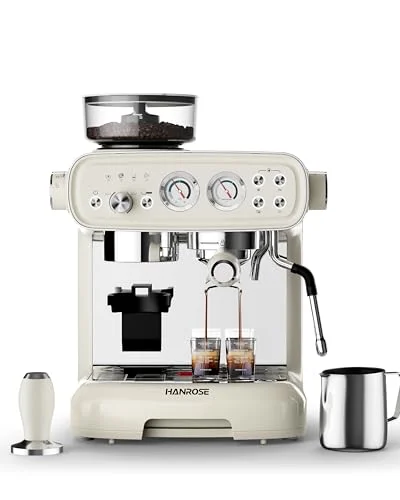
Hanrose Espresso Machine with Grinder and Milk Frother
The one listing here that names its pump maker directly: "20 Bar ULKA Pump," alongside a built-in grinder and a milk frother. Listed size is 12.99 × 13.23 × 16.54 inches — measure your counter and cabinet clearance against that before ordering, since bean-to-cup machines run tall.
$319.79 Check price →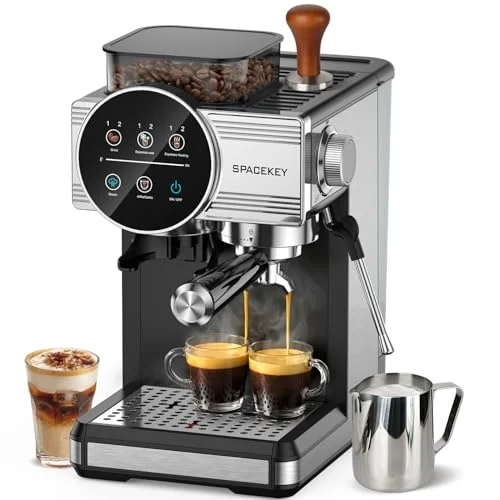
Espresso Machine with Grinder and Frother, 30 Grind Settings, 20 Bar
States the same 20-bar pump rating as the Hanrose above, plus a 30-setting built-in grinder and a frother, but the listing does not name a pump manufacturer. Listed as a "Standard Home Size" — that's the extent of the sizing information published, so confirm exact dimensions on the listing before you buy if counter space is tight.
$299.99 Check price →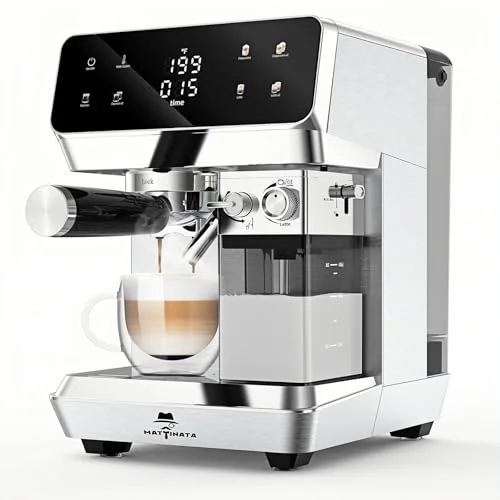
MAttinata 1833L Espresso Machine with Auto Milk Frother
The cheapest of the three at $111.99, and the one with the least published on pressure: no bar number and no pump brand in the listing title, which leads instead with the auto milk frother and cappuccino functionality. We have no size line for this one, so we won't guess at its footprint — check the listing directly if counter clearance matters to you.
$111.99 Check price →| Machine | Pump info on listing | Bar rating stated | Grinder | Price | |
|---|---|---|---|---|---|
| Hanrose with Grinder & Frother | Names maker: ULKA | 20 bar | Built-in | $319.79 | Price |
| 30 Settings, 20 Bar Machine | Not named | 20 bar | Built-in, 30 settings | $299.99 | Price |
| MAttinata 1833L | Not named | Not stated | Not stated | $111.99 | Price |
What a pump brand can and cannot tell you about reliability
Here's the honest ledger, split cleanly into what a named pump maker actually supports and what it doesn't.
What it can tell you: that the machine uses a vibration pump sourced from an established, identifiable manufacturer rather than an unbranded part with no traceable maker. It's a small, verifiable piece of transparency — the listing told you something true and specific instead of staying silent, which is itself worth something when most competing listings give you nothing at all on this point.
What it cannot tell you: almost everything else that determines whether a $319.79 or $299.99 or $111.99 machine lasts. The same pump manufacturers that supply recognizable parts also supply pumps across wildly different price tiers and build-quality levels, so naming the pump tells you nothing about the boiler, the seals, the solenoid valve, the group head, or the assembly tolerances surrounding that pump. A machine can have a perfectly good, well-known pump and still fail from a cracked gasket, a corroded thermostat, or a leak somewhere else entirely. We have no owner reviews, no return-rate data, and no reliability testing for any of the three machines named in this article, and naming one internal part does not change that — so we aren't going to imply a reliability edge that we cannot verify.
It also tells you nothing about grind quality, milk-frothing performance, or how the machine feels to use day to day. A pump is one component in an assembly of dozens. Treat a named pump brand as one accurate data point, not as a stand-in for a rating you can't otherwise find.
The specs worth checking instead of chasing a pump brand name
If the pump maker's name isn't a reliable shortcut to judging a machine, what should you actually look at? A short, practical list:
Bar rating, read correctly. Treat any bar number above 9 as pump headroom, not brew strength — a 20-bar machine and a 9-bar machine both aim to deliver roughly the same pressure at the coffee. The number tells you the pump can sustain that pressure comfortably, not that the shot will be "stronger."
Our guide to automatic pressure relief valves covers the companion part that actually bleeds off that extra headroom before it reaches the puck — another spec most listings skip the way they skip the pump brand.
What's actually in the box. A built-in grinder, the number of grind settings, a milk frother type (automatic versus a manual wand), and tank size are all stated plainly on most listings and matter more day to day than which company supplied the pump. Between the three machines here, the grinder and frother details are where the real feature gap sits — not the pump disclosure.
Published dimensions, when given. The Hanrose lists 12.99 × 13.23 × 16.54 inches; the 30-setting machine is described only as "Standard Home Size." Where a listing gives you exact dimensions, use them — where it doesn't, don't guess at a footprint, check the live listing before you buy.
Price against features, not against a brand name on a sub-component. At $111.99, $299.99 and $319.79, these three machines occupy different tiers of what they include — a frother-only machine, a grinder-plus-frother machine without a stated pump brand, and a grinder-plus-frother machine that does state one. If a built-in grinder matters to your morning more than knowing who made the pump, that's the gap that should decide the purchase. For a wider read on what else separates nearby machines at different price points, see our comparisons of Chefman, Mr. Coffee, and EUHOMY lineups, or the Kismile single- versus dual-boiler breakdown, which is the same exercise applied to a different overlooked spec.
Warranty and return terms. These sit on the Amazon listing and seller page rather than in the product title, and they matter more to what happens if any part — pump included — fails inside the coverage window than any brand name does. If your budget caps out near the low end of this range, our look at what you actually get under $80 walks through the floor of this category and where corners get cut first.
How we compared these
We compare published listing titles, bullet points, prices, and general, non-product-specific facts about how espresso machines work — how vibration pumps operate, what a bar rating measures, and who ULKA is as a manufacturer. We do not physically test these machines, we do not run a testing lab, and we do not publish ratings we cannot verify. Amazon's product data returns no rating and no review count for the machines named here, so there are no stars, no review paraphrases, and no invented scores anywhere on this page. Where we draw a line between what a spec proves and what it doesn't — like the limits of a named pump brand — that's stated plainly as our own reasoning, not as a borrowed opinion from reviews we don't have.
Frequently asked questions
Does naming the pump brand mean a machine is better built?
Not by itself. It means the listing disclosed a real, identifiable manufacturer for one internal component — the vibration pump — instead of staying silent on it. It says nothing about the boiler, seals, grinder, or assembly quality surrounding that pump, and we have no review or reliability data for these machines to say otherwise.
What's the difference between a pump's bar rating and brew pressure?
The bar number on the box is the pump's maximum output pressure. Espresso is conventionally brewed at around 9 bar at the coffee puck, regardless of whether the pump is rated to 15, 20, or higher. The extra headroom above 9 bar is bled off before the water reaches the grounds, so a higher bar number does not mean a stronger shot.
Why don't more espresso machine listings name their pump manufacturer?
Mostly because shoppers search for bar rating, grind settings, and frother type, not for a sub-component supplier's name — so listings lead with the specs that drive search and comparison. Component sourcing can also shift between production runs of the same model, which makes some brands cautious about printing a specific supplier name that might not stay accurate for the life of that listing.
Is ULKA a real pump company?
Yes. ULKA is an established Italian manufacturer of vibration pumps supplied widely across the small-appliance industry. It's a real, identifiable supplier, not a marketing term invented for a listing — though, like any named component, it describes one part of the machine, not the whole appliance.