Best Mr. Coffee Espresso Machines Compared (2026)
Mr. Coffee sells two machines that both say "espresso" on the box. One is a $59.99 steam unit with a stainless frothing pitcher. The other is a $179.99 programmable machine built around a 15-bar pump and an automatic milk frother. Same brand badge, same general shape, and almost nothing else in common. Here is what the extra $175 is actually paying for.
Reader-supported: we may earn a commission if you buy through our links, at no extra cost to you. Prices below are what we recorded for each model on October 20, 2026, and both move constantly on Amazon — confirm the live price before buying.
The short answer
Buy the Mr. Coffee 4-Shot Steam Espresso, Cappuccino and Latte Maker at $59.99 if you want the cheapest possible entry into milk-and-coffee drinks at home and you are honestly fine with something closer to strong, milky coffee than to café espresso. Buy the Mr. Coffee Espresso and Cappuccino Machine with Automatic Milk Frother at $179.99 if you want an actual pump pulling actual espresso, with the frothing automated instead of handed to you as a pitcher.
The two machines share a brand name and a product category on Amazon, and that is close to where the resemblance ends. The $59.99 model is a steam-driven unit: it boils water into steam and pushes that steam through the grounds, which is a fundamentally lower-pressure process than brewing with a pump. The $179.99 model states a 15-bar pump in its own title, puts the whole thing in a programmable stainless-steel body, and automates the milk step instead of leaving you to hand-steam a pitcher. One is a budget cappuccino maker that borrows espresso vocabulary. The other is, on paper, a legitimate pump espresso machine wearing the same badge.
Steam-driven versus pump-driven: the difference a Mr. Coffee badge does not tell you
Nothing on either box screams the distinction that matters most, which is how the water gets forced through the coffee. A steam-driven machine, like the $59.99 model here, heats water until it generates steam pressure, then relies on that steam to push water through the grounds and through a milk-frothing pitcher. It is a simple, cheap mechanism, and it is why machines in this class can sell for well under $100: there is no pump, no pressure-rated brew head, and far less to manufacture.
A pump-driven machine uses an electric pump to force water through the puck of coffee at a controlled, much higher pressure — the $179.99 model's listing puts a number on it directly: a 15-bar pump. Espresso as a style is conventionally brewed at roughly 9 bar of pressure at the coffee itself, which is the benchmark a pump machine is built to reach and a steam machine structurally is not. That gap is not a marketing nuance; it is the entire reason the beverage world treats "steam espresso maker" as its own small category, separate from "espresso machine."
The Mr. Coffee badge does not surface any of this. Both products use the word "espresso" in their titles, both show a portafilter-style basket in their product photos, and a shopper comparing them on price alone has no obvious signal that one is a steam toy and the other is a real pump machine, beyond actually reading the spec line that says "15-Bar Pump." That line is doing more work than its placement in the title suggests.
If this distinction is new information, our broader guide to espresso machines under $80 walks through where the steam-versus-pump line typically falls across brands, not just inside this one.
What $175 more actually buys: pump pressure, boiler type, automatic milk
$179.99 minus $59.99 is $175.00, and three things are doing the work of that gap, by what each listing actually states.
Pump pressure. The expensive model's 15-bar pump is the headline spec, and even accounting for the fact that bar ratings are usually quoting the pump's maximum rather than the pressure that reaches the coffee, a real pump is categorically different from steam. It is the difference between a machine that can be dialed toward the roughly 9-bar extraction espresso is brewed at, and one that structurally cannot get there. The cheap model has no pump rating in its listing at all, because it does not have a pump.
Boiler type. This is the one spec neither listing actually states, and we are not going to invent it. Whether either machine uses a single boiler, a thermoblock, or something else isn't published on either product page we're working from, so if boiler architecture and recovery time between shots matters to you specifically, that is a question for the current Amazon listing or the manufacturer's own spec sheet, not something either of us should assume from a product title.
Automatic milk. This is the clearest, most literal line item in the price gap. The $59.99 machine ships with a stainless steel frothing pitcher — you heat and froth milk yourself, by hand, the way a stovetop milk steamer works. The $179.99 machine's title leads with "Automatic Milk Frother": the frothing step is built into the machine rather than handed to you as a separate tool. If your daily drink is a latte or cappuccino and you don't want to manage milk temperature and texture by hand every morning, that single feature is a meaningful chunk of what you're paying the extra $175 for.
Add it up and the $175 gap buys a real pump instead of steam, programmability instead of a single manual mode, and an automated milk step instead of a pitcher — a bundle of concrete differences, not a brand-name markup for an otherwise similar machine.
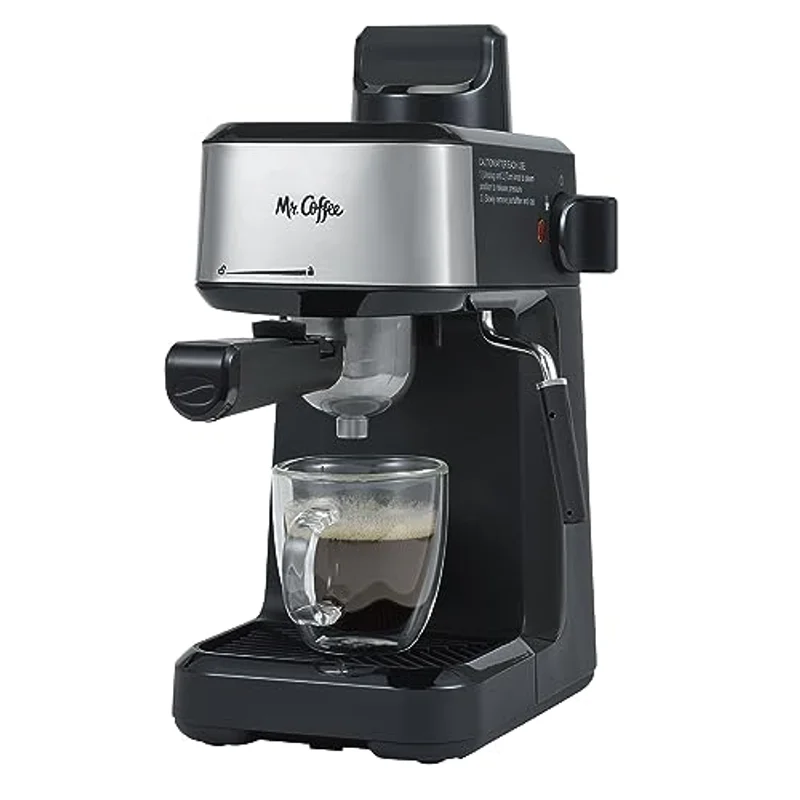
Mr. Coffee 4-Shot Steam Espresso, Cappuccino and Latte Maker
Steam-driven, 4-Shot size, with a stainless steel frothing pitcher for hand-frothed milk. The budget entry point into cappuccino and latte drinks at home.
$59.99 Check price →The picks
With only two machines sharing this brand name, there is no ranked list to build — the honest version of this guide is a straight comparison, not a top-eight. Here is how they sit side by side.
| Machine | Best for | Type | Milk | Price | |
|---|---|---|---|---|---|
| Mr. Coffee 4-Shot Steam Espresso | Lowest-cost entry | Steam-driven | Frothing pitcher (manual) | $59.99 | Price |
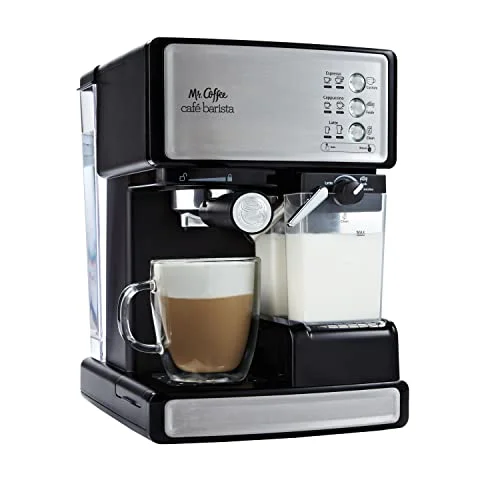 Mr. Coffee Espresso & Cappuccino Machine | Real pump espresso | 15-bar pump | Automatic frother | $179.99 | Price |
Pick the top row if the entire budget for this purchase is under $100 and you are testing whether espresso-style drinks at home is a habit worth having. Pick the bottom row if you already know the answer is yes and you want a pump pulling the shot rather than steam pushing it.
Shot quality: crema from a steam wand versus a real 15-bar pump
Crema — the reddish-tan foam that sits on top of a well-pulled shot — forms when hot water under real pressure emulsifies the oils in coffee and forces dissolved carbon dioxide out of solution fast enough to trap it as tiny bubbles. That process depends on pressure building quickly and staying high through the extraction, which is exactly what a pump is built to deliver and what steam structurally struggles to.
A steam-driven machine like the $59.99 model pushes water through the grounds using steam pressure rather than a pump, and steam pressure is a fundamentally gentler, lower-pressure process than what a 9-bar pump extraction does. What comes out tends to look and taste closer to a strong, concentrated coffee than to a café shot with a persistent crema cap — this is a general property of the steam-brewing class, not a knock on this specific unit, which does not claim to be anything other than a steam machine.
The $179.99 model's 15-bar pump puts it in the class of machine that can produce real crema, because it can generate and sustain pressure in the range that emulsifies oils and traps gas the way a café machine does. We'd flag the usual caveat on bar numbers generally: 15 bar is almost certainly the pump's maximum rating rather than the pressure delivered at the coffee puck, and espresso is conventionally extracted at roughly 9 bar regardless of how high the pump can theoretically go. But having a real pump at all — rather than steam — is the precondition for crema in the first place, and that's the gap between these two machines that matters more than the exact bar number on the box.
On the milk side, both machines can put foam on top of a drink, but by different means: a hand-held frothing pitcher on the cheap model depends entirely on your technique, while the automatic frother on the $179.99 model is built to produce consistent microfoam without you managing temperature and texture by hand.
Who the $59.99 machine is honestly still right for
This is not a guide that exists to talk you out of the cheaper machine. There is a real buyer for it, and being honest about who that is matters more than pretending every budget steam unit is a mistake.
Buy the $59.99 Mr. Coffee if any of the following is true: you have never owned a machine like this and want to find out whether the daily ritual of making a cappuccino or latte at home actually sticks before spending real money; your counter space and budget are both genuinely tight and $240 is not a casual purchase; you already know you prefer a milky, coffee-forward drink over a sharp, crema-topped shot, in which case steam extraction is arguably the right tool rather than a compromised one; or this is going into a dorm, a guest room, or a second home where it needs to exist, work, and cost very little rather than be anyone's daily-driver machine.
Do not buy it expecting café-style espresso with a thick crema cap, and do not pair it with the assumption that spending more on beans or a better grinder will close that gap — the limitation here is the brewing mechanism, not the coffee. If that's the expectation, the $179.99 model with its 15-bar pump is the one that can actually meet it, and our under-$80 buying guide covers where machines like this one sit against other steam and entry-level options at the same price.
Where this brand's jump compares to stepping up within other brands covered on this site
Mr. Coffee's $59.99-to-$179.99 spread is unusually wide for a single brand name, and unusually binary: there is no middle tier, no mid-priced pump machine without the automatic frother, no stripped-down version of the expensive one. You either buy the steam toy or the real machine, with $175 and a genuine mechanism change standing between them.
That is a different shape of step-up than what you'll find elsewhere on this site. Our comparison of the Breville Barista Express, Barista Pro and Barista Touch covers a brand that spreads its range across several tiers, where every machine is already pump-driven and the money as you climb buys refinements — faster heat-up, a better display, finer grind control — rather than a change in fundamental brewing method. Similarly, De'Longhi's La Specialista Arte Evo versus Magnifica Evo is a step-up between two pump machines that differ in how much control they hand you, not in whether they can pull a real shot at all.
Mr. Coffee's spread is closer to what we describe in legacy brand versus direct-to-consumer espresso machines: a household name using one badge across genuinely different product tiers, from a near-toy to something with real pump hardware, aimed at very different shelves and very different shoppers. If you are shopping by brand name on Amazon, the lesson here generalizes: a familiar logo tells you almost nothing about which side of the steam-versus-pump line a specific listing falls on. Read the spec line, not the badge.
How we compared these
We compared the two Mr. Coffee listings on what each product title and listing actually states: brewing mechanism (steam versus pump), pump rating where given, milk system (manual pitcher versus automatic frother), size/variant, and live price. We did not physically test either machine, and we do not run a testing lab — this comparison is research-based, built on published specifications and general, well-established facts about how steam and pump espresso brewing differ.
We also did not invent anything the listings don't state. Neither product's listing specifies a boiler type, so we said so rather than guessing; we have no verified rating or review-count data for either product, so you will not find a star rating, a review count, or any paraphrased feedback summary anywhere on this page — Amazon's product data simply doesn't give us that, and inventing it would be exactly the kind of claim this comparison is trying to avoid.
Frequently asked questions
Is the $59.99 Mr. Coffee machine "real" espresso, or is it just steam?
It's steam-driven: it generates steam pressure and uses that to push water through the grounds and froth milk, rather than using a pump. Espresso is conventionally brewed at around 9 bar of pump-driven pressure, which a steam mechanism is not built to reach, so what comes out tends to be closer to strong, milky coffee than to a café-style shot with persistent crema. It's a legitimate budget cappuccino maker; it just isn't the same brewing category as the pump machine above it.
Does the 15-bar pump rating on the $179.99 model actually matter?
What matters is that it has a real pump at all, not the specific number. Espresso extracts at roughly 9 bar at the coffee puck, and "15 bar" almost certainly describes the pump's maximum rating rather than brew pressure — a common pattern across this category. The meaningful fact is that this model can generate and sustain real pump pressure, which the $59.99 steam model structurally cannot.
Which of the two makes better crema?
The $179.99 pump model, because crema forms when water under real, sustained pressure emulsifies coffee oils and traps carbon dioxide as foam — a process pump machines are built for and steam machines are not. The $59.99 steam model can still produce a drinkable cappuccino or latte; it just won't produce the same crema cap a pump shot does.
Is the $59.99 steam machine worth buying at all?
Yes, for the right buyer: someone testing whether a home cappuccino or latte habit will stick, working with a tight budget or tight counter space, or someone who already prefers a milkier, less crema-forward drink. It's not the machine to buy if the goal is café-style espresso with real crema — for that, the $179.99 pump model is the one built to get there.