Best EUHOMY Espresso Machines Compared (2026)
EUHOMY sells two espresso machines on Amazon right now, and both run the same basic formula: a built-in grinder paired with a milk frother, in the brand's "Large" size listing. The plain EUHOMY Espresso Machine with Grinder and Milk Frother, 20 Bar Pressure runs $282.04. The EUHOMY Automatic Espresso Machine with Built-in Grinder and Milk Frother runs $339.99 — about $60 more, and the one word the listing adds to its own name is "Automatic." Here is what that word is actually telling you, and whether it's worth the gap.
Reader-supported: we may earn a commission if you buy through our links, at no extra cost to you. Prices below are what we recorded for each model — $282.04 for the base model on September 29, 2026, and $339.99 for the Automatic on October 27, 2026 — and both move constantly on Amazon; confirm the live price before buying.
The short answer
If you just want the shape of the decision: both EUHOMY machines in this comparison give you a built-in grinder and a milk frother in one appliance, and both are listed in the brand's "Large" size variant, so footprint isn't what separates them. The base model (B0FVWWW95P) states its pump pressure outright — 20 bar — and costs $282.04. The Automatic model (B0H7HMMLJX) drops the bar-pressure figure from its own title and adds the word "Automatic" instead, at $339.99.
That's a real difference in how EUHOMY chose to describe the two machines, and it's the only differentiator either listing gives us beyond price. We don't have a spec sheet that spells out grind-setting counts or frother mechanism for either machine, so rather than guess at what's inside the chassis, we'll walk through what the naming itself tells you, what's identical between the two as far as the listings go, and which one actually fits a modest daily routine.
The shared formula: grinder plus frother
Both machines commit to the same core idea before you get anywhere near price: fold a burr grinder and a milk-frothing function into one chassis, rather than selling a bare pump machine and leaving those two jobs to separate purchases. That's the formula behind most bean-to-cup machines in this price bracket, and EUHOMY has applied it to its entire current espresso lineup rather than splitting a cheap bare machine from a pricier grinder model the way some brands do.
A grinder matters here for the same reason it matters on any espresso machine: pre-ground coffee is milled to a single compromise size meant to work across every brew method, which is a poor fit for espresso specifically and stales within days regardless of how it's packaged. A milk frother matters for the same reason it matters on any machine aimed at lattes and cappuccinos rather than straight shots — without one, milk drinks fall back on a separate pitcher and a stovetop or handheld whisk. By putting both in the box on every model it sells, EUHOMY has made "do I need to buy anything else" close to a non-question across its range, at either price.
What neither listing specifies is the exact number of grind settings, the frothing mechanism (a manual wand you steam with by hand, or an automated frothing cycle), the tank size, or the wattage. We're not going to assign either machine a number we don't have — if that level of detail matters to your decision, it's a question for the live Amazon listing before you buy, not something this page can answer for you.
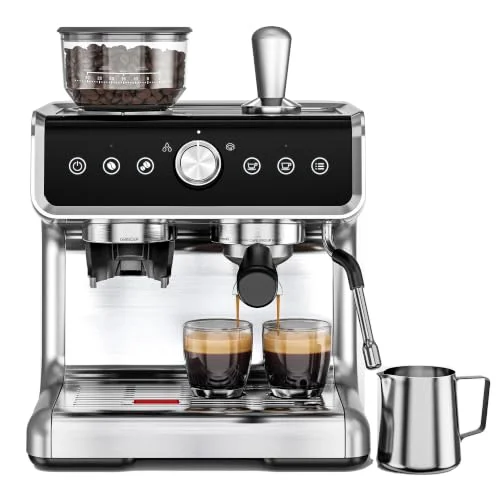
EUHOMY Espresso Machine with Grinder and Milk Frother, 20 Bar Pressure
Built-in grinder, milk frother, a stated 20-bar pump, in the "Large" size listing. The cheaper of EUHOMY's two current espresso machines, and the one whose own title leads with a pressure figure instead of the word "Automatic."
$282.04 Check price →What "Automatic" actually changes on the name
The single word that separates these two titles is "Automatic," and it's worth taking seriously rather than skipping past, because it's the only differentiator EUHOMY itself put in writing. The base model is named the "EUHOMY Espresso Machine with Grinder and Milk Frother, 20 Bar Pressure." The pricier one is named the "EUHOMY Automatic Espresso Machine with Built-in Grinder and Milk Frother" — same grinder-plus-frother formula, but "Automatic" replaces the bar-pressure number as the headline claim.
In the espresso category broadly, "automatic" usually describes how much of the brewing cycle the machine runs on its own once you start it — stopping a shot at a programmed volume instead of requiring you to watch and cut it off by eye, for instance, or running a frothing cycle on a timer rather than needing a hand on the wand the whole time. That's general background about what the word tends to signal across the category, not a confirmed feature list for this specific machine — EUHOMY's listing doesn't spell out which part of the process the automation covers, and we're not going to fill that gap with a guess.
What we can say with more confidence is what the naming choice implies about marketing emphasis. The base model's title sells on a number — 20 bar, which sounds more technical than it is, since espresso is actually brewed at roughly 9 bar at the coffee itself and a 20-bar rating describes the pump's maximum rather than brewing pressure. The Automatic model's title sells on a word instead, aimed at buyers who want less to think about during the brew rather than a bigger number on the spec sheet. Whether that's worth $59.63 more is a question about your own patience at the machine, not about which spec sheet is longer. It's the same lesson we draw in our look at a listing that puts its country of manufacture in the title: what a brand chooses to foreground in a product name tells you what it wants to sell you on, not the full spec sheet underneath it.
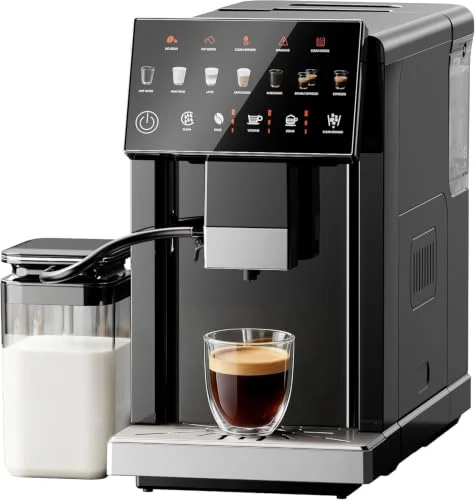
EUHOMY Automatic Espresso Machine with Built-in Grinder and Milk Frother
Built-in grinder, milk frother, in the same "Large" size listing as the base model. The pricier of the two, and the one whose own title leads with "Automatic" rather than a stated pressure figure.
$339.99 Check price →Grind settings and frothing, side by side
This is the section where we'd normally hand you a table of grind-setting counts and frother types and let the numbers do the arguing, the way we can on brands whose listings spell both out. EUHOMY's listings don't give us that for either machine: no grind-setting count on the base model or the Automatic, and no stated frother mechanism — manual wand versus an automated cycle — on either one.
What we can compare honestly is what each title does state. The base model states a 20-bar pump rating; the Automatic model doesn't restate a bar figure at all, which could mean it's unchanged, higher, lower, or simply left off the title for marketing reasons — we don't know, and we're not going to assert a number that isn't published. Both titles state "milk frother" without qualifying it further, so on the words alone, frothing reads as present on both and undifferentiated between them.
If grind adjustability or frother type is the deciding factor for you — and for a lot of buyers moving up from pre-ground coffee, it should be close to the top of the list — that's a detail to confirm directly on each live listing before ordering, not something either of us can settle from the product titles alone. The honest version of this section is that the two machines are harder to tell apart on hard specs than their price gap suggests, and that gap is a real signal worth sitting with rather than explaining away.
Where the cheaper model matches it feature for feature
Strip the word "Automatic" back out of the pricier title, and what's left reads nearly identical to the base model's: built-in grinder, milk frother, "Large" size variant, EUHOMY brand. Neither listing states a tank size, a wattage figure, or a portafilter size that we can hold up against the other, so on every spec we actually have in hand, the two machines match.
That matters because it means the $59.63 gap between $282.04 and $339.99 isn't buying a longer feature list in any way we can verify — it's buying whatever "Automatic" covers, and nothing else we can point to in writing. If your priority is simply "grinder plus frother in one box, as cheaply as EUHOMY sells it," the base model gets you there for $59.63 less, and nothing in either title suggests you'd be giving up a feature the Automatic states and the base model doesn't.
Where that reasoning breaks down is if the automation itself is genuinely what you're after — a shot that stops on its own, or a frothing cycle you don't have to babysit. In that case the base model's matching specs on paper don't help you, because the one thing it's missing is the one thing you wanted. This is the same fork a lot of espresso shoppers hit regardless of brand — grind-it-yourself control against a machine that does more of the work for you, which is exactly the trade-off we walk through in De'Longhi's La Specialista Arte Evo versus Magnifica Evo, a different brand facing the same fork.
Both machines, side by side
Prices are what we recorded on the dates noted at the top of this page.
| Machine | Grinder | Milk frother | Stated pressure | Size | Price | |
|---|---|---|---|---|---|---|
| Espresso Machine with Grinder, 20 Bar | Built-in | Yes | 20 bar | Large | $282.04 | Price |
| Automatic Espresso Machine with Built-in Grinder | Built-in | Yes | Not stated | Large | $339.99 | Price |
Which one fits a daily one-or-two-cup routine
For a single person pulling one or two shots a day — the most common home routine, and the one where a machine's ceiling rarely gets tested — the gap between these two machines is smaller in practice than $59.63 suggests. A low daily volume doesn't stress a grinder's hopper, doesn't demand back-to-back milk drinks, and doesn't push a pump hard enough for small, unstated differences in automation to show up as saved time worth noticing. At that pace, the base model's stated 20-bar pump and built-in grinder cover the job the same way the Automatic's do, for $59.63 less.
The case for paying the Automatic's premium in a one-or-two-cup routine isn't volume — it's friction at a specific moment in the day. If the appeal of "automatic" is genuinely about doing less yourself each morning rather than about handling more drinks, that's a legitimate reason to pay more even at low volume, because the benefit is per-cup, not per-day-total. It's also the harder case to verify from a listing alone: you're paying for a word, not a number, and the only way to know whether that word delivers what you expect is to read the live listing's own description and spec sheet closely before you order.
Where the math clearly favors the base model is a household with more than one or two cups a day, simply because at $282.04 against $339.99 you're starting $59.63 ahead, and neither listing gives you a stated reason tied to higher volume to prefer the pricier one. If your routine is genuinely light, the deciding question isn't "which machine does more" — on the specs we have, neither clearly does — it's "do I want to pay $59.63 for a word in a title, or keep that money and buy the machine whose claim I can actually check against a number." It's the same budget-tier logic we apply across brands in our look at what espresso machines under $80 actually get you: more money only matters if it's buying something you've confirmed you need.
Our picks
If you want the cheaper way into EUHOMY's grinder-plus-frother formula and you'd rather judge the machine by a stated number than a marketing word, the base model's 20-bar pump at $282.04 is the one to buy. Check price →
If doing less yourself at the machine is specifically what you're after, and you're willing to pay for that without a published spec to confirm exactly what changes, the Automatic model at $339.99 is EUHOMY's answer to that. Check price →
How we compared these
We compare published specifications, what each listing states in its own title, and live pricing — we do not physically test these machines and we do not run a testing lab. Where a figure isn't published, as with grind-setting counts and frother mechanism on both EUHOMY machines and the stated pressure on the Automatic model, we've said so rather than estimating one. We show no star ratings or review counts because Amazon's product data returns neither for these machines, and we never paraphrase review sentiment we haven't verified.
Where we've made a judgment call — that the price gap buys automation rather than a longer feature list, or that a light daily routine narrows the practical difference between the two — we've said so in our own voice, so you can weigh it against your own kitchen. The general facts referenced along the way (9 bar at the puck versus a pump's rated maximum, pre-ground coffee staling within days) are standard background, not claims about these two specific products.
Frequently asked questions
Do both EUHOMY espresso machines have a built-in grinder?
Yes. Both the base model (B0FVWWW95P) and the Automatic model (B0H7HMMLJX) list a built-in grinder paired with a milk frother in the same "Large" size variant. Neither listing states a grind-setting count, so we can't compare adjustability between the two beyond confirming both have a grinder at all.
What does "Automatic" mean on the pricier EUHOMY model?
EUHOMY's own listing doesn't spell out exactly which part of the brewing or frothing process the word covers. In the espresso category generally, "automatic" tends to describe a machine running more of the cycle on its own — stopping a shot at a set point, or running a frothing cycle on a timer — rather than requiring manual control throughout. That's background about the category, not a confirmed feature list for this specific machine.
Is the $59.63 price difference worth it?
It depends on what you're paying for. On the specs both listings actually state, the two machines match: built-in grinder, milk frother, same size variant. The base model even states a 20-bar pump rating that the Automatic's title doesn't repeat. If automation at the machine is specifically what you want, the premium may be worth it; if you mainly want the grinder-plus-frother formula as cheaply as EUHOMY sells it, the base model gets you there for less.
Which EUHOMY espresso machine should I buy?
For a typical one-or-two-cup daily routine, the base model at $282.04 covers the same stated formula as the Automatic for $59.63 less, since neither listing ties the Automatic's extra cost to higher volume. Buy the Automatic at $339.99 only if doing less yourself during brewing or frothing is specifically what you're paying for, since that's the one difference the naming itself points to.