Kismile Single Boiler vs Dual Boiler: What $434 More Buys
Both machines carry the Kismile name and the same 20 bar pump rating. One has a single boiler, a pressure gauge and a $155.99 price tag. The other adds a second boiler, a built-in grinder and a $471.99 price tag. Here is exactly what the $434 gap buys, and what it does not.
Reader-supported: we may earn a commission if you buy through our links, at no extra cost to you. Prices are the ones we recorded on October 29, 2026 and they move constantly — confirm the live price before buying.
The short answer
Buy the Kismile 20 Bar Espresso Machine with Milk Frother at $155.99 if you make one drink at a time and are happy to grind your beans separately or buy pre-ground. Buy the Kismile 20 Bar Dual Boiler Espresso Machine with Grinder & Milk Steamer at $471.99 if you regularly make milk drinks back-to-back for more than one person and want the grinder folded into the same box.
That $434 difference is not a markup on the same machine. It buys two specific, structural things — a second boiler and a built-in grinder — and nothing in between is implied. Both machines carry the Kismile name and the same 20 bar pump rating; past that, the listings diverge, and we only assert what each listing actually states.
What stays the same across both Kismile machines
Start with the overlap, because it is smaller than the brand name suggests. Both machines are sold under Kismile and both list a 20 bar pump rating. That number is worth a pause before it does any work in your decision: 20 bar is a maximum pump rating, not the pressure your coffee actually sees. Espresso extracts at roughly 9 bar at the puck regardless of what the pump can theoretically push, so a 20-bar spec on a budget machine and a 20-bar spec on an $1,100 machine both land at the same brewing pressure in the cup. It tells you the pump has headroom, not that one machine out-brews the other.
Beyond the pump rating and the brand, the listings do not give us a shared spec sheet to lean on. We are not told that the dual-boiler model has the same 1.4 L tank as the single-boiler one, the same portafilter size, or the same footprint — so we are not going to claim it does. If a dimension or capacity matters to your counter or your routine, that is a question for the listing page on the specific model, not something either of us should guess at from a product title.
What we can say with confidence is the category both machines sit in: semi-automatic, pump-driven espresso machines built around a portafilter, aimed at home counters rather than commercial ones. Neither is a capsule machine and neither is a super-automatic that grinds and brews at the touch of one button — the dual-boiler model has a grinder built in, but it is still a manual portafilter machine underneath, not a bean-to-cup unit that doses and tamps for you.
The second boiler: brewing and steaming at once, versus queuing
This is the headline difference, and it is a plumbing difference before it is a feature list. A single-boiler machine — the $155.99 model here — heats one reservoir of water and switches that same reservoir between two jobs: brewing espresso at a lower temperature and generating steam at a much higher one. The machine cannot do both at the same target temperature at the same time, so making a milk drink is sequential by design. You pull the shot, then you wait for the boiler to climb from brew temperature up to steam temperature, then you steam the milk.
In practice that wait is the whole story of a single-boiler milk drink. How long it takes depends on the heating element and the boiler's size, neither of which is given in this listing, so we will not put a number on it — but the mechanism itself is not a quirk of this particular machine, it is how every single-boiler espresso machine works, and it is the reason single-boiler machines are the budget-tier default across the category.
A dual-boiler machine — the $471.99 model here — gives brewing and steaming each their own dedicated boiler, held at their own temperature, all the time. There is no switch to wait on because nothing has to change temperature mid-drink. The practical payoff shows up specifically when you are making more than one milk drink, or a milk drink for someone else while you finish your own shot: the brew side and the steam side simply do not block each other.
Where this stops mattering: if you drink straight shots or Americanos most days and steam milk rarely, the second boiler is solving a problem you don't have often enough to pay $434 for. The dual-boiler advantage is entirely about overlapping brew-and-steam demand, not about making any single shot or any single milk drink better on its own.
Adding a built-in grinder to the equation
The dual-boiler Kismile also folds in a grinder — the listing calls it a "Dual Boiler Espresso Machine with Grinder & Milk Steamer," without specifying burr or blade, grind-setting count, or hopper capacity. We are not going to assert any of those details on your behalf; if the grind mechanism matters to you, that is exactly the kind of thing to confirm on the product listing before you buy, not something a title alone tells you.
What we can say in general, independent of this specific unit: a burr grinder crushes beans between two fixed surfaces set a defined distance apart, which produces a reasonably even particle size and makes espresso possible. A blade grinder is a spinning propeller that produces a mix of dust and chunks in the same batch — dust chokes an espresso puck and chunks under-extract, so a blade grinder is a poor match for espresso regardless of which machine it is bolted to. Whichever type is inside this unit, it is doing a job that otherwise falls to you and a separate appliance.
That is the actual trade the $155.99 model asks you to make: no built-in grinder means pre-ground coffee or a standalone grinder bought and run alongside it. Pre-ground coffee is milled to one fixed size meant to work across every brewing method, which is coarser than espresso wants and cannot be adjusted — a real ceiling on shot quality no matter how good the rest of the machine is. A standalone burr grinder removes that ceiling but adds a second appliance, a second thing to clean, and — if you are buying one new — its own cost on top of the $155.99 machine.
Folding the grinder into the dual-boiler machine's $471.99 price means you are not pricing those two purchases separately, and it means one less footprint on the counter and one less plug. The cost of that convenience is the one covered above in the service section of most comparisons like this: a grinder sharing a chassis with a boiler and a pump means a grinder problem is a whole-machine problem, not a problem contained to a $100 accessory you can replace on its own.
The pressure gauge and hot water function on the cheaper model
The $155.99 Kismile is not simply the dual-boiler machine with parts removed — its own listing calls out two specific features worth taking at face value: a pressure gauge and a hot water function, alongside the milk frother, stainless steel build, 1.4 L water tank and "Cappuccino & Latte" capability stated on the listing.
A pressure gauge gives you a visual read on what the pump is doing during a shot, typically showing where extraction sits relative to that roughly 9-bar target. On a machine without one, you are dialing in grind and dose by taste and by shot time alone; with a gauge, you get an extra signal while the shot is running, which matters most while you are still learning where your particular grinder and dose land. The dual-boiler listing we're comparing it against does not mention a gauge at all, so if that visual feedback matters to your workflow, it is a point in the cheaper machine's favor rather than a feature you can assume carries over to the pricier one.
A hot water function means the machine can dispense plain hot water on demand — independent of the brew path — which is what you want for an Americano, for rinsing a cup before pulling a shot into it, or for instant tea and oatmeal, without routing hot water through the brew head and the coffee puck it's meant for. It is a small, unglamorous feature on a spec sheet, and it is also the kind of thing that changes how often a machine actually gets reached for day to day, since it turns the machine into something more than a single-purpose espresso tool.
Neither feature is framed here as better or worse than what the dual-boiler model offers — the dual-boiler listing simply does not surface a pressure gauge or a named hot water function, so we cannot tell you it has either. That absence of a stated feature is not proof the feature is missing; it just means we are not going to claim it exists.
The picks
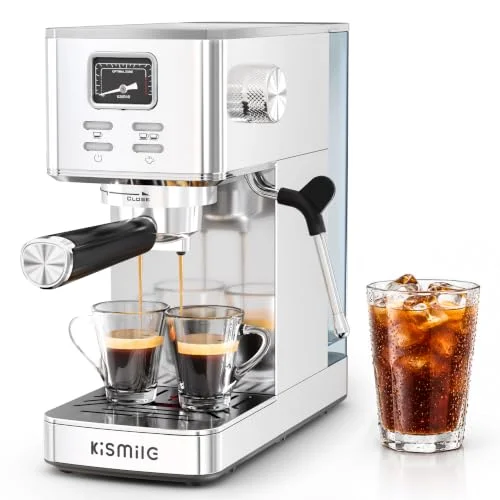
Kismile 20 Bar Espresso Machine with Milk Frother
Compact semi-automatic, stainless steel build, pressure gauge, 1.4 L water tank, hot water function, milk frother for cappuccino and latte. The pick for one person who wants a straightforward shot-and-milk routine without taking on a grinder purchase.
$155.99 Check price →This is the machine for a one-person counter where milk drinks happen one at a time and where you either already own a grinder or are fine starting on pre-ground. The pressure gauge is a genuine teaching aid while you learn grind and dose, and the hot water function earns its keep on Americano and tea days.
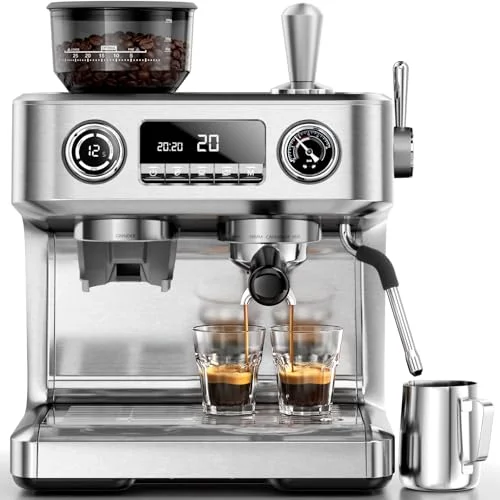
Kismile 20 Bar Dual Boiler Espresso Machine with Grinder & Milk Steamer
Dual boiler for simultaneous brewing and steaming, built-in grinder, milk steamer, same 20 bar pump rating as the single-boiler model. The pick for a household making back-to-back milk drinks or anyone who wants grinding handled inside one appliance.
$471.99 Check price →This is the machine for two people who both want milk drinks most mornings, or for one person who does not want to own and clean a separate grinder. The $434 premium over the single-boiler model is concentrated in exactly those two mechanisms — nothing more exotic is being sold here.
Side by side
Prices are what we recorded on October 29, 2026. Every row reflects only what each listing states — blanks are left blank rather than guessed at.
| Machine | Boilers | Grinder | Stated extras | Price | |
|---|---|---|---|---|---|
| Kismile 20 Bar with Milk Frother | Single | None (BYO grinder) | Pressure gauge, hot water function, 1.4 L tank | $155.99 | Price |
| Kismile 20 Bar Dual Boiler with Grinder | Dual | Built-in | Milk steamer | $471.99 | Price |
Is the $434 gap worth it for a one- or two-person kitchen?
Run the numbers the plain way first. $471.99 minus $155.99 is $434.00, and that gap buys exactly two things: a dedicated steam boiler and a built-in grinder. There is no hidden third upgrade in there — no larger stated tank, no documented extra pressure headroom beyond the shared 20 bar rating, nothing else the listings put a name to.
For a one-person kitchen where milk drinks happen one at a time, the single-boiler machine's limitation barely bites. You pull a shot, you wait for the boiler to retarget, you steam — a sequence, not a bottleneck, because nobody else is waiting on the second cup. If you already own a grinder, or you are genuinely fine starting on pre-ground while you decide whether espresso sticks as a habit, the $155.99 machine gets you brewing with a pressure gauge to learn on and a hot water function you will use more than you expect. Our look at the honest floor one tier below $100 covers just how much gets cut at the very bottom of this market — the single-boiler Kismile sits comfortably above that floor, with a gauge and a hot water tap those cheaper units typically skip.
For a two-person kitchen — or a one-person kitchen where milk drinks for guests are routine — the math changes. Two cappuccinos made back-to-back on a single-boiler machine means the second person's drink waits on the boiler's retarget time, every single morning, indefinitely. That recurring friction is what the dual boiler is actually priced to remove, and removing a daily annoyance for years is a different kind of purchase than removing it once. Layer the built-in grinder on top — a cost most buyers would pay separately anyway if they went the single-boiler-plus-standalone-grinder route — and the $434 reads less like a premium and more like two purchases bundled into one.
The one-person case against the dual-boiler machine is simple: a single-boiler machine's queuing is a non-issue if there is no second drink to queue behind the first. Paying $434 to remove a wait that only exists when two people want milk drinks at once is paying for a problem you may not have. If that is your household, the better upgrade path is the $155.99 machine plus — eventually, if you want it — a standalone grinder bought on its own terms, which is also the more flexible route if you ever change machines, since the grinder moves with you and the boiler-switching machine does not.
If grinding beans yourself at all is still an open question for you rather than a settled habit, our comparison of grinding it yourself versus letting the machine decide walks through that fork directly, independent of boiler count. And if the whole "20 bar" number on either Kismile listing is doing more convincing than it should, our note on what a label does and doesn't change and our budget-tier comparisons of Chefman, Mr. Coffee and EUHOMY machines are useful context for how this pump-rating marketing shows up across the category, not just on these two listings.
One thing not to assume
Do not assume the dual-boiler model simply has "everything the single-boiler model has, plus a boiler and a grinder." The cheaper listing names a pressure gauge and a hot water function that the pricier listing does not mention. A higher price does not automatically carry every lower-priced feature forward — check both listings against what you actually use before paying for the upgrade.
How we compared these
We compared the two Kismile listings on what each one states — boiler count, grinder presence, named features and live pricing — and we read "20 bar" sceptically, since it is a maximum pump rating rather than the roughly 9 bar pressure espresso actually brews at. Where one listing names a feature the other does not mention, we treated that as an absence of information, not as proof the feature is missing, and we said so each time rather than guessing.
We do not physically test these machines, we do not run a testing lab, and we do not publish ratings we cannot verify. Amazon's product data returns no rating and no review count for either machine, so there are no stars and no invented scores anywhere on this page — only the specifications each listing states, general espresso-machine mechanics that apply across the category, and our own labeled judgment where a call is a trade-off rather than a fact.
Frequently asked questions
Does the single-boiler Kismile also have a grinder?
No. The $155.99 Kismile 20 Bar Espresso Machine with Milk Frother is not listed with a built-in grinder — it pairs with pre-ground coffee or a standalone grinder you add yourself. Only the $471.99 dual-boiler Kismile lists a built-in grinder.
Can the dual-boiler Kismile brew and steam milk at the same time?
Yes, that is the structural purpose of a second boiler: brewing and steaming each run off their own dedicated boiler held at their own temperature, so neither has to wait for the other to retarget. A single-boiler machine, by contrast, has to switch one boiler between brew temperature and steam temperature, which makes brewing and steaming sequential rather than simultaneous.
Does a 20 bar pump rating mean stronger or better espresso?
Not on its own. Both Kismile machines in this comparison list the same 20 bar pump rating, but 20 bar is a maximum pump capability, not the pressure your coffee is actually brewed at — espresso extracts at roughly 9 bar at the puck regardless of how high the pump can theoretically go. A shared pump rating tells you both machines have headroom; it does not tell you one brews better than the other.
Is the $434 price gap just a markup, or does it buy something specific?
It buys two named things: a second, dedicated boiler for simultaneous brewing and steaming, and a built-in grinder. The cheaper machine's listing names a pressure gauge and a hot water function that the pricier listing does not mention, so the gap is not simply "more machine" in every direction — it trades some named features for others.