How to Choose an Espresso Machine (2026 Buying Guide)
Four machine classes, one over-marketed number, and a portafilter size nobody explains before you buy. Here is what actually decides whether the machine you order fits how you drink coffee — and how much of that decision is really about your grinder budget.
Reader-supported: we may earn a commission if you buy through our links, at no extra cost to you. Prices are the ones we recorded on August 22, 2026 and they move constantly — confirm the live price before buying.
Quick answer
Most first-time buyers should choose a semi-automatic pump machine — you grind, dose and tamp, the machine handles the pump and boiler — because it is the only class that lets you fix a bad shot instead of just repeating it. Decide the grinder question first: either buy a machine with one built in, such as the AMZCHEF Espresso Machine With Grinder at $180.49, or budget $80 and up for a standalone burr grinder alongside a grinder-less machine like the CASABREWS 3700 at $93.49. Ignore the pressure-bar number on the box entirely; it does not describe what happens in the cup. Everything below explains why, in the order it actually matters.
Why there are no star ratings on this page
Amazon's product API does not return a rating or a review count for the machines named in this guide, so we do not print one, and we do not paraphrase review sentiment we cannot verify. Every claim here traces back to a published spec, a price we recorded, a machine's class, or a general coffee fact that holds regardless of brand — not to unverifiable buyer sentiment or a star count we made up.
Things to know before you buy
- The grinder decides more of your cup quality than the machine does — plan for one before you plan for a machine.
- A pressure-bar number above 9 changes nothing you can taste; it is the pump's maximum rating, not the brewing pressure.
- Warm-up time ranges from about 15 seconds to several minutes depending on the heating system, and it affects your actual morning more than most spec-sheet numbers.
- Portafilter size and basket type determine whether a machine can use standard third-party baskets later.
- The honest budget line item most buyers skip is the grinder and the accessories, not the machine itself.
Why you should trust this guide
We compare published specifications, prices and machine classes, not sensory impressions from a testing lab we do not run. We do not physically test these machines and we do not run a testing lab. Ilane Tall has covered the home-espresso category for this site since it launched, cross-checking manufacturer spec sheets against what buyers actually report needing to know before checkout — grind compatibility, warm-up time, footprint — and writes every guide on that basis rather than on a taste panel.
The four classes of espresso machine
Every home espresso machine on the market falls into one of four classes, and the class matters more than the brand. Read the listing title carefully — "espresso machine" alone tells you almost nothing; the class tells you what your morning routine will actually look like.
1. Manual (lever) machines
You supply the pressure yourself, pulling a spring-loaded or direct lever to force water through the puck. This class is the smallest slice of the home market by far, prized by hobbyists for the tactile control it gives over pressure profiling — easing off partway through a shot, for instance — and none of the six machines in this guide's product set are lever machines, which is typical: lever machines are a specialist purchase, not a starting point, and most buyers researching their first machine can skip this class entirely.
2. Semi-automatic pump machines
The largest class at home, and the one we recommend most first-time buyers start with. A semi-automatic has an electric pump that generates brewing pressure, but you control the variables that actually shape the shot: grind size, dose, tamp pressure, and when to start and stop the pump. The CASABREWS 3700 Essential ($93.49), the Maestri House Slim ($56.51), the Breville BES450BSS Bambino ($249.95) and the Breville BES870XL Barista Express ($499.95) are all semi-automatic pump machines, spanning nearly the entire price range this class covers. What separates them is not the pump — it's whether a grinder, a steam wand and dose control are built in, which is the real driver of price inside this class.
3. Automatic pump machines
An automatic machine is a semi-automatic with the shot-length decision taken off your hands: you still grind, dose and tamp, but the machine stops the pump itself once it has delivered a programmed volume of water, usually via a flow meter or a timer. This removes one source of inconsistency — a shot that runs long because you got distracted — at the cost of the fine control a barista uses to adjust extraction on the fly. Few machines at the entry and mid-range price points implement true automatic shot-volume cutoff; it is more common as a feature bolted onto a semi-automatic than as a separate class you'll see labeled outright, so check the listing's feature list rather than assuming from the price.
4. Super-automatic (bean-to-cup) machines
A super-automatic grinds, doses, tamps and brews behind a single button, and often steams or froths milk automatically as well. The Ninja Luxe Café Premier 3-in-1 ($499.99) sits closest to this territory among the machines in this guide, combining an espresso mode with drip coffee and cold brew behind largely automated controls, though it still gives you more manual choice over drink type than a pure single-button bean-to-cup unit. True super-automatics trade the entire brewing decision for consistency and speed: press once, walk away, get espresso. The cost is a lower ceiling on how far you can push a shot toward your own taste, and — because the grinder and brew group share one chassis — a repair on any part of the machine usually means the whole unit goes in for service.
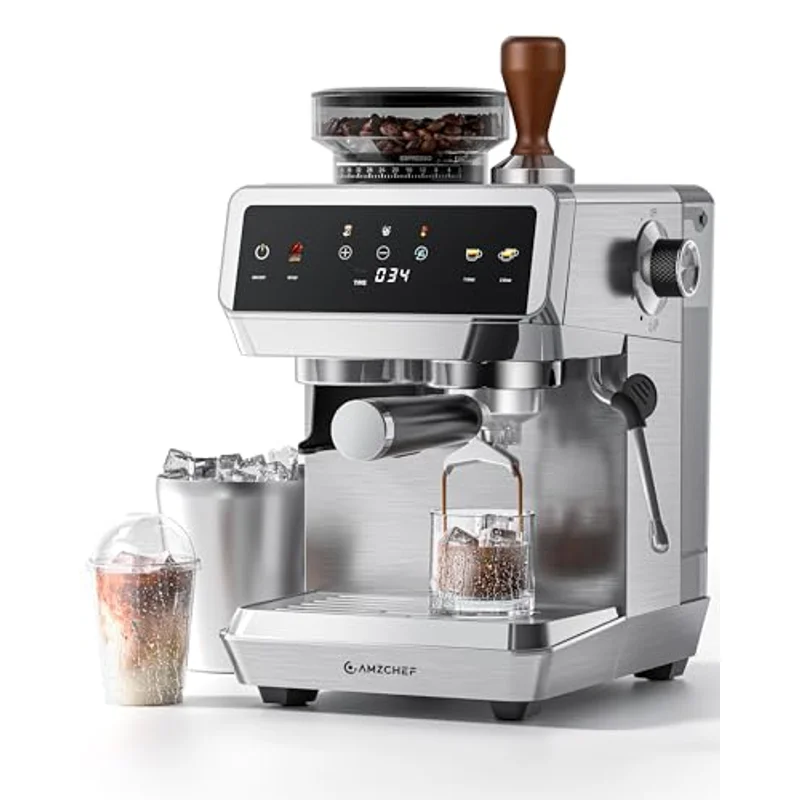
AMZCHEF Espresso Machine With Grinder
Semi-automatic with a built-in grinder offering 44 grind settings and temperature control, priced well under the machines that bundle comparable features. A practical middle ground between buying a bare pump machine and a full bean-to-cup unit.
$180.49 Check price →Pressure bars: the most over-marketed number in the category
Espresso is conventionally brewed at roughly 9 bar of pressure measured at the coffee puck. That number is decades old, comes from commercial café equipment, and is the pressure the drink is designed around — not a minimum floor that more is always better than.
Listings routinely advertise 15, 19 or 20 bar pumps, and the number is real but describes the wrong thing: it is the pump's maximum rated output, not the pressure the coffee actually experiences during a shot. A pressurised basket (more on that below) or a restriction elsewhere in the flow path bleeds off the excess before it reaches the puck, so a 20-bar pump and a 9-bar pump can produce functionally identical shots once the water is actually moving through coffee. No pump machine sold for home use brews espresso at a literal 20 bar at the puck — the physics of a compressed coffee bed won't allow it without the basket doing the pressure-limiting work for you.
What this means practically: when you're comparing two semi-automatic machines and one lists "15 bar" and the other lists "20 bar," treat that line as roughly equivalent marketing copy, not a quality signal. Spend your comparison time on the grinder, the boiler size, the portafilter diameter and the steam wand instead — those are the specs that actually change what lands in the cup.
Heating systems and warm-up time
How a machine heats water affects two things you'll notice every single morning: how long you wait before the first shot, and how well the machine handles back-to-back drinks — espresso followed immediately by steamed milk.
Entry and mid-range pump machines typically use a thermoblock or thermocoil heater, which heats water on demand as it passes through a heating element rather than storing a reservoir of hot water. These systems tend to warm up faster — often under a minute — because they're heating a small volume of water at a time, not a full boiler. The trade-off shows up when you want espresso and steamed milk close together: a single thermoblock has to switch between brew and steam temperatures, which usually means a short pause between pulling the shot and getting the wand to steam-ready.
More expensive semi-automatics, including machines built around the Barista Express platform, use a stainless steel boiler with separate temperature control paths, which is part of why they can be ready to steam almost immediately after brewing rather than needing a temperature-recovery pause. None of the products in this guide publish a boiler-type spec beyond wattage, so treat wattage as a rough proxy — a higher-wattage unit generally recovers heat faster — and check the individual listing if fast back-to-back milk drinks matter to your routine.
Super-automatic and 3-in-1 machines like the Ninja Luxe Café Premier generally optimize for walk-away convenience over instant readiness, since the whole point of the category is that you press a button and let the machine sequence the steps itself — a longer first-brew warm-up is a reasonable trade for not having to babysit the process.
Portafilter size and pressurised vs non-pressurised baskets
The portafilter is the handle-and-basket assembly you lock into the group head, and its diameter sets a hard ceiling on how large a dose you can brew and, eventually, whether third-party baskets will fit if you want to upgrade later.
54 mm is the size used by the Breville BES870XL Barista Express and has become something close to a de facto standard among prosumer and upper-mid-range machines, which means a wide range of aftermarket baskets, bottomless portafilters and accessories are built to fit it. Smaller or proprietary portafilter sizes on budget machines aren't necessarily worse for brewing, but they narrow your accessory options if you later want to swap in a precision basket or go bottomless to watch your extraction. None of the machines in this guide besides the Barista Express publish a portafilter diameter — check the listing itself before assuming compatibility with any basket you already own.
Baskets themselves come in two types. A pressurised (or "crema") basket has a small secondary restriction near the outlet that builds back-pressure regardless of your grind or tamp, which is forgiving of an imperfect grind and is why many entry machines ship with one — it produces a passable crema even from coarser, inconsistent grounds. A non-pressurised basket has no such restriction: it relies entirely on your grind size and tamp to build resistance, which means it rewards a dialed-in grinder with a noticeably better shot but punishes an inconsistent one with a thin, fast-running mess. If your machine came with a pressurised basket and you've since bought a proper burr grinder, switching to the non-pressurised basket that usually ships alongside it is one of the highest-value free upgrades available — it's just a basket swap, not a new machine.
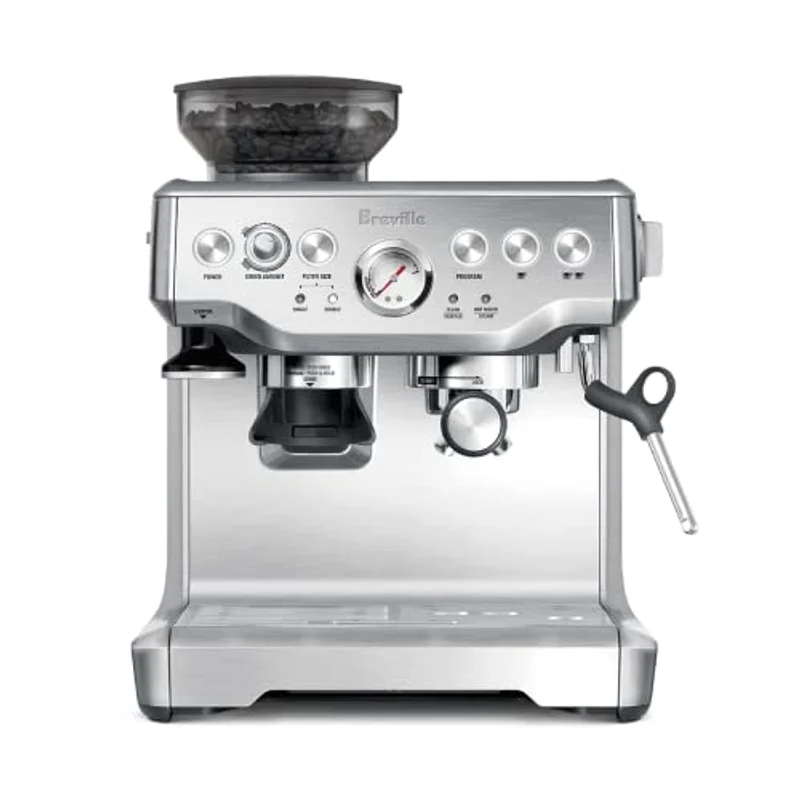
Breville BES870XL Barista Express
54 mm portafilter with both pressurised and non-pressurised baskets included, plus a built-in grinder — the machine in this guide's product set most set up to grow with you as your grind and tamp get more consistent.
$499.95 Check price →The total budget: machine, grinder and accessories
The sticker price on the machine is rarely the total cost of getting a decent shot at home, and treating it as the whole budget is the single most common way a first purchase disappoints. Walk through the pieces:
The machine. The six products referenced in this guide span $93.49 to $499.95 (prices as recorded August 22, 2026): the CASABREWS 3700 ($93.49), the Maestri House Slim ($56.51), the AMZCHEF with grinder ($180.49), the Breville Bambino ($249.95), the Ninja Luxe Café Premier 3-in-1 ($499.99) and the Breville Barista Express ($499.95).
The grinder, if not built in. The CASABREWS, the Maestri House Slim and the Bambino ship without a grinder. A standalone burr grinder capable of a fine-enough, consistent grind for espresso is a real and necessary line item — expect a wide range depending on how much adjustability and consistency you want — and it is not optional if you're serious about the drink, because pre-ground coffee cannot be tuned to your machine.
Accessories. A tamper (some machines, including the Barista Express, include one; others don't), a scale for weighing dose and yield, and a milk pitcher if your machine has a manual steam wand rather than automatic frothing. None of these are large individually, but they add up, and skipping the scale in particular makes it much harder to repeat a shot you liked.
Consumables and upkeep. Beans, water filters if your machine calls for one, and descaling solution on a schedule tied to your water hardness. Our maintenance schedule guide and our cleaning and descaling guide both cover what that ongoing cost actually looks like.
Put together, a machine with a built-in grinder like the AMZCHEF at $180.49 can be a genuinely complete starting setup for close to its sticker price, while a grinder-less machine like the $93.49 CASABREWS realistically becomes a $180–$300 setup once a standalone grinder is added — often landing in the same range as buying the AMZCHEF outright. Neither route is objectively better; it depends on whether you'd rather keep the grinder when you eventually upgrade the machine, which our built-in vs separate grinder comparison works through in detail.
The decision tree: three questions that pick your machine
If you only take one thing from this guide, take this. Answer these three questions in order and you'll land on a class, and usually a specific machine, without reading another spec sheet.
1. Do you already own a burr grinder, or are you willing to buy one separately?
Yes → look at grinder-less semi-automatics: the CASABREWS 3700 ($93.49) if budget is the priority, or the Breville Bambino ($249.95) if you also want automatic milk frothing.
No → look at machines with a grinder built in: the AMZCHEF ($180.49) for value, or the Breville Barista Express ($499.95) if you want the 54 mm portafilter and non-pressurised basket upgrade path too.
2. Do you drink milk-based drinks (lattes, flat whites, cappuccinos) daily, or mostly straight espresso?
Daily milk drinks → prioritize a machine with a capable steam wand or automatic frother — the Bambino's automatic microfoam wand or the Maestri House Slim's built-in frother ($56.51) both target this directly.
Mostly straight espresso → the steam wand matters less; put the budget weight on the grinder and portafilter size instead.
3. Do you want to learn and adjust the process, or do you want the fewest steps possible each morning?
Want to learn → semi-automatic, non-negotiable — you need the manual control to actually improve.
Want fewest steps → lean toward the most automated option available to you, such as the Ninja Luxe Café Premier 3-in-1 ($499.99), which sequences espresso, drip and cold brew with minimal manual input.
Our top picks
Three starting points that answer the decision tree above for the three most common buyers we hear from.
Breville BES870XL Barista Express
Built-in burr grinder, 54 mm portafilter, both basket types included — the machine that grows with you.
AMZCHEF With Grinder
44 grind settings and temperature control at under $200 — a complete setup near its sticker price.
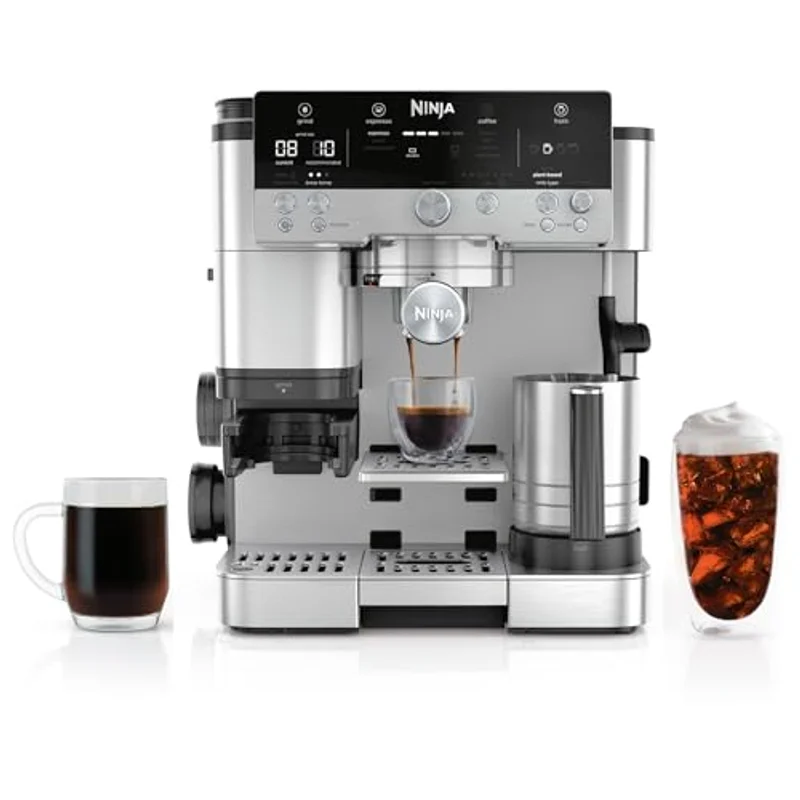
Ninja Luxe Café Premier 3-in-1
Espresso, drip and cold brew from one built-in-grinder machine, for households that want fewer steps.
How we compared
We compare published specifications, machine class, what ships in the box and live pricing, and we read pressure-bar and other marketing claims sceptically — the pressure figures in this category are routinely misleading, as explained above. We do not physically test these machines and we do not run a testing lab. Amazon's product data returns no rating and no review count for the machines named in this guide, so this page carries no stars, no invented scores, and no paraphrased review sentiment. Where a recommendation is a judgment call rather than a spec — which class suits a given routine, which basket to use once your grinder improves — we've said so in our own voice so you can weigh it yourself. General facts used throughout (9 bar at the puck as the brewing target, burr grinders outperforming blade grinders, pressurised baskets compensating for inconsistent grind) are standard background rather than claims about any specific product.
Frequently asked questions
Do I need a machine with a built-in grinder?
Not strictly — what you need is access to a burr grinder, whether it's built into the machine or sits beside it. A machine like the AMZCHEF ($180.49) bundles the grinder in for you; a machine like the CASABREWS ($93.49) leaves that purchase to you separately. Either route works if you follow through on the grinder half of it — pre-ground coffee will not extract well on any espresso machine regardless of price.
Is a higher pressure-bar rating actually better?
No. Espresso is brewed at roughly 9 bar at the coffee puck, and a machine advertised at 15, 19 or 20 bar is quoting its pump's maximum rating, not the brewing pressure. A pressurised basket or the resistance of the coffee bed itself brings the effective pressure down regardless of the pump's ceiling, so this number tells you very little about cup quality. Judge the grinder, portafilter size and steam wand instead.
What's the difference between a pressurised and non-pressurised basket?
A pressurised basket has a built-in restriction that generates back-pressure on its own, which forgives an imperfect grind and tamp — useful early on or with pre-ground coffee. A non-pressurised basket relies entirely on your grind and tamp to build resistance, rewarding a dialed-in setup with a better shot but punishing an inconsistent one. Many semi-automatic machines, including the Breville Barista Express, ship with both so you can switch once your technique and grinder are consistent.
How much should I budget beyond the machine itself?
If the machine doesn't include a grinder, budget for a standalone burr grinder as a real, necessary cost — not an optional add-on. Beyond that, a tamper (if not included), a scale for weighing dose and yield, and a milk pitcher for a manual steam wand are worth planning for. A grinder-less machine plus a decent grinder often lands in a similar total to a mid-range machine that includes one, such as the $180.49 AMZCHEF.