Beans and Grind Size: The Two Things That Fix a Bad Shot
Most disappointing home espresso has nothing to do with the machine. It's a bag of beans that went stale before it was opened, or a grinder set two clicks off — and both are free to fix once you know what to look for.
Reader-supported: we may earn a commission if you buy through our links, at no extra cost to you. Prices are the ones we recorded on August 19, 2026 and they move constantly — confirm the live price before buying.
The short answer
If your espresso tastes wrong, check two things before you touch the machine settings: how long ago the beans were roasted, and where the grinder is set. Roast date matters more than roast level — a well-stored bag between roughly one and four weeks past its roast date will out-perform a "better" bag that's already six weeks old. Grind size is the dial that turns a sour, thin shot into a balanced one or a bitter, sluggish shot into something drinkable, and it's free to adjust.
Both are true regardless of which machine sits on your counter — the Breville BES870XL Barista Express at $499.95 and a $79.99 pump machine both extract espresso through the same physics. A great grinder with stale beans still makes a mediocre shot, and a mediocre grinder with fresh, correctly-sized beans still beats it. Coffee spend is better aimed at freshness and grind accuracy than at machine price alone.
Roast date beats roast level
Roast level — light, medium, dark — is a flavor choice: lighter roasts stay closer to the bean's origin character and taste brighter and more acidic, darker roasts taste heavier and more bitter-leaning, with less of the origin coming through. Neither is objectively better for espresso, and both roast well or badly depending on the roaster. Roast date is a different kind of variable entirely: it's a freezing clock on how the beans behave once you grind them, and it applies to every roast level equally.
Coffee beans release carbon dioxide for days after roasting, a process called degassing. Fresh-off-the-roaster beans (under about 4-5 days) are still full of trapped CO2, and when hot water hits them under pressure, that gas fights the water for space in the puck, pushing unevenly and often producing a fast, uneven shot with an unstable crema. Give the same beans one to two weeks to rest and the degassing slows enough that water moves through the bed predictably — most home baristas find beans pull best somewhere between about one and four weeks past the roast date, though the exact window varies by roast level and bean density.
The other side of the clock is staling. Beans keep reasonably well for a few weeks in an airtight container away from light and heat, but flavor keeps fading after that — by six to eight weeks post-roast, most beans have lost the brightness and complexity that made them worth grinding fresh in the first place. A bag with no roast date printed on it, or one you can't verify, is a bag you're gambling on: it might be three weeks old or three months old, and you have no way to dial in around an unknown.
The practical habit: buy from a roaster (local, mail-order or a specialty grocery bag) that prints a roast date, not just a "best by" date — best-by dates are often set a year out and tell you nothing about freshness for espresso. Buy in quantities you'll use within about a month, and store the bag sealed at room temperature, not in the fridge or freezer for daily use, since temperature cycling introduces condensation that damages the beans faster than it preserves them.
Grind size, dose and time: the only three dials that matter
Espresso extraction comes down to three variables you actually control, and everything else — pressure, water temperature, machine brand — is either fixed by the equipment or secondary to these three. Espresso brews at roughly 9 bar of pressure and around 195-205°F regardless of what machine you own; the machine holds those roughly constant. What changes shot to shot is grind size, dose (how much coffee you use) and time (how long the shot runs).
Grind size sets how much resistance the water meets. Finer grounds pack tighter and slow the water down; coarser grounds pack looser and let water through faster. This is the dial you'll touch most, because grind size needs to change with roast, with humidity, and sometimes day to day as a bag ages.
Dose is the dry weight of coffee in the basket, conventionally measured in grams. A double shot commonly starts around 18 grams in, though baskets vary — the number stamped or etched into your portafilter basket is a better guide than a universal rule. Dose interacts with grind: more coffee in the same basket means a tighter bed and more resistance, so a heavier dose usually needs a slightly coarser grind to hit the same shot time, and vice versa.
Time is how long the shot runs, typically judged from when the pump starts to when you stop it. A conventional target for a double is somewhere around 25-30 seconds, though this is a guideline that varies by bean and by taste, not a hard rule. Time is the readout, not a dial you turn directly — you change grind size or dose, then read the resulting time and taste to see if you're closer or further from balanced.
Ratio ties the three together: a common starting point is roughly 1:2, meaning about 18 grams in produces about 36 grams of liquid out, though many people prefer shots anywhere from 1:1.5 to 1:2.5 depending on taste. A kitchen scale under the cup, weighing both the dry dose and the liquid yield, turns dial-in from guesswork into something repeatable — it's the single cheapest upgrade to a home espresso setup, well under the price of any machine on this site.
Bars are marketing, grind is real
A "20 bar" pump on the box means the pump's maximum rating, not the pressure at the coffee — espresso brews at roughly 9 bar regardless. Every pump machine we cover reaches that. Grind size, by contrast, changes the cup every time you adjust it. Spend your attention there, not on comparing bar numbers between listings.
Reading your shot: gusher, choke and the sour/bitter split
Two failure modes cover most bad shots, and both point back to grind size.
The gusher (too coarse). The shot runs fast — well under 20 seconds for a double — and the stream looks thin and pale rather than a slow, thickening ribbon. Water is finding gaps in the coffee bed and rushing through before it can extract much flavor. The result in the cup is usually described as sour or sharp, sometimes with a watery, thin body. Fix: grind finer, in small increments, and re-pull.
The choke (too fine). The shot barely moves, or stalls entirely, taking 40 seconds or more to fill the cup, sometimes dripping rather than flowing. The bed is packed so tight the water can't move through it at a normal rate, and it over-extracts the compounds that taste bitter and harsh. Fix: grind coarser, again in small steps.
The useful habit is treating sour and bitter as directional signals rather than just "good" or "bad." A sour, thin, fast shot needs a finer grind. A bitter, harsh, slow shot needs a coarser grind. Taste and time usually agree with each other — if the shot ran fast and tastes sour, that's confirmation, not two separate problems. When they disagree (say, a shot in the target time range that still tastes off), the bean's freshness or the dose is more likely the culprit than grind size.
One extraction note worth keeping honest: none of this is instant. Dial-in is iterative by nature — change one variable, pull a shot, taste and time it, adjust again. Expect several shots to get a new bag settled, and expect to need small readjustments again as that same bag ages over the following weeks, since grounds pack differently as beans lose moisture and gas over time.
Built-in grinder vs separate: honest trade-offs
Whichever machine you buy, the grinder is doing the work described above, and it either lives inside the machine or beside it. Both routes can produce good espresso; they trade differently on convenience, cost and flexibility.
A built-in burr grinder integrates the whole workflow: grind straight into the portafilter, no separate purchase, no extra counter footprint, and usually a dose-timer or a dial you can nudge without opening a second gadget. The AMZCHEF Espresso Machine with Grinder at $199.98 gives 44 grind settings and temperature control from 190-201°F for well under what a comparable machine-plus-standalone-grinder combination usually costs, and the Breville BES870XL Barista Express at $499.95 pairs a conical burr grinder with a razor dose-trimming tool and dual-wall baskets in one unit. The trade-off is that grinder and brew group share one chassis: if the grinder needs service, the whole machine typically goes in, and you can't swap grinders independently if you decide you want finer control later.
A separate standalone burr grinder costs more up front — a decent one runs roughly $80-200, a category estimate rather than a specific product we track here — but it survives your next machine purchase and lets you single-dose (grind exactly what you're brewing, nothing sitting in a hopper going stale). It also pairs with a machine that has no grinder at all, like the Breville BES450BSS Bambino at $249.95, which focuses its price on an automatic microfoam steam wand instead and assumes you're bringing your own grinder.
Neither route works with a blade grinder — the propeller-style grinders sold cheaply for drip coffee chop unevenly, leaving both fine dust and coarse chunks in the same batch, which is close to the worst possible input for espresso. If you're grinding for espresso, it has to be a burr grinder, built in or standalone.
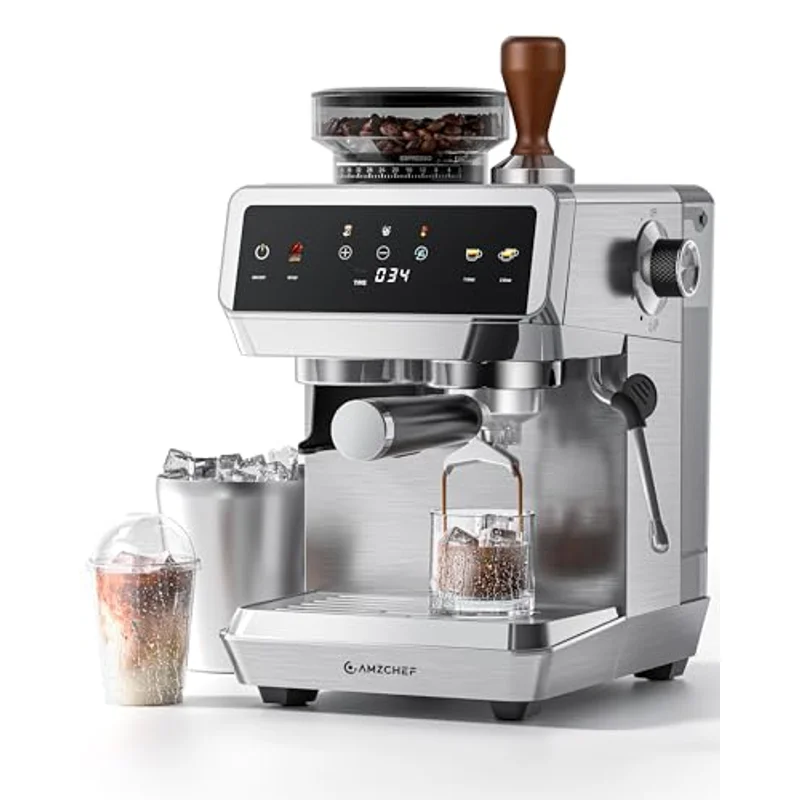
AMZCHEF Espresso Machine With Grinder, Temp Control, 44 Grind Settings
Built-in burr grinder with 44 settings, so the grind-size adjustments described above happen on the machine itself, plus brew-temperature control from 190-201°F — useful because lighter roasts generally extract better at the hotter end of that range.
$199.98 Check price →Pre-ground espresso — when it's acceptable
Pre-ground coffee is milled to one fixed size that has to work reasonably well across drip, pour-over and other brew methods, which makes it too coarse for espresso and — critically — not adjustable. If a pre-ground bag chokes or gushes your machine, you have no dial to turn; you're stuck with whatever grind the bag shipped with. It also stales faster than whole beans, because grinding multiplies the surface area exposed to air, so a bag of grounds that's been open for a week has usually lost much more character than a bag of whole beans would over the same week.
That said, pre-ground labeled specifically "for espresso" from a reputable roaster, bought recently and used quickly, is a reasonable stopgap — for travel, for a shared office machine where nobody wants to own a grinder, or simply while you're saving up for one. It will produce a flatter, less adjustable shot than fresh-ground beans, but it's not automatically undrinkable. What doesn't work is generic pre-ground drip coffee (the kind sold for automatic drip makers) run through an espresso machine — that grind is meaningfully coarser than espresso needs and will gush almost regardless of dose or time.
If you're weighing whether to buy a grinder at all versus staying with pre-ground indefinitely, our built-in vs separate grinder comparison runs the cost and convenience math at a few budget tiers.
A simple dial-in routine for a new bag
Every new bag of beans — even from the same roaster, same origin, same roast level as your last one — behaves slightly differently, because roast batches vary and freshness is a moving target. A short routine when you open a bag saves a week of confusing, inconsistent shots.
1. Check the roast date. If it's within the first few days of roast, expect degassing to make early shots less predictable; if you can wait a few more days before opening, do. If the date is already several weeks old, adjust your expectations rather than assuming your technique is off.
2. Start at your machine's middle grind setting, or wherever your last bag ended up settling, as a baseline — not the finest or coarsest setting, so you have room to move in either direction.
3. Weigh the dose. Use the basket's stamped capacity as a target (commonly around 18 grams for a double, but check your specific basket) and weigh it on a kitchen scale rather than eyeballing a scoop.
4. Pull a shot and time it from when the pump starts to when you stop pouring, and weigh the liquid that comes out.
5. Read the result against the sour/bitter split above. Fast and thin, tasting sour or sharp: grind finer. Slow and dripping, tasting bitter or harsh: grind coarser. Roughly in the target time range but still off: check your dose is accurate and your tamp is level, since an uneven tamp creates channels that behave like a too-coarse grind in part of the puck and a too-fine grind elsewhere.
6. Adjust in small increments — one or two clicks on most grinders — and re-pull. Most bags settle into a workable range within three to five adjustment shots. Write the setting down; it's your starting point next time you buy the same bean.
7. Expect to nudge it again as the bag ages over the following weeks — beans generally need a slightly finer grind as they get further from roast date, since staler beans have lost some of the resistance fresher beans put up.
Our top picks
Three ways to put the grind-size and freshness principles above to work, at three different budgets and grinder philosophies.
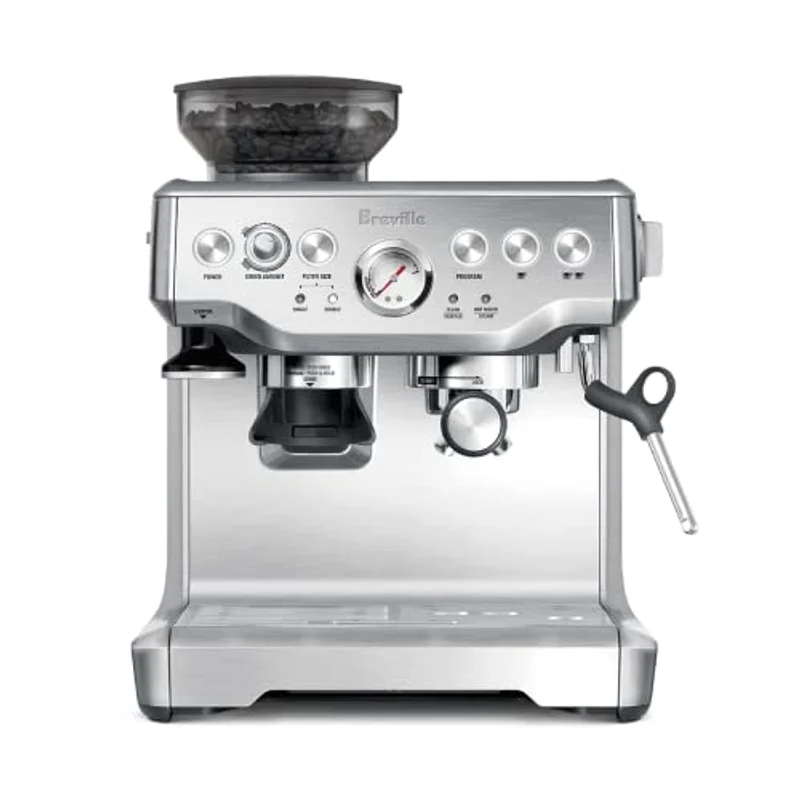
Breville BES870XL Barista Express
Conical burr grinder with dose control built into the same unit as the brew group, so grind-size adjustments and shot-pulling happen in one place.
$499.95 Check price →AMZCHEF With Grinder, Temp Control
44 grind settings and adjustable brew temperature at roughly a third of the price of the Breville, a wide dial-in range for the money.
$199.98 Check price →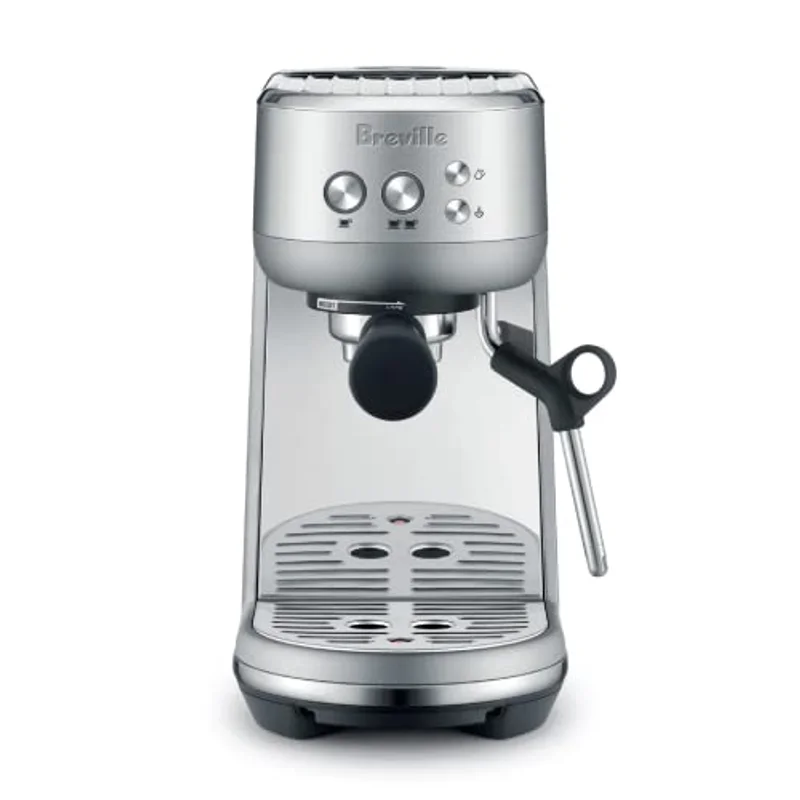
Breville BES450BSS Bambino
No built-in grinder — pairs with a standalone burr grinder of your choice, for readers who want full control over grind size independent of the machine.
$249.95 Check price →How we compared this
This guide is built on general, well-established coffee facts — degassing and CO2 release after roasting, espresso's roughly 9 bar brew pressure and 195-205°F water temperature, standard dose and ratio conventions, burr versus blade grinding — cross-referenced against the published specifications of the machines named. We do not physically test these machines, we do not run a testing lab, and we do not publish ratings we cannot verify: Amazon's product data returns no rating and no review count for the machines on this site, so there are no stars and no invented scores anywhere on this page. Where a recommendation is a judgment call rather than a hard fact — for instance, that most bags pull best one to four weeks post-roast — we've said so, because that window varies by bean and by taste.
Frequently asked questions
How long after roasting should espresso beans rest before use?
Most home baristas find beans pull best somewhere between about one and four weeks past the roast date. Very fresh beans (under about 4-5 days) are still releasing CO2 from roasting, which can make shots run unevenly; beans much past six to eight weeks have usually lost enough flavor that the cup tastes flatter, regardless of how carefully you dial in the grind.
What's the difference between a gusher and a choked shot?
A gusher runs too fast (well under 20 seconds for a double) with a thin, pale stream and usually tastes sour or sharp — the grind is too coarse and water is moving through the bed too easily. A choked shot barely moves, often taking 40 seconds or more, and tends to taste bitter or harsh — the grind is too fine and the water is over-extracting as it struggles through. The fix in both cases is a small grind-size adjustment in the opposite direction.
Do I need a built-in grinder, or can I use a separate one?
Either works, as long as it's a burr grinder rather than a blade grinder. A built-in grinder, like the one on the AMZCHEF or the Breville Barista Express, keeps everything on one machine and is usually cheaper than buying an equivalent machine and grinder separately. A standalone grinder costs more up front but survives your next machine and lets you single-dose. Blade grinders chop unevenly and aren't suitable for espresso either way.
Is pre-ground coffee ever okay for espresso?
Pre-ground coffee specifically labeled for espresso, from a reputable roaster and used quickly after opening, is a reasonable stopgap for travel or a shared machine. Generic pre-ground drip coffee is meaningfully too coarse for espresso and will usually gush regardless of dose or time, since there's no way to adjust a bag that's already been ground.