Espresso Machine vs Moka Pot vs AeroPress: What You Actually Get
Three ways to make strong coffee at home, three completely different machines behind the word "strong." Only one of them makes espresso. Here is what 9 bar actually buys you, what crema does and doesn't tell you, and the real two-year cost of each route.
Reader-supported: we may earn a commission if you buy through our links, at no extra cost to you. Prices are the ones we recorded on August 18, 2026 and they move constantly — confirm the live price before buying.
The short answer
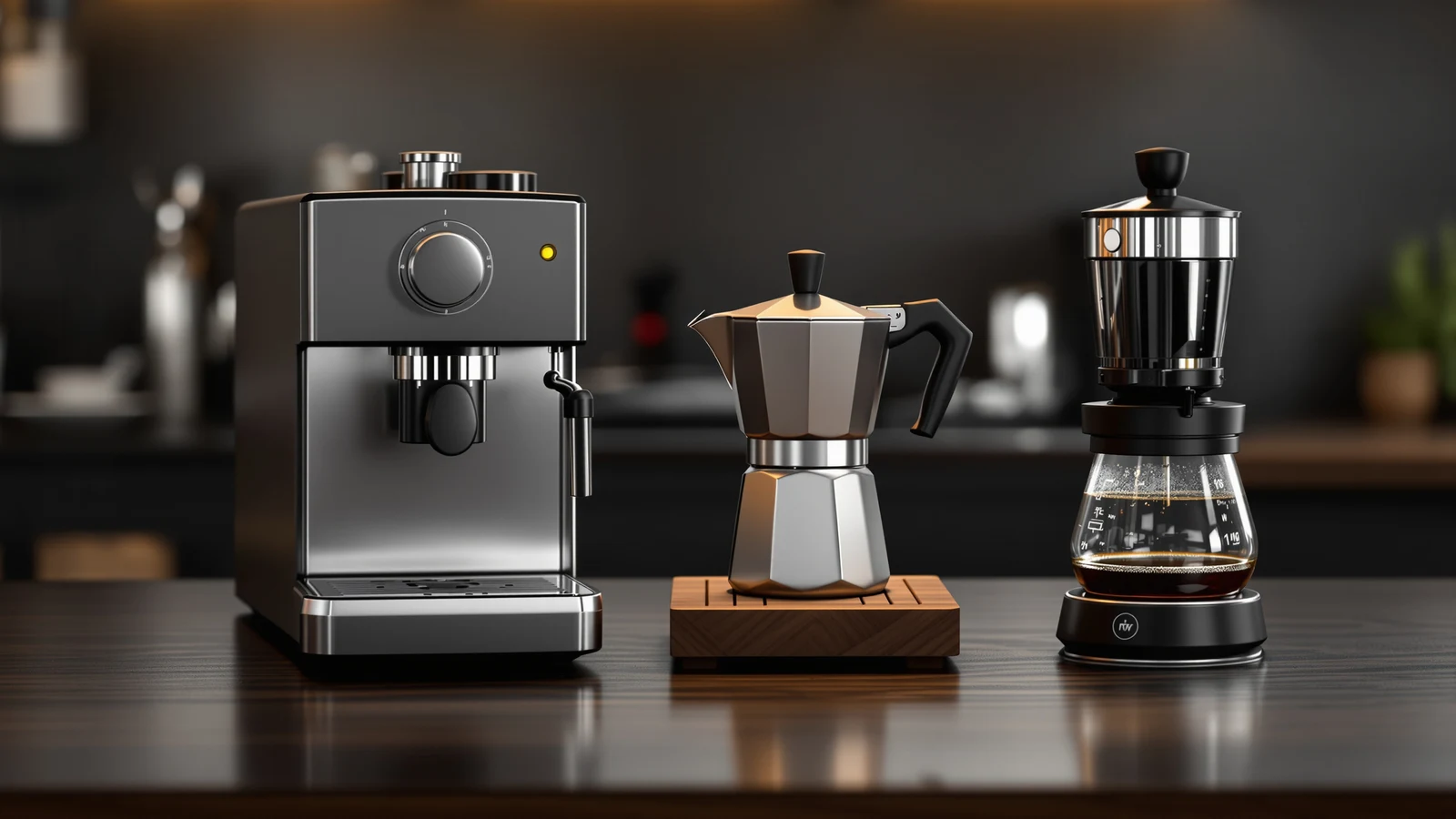
These three brew methods aren't competing for the same job. An espresso machine forces hot water through finely-ground, tamped coffee at roughly 9 bar of pressure and produces a small, concentrated shot with crema on top — that pressure is the one thing a moka pot and an AeroPress cannot replicate, no matter how good the beans are. A moka pot uses steam pressure, well under 2 bar, to push water up through grounds on a stovetop, and it makes something genuinely strong and enjoyable that is not espresso. An AeroPress uses hand pressure through a paper filter and makes a clean, low-bitterness concentrate closer to strong filter coffee than to either of the others.
If what you actually want is a small cup of intense, crema-topped coffee with steamed milk on top, only a pump espresso machine gets there — something like the Chefman CraftBrew at $74.99 or the CASABREWS 3700 at $99.99 is the floor for that. If what you want is strong black coffee for less money, less counter space and almost no learning curve, a moka pot or an AeroPress does the job for under $50 and neither one needs an outlet.
What 9 bar actually means, and why the number on the box lies
Espresso is defined by pressure, not by darkness of roast or strength of taste. A bar is a unit of pressure roughly equal to atmospheric pressure at sea level, and espresso extraction happens at approximately 9 bar of pressure at the coffee puck — water forced through a compacted bed of finely-ground coffee in about 25 to 30 seconds. That combination of fine grind, firm tamp and sustained pressure is what pulls oils and dissolved solids out of the coffee fast enough to produce a concentrated shot with a layer of crema, rather than a large cup of dilute coffee.
Here is where the marketing gets misleading: machines are routinely sold on their pump's maximum rating — "15 bar," "19 bar," even "20 bar," like the AMZCHEF 20 Bar at $74.99. That number describes what the pump can generate before the water ever reaches the coffee, not the pressure the coffee actually experiences. Every properly built pump machine, including ones rated at 15 bar like the Chefman CraftBrew, regulates down to roughly 9 bar at the puck, because that's the number that produces good espresso — going higher just channels through the grounds unevenly and extracts worse, not better. A 20-bar rating is not twice as good as a 9-bar shot; it's a pump spec that has nothing to do with what lands in your cup.
What actually matters is whether the machine has a pump at all. Steam-driven machines, like the Mr. Coffee 4-Shot at $54.99, use boiling water and steam pressure instead of a dedicated pump, and steam pressure tops out well below the 9 bar that real espresso needs. That's an entirely different category from the CraftBrew or the CASABREWS 3700, both of which use a pump. If a listing doesn't say "pump," don't assume it behaves like one.
Why a moka pot isn't espresso, and why that's not an insult
A moka pot has three chambers: water in the bottom, ground coffee in a funnel-shaped basket in the middle, and the brewed coffee collects in the top. You put it on a stove burner, the water heats, steam pressure builds in the sealed bottom chamber, and that pressure — typically estimated at somewhere around 1 to 1.5 bar, nowhere near 9 — pushes the water up through the grounds and into the top chamber, where it hisses and gurgles until it's done.
That pressure difference is the whole story. At roughly a sixth of espresso's brewing pressure, a moka pot cannot force water through coffee fast enough to pull a true crema, and the grind is typically coarser than an espresso grind because a finer one would choke the flow entirely at that low pressure. What you get instead is a small, strong, black coffee — closer to a very concentrated drip coffee than to espresso, with more body than a standard cup but without the syrupy mouthfeel or the crema layer.
None of that makes it worse coffee, just a different drink. It's also mechanically simple: no motor, no pump, no electronics, no water reservoir to descale on a schedule the way an espresso machine's boiler needs — our cleaning and descaling guide covers why that matters for machines with pumps and boilers. A moka pot's only maintenance is rinsing it out and occasionally replacing the rubber gasket that seals the two halves.
Where the AeroPress fits: neither pressure route
The AeroPress skips pressure-driven extraction almost entirely. You steep coffee and hot water together in a plastic chamber for roughly 30 seconds to two minutes, then press a plunger down through a paper filter to push the brewed coffee into your cup. The force is whatever your arm applies — informally estimated by enthusiasts at somewhere around half a bar to 1 bar depending on grind and how hard you push, far below even a moka pot's steam pressure, let alone espresso's 9 bar.
Because it uses a paper filter rather than a metal one, the AeroPress produces a notably clean cup: the paper traps oils and fine sediment that a moka pot's metal filter and an espresso machine's portafilter both let through. The result is closer to a very strong, low-bitterness filter coffee than to a moka pot's intensity or an espresso's concentration — no crema, less body, but also less of the harshness either pressure method can produce from a slightly wrong grind. It's also the fastest of the three to clean: the used puck of grounds and filter pops out in one piece.
If your goal is genuinely just "strong coffee, minimal fuss, minimal cost," the AeroPress is arguably the easiest of the three to get right on the first try, because there's no tamping technique and no stovetop timing to misjudge.
Crema: what it tells you, and what it doesn't
Crema is the reddish-tan foam that sits on top of a properly pulled espresso shot, formed when hot water under real pressure emulsifies the coffee's natural oils and forces dissolved carbon dioxide out of solution as tiny bubbles. It only forms reliably at pressures in the espresso range — which is precisely why a moka pot's coffee looks flatter and darker on top, and why an AeroPress produces essentially none.
What crema does tell you: the shot was pulled at real pressure through a reasonably fresh, reasonably fine, reasonably even grind. Fresher-roasted beans also produce more crema, because they still hold more dissolved CO2, so a thick crema layer is a rough signal that both the machine and the beans are doing their job.
What crema does not tell you: it is not a measure of flavor quality, and a thick crema layer does not mean a shot tastes good — a stale, over-extracted, or badly-dosed shot can still produce visible crema if the pressure and grind were technically in range. It's also not a health or caffeine indicator, and it says nothing about the coffee's origin or roast level beyond "roasted somewhen recently." Treat it as a pass/fail signal on brewing method and freshness, not as a scorecard for the cup.
Cost per cup and total cost of ownership over two years
The honest version of this math requires stating assumptions, because none of these routes has a fixed price — bean cost varies by roast and origin, and how often you brew changes everything. Here is the arithmetic with the assumptions on the table: one cup a day, 365 days a year, for two years, using a mid-range grocery coffee at roughly $14 per 12-ounce bag, which yields about 20 cups at a typical dose.
Moka pot: A basic stovetop moka pot generally runs $20–40 depending on size — a category estimate, not a product we sell here. No electricity cost worth counting on a gas or electric stovetop burner already in use. Bean cost per cup at roughly 15 grams of grounds is about $0.70. Two-year total: roughly $30 hardware plus about $511 in beans, call it $541, almost entirely bean cost.
AeroPress: The device itself typically runs $30–40, plus ongoing paper filters that cost only a few cents per cup in bulk packs. Bean dose per cup is similar to the moka pot's, around $0.70. Two-year total: roughly $35 hardware plus about $511 in beans plus perhaps $15 in filters, call it $561.
Espresso machine: A pump machine worth owning starts around $74.99 (the Chefman CraftBrew) to $99.99 (the CASABREWS 3700). Espresso doses run higher per cup — about 18 grams — so bean cost is closer to $0.85 a cup, or roughly $621 over two years. Add the machine, and the CraftBrew route totals roughly $701; the CASABREWS route roughly $721. Neither figure includes a burr grinder, which you need for real espresso and which typically adds $80–200 — our grinder-versus-machine comparison works through that decision in detail.
The gap isn't really about the appliance — a $74.99 machine and a $30 moka pot are both cheap. It's that espresso's finer grind and larger dose burn through beans faster, and that a legitimate machine setup usually needs a grinder the other two don't. If your goal is the lowest cost per cup, full stop, the moka pot wins; if your goal is a genuine espresso-and-milk drink at home instead of a $6 café one, the math in are home espresso machines worth it still generally favors the machine over time, because it's being compared against café prices, not against a moka pot.
Time and skill: the morning routine for each
A moka pot's routine is fill, load, screw shut, put on a burner, and wait — typically five to eight minutes depending on stove heat, with the only skill being knowing when to pull it off before it scorches (the tell is usually a change in the sound as the chamber empties). No tamping technique, no dialing in grind size against a stopwatch. It's the lowest-attention option of the three once you've done it a handful of times, precisely because it doesn't demand precision the way pressure-driven extraction does.
An AeroPress routine runs about two to three minutes total: heat water, add grounds, steep, stir, press. There's a small technique curve around grind size, steep time and press pressure, but the tolerance for error is wide because the paper filter smooths out a lot of mistakes that would ruin an espresso shot. It's also nearly silent and needs no stovetop or dedicated outlet — genuinely the fastest clean-start-to-finish routine of the three.
An espresso machine demands the most of you before it demands anything of your morning. Grind size, dose weight, tamp pressure and shot time all have to land in a fairly narrow window for the shot to taste right, and getting there takes real dialing-in — our guide to pulling a good shot walks through it step by step. Once dialed in, the actual pull takes 25 to 30 seconds, plus warm-up time for the machine, plus milk-steaming time if you're making a latte or cappuccino rather than a straight shot. It is also the only one of the three where getting it slightly wrong is common and produces something genuinely unpleasant — sour, thin, or bitter and choked — rather than just "milder than usual."
Who should skip the machine entirely
Skip the espresso machine if you drink coffee for the caffeine and the ritual more than for the specific taste of a pressure-pulled shot — a moka pot or an AeroPress gets you strong, satisfying coffee with far less money, far less counter space, and none of the learning curve. Skip it if you don't drink milk-based drinks; a large part of an espresso machine's appeal over the other two is the steam wand, and if lattes and cappuccinos aren't part of your routine, that's the main thing you're paying for and not using.
Skip it if you make coffee for one person, occasionally, rather than daily — the fixed cost of a machine plus a grinder is hard to justify against a $30–40 moka pot or AeroPress if you're brewing three or four times a week rather than every morning. And skip it if kitchen space or noise is a real constraint: pump machines need a dedicated spot near an outlet and a water source, run a boiler and a pump audibly, and need periodic descaling — our maintenance schedule guide lays out what that upkeep actually looks like. A moka pot lives in a drawer between uses and an AeroPress needs a shelf the size of a coffee mug.
The people who benefit most from a machine are the ones replacing a genuine daily café habit — someone spending $5–6 a day on a latte has the clearest payback case, worked through with stated assumptions in are home espresso machines worth it. Everyone else should weigh whether they actually want the specific thing espresso is — small, concentrated, crema-topped, milk-compatible — against wanting strong coffee generally, which the other two routes deliver for a fraction of the cost and complexity.
If you do want a machine: the cheapest one worth owning
Below a certain price, "espresso machine" stops meaning pump-driven and starts meaning steam-driven, and that distinction matters more than any other spec on the box. The Mr. Coffee 4-Shot Steam Espresso Cappuccino and Latte Maker at $54.99 is the cheapest machine in this comparison, and it uses steam pressure rather than a pump — which puts it in the same pressure category as a moka pot, not in the same category as the machines below it in price. It includes a stainless steel frothing pitcher, so milk drinks are part of the design, but the coffee side of the equation won't produce a true espresso shot.
The floor for a real pump-driven shot is the Chefman CraftBrew Espresso Machine at $74.99. It's a 15-bar pump machine with a digital panel, a steam wand for milk, and a 1.5 L removable water reservoir — a genuine pump, real portafilter-based extraction, and the ability to actually reach that 9-bar brewing pressure that steam-driven machines can't. Just above it, the CASABREWS 3700 Essential at $99.99 is also a pump machine with a steam wand, in a compact stainless build, if the extra $20 buys a build you prefer.
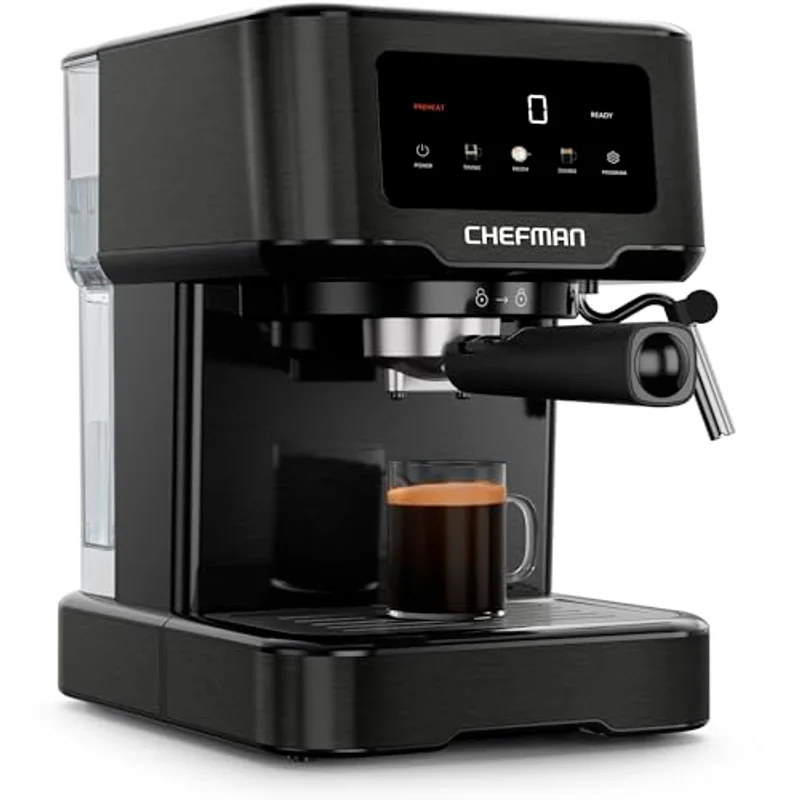
Chefman CraftBrew Espresso Machine
The cheapest pump-driven machine in this comparison: 15-bar pump, digital shot-volume control, steam wand for milk, 1.5 L removable water reservoir. This is the floor price for a machine that can actually reach real espresso pressure rather than steam pressure.
$74.99 Check price →None of the machines in this comparison include a burr grinder, so pre-ground coffee is what you'd start with on any of them — fine for a first machine, but a real limitation once you want to dial in a specific shot. If a built-in grinder matters to you, our picks under $200 cover that tier in more depth, and built-in versus separate grinder works through whether to buy one bundled or on its own.
The three methods, side by side
Prices are what we recorded on August 18, 2026.
| Method | Brewing pressure | Crema | Time | Typical entry cost | |
|---|---|---|---|---|---|
| Pump espresso machine | ~9 bar | Yes | 25–30 sec pull, plus warm-up | $74.99 | Price |
| Moka pot | ~1–1.5 bar (steam) | No | 5–8 min on the stove | ~$20–40 | — |
| AeroPress | ~0.5–1 bar (hand) | No | 2–3 min total | ~$30–40 | — |
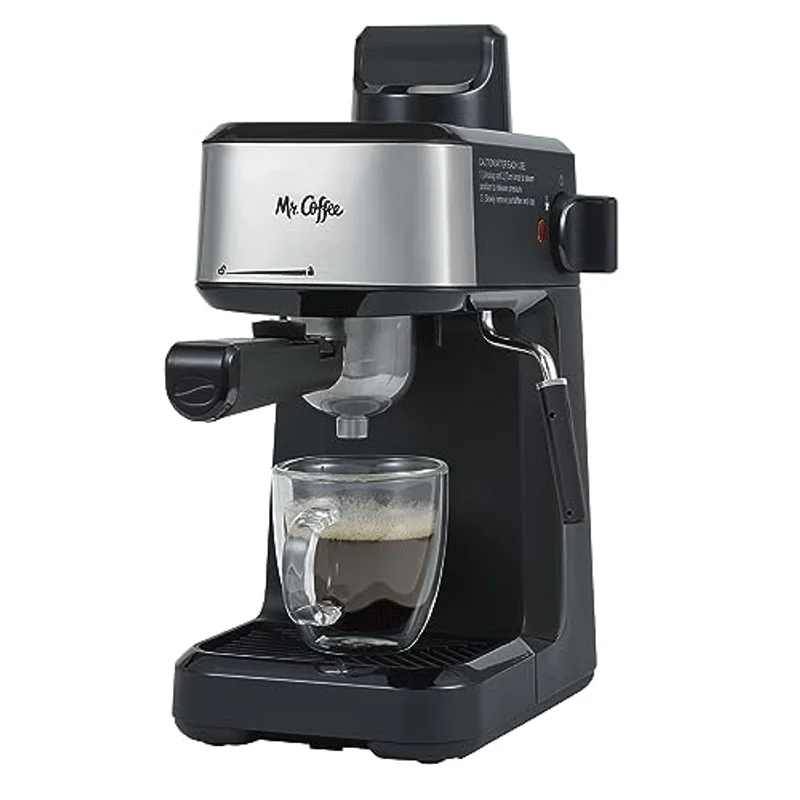 Steam machine (Mr. Coffee 4-Shot) Steam machine (Mr. Coffee 4-Shot) | Below espresso range | Minimal | ~2–4 min | $54.99 | Price |
Moka pot and AeroPress prices are general category estimates, not products we sell links for — see the products list above for the machines we do carry links to.
One thing not to conflate
"Strong" and "espresso" are not the same word. A moka pot and an AeroPress can both make coffee that tastes just as strong, or stronger, than a shot of espresso — strength is about concentration and dose, which any of the three can push up or down. Espresso is specifically defined by the pressure it's brewed under and the crema that pressure produces. If strength is your goal, all three routes get you there; if the specific espresso experience is your goal, only a pump machine does.
How we compared these
We compare published specifications, machine class, what ships in the box, and live pricing — we do not physically test these machines, we do not run a testing lab, and we do not publish ratings we cannot verify. Amazon's product data returns no rating and no review count for the machines on this site, so there are no stars and no invented scores anywhere on this page. The general brewing facts in this article — approximate brewing pressures, crema formation, grind and dose ranges — are standard, widely documented coffee-science background rather than claims about any specific product, and where a comparison involves a judgment call rather than a spec, we've said so in our own voice.
Cost figures use the stated assumptions (one cup a day, two years, a $14 mid-range bag of beans) so you can substitute your own bean cost and brewing frequency and get a different, equally valid number. Moka pot and AeroPress hardware prices are general category ranges rather than prices for specific products we link to, since this site's product links are limited to the espresso machines listed above.
Frequently asked questions
Can a moka pot make real espresso if I use a fine enough grind?
No. Espresso is defined by brewing pressure of roughly 9 bar, and a moka pot's sealed chamber generates steam pressure generally estimated at around 1 to 1.5 bar — a fraction of what's needed. Using an espresso-fine grind in a moka pot typically chokes the flow entirely rather than producing crema, since the pot has no pump to force water through that fine a bed. The grind that works in a moka pot is coarser than an espresso grind for exactly this reason.
Is AeroPress coffee the same strength as espresso?
It can be brewed strong, but it's a different drink. AeroPress uses hand pressure — far below even a moka pot's steam pressure — through a paper filter, producing a clean, low-bitterness concentrate closer to strong filter coffee than to espresso. You can increase the coffee-to-water ratio to make it more intense, but it won't develop crema or the syrupy body that comes specifically from brewing at espresso pressure.
Does more crema mean better-tasting espresso?
Not necessarily. Crema mainly indicates that a shot was pulled at real pressure through a reasonably fresh, reasonably even grind — it's a rough pass/fail signal on method and bean freshness, not a flavor score. A shot can be technically over-extracted or badly dosed and still show visible crema if the pressure and grind were in range, so don't judge a shot on crema alone.
What's the cheapest way to get an actual espresso shot at home?
Among the products in this comparison, the Chefman CraftBrew at $74.99 is the floor: it's a genuine 15-bar pump machine that can reach the roughly 9-bar brewing pressure espresso needs, unlike steam-driven machines such as the Mr. Coffee 4-Shot at $54.99, which brew at pressures below the espresso range. Budget separately for a burr grinder if you want to dial in the shot, since none of the machines here include one.