Measure before you buy
Every listing photo makes a machine look like it will fit anywhere. The number that matters is not on the hero image — it is in the specifications table, three scrolls down, and it is the one dimension sellers routinely underplay: depth with the portafilter locked in.
Width is the easy part. It is the number printed in bold on the listing and it is usually accurate. The CASABREWS CM5418 and the Maestri House Slim are both built around a narrow chassis specifically so they read as "compact" in search results, and width is where that shows up first — measure the gap on your counter with a tape measure, not by eyeballing the product photo next to a coffee mug for scale.
Depth is where kitchens actually run out of room. A portafilter handle sticking out the front adds several inches beyond the machine's resting footprint, and that clearance has to exist for you to lock it in, twist it out, and knock the puck free without the handle hitting a backsplash, a spice rack or the kettle next to it. If your counter runs along a wall with upper cabinets close behind, measure front-to-back with an imaginary portafilter extended, not just the machine's resting depth.
Clearance above the tank is the one people forget entirely. A water tank you fill from the top needs the lid to open fully with the machine still sitting under its shelf or cabinet — not pulled out onto the counter every time, because that gets skipped after week two and the machine runs dry instead. Before you buy, open the cabinet or shelf situation you plan to use and check there is room for a lid to swing up, not just for the machine's resting height.
None of the five machines below publish a "clearance above tank" spec, because nobody does — it is not a standard measurement. The proxy is overall height: a shorter machine generally needs less clearance above it, but confirm against your own shelf before ordering, and expect to return something that clears the spec sheet but not your actual cabinet.
What compact costs you: tank, cup height, steam recovery
A smaller footprint is not a free upgrade. Three things shrink along with the chassis, and all three change how the machine behaves on a Tuesday morning, not just how it looks in a listing photo.
Tank size. Water has to live somewhere, and in a narrow body that means a shorter, shallower reservoir. The AERCANA lists a 34 oz removable tank, which is the largest of the five we cover here and still noticeably smaller than the 60–67 oz tanks common on full-size bean-to-cup machines. A smaller tank means more trips to the sink — the tradeoff runs through this whole guide, and it is covered on its own below.
Cup height. The gap between the drip tray and the spout has to accommodate whatever you put under it, and compact machines sometimes shave that clearance to keep the overall unit shorter. If you drink from a tall travel mug or a 12-ounce latte glass rather than a standard 2 to 3-ounce espresso cup, check the clearance dimension specifically — none of the five machines here publish a cup-height figure, so treat this as a question for the listing's Q&A section or a return-window test, not something to assume.
Steam recovery. A boiler sized for a compact chassis holds less water and less heating element, which generally means it takes longer to get back to steam temperature after pulling a shot, and it runs out of steam sooner during back-to-back milk drinks. None of the products in this guide publish a steam-recovery time, so we are not going to assign specific numbers to specific machines — but it is the mechanical reason "small and cheap" and "makes four lattes in a row without a wait" rarely describe the same unit. If your household routinely wants two or three milk drinks back to back, budget mentally for a wait between them rather than assuming a compact machine matches a full-size one; our guide to espresso machines with a milk frother covers the wand-versus-automatic tradeoff in more depth.
None of this is a reason to skip compact machines — it is the honest list of what a smaller chassis trades away, so you can decide which trade you can live with before the box arrives rather than after.
Maestri House Slim Espresso Machine with Milk Frother
A 20-bar Italian pump machine built around a slim chassis, with a 1.3 L water tank and a milk frother included. The name is the design brief: this is a machine built to be narrow first.
$139.99 Check price →
The picks, by footprint and price
These are the five real, currently listed machines we compare in this guide. We sorted them by what actually varies for a small kitchen — price floor, milk system, and tank size — rather than by an invented overall winner, because the right one depends on your counter and your coffee habit, not on a single score.
01Cheapest entry
IMUSA 4 Cup Electric Espresso Cappuccino Coffee Maker
The lowest-cost way to find out if espresso in a small kitchen suits you
4 Cup · electric moka-style brewer · black
At under $50, the IMUSA is the floor price in this guide, and it earns its place here on that alone: if you are not sure you will keep making espresso at home, or you are furnishing a first apartment and every dollar of counter appliance budget is spoken for, this is the machine to find out with before spending three times as much. It is a 4-cup electric maker rather than a pump machine with a portafilter, so treat it as an entry point into the habit, not as the machine you compare on pressure or milk-texturing spec against the others below.
The trade-offThe listing does not give us a width, depth or tank-size spec to publish here, so measure the photo dimensions against your own counter before ordering rather than assuming "4 Cup" means small in every direction. If you want a milk system or a stated tank size, look at the AERCANA or Maestri House instead — and if $47 still feels like a stretch for a machine you're not sure will stick, our picks under $200 cover the next tier up.
02Biggest tank
AERCANA Espresso Machine 20 Bar with Milk Frother
The most water between refills, in a compact stainless body
Compact · 20-bar pump · 34 oz removable water tank · milk frother · stainless steel
Of the five machines here, the AERCANA carries the largest published tank at 34 ounces, and a removable one at that — you can fill it at the sink instead of hauling a jug to the machine, which matters more than it sounds like in a kitchen too tight to stand a jug on the counter next to the unit. It pairs the tank with a milk frother and a 20-bar pump, and Amazon lists it for home, office or small-space use, which is the segment it is aimed at.
The trade-off"20 bar" describes the pump's maximum rating, not the pressure delivered to the coffee — espresso brews at roughly 9 bar regardless of what the pump can reach, so don't pick this over another compact machine on that number alone. Judge it on the tank and the milk system instead, which are the specs that actually differ here.
03Built narrow
Maestri House Slim Espresso Machine with Milk Frother
A footprint-first design, for counters where every inch is spoken for
1.3L Espresso Machine · 20-bar Italian pump · milk frother
Where the AERCANA leads with tank size, the Maestri House leads with the chassis itself — "Slim" is in the product name, and the 20-bar Italian pump and included milk frother put it in the same functional class as the AERCANA at a higher price. If your kitchen's bottleneck is genuinely width rather than how often you refill, this is the one to measure your counter against first.
The trade-offThe listing gives a 1.3 L tank capacity but not a width or depth figure we can publish here, so confirm the actual footprint on the current listing before buying — "Slim" in a product name is a marketing claim, not a spec.
04Compact + steam wand
CASABREWS CM5418 Compact Espresso Machine
A steam wand instead of an automatic frother, in a small chassis
Small · milk frothing steam wand
CASABREWS builds specifically toward the small-kitchen buyer — the CM5418 is listed as a compact espresso machine and pairs that footprint with a milk frothing steam wand rather than an automatic frother. A manual wand asks more of you than a one-touch frother, but it also gives you control over milk texture that an automatic system does not, which is worth knowing before you assume "compact" and "simple" mean the same thing here.
The trade-offWe don't have a published width, depth or tank-size figure for this listing, so verify the current spec sheet against your counter before ordering, and expect the steam wand to take a few tries to get comfortable with if you have only used automatic frothers before.
05Premium compact
Breville BES450BSS Bambino
The narrowest machine here that still automates the milk
Small · brushed stainless steel · automatic microfoam steam wand
The Bambino is the most expensive machine in this guide at $249.95, and the reason to consider it in a small kitchen is the same reason it made our main guide's "best for milk" pick: Breville built it narrow specifically so it fits where a full bean-to-cup machine can't, and its steam wand textures milk automatically rather than asking you to learn one by hand. If your kitchen is tight and your daily drink is a latte or flat white, this is the compact machine that removes the most manual steps.
The trade-offThere is no grinder built in, so factor in a separate burr grinder — our grinder guide covers that decision by budget. At $249.95 it is also more than double the next machine on this list, which is real money in an apartment kitchen budget.
Refill frequency: the real annoyance of a small water tank
Nobody returns a compact espresso machine because it makes bad coffee. The complaint that actually shows up, months in, is smaller and more tedious: the tank runs dry mid-week, at the exact moment you're rushing out the door, and the sink is a few steps further than it would be if the machine were still sitting on a bigger counter.
The math is simple once you separate the two variables that decide it: how much water your tank holds, and how much espresso your household actually drinks. A double shot uses roughly 2 ounces of brew water; add rinsing, steam for milk, and a wasted first pull while the machine heats up, and real daily use runs higher than the shot volume alone suggests. Against a 34 oz tank like the AERCANA's, two people having one drink each most days empties it over roughly a week; skip a day of dishes and the tank quietly runs low without anyone noticing until the pump starts sputtering air.
A removable tank — the AERCANA specifically calls this out — turns the refill from "carry the whole machine to the sink" into "lift out a container, fill it, put it back," which sounds trivial until you've done the alternative in a kitchen too small to shuffle a plugged-in appliance around. If a listing doesn't specify whether the tank is removable, treat that as a real question to ask before buying, not a detail to assume.
The practical fix, regardless of which machine you buy, is to make refilling a fixed habit rather than a response to running dry: top off the tank every morning before the first cup, the same way you'd check a coffee maker's carafe. It costs ten seconds and removes the failure mode entirely.
Storage tricks for beans, tamper and portafilter in a tiny kitchen
The machine is only half the footprint. Beans, a tamper, a spare portafilter basket and — if you have one — a knock box all need a home, and in a small kitchen "on the counter next to the machine" is usually not an option.
A few things that actually help: store beans in a small opaque canister in a cabinet rather than the bag they came in left out on the counter — light and heat both degrade roasted coffee, and counters near a window or a warm machine are the worst place for them anyway. Keep the tamper and any spare basket in a shallow drawer near the machine rather than a cabinet across the kitchen, since the annoyance of a two-step walk is exactly the kind of friction that makes a habit lapse after a few weeks. A magnetic strip or small hook mounted to the inside of a cabinet door can hold a tamper off the counter entirely, which matters more on an 8-inch-wide footprint than it would on a full kitchen island.
If your machine has a portafilter, get in the habit of knocking out the puck directly into the trash or a small dedicated container rather than leaving it to sit — wet grounds in a cramped space attract fruit flies faster than you'd expect, and a rinse-and-dry routine takes seconds if you do it immediately after pulling a shot rather than at the end of the day. The bigger maintenance job — descaling — matters just as much in a small kitchen as a large one; our cleaning and descaling guide lays out the schedule.
When a pod machine is the honest better answer
None of the five machines in this guide are capsule systems — this site covers pump and steam-driven machines, and a genuinely honest buying guide has to say plainly when that's not the right category for you.
If your kitchen constraint isn't really about a few inches of width but about not wanting to deal with a portafilter, a tamper, dialing in a grind, or cleaning a steam wand at all, a pod-based machine is a legitimate and often better answer — not a compromise you're settling for. Capsule machines are typically the narrowest units on the market because there's no portafilter clearance to design around, no hopper, and often no removable water tank larger than what a handful of pods need. The tradeoff runs the other way from everything in this guide: you give up grind control and per-cup cost, and gain a footprint smaller than any pump machine can match along with genuinely zero technique.
If that trade sounds right for your kitchen and your patience, it's worth researching pod machines specifically rather than forcing a pump machine into a space it will always fight. And if you're still undecided between control and convenience more broadly, our semi-automatic versus super-automatic guide covers that same tension one level up, before you even get to pods.
The five, side by side
Same five machines, sorted by price. Prices are what we recorded on August 17, 2026.
| Machine | Best for | Milk | Tank | Price | |
|---|
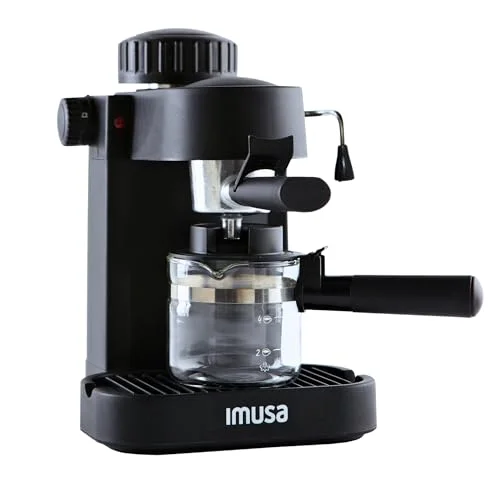 IMUSA 4 Cup IMUSA 4 Cup | Cheapest entry | None | Not published | $46.98 | Price |
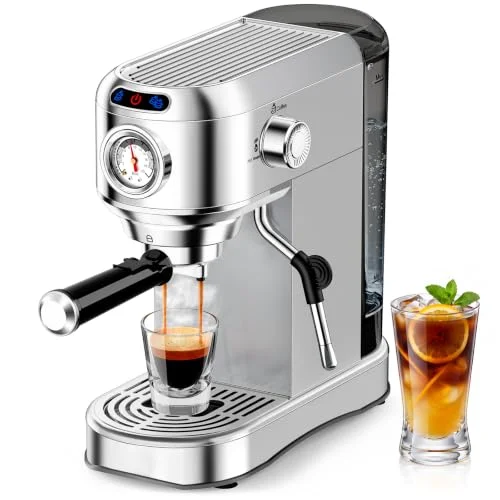 AERCANA 20 Bar AERCANA 20 Bar | Biggest tank | Frother | 34 oz, removable | $99.99 | Price |
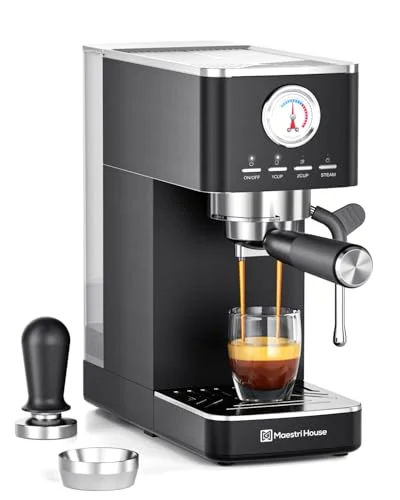 Maestri House Slim Maestri House Slim | Built narrow | Frother | 1.3 L | $139.99 | Price |
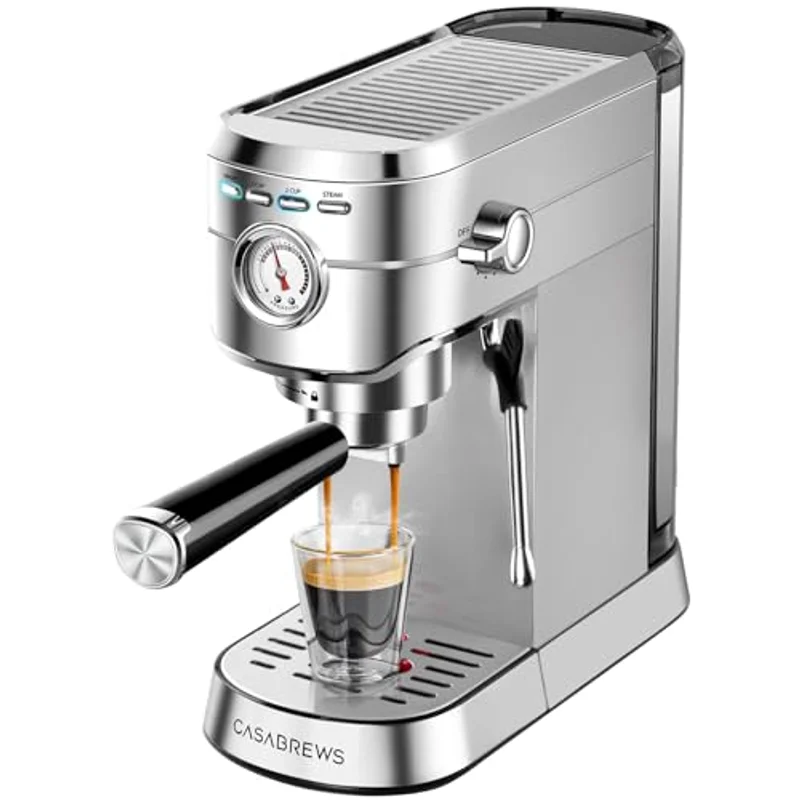 CASABREWS CM5418 CASABREWS CM5418 | Compact + wand | Steam wand | Not published | $139.99 | Price |
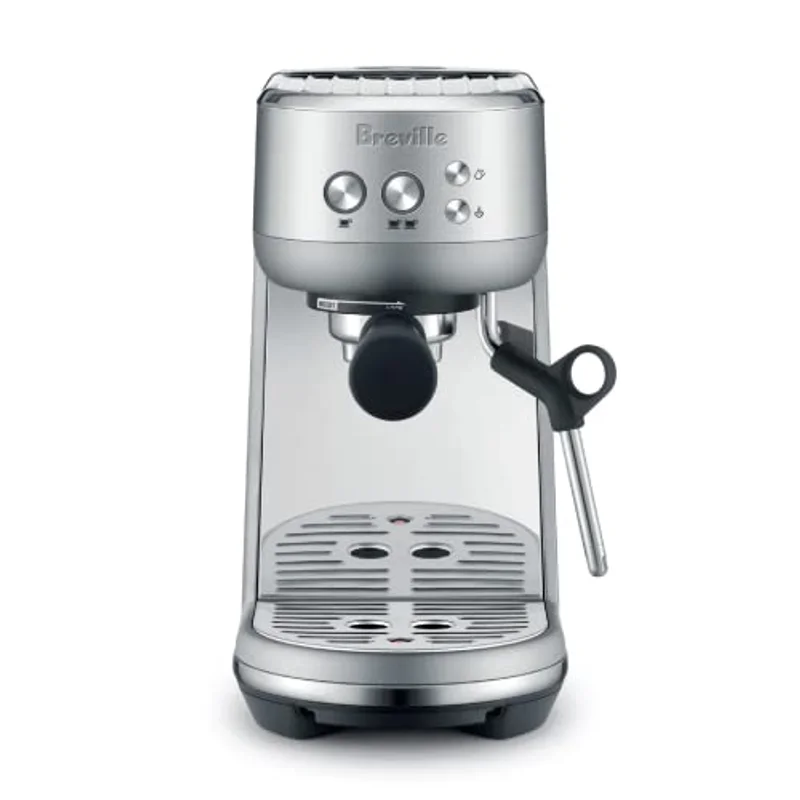 Breville Bambino Breville Bambino | Premium compact | Auto microfoam | Not published | $249.95 | Price |
How we compared these
We compare published specifications, what ships in the box, machine class and live pricing, and we read pump-pressure marketing sceptically — a "20 bar" rating describes the pump's maximum, and espresso brews at roughly 9 bar at the puck regardless of that number. We do not physically test these machines, we do not run a testing lab, and we do not publish ratings we cannot verify: Amazon's product data returns no rating and no review count for the machines on this site, so there are no stars and no invented scores anywhere on this page.
Several of the five machines here don't publish a width, depth or tank-size figure in the data we have, and where that's true we've said so directly rather than guessing at a number that sounds plausible — if a spec isn't given, we don't assert it, and we point you to the current listing to confirm it yourself before buying. The general facts referenced above (espresso brewing at roughly 9 bar, a double shot using about 2 ounces of water, roasted beans degrading faster in light and heat) are standard background rather than claims about any specific product. The rest of the method sits on our main espresso machine guide.
Frequently asked questions
What's the narrowest espresso machine that still makes real espresso?
Of the machines in this guide, the CASABREWS CM5418 and Maestri House Slim are both built specifically around a narrow chassis — "Slim" and "Compact" are in their product names — while the AERCANA and Breville Bambino are also described as compact. None of the four publish an exact width figure in the data we track, so confirm the current listing's dimensions against your counter before ordering rather than relying on the product name alone.
Does a smaller espresso machine make weaker coffee?
No — a smaller chassis doesn't change the pressure or the chemistry of extraction, since espresso brews at roughly 9 bar regardless of the machine's footprint. What a compact body typically shrinks is the water tank, the boiler size, and sometimes the cup clearance, which affects tank refills and steam recovery between drinks, not shot quality itself.
How often will I need to refill a small espresso machine's tank?
It depends on tank size and household use, so do the arithmetic with your own numbers: a double shot uses roughly 2 ounces of brew water, plus more for steaming milk or rinsing. Against a 34 oz tank like the AERCANA's, two people having one drink each most days will empty it over roughly a week. A removable tank makes the actual refill faster even if it doesn't change how often you do it.
Should I just buy a pod machine instead for a small kitchen?
If your main constraint is wanting zero technique — no grind, no tamp, no steam wand to clean — a pod machine is often a better fit than forcing a pump machine into a tight footprint, since capsule systems are typically the narrowest machines on the market. The tradeoff is giving up grind control and paying more per cup over time. None of the five machines in this guide are pod systems; if that's the route you want, it's worth researching capsule machines specifically.
Keep reading