Best Espresso Machines
Buying guide · Under $500

The best espresso machines under $500 — the sweet spot, explained.

Five hundred dollars is where steam-driven toys and pressurized-basket tricks stop and real pump espresso starts — but it's still short of prosumer pricing. Here is exactly what the extra $200 over an entry-level machine buys you, and where we'd tell you to stop spending.

By Ilane Tall · Updated August 20, 2026 · Research-based.5 machines compared, $46.96 to $299.95

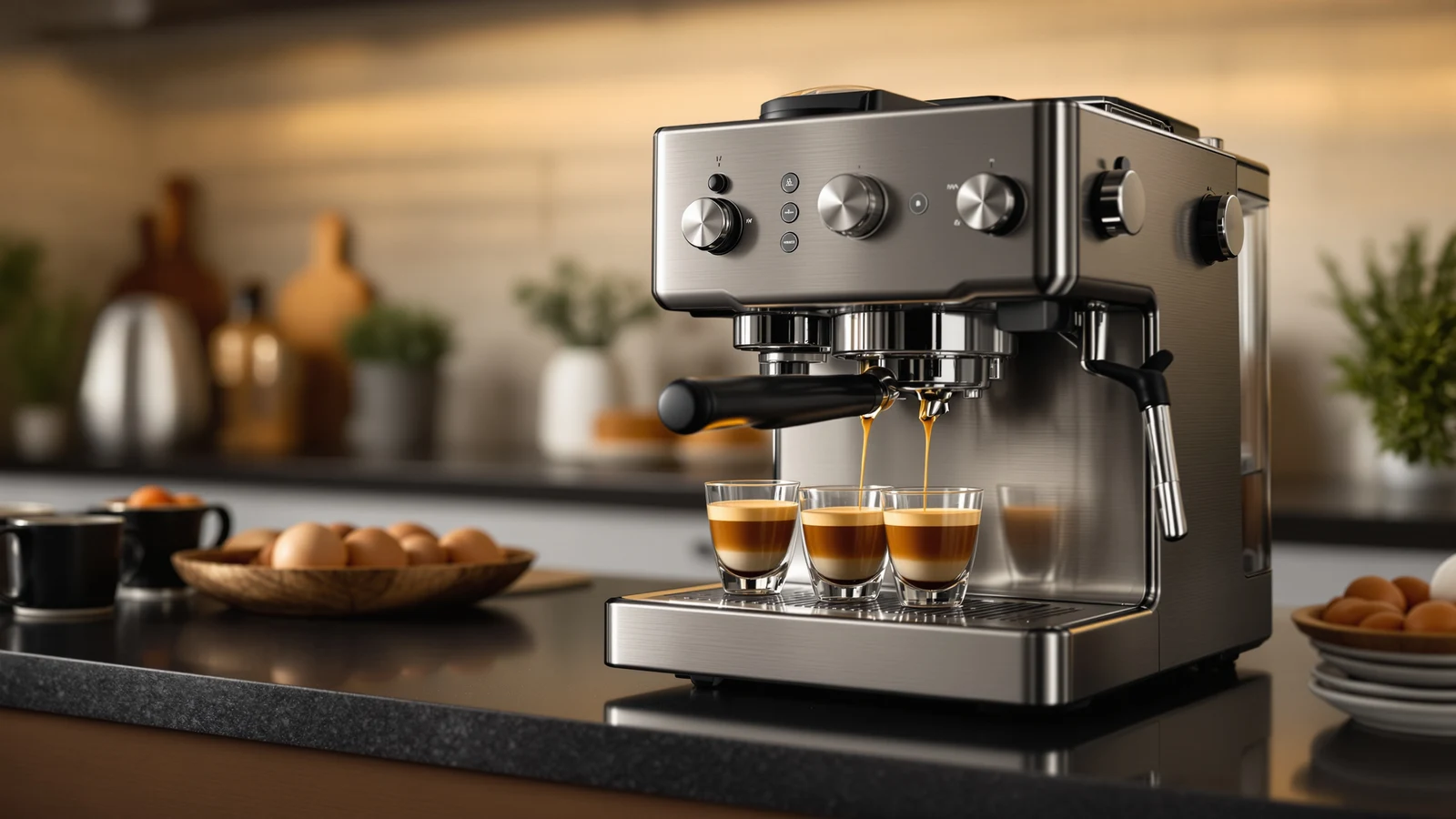
A stainless steel mid-range espresso machine with a steam wand on a kitchen counter, representing the under-$500 buying bracket

Reader-supported: if you buy through the Amazon links here we may earn a commission at no extra cost to you. It never changes which machine we recommend.

Under $500 is the bracket where home espresso stops being a compromise. Below roughly $150 you're usually giving up a real pump, a proper steam wand, or both. Above roughly $700 you're paying for a built-in burr grinder and dose control — genuinely useful, but a different purchase entirely. In between sits the range this guide covers: machines with a real 15-bar-or-better pump, a steam wand or automatic frother that can actually texture milk, and enough boiler to pull more than one drink in a row.

We pulled five machines from our database that bracket this range, from a $46.96 entry-level electric brewer up to a $299.95 semi-automatic with an automatic microfoam wand, and compared them on what changes in the cup: pump versus steam, grinder or none, milk system, and tank size. None of them include a rating or review count in our data — Amazon's product API doesn't return that for these listings — so nothing here is a star score. It's specs, prices and machine class, compared honestly.

The short answer

If you only read one paragraph

Buy the Breville Bambino at $299.95 if milk drinks are most of what you make

It's the most capable machine in this bracket: a real pump, an automatic microfoam steam wand with adjustable milk temperature and texture, and a footprint narrow enough for a small kitchen. You'll need to add a grinder, but that's true of every machine here except the two AMZCHEF listings below.

If you want the grinder built in, the AMZCHEF with Grinder, Temp Control & 44 Settings at $199.99 is the value pick — a burr grinder, adjustable brew temperature and a 60 oz tank for two-thirds less than the Bambino. Want a bigger tank and don't mind fewer documented specs, the AMZCHEF with Grinder (Latte & Cappuccino) at $179.99 is the alternative. Tighter budget still: the CASABREWS 3700 at $99.99 is a legitimate pump machine for half the price of the Bambino. And the IMUSA 4 Cup at $46.96 is the entry point this whole guide measures against.

At a glance

The five, side by side

Ordered by our recommendation. Prices are what we recorded on August 20, 2026, and Amazon prices move constantly — confirm the live price before you buy.

MachineBest forGrinderMilkPrice
Breville BambinoBest overall / milk drinksNoneAutomatic microfoam$299.95Price
AMZCHEF, Temp Control & 44 SettingsBest value / grinder includedBuilt-in, 44 settingsManual steam wand$199.99Price
AMZCHEF with Grinder (Latte & Cappuccino)Biggest tank, milk-focusedBuilt-inMilk-drink oriented$179.99Price
CASABREWS 3700 EssentialBest budget pump machineNoneManual steam wand$99.99Price
IMUSA 4 CupThe entry pointNoneNone$46.96Price
The picks

Five machines, and who each is for

01Best overall

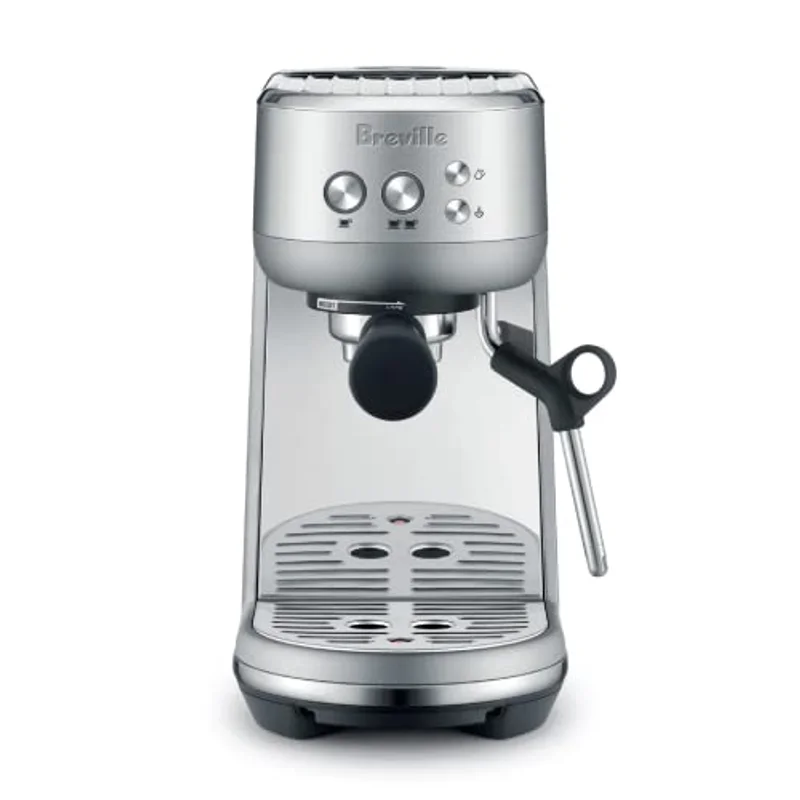
Breville BES450BSS Bambino

The ceiling of this bracket, especially for lattes and flat whites
Semi-automatic · no grinder · automatic microfoam steam wand · compact

The Bambino is what a $200 jump over an entry-level machine actually buys: a real pump, fast heat-up, and a steam wand that textures milk to a set temperature on its own instead of asking you to learn latte art first. Because it's narrow, it fits kitchens that can't take a bean-to-cup machine, and because the frothing is automated, a genuinely good flat white is a weekday-morning thing rather than a weekend project.

The trade-offNo grinder, so budget for one separately — pre-ground coffee will waste what this machine can do. If you want the grinder built in instead, look at the AMZCHEF picks below.

Breville Bambino espresso machine in brushed stainless steel
$299.95
Auto microfoamCheck price →
02Best value

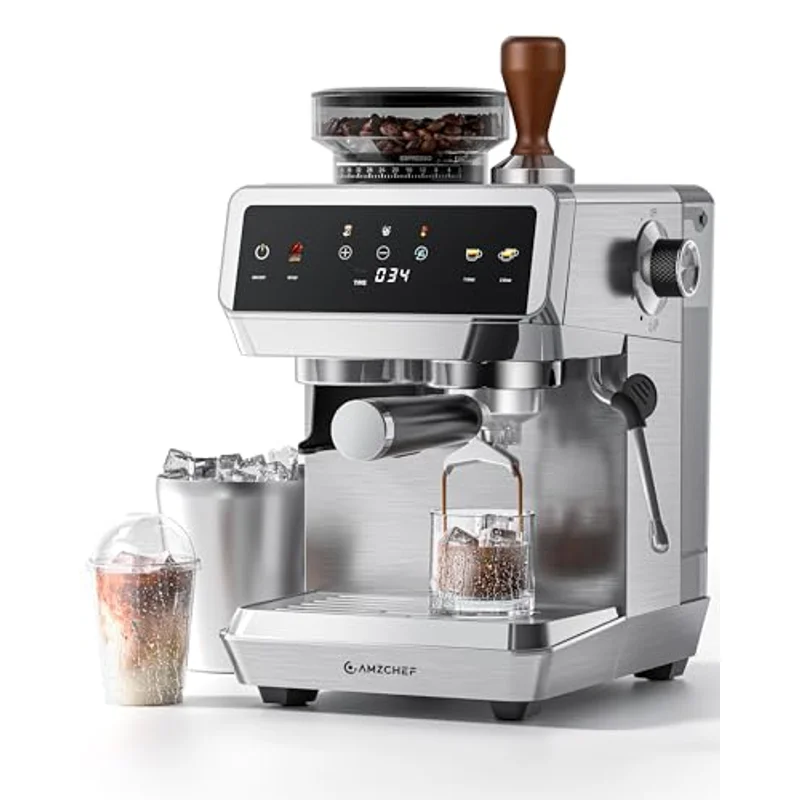
AMZCHEF Espresso Machine with Grinder, Temp Control, 44 Grind Settings

A built-in grinder and brew-temperature control for two-thirds less than the Bambino
Pump semi-automatic · built-in grinder, 44 settings · brew temp 190–201 °F · 60 oz tank · cold-brew mode · descaling function

At $199.99 this is the machine to buy if you don't already own a grinder, because the arithmetic changes completely once you account for one. A burr grinder is the single component that most determines whether espresso tastes like espresso — extraction depends on even, correctly-sized particles — and buying a $100 machine here still leaves you owing $80 to $200 for one separately. This one folds it into the price and adds brew-temperature control across an 11-degree range, which is a genuinely useful spec: lighter roasts extract better toward the hotter end of espresso's 195–205 °F window. A 60 oz tank, a cold-brew mode and a documented descaling function round it out.

The trade-off44 grind settings on an entry-level burr is a range, not a promise of precision — expect a narrow useful window and a week of finding yours. AMZCHEF is also a newer, smaller brand than Breville, so parts availability and long-term support are less established.

AMZCHEF espresso machine with built-in grinder and temperature control
$199.99
Grinder + temp controlCheck price →
03Biggest tank

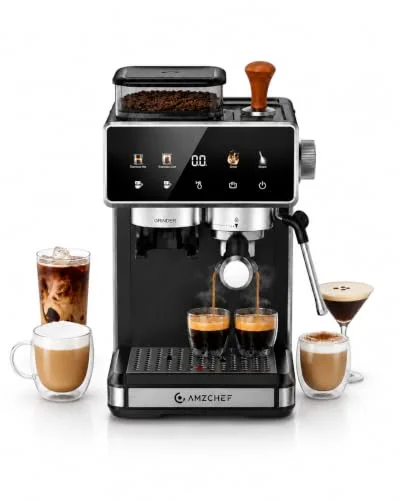
AMZCHEF Espresso Machine with Grinder, Latte & Cappuccino for Home Use

More water capacity, built for milk drinks specifically
Built-in grinder · 61 oz water tank · marketed for lattes and cappuccinos

This is the other integrated-grinder option in the bracket, at $179.99 — $20 less than its stablemate above — and its standout number is the 61 oz tank, the largest reservoir of any machine on this page. The listing name leans specifically on lattes and cappuccinos, which suggests a milk-forward design, though our data doesn't give us a grind-setting count, a temperature-control range, or a wattage figure for this exact model the way it does for the 44-setting AMZCHEF, so we won't claim those numbers here. If tank capacity and milk drinks matter more to you than a documented brew-temperature spec, check the current listing for the details we don't have.

The trade-offFewer published specs than the machine above means more of your decision rests on the listing itself rather than on numbers we can verify. If precise temperature control matters to you, the 44-setting AMZCHEF documents it and this one doesn't.

AMZCHEF espresso machine with built-in grinder for lattes and cappuccinos
$179.99
61 oz tankCheck price →
04Best budget pump

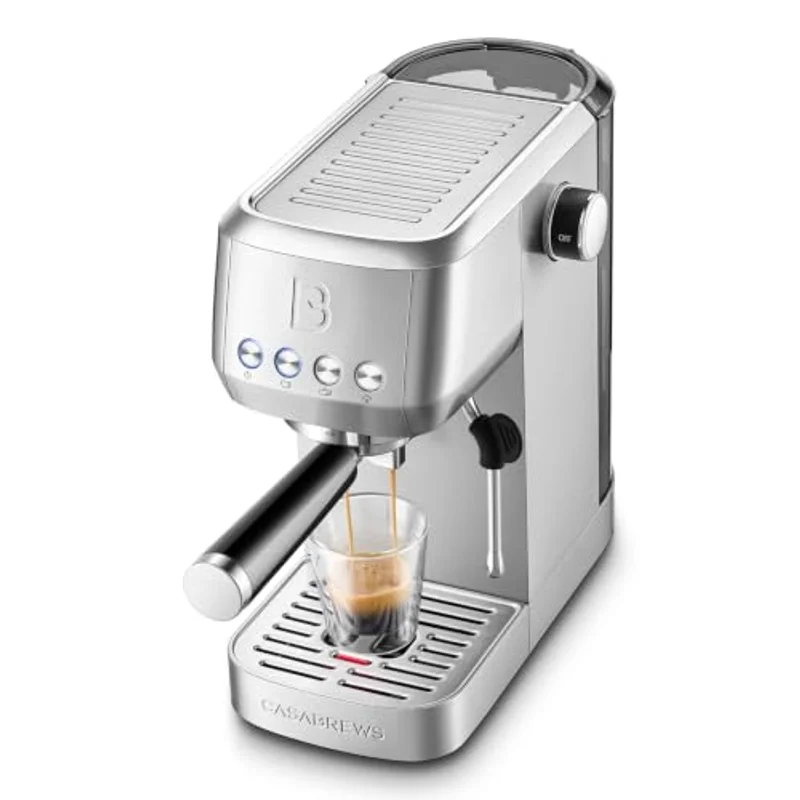
CASABREWS 3700 Essential

Real pump espresso for a third of the Bambino's price
Pump semi-automatic · 1,350 W boiler · manual steam wand · stainless · 12.6 × 5.7 × 12.2 in

At $99.99 the CASABREWS 3700 is proof you don't need to spend $300 to get a legitimate machine: a real portafilter, a real steam wand, and a 1,350 W element that heats fast for its size. The number worth noting is 5.7 inches wide — narrower than most dish racks — which is why it turns up in small kitchens, dorms and offices where a bigger machine can't go. Pair it with a separate burr grinder and you have a complete setup for well under $300 total.

The trade-offNo grinder, and a small single boiler means milk drinks are sequential — pull the shot, wait for steam temperature, then froth. Fine for one or two cups; tiresome for four.

CASABREWS 3700 Essential compact stainless espresso machine
$99.99
5.7 in wideCheck price →
05The entry point

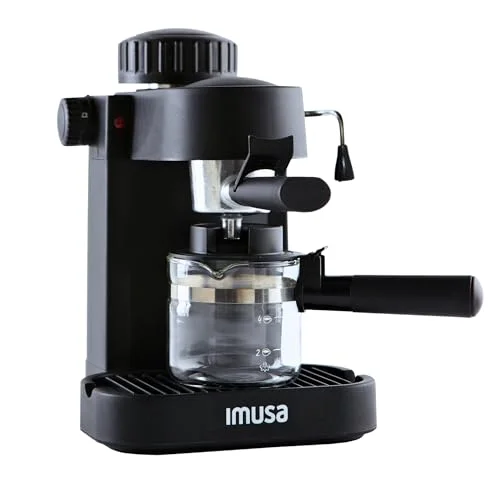
IMUSA 4 Cup Electric Espresso Cappuccino Coffee Maker

What you're moving up from — and the reason this guide exists
4 Cup · electric moka-style brewer · no grinder · no milk frother · black

At $46.96 this is the machine we measure the rest of the bracket against. It's an electric moka-style brewer, not a pump machine, and it has no grinder and no milk frother — you're buying the cheapest possible way to make a strong, concentrated cup at home, not espresso in the pump-and-portafilter sense. It's a genuinely useful reference point precisely because it shows you what you're not getting for $46.96: no adjustable pressure, no steam wand, no way to dial in a shot.

The trade-offThis is a different appliance class from everything else on this page. If you want the pump, the portafilter and the steam wand that make espresso adjustable, the $99.99 CASABREWS above is the real starting line — see the next section for exactly what that $53 difference buys.

IMUSA 4 Cup electric espresso and cappuccino coffee maker in black
$46.96
Entry priceCheck price →
The upgrade that matters

What another $200 buys you over the entry tier

The jump from the $46.96 IMUSA to something like the $299.95 Bambino isn't a smooth curve of "slightly better" — it's a handful of specific, discrete upgrades, and knowing what they are is more useful than any single price comparison.

A pump instead of a boiler pushing on its own

The IMUSA is an electric moka-style brewer: it heats water in a sealed chamber and lets pressure push it through the grounds, the same basic principle as a stovetop moka pot. Every other machine in this guide has an electric pump forcing water through the coffee bed at a controlled rate. That distinction is the whole ballgame — a pump is what lets you use a real portafilter, get consistent extraction, and actually dial a shot in rather than accept whatever the boiler gives you.

A portafilter and basket you can adjust

Moka-style brewers use a fixed chamber; there's no dose to change, no tamp to get right, no basket depth to pick. The CASABREWS 3700 and everything above it in price gives you a real portafilter with a basket you fill, level and tamp yourself — which means the result is something you can improve rather than something you simply accept.

A steam wand that can actually texture milk

The IMUSA has no milk system at all. Once you're spending $99.99 and up, you get a manual steam wand at minimum, and at $299.95 the Bambino's wand is automatic — it textures milk to a set temperature without you standing over it. That's the difference between "can technically add hot milk" and "can make a flat white."

Enough boiler to not wait between drinks

Wattage and boiler size scale with price in this bracket. The CASABREWS 3700 runs a 1,350 W element, enough to recover between a shot and steaming, but a single boiler still means waiting between the two steps. Spend more and you generally get faster recovery — the single biggest quality-of-life change if you're making more than one drink at a time.

None of this makes the IMUSA a bad $46.96 purchase for what it is — a cheap, simple way to make a strong cup. It just isn't the same category of appliance as the machines above it, and that's worth knowing before you compare them on price alone. For the field just below this one, see our best espresso machines under $200 guide.
Plain-language spec

Thermoblock vs. thermocoil vs. boiler, in plain language

Machine listings in this bracket love to mention their heating system without explaining what it means. All three do the same job — get water to brewing temperature — but they trade off speed, stability and cost differently. Our database doesn't list which specific heating technology any one machine in this guide uses, so treat what follows as general background for reading a spec sheet, not a claim about a particular product here.

Thermoblock

Water passes through a metal block with a heating element wrapped around it and comes out hot almost instantly — no waiting for a tank to fill and heat. It's the cheapest system to manufacture, which is why it dominates the entry and mid tiers of home espresso. The trade-off is temperature drift: a thermoblock heats water on demand rather than holding a stable reservoir, so back-to-back shots can vary slightly in temperature unless the machine actively compensates.

Thermocoil

A step up in stability: a coiled tube, often wrapped around or built into a small boiler, pre-heats water flowing to the group head so it arrives more consistently than a bare thermoblock. It's a middle-ground design — quicker than a full boiler, steadier than a basic thermoblock — and it's common in the $150–350 range where machines need to do more than one thing well.

Boiler (single or dual)

A dedicated reservoir of water held at a set temperature, the way prosumer and commercial machines do it. A single boiler heats a batch and has to switch modes between brewing and steaming, which is why budget and mid-range machines with a "boiler" still make you wait between a shot and frothing milk. A dual-boiler design — one reservoir for brew water, one for steam — lets you do both at once, but that's a feature that shows up well above $500, not in this bracket.

The practical takeaway: don't let "boiler" on a box read as automatically superior to "thermoblock." At this price range, what predicts a good experience is boiler or tank size, wattage, and whether the listing documents temperature control — like the 190–201 °F range on the 44-setting AMZCHEF — more than the name of the heating technology itself.

Budget honestly

The hidden costs: grinder, tamper, scale, jug

Every price on this page is for the machine alone. None of the five machines here ships with everything you need for consistent espresso, and three of them — the Bambino and both CASABREWS-adjacent picks — ship with no grinder at all. Budget for the rest before you commit to a machine, or the "$99.99 espresso machine" quietly becomes a $250 setup a week later.

  • Burr grinder — roughly $80–200 (electric) or less for a hand grinder. Non-negotiable if your machine doesn't have one built in. This is a category estimate based on what a competent burr grinder generally costs, not a price we're quoting for a specific product we sell here — check current listings. Skip blade grinders entirely; they produce uneven particles that ruin espresso extraction regardless of what machine they feed.
  • Tamper — roughly $10–25. Some machines include a basic one; a flat, properly-sized tamper matched to your portafilter's basket diameter makes an even, level puck, which matters as much as grind size for a balanced shot.
  • Digital scale — roughly $15–30. Espresso is a ratio, typically around 18 g of dry coffee in to 36 g of liquid out. Eyeballing that ratio is how inconsistent shots happen; a cheap gram scale removes the guesswork.
  • Milk jug or pitcher — roughly $10–20. Needed for any machine with a steam wand, manual or automatic, sized to the amount of milk you actually froth at once. The Bambino and either AMZCHEF pick both need one; none of our five machines list a milk pitcher as included.

Add those up and a "budget" $99.99 CASABREWS 3700 with a mid-range grinder, a tamper, a scale and a jug lands closer to $250–300 total — which is, not coincidentally, in the same neighborhood as the Bambino or a built-in-grinder AMZCHEF bought as one purchase. That's not an argument against the split route; it's an argument for doing the full-setup math before you compare sticker prices, the same way we walk through grind consistency and dial-in in beans and grind size.

Going over budget

When to stretch to the Barista Express instead

Every machine in this guide sits at or under $299.95, comfortably inside a $500 ceiling with room to spare. There's one case where we'd tell you to keep saving past this bracket entirely: if you've read the hidden-costs math above and it's telling you that you're about to spend $250–300 assembling a machine plus a separate grinder plus a tamper and a scale, it's worth comparing that total against buying a single machine that already includes all of it.

That's the argument for the Breville Barista Express, a semi-automatic bean-to-cup machine that sits meaningfully above this guide's $500 ceiling — so we won't restate its price or spec sheet here, since it isn't one of the machines we're comparing in this bracket. The logic for stretching to it is simple: once your realistic total for the split route (machine plus grinder plus accessories) starts approaching what a well-built all-in-one machine costs, the case for staying under $500 with separate pieces gets weaker. If you're weighing exactly how much control you give up by paying for that kind of integration, our semi-automatic vs. super-automatic guide covers the trade-off. The reverse logic also applies: if you're confident you'll want to upgrade the machine again in a few years, buying a standalone grinder now — something you'd pair with the CASABREWS 3700 or either AMZCHEF pick — means that grinder survives the upgrade, while a grinder bought inside a bean-to-cup machine doesn't.

For most people reading this specific guide, though, the honest answer is: you don't need to stretch. The Bambino and the two AMZCHEF machines cover the two things a pricier integrated machine offers — good milk texturing and a built-in grinder — at well under half the cost.

The bottom line

Verdict: the one most people should buy

The AMZCHEF with Temp Control & 44 Settings, at $199.99

Most people shopping under $500 don't already own a burr grinder, and buying one separately is the expense that most budget espresso setups quietly skip. At $199.99, this AMZCHEF folds a built-in grinder, adjustable brew temperature and a 60 oz tank into one purchase — for less than the machine-only Bambino, and without the follow-up trip to buy a grinder that the CASABREWS 3700 requires.

The exception is milk. If lattes and flat whites are most of what you'll make, the extra $100 for the Breville Bambino's automatic microfoam wand is the better spend — you'll still need a separate grinder, but the milk system is the best in this bracket. And if $200 is genuinely more than you want to spend right now, the CASABREWS 3700 at $99.99 plus a hand grinder is a legitimate way to start for under $150 total, with a clear upgrade path once you know espresso is a habit you'll keep.

How we picked

Five machines that bracket $500 from below

We pulled machines from our database priced well under $500 and sorted them by what they physically are — moka-style versus pump-driven, grinder or no grinder, manual versus automatic milk system — then picked one per buying situation: best overall, best value, biggest tank, best budget pump, and the entry-level reference point everything else is measured against.

How we compared

Research, not a lab

Plainly: we compare published specifications and prices, we don't run a testing lab, and we don't publish ratings we can't verify. Amazon's product data returns no rating or review-count figures for these machines, so there are no stars anywhere on this page. Where our data doesn't include a spec — like grind-setting counts for the Latte & Cappuccino AMZCHEF — we say so rather than guess. Where a call is a judgement rather than a spec, we've labelled it a trade-off.

FAQ

Questions people actually ask

Is $500 enough for a real espresso machine?

Yes, comfortably. Every machine in this guide costs $299.95 or less, all with real pumps except the entry-level IMUSA, and a $500 ceiling leaves room to add a separate burr grinder, a tamper and a scale on top of any of them. You start giving things up well before $500 becomes a limit — the constraint at this budget is choosing between a built-in grinder and a better milk system, not squeezing in either one.

Should I buy a machine with a grinder built in, or buy them separately?

It depends on whether you already own a grinder and how much you value flexibility. A built-in grinder, like on either AMZCHEF pick here, saves you a second purchase and a decision. A separate burr grinder, paired with the CASABREWS 3700 or the Bambino, costs more up front but survives your next machine upgrade — the same trade-off that decides whether a pricier integrated machine like the Barista Express is worth stretching to, covered above.

What's the real difference between the IMUSA and the CASABREWS 3700?

Machine class, not just price. The IMUSA at $46.96 is an electric moka-style brewer that pushes water through coffee with heat and pressure in a sealed chamber, similar in principle to a stovetop moka pot. The CASABREWS 3700 at $99.99 has an electric pump and a real portafilter, which is what lets you adjust dose, tamp and grind to actually dial in a shot. If you want espresso you can improve over time rather than a fixed result, the pump machine is the real starting line.

Do I need a thermoblock, thermocoil or boiler machine?

Don't shop by the name of the heating system alone. Thermoblocks heat water instantly but can drift in temperature between shots; thermocoils are a steadier middle ground; boilers hold a stable reservoir but usually make you wait between brewing and steaming unless the machine has two of them, which is rare under $500. Documented specs — wattage, tank size, and whether brew temperature is adjustable, like the 190–201 °F range on the 44-setting AMZCHEF — tell you more than the heating technology's name.

Keep reading

Next steps, in order of usefulness

Ilane Tall

Ilane writes the espresso comparisons on this site, built from published specifications, machine class and live pricing — never from testing we haven't done, and never from ratings we can't verify. Get in touch, or read about this site and our privacy policy.