Built-In Grinder or Separate Grinder? The Honest Answer
Bean-to-cup machines fold the grinder into the chassis and save you a purchase, a plug and a foot of counter. A separate burr grinder costs more up front and outlives every machine you will own. Here is how that trade plays out at $100, at $250 and at $700.
Reader-supported: we may earn a commission if you buy through our links, at no extra cost to you. Prices are the ones we recorded on August 12, 2026 and they move constantly — confirm the live price before buying.
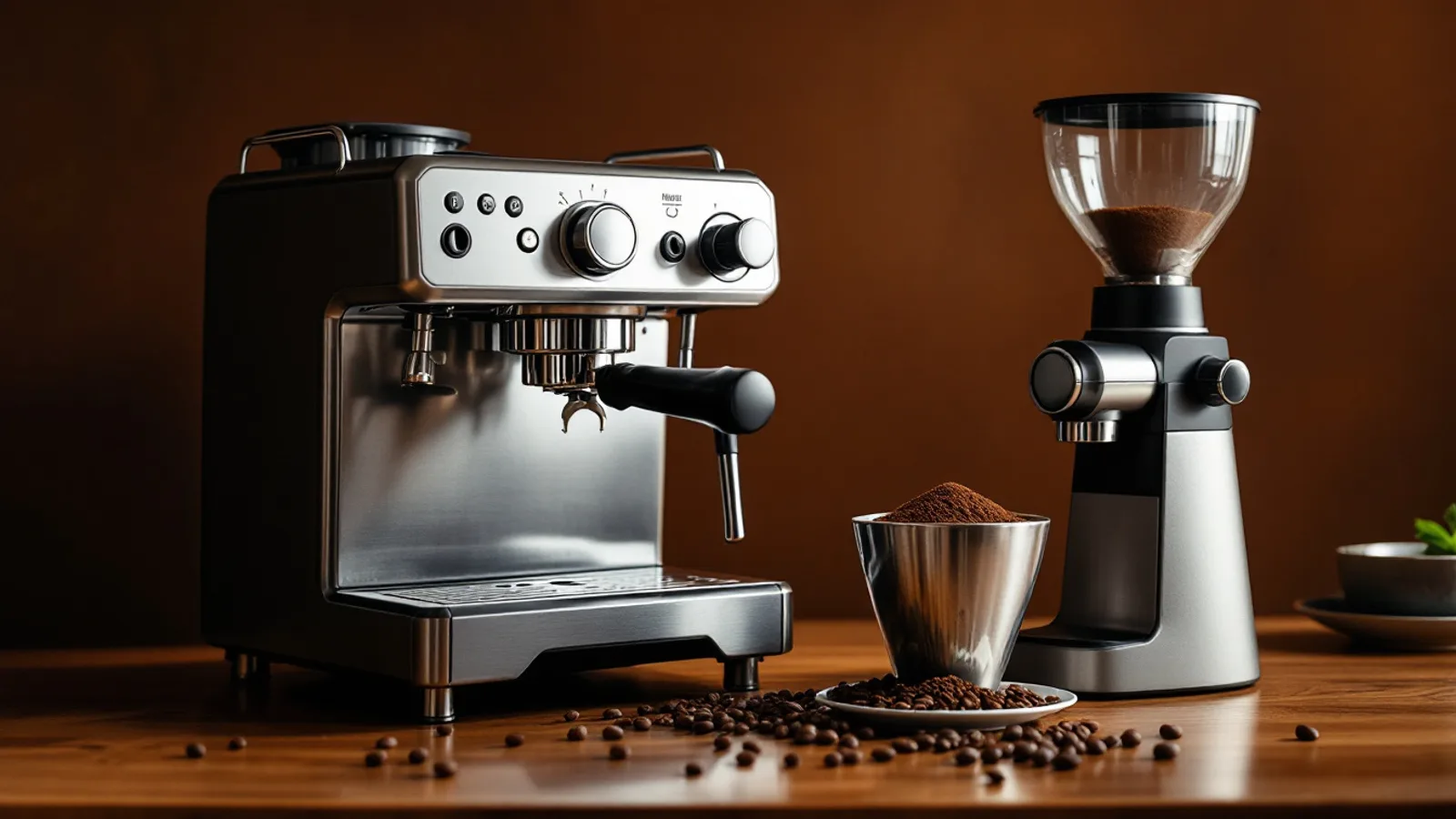
The short answer
Buy the built-in grinder if you want one appliance, one plug and one thing to learn, and you are reasonably confident espresso will stick as a habit. Buy the separate grinder if you suspect you will still care about this in three years, because the grinder is the part that keeps paying off after the machine is gone.
That is deliberately not a single winner: the two routes fail in different places. A bean-to-cup machine like the Breville BES870XL Barista Express at $694.94 hands you a conical burr grinder, dose control and a razor dose-trimming tool in one box, and the integration is the point — grind straight into the 54 mm portafilter, trim, tamp, pull. The cost is that the grinder and the brew group now share a chassis, a warranty and a service trip.
The split route starts cheaper and ends more flexible. A CASABREWS 3700 Essential at $99.99 or a Chefman CraftBrew at $74.99 gives you a real pump, a real portafilter and a real steam wand, and the difference goes into the grinder. A decent entry electric burr grinder generally runs $80–200, less for a hand grinder — a category estimate, not a product we list here and not a price we are quoting you.
Why the grinder decides more than the machine
Espresso is the least forgiving brew method in the house, and the reason is geometry. You force water at roughly 9 bar through a compressed bed of coffee in 25 to 30 seconds, and how evenly that water moves through the bed is decided almost entirely by particle size and consistency.
Slightly too coarse and the water finds the path of least resistance, races through in twelve seconds and gives you something sour and thin. Slightly too fine and the bed chokes, the shot drips for a minute, and you get bitterness. The window between those two failures is a few clicks on a grinder — which is why grind adjustment is not a convenience feature here. It is the primary control.
That is also why pre-ground supermarket coffee is a dead end no matter what you spend on the machine. It is milled to one fixed size that has to work in every brewer on the shelf: too coarse for espresso, and impossible to adjust. Our guide to pulling a good shot walks the dial-in, and every step in it assumes you can change the grind.
So the real question is never whether you need a grinder. You need one. It is only whether it lives inside the machine or beside it.
Burr versus blade
A burr grinder pushes beans between two abrasive surfaces set a fixed distance apart. Coffee cannot leave until it is small enough to pass through the gap, so the output is fairly uniform, and moving the burrs changes the size of everything that comes out. Conical burrs — the type in the Barista Express, the Magnifica Start and the Gevi — are the standard shape at home prices.
A blade grinder is a propeller in a cup, smashing beans at random. Ten seconds gives you boulders and dust in the same batch, and for espresso that is fatal: the dust plugs the bed and over-extracts into bitterness while the boulders sit barely touched, and more run time only makes more dust. For espresso a blade grinder is not a cheaper option, it is a non-option.
That sets a floor under the budget route. Machine-plus-grinder only beats bean-to-cup if the grinder has burrs — pairing a $99.99 CASABREWS with a $20 blade unit buys two disappointments, not an espresso setup.
What grinding into the portafilter buys you
This is where built-in grinders earn their reputation, and the mechanism is worth stating precisely rather than hand-waving about convenience.
A double shot conventionally starts around 18 grams of dry coffee in and about 36 grams of liquid out. That ratio is what you adjust against, so the dry weight has to be repeatable. If Monday's basket holds 17 grams and Tuesday's holds 19, the shots taste different for reasons unrelated to your grind, and you spend a week chasing a variable you did not know was moving.
Dose control answers that directly. On the Barista Express the grinder is timed and adjustable, dispenses into the portafilter you clamp under the spout, and the razor tool levels the bed at a fixed height so the excess sweeps into the bin. Nothing is lost in transfer either — coffee ground straight into the basket is not scattered across a container, a spoon and the counter.
A separate grinder can do the same, often better; the good ones grind on demand into a held portafilter. What it does not do is arrive pre-aligned with your basket, so expect a funnel, a small scale and some counter choreography. Whether that reads as friction or as ritual depends on you.
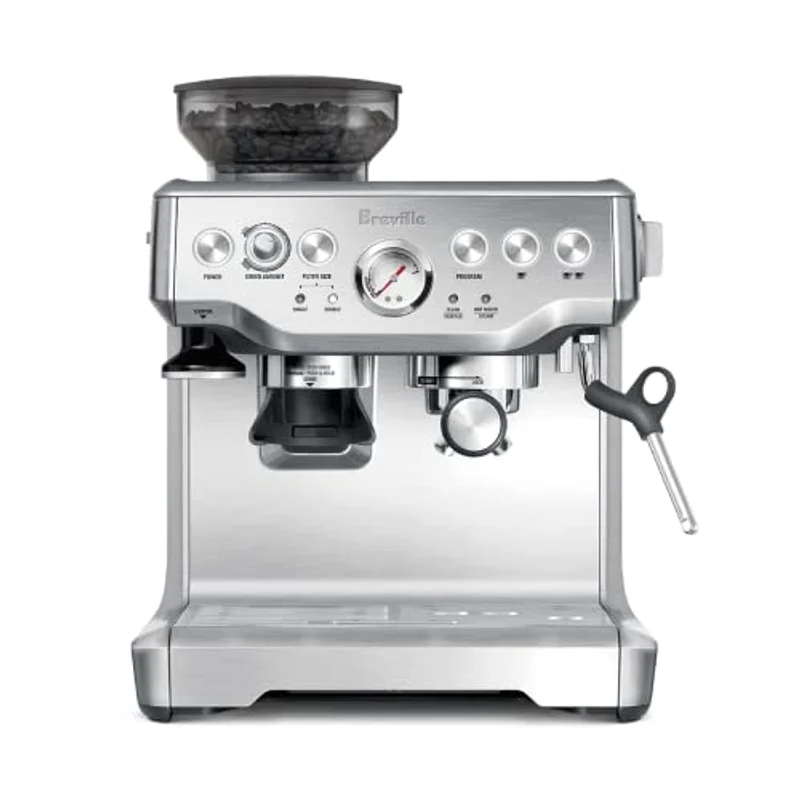
Breville BES870XL Barista Express
The reference build for the integrated route: conical burr grinder with dose control and manual override, 54 mm stainless portafilter, razor dose-trimming tool, integrated tamper, single and dual-wall baskets, low-pressure pre-infusion, 67 oz tank, 1,600 W.
$694.94 Check price →Retention and staleness
Every grinder holds a little coffee back. Grounds cling to the burr chamber and the chute, so some of what you grind today does not leave until tomorrow. That is retention, the least discussed difference between the two routes.
Ground coffee stales fast, because grinding multiplies the surface area exposed to oxygen — beans keep for weeks, grounds are flat in days. If a grinder retains a few grams, your first shot each morning is part yesterday's leftovers: a ceiling on your first cup, and an invisible one, since you cannot see into the chamber.
Bean-to-cup machines add the hopper. The Barista Express carries about a half-pound bean hopper, and half a pound of beans sitting on a warm machine under a clear lid is half a pound going stale in daylight. Fine at two or three doubles a day. Less fine if you make one cup on weekdays and none on weekends, or if you keep two roasts around — switching beans means emptying the hopper first.
The separate route is where single-dosing becomes practical: weigh 18 grams, grind them, nothing sits in a hopper, and going from a chocolatey Brazilian to a bright Ethiopian is a five-second decision. If your habit is intermittent or exploratory, that is a real reason to keep the grinder outside the machine — and one no spec sheet mentions, because it is not a feature. It is a shape.
Counter space and cleaning
Both routes get sold on tidiness, and both claims deserve a tape measure.
The integrated case is simple: one footprint, one outlet, one thing to wipe down. The Gevi with grinder measures 11.5 by 12.01 by 16.53 inches, and that 16.5-inch height is the number people forget. Bean-to-cup machines are tall because the hopper sits on top and needs clearance above it to be filled. A cabinet 18 inches up technically clears the machine and practically does not — you cannot pour beans in without dragging it forward every morning.
The split case is wider but shorter, and it can be arranged. The CASABREWS 3700 is 12.6 by 5.7 by 12.2 inches, and 5.7 inches wide is narrow enough that machine plus grinder side by side can take less counter width than one bean-to-cup unit, with both pieces short enough to live under a cabinet. It also allows what people forget to consider: the grinder does not have to sit out at all.
Cleaning inverts the marketing. A separate grinder comes apart to the burrs with no tools and brushes out over a sink in a minute; a built-in one is harder to reach, and coffee oils build up in the chute over months — the exact passage your fresh grounds travel through. Neither route escapes the other job: limescale is what actually kills home machines, and descaling frequency depends on your water hardness and the manufacturer's instructions. Our cleaning and descaling guide covers it either way.
Upgrade-path economics
This argument should carry the most weight and usually carries the least, because it plays out over years rather than at checkout.
Machines get replaced. Someone starts with a $100 pump machine, discovers they care, and moves up; or a pump gives out at year four. Either way the machine is the piece that turns over. A standalone grinder is not — burrs are consumable but replaceable, and a good burr grinder bought in 2026 will still be grinding for a machine you have not chosen yet.
Run both paths with our August 12, 2026 prices, the $80–200 category estimate at its $140 midpoint, and one machine upgrade in five years.
Split route: $99.99 CASABREWS plus a $140 grinder is about $240 today. The upgrade is machine-only — say the $299.95 Breville Bambino, which has no grinder and does not need one. Five-year total roughly $540, ending with a Bambino and a grinder you already know.
Integrated route: $694.94 now, more than the split route's entire five-year spend — though for a better machine and a better grinder than either piece above. If you outgrow it, the grinder does not come with you: you buy another bean-to-cup machine and pay for a second grinder inside it, or a machine-only unit and now need the standalone grinder you never bought.
Two caveats. Most people never upgrade, and for them the integration discount is real money saved. And at $694.94 the bundled grinder is good enough that assembling comparable pieces separately usually costs more, not less — this is an argument about optionality, not about the sticker. If you are still weighing whether any of it is worth it, we run that arithmetic in are home espresso machines worth it.
When a built-in grinder fails
A grinder is the most mechanically stressed part of an espresso setup: a motor, a gearbox, moving abrasive surfaces, and a diet that occasionally includes a small stone, because coffee is an agricultural product. Grinders jam. Burrs wear. Adjustment mechanisms drift.
On the split route that is contained. The grinder has its own warranty, and if it dies the machine keeps pulling shots from a bag of grounds meanwhile. Your morning coffee is degraded, not cancelled.
On the integrated route they are one product. A failed grinder inside a bean-to-cup machine usually means the whole machine goes in for service rather than a component — the Barista Express carries a one-year limited warranty on the unit as a whole. No coffee at all while it is away, and out of warranty, a repair bill on a $685 appliance instead of on a $140 accessory. The risk concentrates in the super-automatic class: the De'Longhi Magnifica Start at $649.95 grinds, doses and brews behind one button, and that integration is the entire product. More on that trade in semi-automatic versus super-automatic.
None of this predicts that any particular machine will break — we have no reliability data for these units and will not pretend otherwise. It is a structural point, and it cuts one way: fewer parts sharing a chassis means fewer failures that take the rest down with them.
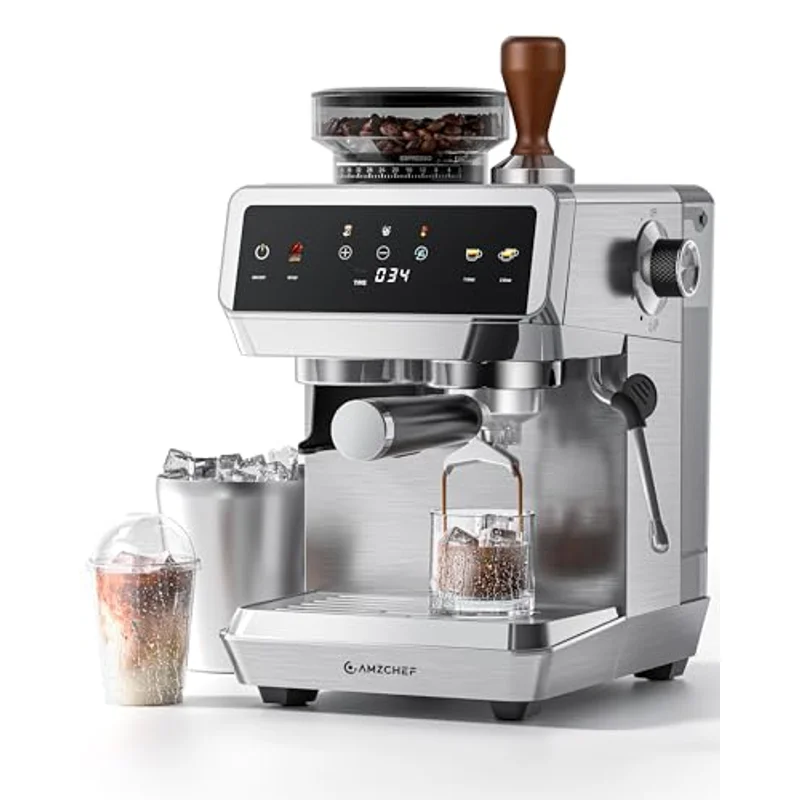
AMZCHEF Espresso Machine with Grinder
The cheapest way into the integrated route on our list: built-in grinder with 44 grind settings, brew-temperature control from 190 to 201 °F, 60 oz tank, cold-brew mode, descaling function. The trade-off is a newer listing from a smaller brand, so parts availability is unproven next to Breville or De'Longhi.
$199.98 Check price →Hand grinders: the budget-serious option
There is a third route, usually skipped because it involves labour, and it is the one we would push hardest on anyone spending under $150 on a machine.
A hand grinder has no motor, which is why it is cheap: what you pay for goes into the burrs, the shaft and the bearing that keeps them from wobbling — and burr quality plus alignment is most of what grind consistency is. One in the $40–100 bracket can produce espresso grounds that a much pricier electric unit struggles to match. Again, a general read on the category, not a product we track here.
The cost is your arms and about a minute. Grinding 18 grams fine enough for espresso takes real effort — more than grinding for filter, because the burrs sit closer together — and it does not scale. One double is a pleasant thirty to sixty seconds; four for guests on a Sunday is a workout, which is when people quietly buy something electric.
So: the best cup-per-dollar decision in home espresso, and a bad fit for a household. Pair one with the $99.99 CASABREWS 3700 or the $74.99 Chefman CraftBrew and you have a capable setup for under $200 total — roughly what the AMZCHEF costs as one integrated unit. The difference is where the compromise sits: the AMZCHEF on brand track record and on keeping the grinder later, the hand grinder on your morning. If that is your bracket, our picks under $200 go through the options.
The two routes, side by side
Same machines, sorted by the route they commit you to. Prices are what we recorded on August 12, 2026.
| Machine | Route | Grinder | Milk | Price | |
|---|---|---|---|---|---|
| Breville BES870XL Barista Express | Built-in | Conical burr, dose control, razor tool | Manual wand | $694.94 | Price |
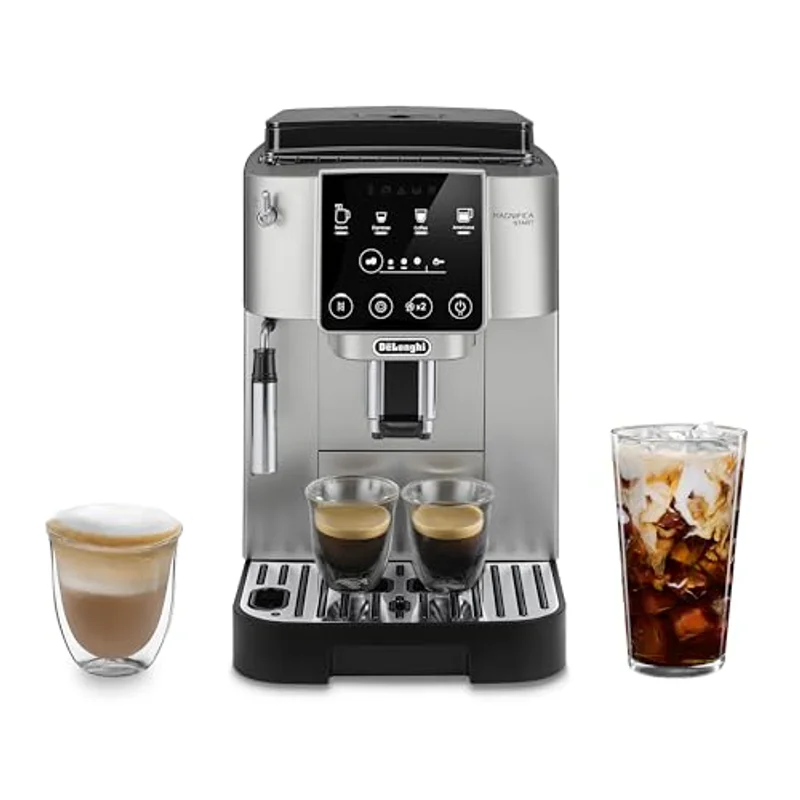 De'Longhi Magnifica Start De'Longhi Magnifica Start | Built-in, super-auto | Conical burr, 13 settings | Manual frother | $649.95 | Price |
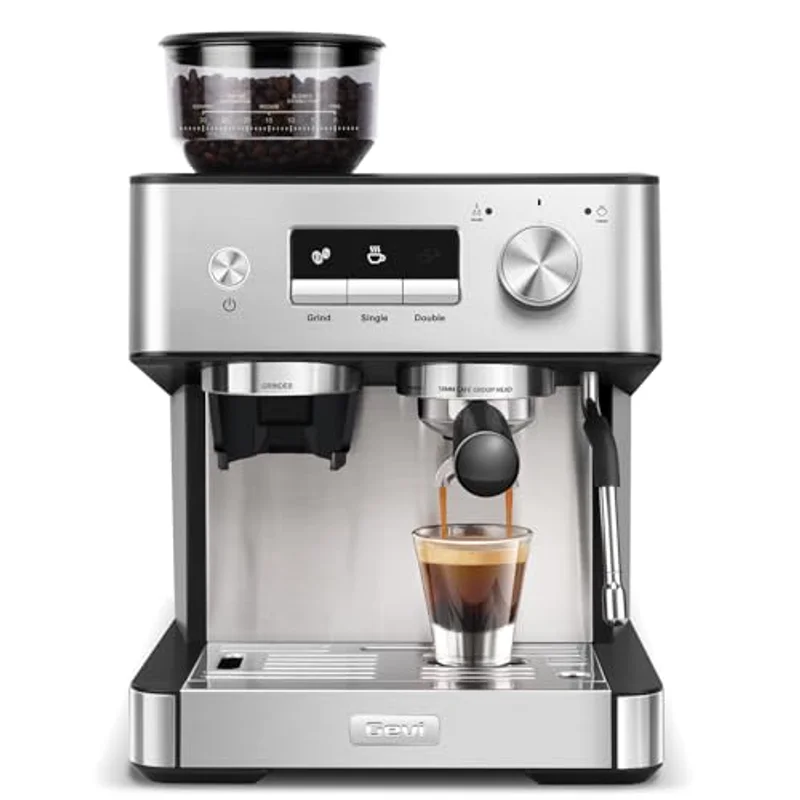 Gevi 20 Bar with Grinder Gevi 20 Bar with Grinder | Built-in | Conical burr, 30 settings | Manual wand + hot water | $309.99 | Price |
| AMZCHEF with Grinder | Built-in | Built-in, 44 settings | Manual wand | $199.98 | Price |
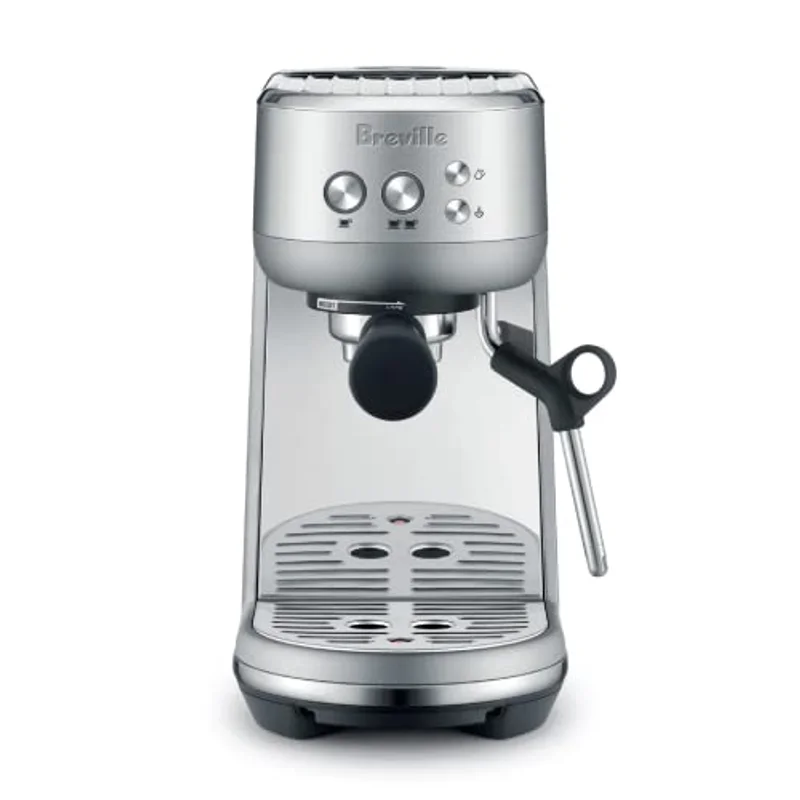 Breville BES450BSS Bambino Breville BES450BSS Bambino | Bring your own | None | Automatic microfoam | $299.95 | Price |
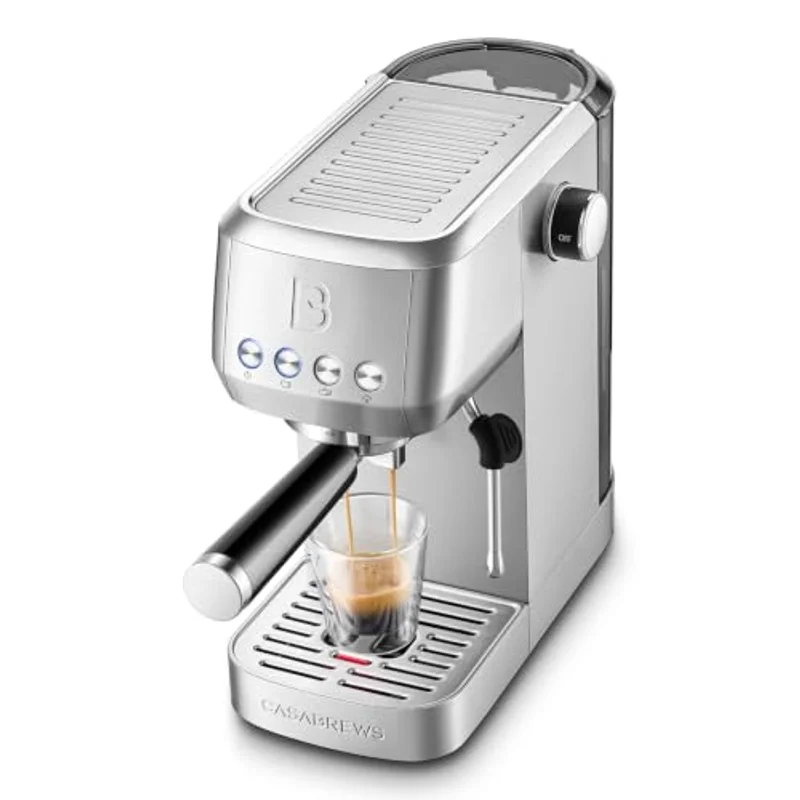 CASABREWS 3700 Essential CASABREWS 3700 Essential | Bring your own | None | Manual wand | $99.99 | Price |
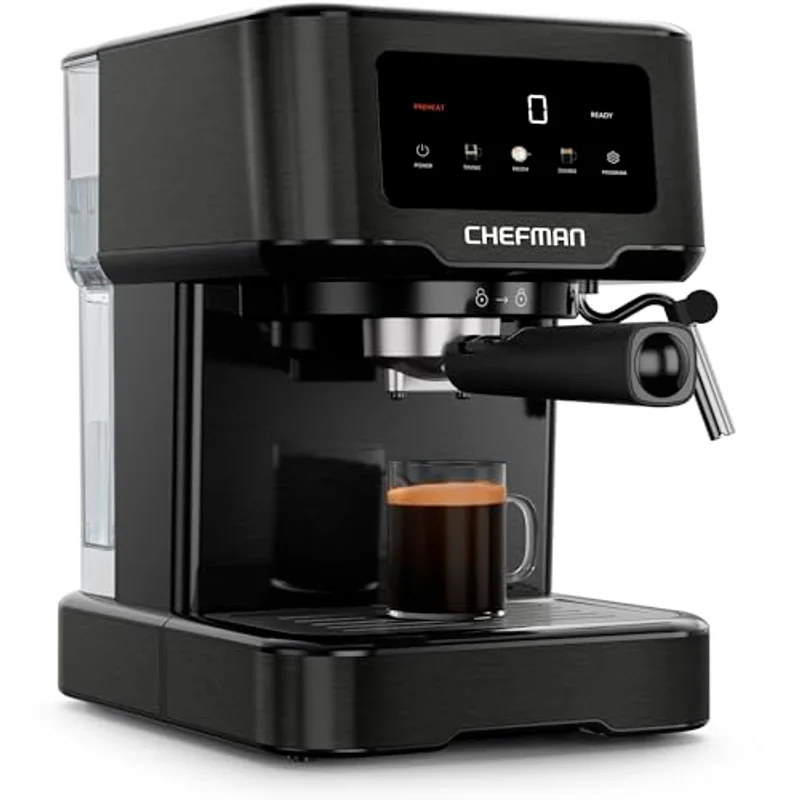 Chefman CraftBrew Chefman CraftBrew | Bring your own | None | Manual wand | $74.99 | Price |
The verdict, by budget tier
Route choice is really a function of total budget, because at the bottom of the market integration is impossible and at the top it is nearly free.
Around $100 total: separate, and make it a hand grinder
No bean-to-cup machine at this price is worth owning, so the decision is made for you. Put the machine money into the cheapest competent pump unit — the Chefman CraftBrew at $74.99 has a 15-bar pump, a 1.5 L removable reservoir, two shot baskets and a digital panel with programmable shot volume, so you can pull a ristretto or a lungo on purpose — and the rest into a hand grinder. Do not save $30 with a blade grinder; you will have spent $110 on a machine that cannot make espresso. And do not drop below this tier into steam-driven territory: the Mr. Coffee 4-Shot at $54.99 brews with steam pressure rather than a pump, so what comes out is closer to strong coffee than to espresso.
Around $200 to $300 total: the genuinely close call
Here the two routes cost the same, so pick on temperament. The integrated option is the AMZCHEF at $199.98 — 44 grind settings and brew-temperature control across 190–201 °F, a specification you normally pay several hundred more for and a useful one, since lighter roasts extract better hotter. The Gevi at $309.99 sits just above it with a conical burr and 30 settings.
The split option at the same money is a $99.99 CASABREWS 3700 plus a burr grinder from that $80–200 bracket: a worse machine, probably a better grinder, the ability to single-dose, and something you keep when the CASABREWS goes. Our lean: if this is your first espresso machine and you are not certain it will stick, buy the AMZCHEF. If you already know you are the kind of person who buys two bags of beans at a time, split it.
Around $700 total: buy the built-in and stop thinking about it
At the top of this range integration wins on price, which is counterintuitive but true. The Barista Express at $694.94 includes the conical burr grinder, dose control, razor trimming tool, integrated tamper, single and dual-wall baskets, a stainless milk jug and low-pressure pre-infusion; assembling equivalent pieces separately typically costs more, not less. The BES870BTR at $694.94 is the same machine in Black Truffle — pay the $15 for the colour, not for a feature.
The one case for splitting here is a milk workflow the bundle does not offer. The Bambino at $299.95 has an automatic microfoam steam wand with adjustable milk temperature and texture, and if you drink flat whites every morning that may matter more than an integrated grinder. Bambino plus a good standalone grinder lands in similar territory: you give up dose-control integration and gain a milk system and a grinder you keep. Defensible — just make it deliberately.
One thing not to do
Do not buy the machine now and add the grinder later. It is the most common way this goes wrong: the machine arrives, there is no grinder, the first bag is pre-ground, the first ten shots are flat, and the machine is in a cupboard before the grinder is ordered. If you are splitting, order both together.
How we compared these
We compare published specifications, what ships in the box, machine class, footprint and live pricing, and we read manufacturer claims sceptically — the pressure figures in this category are routinely misleading, since a "20 bar" pump is a maximum rating and espresso brews at roughly 9 bar at the puck. We do not physically test these machines, we do not run a testing lab, and we do not publish ratings we cannot verify: Amazon's product data returns no rating and no review count for the machines on this site, so there are no stars and no invented scores anywhere on this page.
Where a claim here is a judgement rather than a specification — that integration wins at $700, that a hand grinder is the best cup-per-dollar buy under $150 — we have said so in our own voice and shown the reasoning, so you can disagree with it. The general coffee facts (9 bar at the puck, brew water around 195–205 °F, 18 g in and 36 g out as a starting ratio, burrs beating blades, limescale killing machines) are standard background rather than product claims. The rest of the method sits on our main espresso machine guide.
Frequently asked questions
Is a machine with a built-in grinder cheaper than buying both separately?
Usually yes at the same quality level, and that is the main argument for integration. The Barista Express at $694.94 bundles a conical burr grinder, dose control, a razor trimming tool, a tamper, two sets of baskets and a milk jug; a comparable semi-automatic plus an equally good grinder generally costs more. At the low end the gap closes — the AMZCHEF at $199.98 costs about what a $99.99 CASABREWS plus an entry burr grinder from the roughly $80–200 category range would.
Can I use pre-ground coffee in an espresso machine?
You can put it in, but you will not get good espresso. Pre-ground is milled to one fixed size meant to work across every brew method, which is too coarse for espresso and cannot be adjusted — and grind size is your primary control over how a shot extracts. It also stales within days, because grinding hugely increases the surface exposed to air.
What happens if the grinder inside my espresso machine breaks?
On a bean-to-cup machine the grinder and the brew group are one product, so a failed grinder normally means the whole machine goes in for service rather than a single component — the Barista Express, for example, carries a one-year limited warranty on the unit. No coffee while it is away, and out of warranty, a repair bill on an expensive appliance. With a separate grinder the failure is contained.
Is a hand grinder good enough for espresso?
Yes, and it is the strongest value in home espresso: with no motor to pay for, the money goes into burr quality and alignment, which is most of what grind consistency depends on. The limits are physical — grinding 18 grams fine enough for espresso takes real effort, and it does not scale to several drinks in a row. One or two doubles a day, excellent. Four at once, buy electric.