The Best Super-Automatic Espresso Machines: One-Touch Lattes With No Learning Curve
A super-automatic grinds the beans, doses them, tamps the puck, brews the shot and froths the milk, and the only thing you do is press one button. No portafilter to learn, no burr grinder to dial in, no steam wand to practice on. Four machines that do the whole routine well, and the honest list of what you give up to get it.
Reader-supported: we may earn a commission if you buy through our links, at no extra cost to you. Prices are the ones we recorded between October 12 and October 14, 2026, and they move constantly — confirm the live price before buying.
The short answer
If what you want from coffee on a weekday morning is a drink in your hand with no decisions in between, buy a super-automatic. The category exists to remove the parts of espresso that take practice — grind, dose, tamp, extraction time — and replace them with a programmed routine that runs the same way every time you press the button.
The Philips 2200 Series EP2220/14 at $353.68 is the floor of the category done properly: a built-in ceramic grinder, a touch display, and a classic milk frother, for under $400. The Philips 2300 Series with LatteGo at $429.06 adds a frothing system designed to come apart and rinse in seconds, which matters more than it sounds like it should once you own one. The De'Longhi Magnifica Start at $649.95 is the most established name in one-touch espresso, with three one-touch recipes and adjustable intensity. The De'Longhi Magnifica Duo at $999.95 sits at the top of this list, for a buyer who wants the Magnifica name with more machine behind it.
None of these four is better than a good semi-automatic at pulling a shot you've dialed in yourself. That isn't the job they're built for. The job is consistency with zero technique, and on that measure, all four deliver it.
What "super-automatic" actually means
Every espresso machine, regardless of class, needs the same five things to happen in order: grind the beans to the right size, measure out a dose, compress it into a puck, force hot water through it at pressure, and — if the drink calls for it — texture milk. A manual lever machine makes you do all five by hand. A semi-automatic machine does the water pressure and timing for you but leaves grind, dose and tamp in your hands. A super-automatic, sometimes called a bean-to-cup machine, does all five itself.
Mechanically, that means the machine has a grinder bolted to the chassis, a brew group that doses and tamps automatically inside its own chamber, and — on these four machines — a milk system plumbed into the same button press. You load whole beans into a hopper and water into a tank, and from there the machine's internal timer and sensors decide how long to grind, how hard to pack the puck, and when to stop the shot. The Philips 2200 Series packages this behind an intuitive touch display with two coffee varieties and a 100% ceramic grinder — the component doing the actual work every one-touch machine depends on, since it's never getting swapped out or upgraded once installed.
That single mechanism — a sealed, self-adjusting grind-to-brew chain — is also why these machines can jam in ways a simpler pump machine can't. Beans that are too oily, too stale, or simply wedge against the hopper walls can stall the grinder before it ever reaches the brew chamber, and because everything happens out of sight, you often only notice when the cup comes out thin or doesn't come out at all. We cover what the manufacturer "anti-clog" claims on various grinders actually mean, and where beans still jam regardless, in our anti-clog grinder guide — worth reading before you assume a sealed hopper means zero maintenance.
One-touch recipes are the other defining feature. The De'Longhi Magnifica Start ships with three: espresso, coffee and americano, each with adjustable intensity, so the machine is choosing a grind-and-brew profile per drink rather than running one fixed routine regardless of what you ask for. That's a meaningfully different machine from a single-button pod system — it's still grinding fresh whole beans per cup, just without consulting you on the specifics.
The trade-off: convenience against control
Every one-touch machine on this list makes the same trade, and it's worth stating plainly rather than letting the marketing soften it: you give up control over grind size and dose in exchange for not having to think about grind size and dose. For most people, most mornings, that's the correct trade. For a smaller group of people, it's the reason they end up disappointed six months in.
Here is the version nobody puts on the box. A semi-automatic machine lets you change the grind size in response to the bean — a lighter roast typically wants a slightly different grind and sometimes a different water temperature than a dark roast, and chasing that is most of what "dialing in" means in practice. Our guide on dialing in dark roast versus light roast espresso at home walks through why the two roast styles don't extract the same way. A super-automatic's internal settings are adjustable only within whatever range the manufacturer built in — intensity levels, cup size, sometimes a grind-coarseness dial reachable inside the hopper — and that range is deliberately narrower than what a semi-automatic's portafilter and burr grinder expose.
This is exactly the mistake that sends some first-time buyers back to the store. A common one, covered in our buying mistakes first-time buyers make guide, is choosing a one-touch machine while actually wanting the hobby of dialing in shots — and then feeling let down that the machine "won't let" them chase a better cup. The honest framing: a super-automatic isn't a worse semi-automatic. It's a different appliance with a different job, closer to a very good coffee maker than to a barista's espresso station, and judging it against the wrong job is where the disappointment comes from.
What you get in return is real and shouldn't be undersold. No portafilter to clamp, no tamper to apply even pressure with, no stopwatch on extraction time, no bed of grounds to knock out and no learning curve measured in weeks of inconsistent shots before the first genuinely good one. If your actual goal is a competent espresso drink before you've had coffee, that's worth more than a few points of theoretical cup quality you were never going to chase anyway.
LatteGo versus a classic internal frother
Milk is the other half of a one-touch latte or cappuccino, and the four machines here split into two different approaches to automating it.
The Philips 2200 Series EP2220/14 uses what Philips calls a classic milk frother — a wand-style system that draws milk from a container and steams it, in the lineage of the frothing wands that have shipped on espresso machines for decades. It's a known, simple mechanism: steam and air are introduced into the milk as it passes through, and the machine controls the process so you don't have to position a wand or judge texture by ear. The trade-off with classic frothers in general is in the parts that touch milk — the tubing and nozzle the milk travels through need to be flushed or rinsed after use, because dried milk residue in a narrow channel is both a hygiene issue and the most common cause of a frother that stops frothing properly.
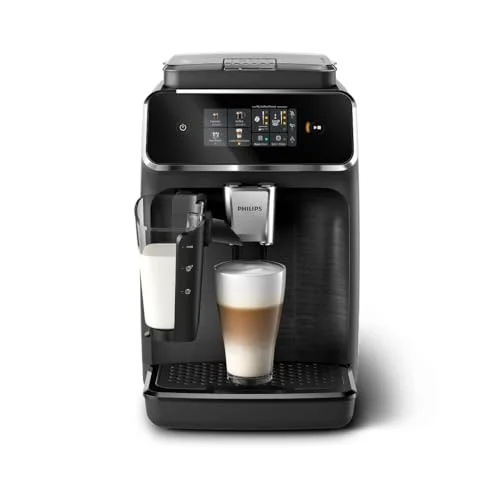
The Philips 2300 Series instead uses Philips' LatteGo system, which is built around a two-piece reservoir that locks onto the machine, has no connecting tubes for milk to pass through, and is designed to be pulled off and rinsed under a tap or set in a dishwasher. The appeal is structural, not cosmetic: fewer internal passages for milk means fewer places for residue to collect unseen, and a design meant to be removed in one motion is more likely to actually get cleaned daily than one that requires partial disassembly. The cost is that LatteGo is a Philips-specific system — it isn't a feature you can retrofit onto a machine that doesn't already ship with it, and it only exists on the Philips side of this list.
Philips 2300 Series with LatteGo
A fully automatic espresso machine built around the LatteGo milk system — a two-piece, tube-free milk reservoir designed to detach and rinse clean in seconds rather than requiring a flush cycle through internal tubing.
$429.06 Check price →The De'Longhi Magnifica Start and De'Longhi Magnifica Duo both ship with a milk frother — De'Longhi's own listings describe a milk frother on each, without naming the specific system on the Magnifica Duo's current listing, so check the product page for which mechanism your unit ships with before assuming it matches the Start. What we can say from the Magnifica Start's published specification is that its milk side is manual: you still position the frother and judge when the milk is textured, which is a meaningfully different workflow from a fully automatic, one-touch latte. If walking away entirely during milk texturing is the feature you actually want, confirm it on the listing rather than assuming it from the product name — "milk frother" alone doesn't tell you whether the machine finishes the job unattended or needs you to stop it.
The picks
Four machines, ordered from the simplest one-touch setup to the most capable, with the trade-offs stated for each rather than buried in a spec sheet.
Philips 2200 Series EP2220/14 — best entry point
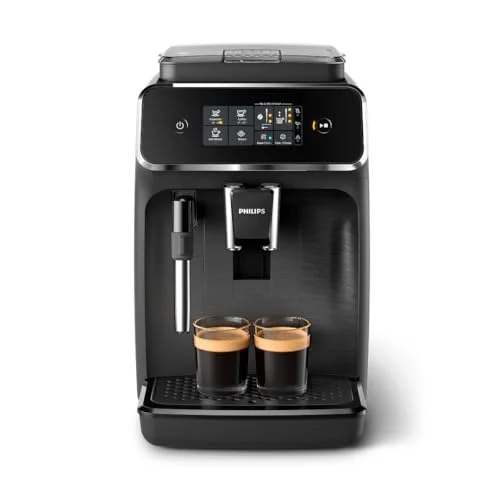
A 100% ceramic grinder, an intuitive touch display, two coffee varieties, a classic milk frother, an AquaClean filter for extended descaling intervals, and an aroma seal to keep beans fresher in the hopper — at under $400. The trade-off: a classic frother means manual positioning and a rinse-after-use habit, not a tube-free system.
$353.68 Check price →Philips 2300 Series with LatteGo — best milk cleanup
The same fully automatic foundation as the 2200 Series, built instead around the tube-free LatteGo milk system. If the frother is the part of a super-automatic you're worried about keeping clean day to day, this is the one built to make that easy rather than optional.
$429.06 Check price →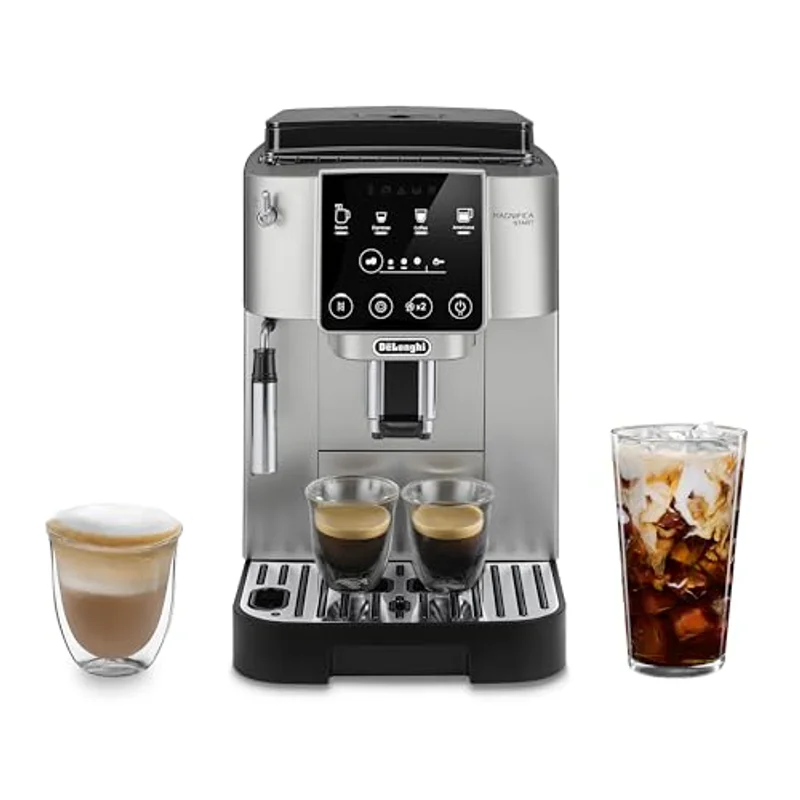
De'Longhi Magnifica Start — best one-touch recipes
A built-in conical burr grinder with 13 grind settings and three one-touch recipes — espresso, coffee and americano — each with adjustable intensity, from the most established name in one-touch espresso. The milk frother on this model is manual, so milk drinks still need a hand at the finish.
$649.95 Check price →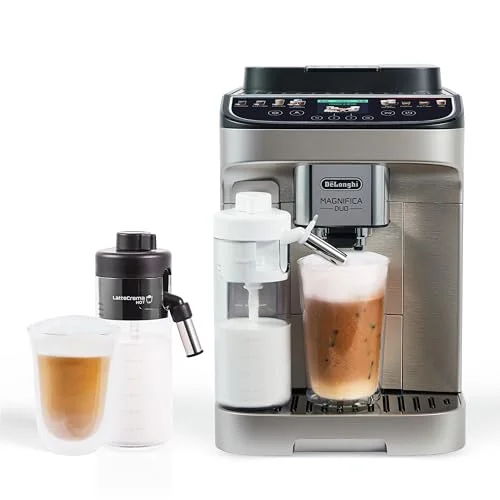
De'Longhi Magnifica Duo — most machine on this list
The Magnifica name at the top of its range: a fully automatic espresso machine with a built-in grinder and a milk frother, for a household that wants the Magnifica Start's one-touch philosophy with more machine underneath it. Confirm the milk-system details and the exact recipe list on the current listing — De'Longhi's naming varies by configuration and this one isn't specified as LatteGo-equivalent.
$999.95 Check price →Super-automatics run tall, because the bean hopper sits on top of the machine and needs clearance above it to refill — a detail that's easy to miss when you're comparing listings by footprint alone. Before any of these four goes under a cabinet or open shelf, check the clearance with the hopper lid accounted for; our guide to espresso machine height and under-cabinet clearance covers how much room one-touch machines actually need and where that number gets measured from.
| Machine | Milk system | Grinder | Price | |
|---|---|---|---|---|
| Philips 2200 Series EP2220/14 | Classic milk frother | 100% ceramic, built-in | $353.68 | Price |
| Philips 2300 Series LatteGo | LatteGo (tube-free) | Built-in | $429.06 | Price |
| De'Longhi Magnifica Start | Manual frother | Conical burr, 13 settings | $649.95 | Price |
| De'Longhi Magnifica Duo | Milk frother (check listing) | Built-in | $999.95 | Price |
Cleaning a super-automatic, honestly: what still needs your hands weekly
The single most common misconception about one-touch machines is that "automatic" extends to cleaning. It doesn't, and every manufacturer says so in the manual even while the marketing on the box implies otherwise.
What the machine does handle on its own: a brew-group rinse cycle that typically runs on power-up and shutdown, flushing residual water through the lines so nothing sits stagnant between cups. That's genuinely automatic, and it's the reason these machines can sit idle for a day or two without tasting stale on the next shot.
What still needs your hands, every week without exception: the drip tray needs emptying and wiping, because used grounds and spilled milk collect there and start to smell before they visibly overflow. The water tank needs refilling with fresh water rather than topping off old water, since standing water is where limescale and off-tastes both start. The milk system — whichever of the two approaches above your machine uses — needs an actual rinse after every session, because milk residue left in a warm machine for hours is a hygiene problem, not a cosmetic one. And the bean hopper benefits from being run down close to empty periodically, since oils from whole beans build up on its walls over weeks regardless of how sealed the design is.
Then there's the brew group itself, which on most super-automatics is removable for a manual rinse under a tap — De'Longhi recommends this as a weekly habit on its Magnifica line, separate from the automatic rinse cycles. Skipping it doesn't break the machine immediately, but it's the single most common reason a one-touch machine's shots get gradually worse over months without an obvious cause.
None of this is unique to super-automatics — every espresso machine needs regular descaling, and water hardness in your area decides how often more than anything else does. What's specific to this category is the milk system and the removable brew group, because those are the two components a semi-automatic machine simply doesn't have to clean in the same way.
Who should buy a semi-automatic instead, and save the money
Super-automatics earn their price by doing the grinding, dosing and tamping for you — which means you're also paying for a sealed, internal grinder you can never remove, upgrade, or use for anything but that one machine. For a specific kind of buyer, that's money spent on a feature they'd rather not have.
If you already know you enjoy adjusting grind size in response to a bean, or you want to chase a specific shot rather than accept whatever intensity level the machine offers, a semi-automatic with its own built-in grinder gets you a portafilter, a tamper and real control over dose — usually for less money than the De'Longhi machines on this list. Our comparisons of the best AMZCHEF espresso machines and the best Gevi espresso machines both cover semi-automatic lines with built-in grinders that start well under $300 — the same core idea as a super-automatic (grinder and machine in one chassis) without sealing away the controls that let you actually dial in a shot.
There's also a household-size argument. A super-automatic's one-touch recipes are tuned for a single cup at a time, and a shared space pouring drinks back-to-back puts different demands on a machine than one person making a latte before work. Our guide to espresso machines for a shared office goes through what actually matters when several people share one machine — tank size and recovery speed tend to outrank one-touch convenience once more than two or three people are involved.
The honest rule of thumb: buy the super-automatic if you want the decision made for you every single time, with no interest in changing it later. Buy the semi-automatic if any part of you suspects you'll eventually want to turn a dial.
How we compared these
We compare published specifications, what's named in the product listing, machine class and live pricing — we do not physically test these machines, we do not run a testing lab, and we do not publish ratings we cannot verify. Amazon's product data returns no rating and no review count for the machines on this site, so there are no stars anywhere on this page and nothing paraphrased from reviews we haven't read.
Where the listing names a specific mechanism — the Philips 2200 Series' ceramic grinder, the 2300 Series' LatteGo system, the Magnifica Start's 13 grind settings and three recipes — we've stated it as given. Where a listing is generic, as with the milk frother named on the Magnifica Duo, we've said so rather than assuming it matches a better-documented sibling model. General coffee facts in this guide — that espresso needs a consistent grind and dose to extract evenly, that milk residue left in warm tubing is a hygiene concern, that ceramic burrs resist wear better than cheap steel ones — are standard background rather than claims about any one product.
Frequently asked questions
What does "super-automatic" mean on an espresso machine?
It means the machine grinds the beans, measures the dose, tamps the puck, brews the shot and — on most models, including all four here — froths the milk, all from a single button press. You load whole beans and water, and the machine's internal timer and mechanism handle every step a semi-automatic machine would otherwise leave to you.
Is LatteGo better than a traditional milk frother?
They solve the same job differently. LatteGo uses a two-piece, tube-free reservoir designed to detach and rinse in seconds, which tends to get cleaned more consistently because there's less friction involved. A classic frother is a wand-style system that's been standard for decades and works well, but its internal tubing needs a deliberate flush after use rather than a quick rinse. Neither is a feature you can retrofit onto a machine that doesn't already ship with it.
How often do I need to clean a super-automatic machine?
Weekly, at minimum, for the drip tray, the water tank refill and the milk system, and the automatic rinse cycles that run on power-up and shutdown don't cover any of those. Most models also have a removable brew group that manufacturers recommend rinsing by hand on a similar schedule. Descaling frequency depends on your water hardness and the manufacturer's instructions, same as on any espresso machine.
Should I buy a semi-automatic instead of a super-automatic?
If you want real control over grind size and dose, or you suspect you'll eventually want to adjust a shot rather than accept a fixed intensity setting, a semi-automatic with its own built-in grinder gives you that for usually less money. If what you want is the same good drink every morning with zero decisions involved, the super-automatic is doing exactly the job it was built for.