Espresso Machines for a Shared Office: What Actually Matters
A machine built for one person is judged on grind precision and latte art. A machine built for a break room is judged on a different question entirely: can person six still get a decent shot four minutes after person one steamed milk, without anyone learning a skill or anyone personally owning the cleaning schedule.
Reader-supported: we may earn a commission if you buy through our links, at no extra cost to you. Prices are the ones we recorded on October 8, 2026 and they move constantly — confirm the live price before buying.
The short answer
Buy for recovery and volume, not for technique. The spec that matters most in a shared office is how fast the machine gets back to brewing temperature between drinks, followed by how much water the tank holds before someone has to notice and refill it. Technique-dependent features — a manual steam wand, a 54 mm portafilter you tamp by feel — are an asset for one dedicated person and a liability for a rotating cast of six or more who will never all learn the same habit.
Of the machines in our database that fit an office budget, the AMZCHEF 9 Bar OPV with Dual Boiler at $499.99 is built around exactly that problem: a dual boiler and a 61 oz tank, the largest of the four. If one-touch simplicity matters more than price, the Philips 2200 Series at $389.00 removes the technique question almost entirely. And if the team is genuinely mixed-preference and twelve people deep, the honest answer later in this guide is that a pod machine, not anything on this page, is probably the better buy.
Why a shared machine needs different specs than a solo one
At home, you dial a machine in once and then drink roughly the same thing every morning. The grind setting, the dose, the milk temperature — all of it gets tuned by one person who has every incentive to get it right and remembers what "right" felt like yesterday. Our guide to common buying mistakes covers that calculus in detail, and most of it assumes a single, consistent user.
None of that holds in a break room. Six or more people means six or more ideas of what a "good" shot tastes like, nobody dialing anything in, and a tamping habit that resets with every new hand on the portafilter. The variables that decide whether the machine survives flip accordingly: a fast reheat between back-to-back drinks matters more than a precision 58 mm portafilter; an automatic milk system that works the same way for the fifth person as it did for the first matters more than manual-wand control; tank ounces and refill frequency matter more than grind adjustability; and how forgiving the machine is about nobody owning its cleaning schedule matters more than how it looks on the counter.
That reframing is the whole guide. Every section below is really the same question asked from a different angle: what happens to this machine when it has to perform for a queue instead of for one person who cares.
Recovery time between shots: the number that decides the queue
At home, the gap between your shot and your partner's second cup an hour later is irrelevant. In an office at 8:58 am it is the whole experience. The mechanism behind that gap is the boiler, and it comes in three rough categories. A single boiler heats one reservoir of water and has to shift between brewing temperature and the hotter temperature needed for steam, so it makes you wait between a shot and a milk drink even when only one person is in line. A thermoblock heats faster on demand but is still one heating element doing two jobs in sequence. A dual boiler uses two independent heating elements — one dedicated to brewing, one to steam — so the next person's shot can be pulled while someone else is still texturing milk.
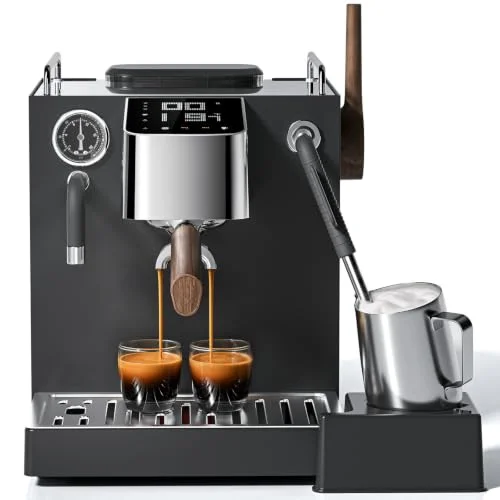
That distinction is a general one about machine design, not a claim about any specific unit's lab-tested recovery time, which none of our listings report. What the AMZCHEF 9 Bar OPV Espresso Machine with Automatic Milk Frother, Dual Boiler ($499.99) does report is the architecture built to address it: a dual boiler, a 1650 W steam system with a dual-hole nozzle for the automatic frothing station, a 58 mm commercial portafilter, and a "Thermal Balance Group Head" that pairs an active PTC heater with PID temperature control, which the listing describes as reducing heat loss and temperature swings during extraction. For a shared machine, that is the one feature description worth reading twice: it is aimed directly at the office problem of shot six tasting different from shot one because the group head cooled while someone else was steaming oat milk.
The same listing calls its pressure system "9 Bar OPV," meaning an overpressure valve regulates extraction within a 9–12 bar range rather than simply quoting a pump's maximum rating — a more specific and more useful claim than the "20 bar" style number that tells you nothing about what reaches the coffee. Espresso brews at roughly 9 bar regardless of what the pump can theoretically produce, so a machine that explicitly regulates toward that range is making a more honest claim than one that just advertises a bigger peak number.
One-touch presets versus a manual wand in a break room
At home this is a personality question — do you want to learn to steam milk, or not. In an office it is close to decided for you, because a manual steam wand asks every single person in line to learn microfoam technique before they can make their own latte, and most of a 30-person floor simply will not.
The Philips 2200 Series Fully Automatic Espresso Machine (EP2220/14) at $389.00 is built for the office answer to that problem. It grinds, tamps and brews at the push of one button on an "intuitive touch display," with three presets — espresso, coffee, or hot water — and adjustable strength and volume that each person can set once and never touch again. Its classic milk frother is listed as working with "milk and plant based alternatives," which matters in practice: offices increasingly stock oat or almond milk alongside dairy, and our guide to machines for plant milk goes through which frothing systems actually cope with the lower fat content. A built-in ceramic grinder also sidesteps one more shared-equipment failure point — ceramic burrs run cooler over long, repeated grinding sessions than the cheaper steel burrs in some budget units, a material property rather than a brand claim.
Against that, the AIRMSEN Espresso Machine with Grinder at $249.99 and the (2026 Upgrade) Espresso Machine with Grinder at $339.99 are both semi-automatic, with a manual steam wand doing the milk work. Both are genuinely capable machines for less money — the AIRMSEN's conical burr grinder offers 10 grind settings, and the newer model's "20% wider polished chute" and reinforced auger are built specifically to resist the grounds jams that oily dark-roast beans cause in cheaper grinders. Neither asks you to pay for automation you might not need. The honest trade-off: every latte on either machine depends on whoever is holding the wand that day, which is a fine bet for a three-person team that already knows what it's doing and a worse one for a floor where half the people have never frothed milk in their life.
The picks
Four machines from our database fit a shared-office budget without asking the office to learn barista skills first. None of them has a published rating or review count we can verify, so none of what follows leans on star ratings — just what each listing specifies, its price, and what that combination is actually good for.
AMZCHEF 9 Bar OPV Espresso Machine, Dual Boiler
Best for a genuinely busy floor. Dual boiler for brewing and steaming at the same time, a 61 oz tank (the largest of the four), a hands-free automatic milk frothing station, a 58 mm commercial portafilter and a 9 Bar OPV system that regulates extraction pressure rather than just advertising a peak number.
$499.99 Check price →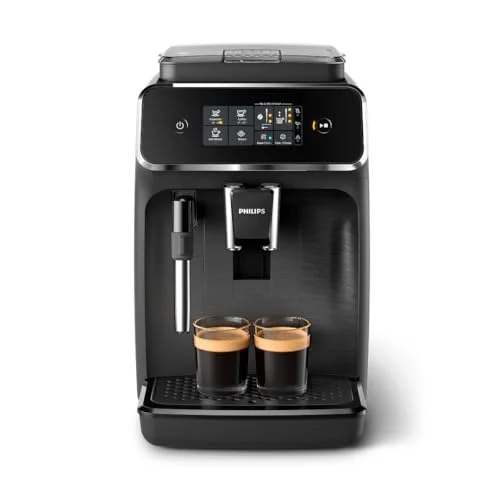
Philips 2200 Series Fully Automatic (EP2220/14)
Best one-touch. Fully automatic grind-tamp-brew behind a single button on a touch display, three presets (espresso, coffee, hot water), adjustable strength and volume, a built-in ceramic grinder, and a classic milk frother rated for plant-based alternatives as well as dairy.
$389.00 Check price →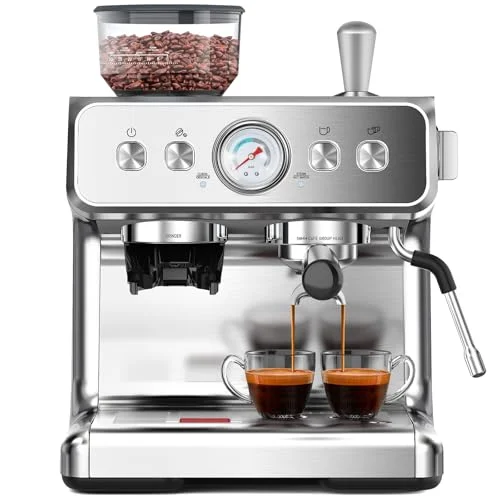
(2026 Upgrade) Espresso Machine with Grinder
Best for a team that keeps dark-roast beans in the hopper. Built-in anti-clog grinder with a 20% wider chute and a reinforced helical auger, designed specifically to eject oily, dark-roast grounds instead of jamming on them — a common failure point when a grinder runs all day without anyone babysitting it.
$339.99 Check price →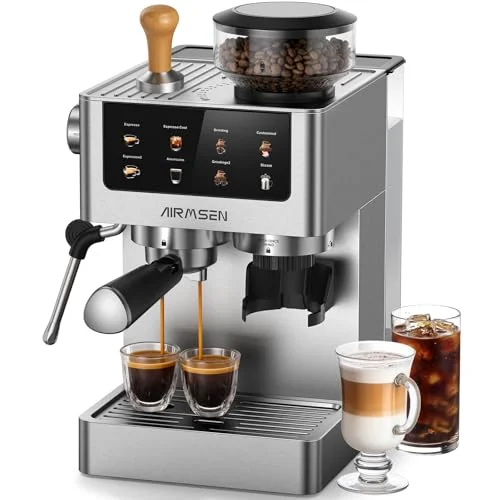
AIRMSEN Espresso Machine with Grinder
Best entry price with a real grinder. Built-in conical burr grinder with 10 grind settings, a removable burr that rinses clean in 10 seconds with no tools, and a detachable steam wand the listing describes as rinsing without sticky residue — both genuinely useful when nobody on staff is assigned to maintain it.
$249.99 Check price →| Machine | Best for | Boiler / grinder | Milk | Price | |
|---|---|---|---|---|---|
| AMZCHEF 9 Bar OPV, Dual Boiler | Busy floor | Dual boiler · no grinder | Automatic frother | $499.99 | Price |
| Philips 2200 Series EP2220/14 | One-touch | Super-automatic · ceramic grinder | Classic frother (dairy + plant) | $389.00 | Price |
| (2026 Upgrade) with Grinder | Dark-roast teams | Semi-automatic · anti-clog grinder | Manual steam wand | $339.99 | Price |
| AIRMSEN with Grinder | Lowest entry price | Semi-automatic · conical burr grinder | Manual steam wand | $249.99 | Price |
Tank size and cleaning schedule for six-plus users a day
A home machine's tank is sized around one or two people and refilled whenever it runs low, which in practice is often once a day or less. Scale that to six-plus people each having one or two drinks, and the tank stops being a convenience feature and starts being a logistics problem: whoever notices it's empty has to care enough to refill it, and in a shared space that job belongs to everyone, which usually means it belongs to no one until the machine simply stops working mid-morning.
Each shot uses roughly an ounce or two of brewing water, and steaming milk draws more from the same tank — so the honest way to think about tank size is in refills per day rather than a precise cup count, since usage varies with how many people take milk drinks versus straight espresso. On that basis, the AMZCHEF's 61 oz tank is the one in this guide sized with a shared office in mind rather than a single desk; the other three machines don't list a tank capacity in their current listings, which is itself worth noting before you buy — if the volume matters to you, check the live listing's specifications rather than assuming. Our guide to tank size and refill frequency works through what different ounce figures translate to for different household and office sizes.
Cleaning compounds the same ownership problem. Descaling frequency depends on local water hardness and the manufacturer's instructions, and both climb faster under office-level volume than the single-user interval most manuals assume. This is where small design choices matter more than they would at home: the AIRMSEN's tool-free, 10-second removable burr and detachable steam wand are easy enough that cleaning doesn't require anyone to feel ownership of the machine to actually do it. Check what's actually in the box before buying, since cleaning brushes, descaling tablets and spare gaskets vary by listing — our guide to what comes in the box breaks that down by price tier. Whatever you buy, the practical fix for office-grade neglect is the same one that works everywhere else: put a recurring reminder on someone's calendar, because nobody will remember on their own.
Where a pod machine is honestly the better office answer
None of the four machines above are capsule machines, and that is deliberate — this guide only names products in our verified database, and none of those happen to be pod systems. But the honest answer for some offices is that a capsule machine, not anything above, is the right purchase, and it is worth saying plainly rather than only selling what we have.
The case for pods is strongest exactly where the case for everything above gets weakest: a large, mixed-preference team with close to zero shared appetite for learning anything about espresso. A capsule fixes the dose, grind and pressure at the factory, so there is no shared technique to get wrong, no group head whose performance drifts with twelve different tamping habits, and typically a fast recovery between drinks because the machine is only heating a small, fixed volume of water per capsule rather than managing a shared boiler under variable load. Grinders are also usually the loudest single component in a home or office machine, and a pod system that skips the grinder entirely tends to run quieter as a side effect — our guide to noise levels covers what actually makes these machines loud.
The trade-off, in our own voice: the per-cup consumable cost of capsules is real money that compounds fast across a team of a dozen or more, in a way a shared bag of beans simply does not, and you give up control over strength and recipe entirely to whatever the capsule maker decided. For a tight team of three to six people who are willing to learn a one-touch workflow or a manual wand, the semi-automatic and super-automatic machines above win clearly on cost per cup. For a floor where half the daily complaints are "this doesn't taste like it did yesterday," that inconsistency is usually a people problem a pod system engineers away, not a machine problem the picks above can fully solve.
Why there's nothing with a star rating on this page
We don't physically test these machines and we don't run a testing lab. We compare what's published: specifications, listed features, price and machine class. Amazon's product data returns no rating and no review count for any of the four machines named here, so there are no stars anywhere on this page and nothing paraphrased from reviews we haven't read.
Where a recommendation above is a judgement rather than a published spec — that a dual boiler matters more than grind precision for a shared machine, that a pod system suits a large mixed-preference team — we've said so in our own voice and shown the reasoning, so you can weigh it against your own office rather than take it on faith.
How we compared these
We started from our office-relevant subset of the espresso machine database and read each listing's own specifications and feature claims rather than marketing adjectives — dual boiler versus single boiler, automatic frother versus manual wand, tank ounces where they're stated, grinder settings where they're stated. Pressure numbers get read sceptically on principle: espresso brews at roughly 9 bar at the puck regardless of a pump's advertised maximum, so a machine that specifies an overpressure valve regulating toward that range, like the AMZCHEF, is making a more useful claim than a bare "20 bar" figure. Where a listing doesn't state a spec — none of our four give a decibel rating or a lab-measured recovery time — we said so rather than estimate a number we can't verify, and recommended checking the live listing instead.
Frequently asked questions
How many people can realistically share one espresso machine?
It depends far more on boiler recovery and tank size than on any "cups per day" number printed on a box. A single-boiler machine that makes someone wait through a reheat before steaming milk starts to strain past three or four regular users; a dual-boiler machine built to brew and steam at once, like the AMZCHEF above, is built specifically to hold up for a bigger team. Tank size is the other half: a 61 oz tank goes further between refills than a machine with no stated tank capacity at all.
Is a dual boiler worth the extra cost for an office?
For a team of six or more drinking multiple rounds a day, generally yes. A dual boiler uses two separate heating elements, one for brewing and one for steam, so the next shot doesn't have to wait for someone else's milk to finish steaming. On a single-boiler or thermoblock machine that wait is built into the design, and in a break room it shows up as a literal queue.
Do one-touch espresso machines make worse coffee than manual ones?
Not inherently worse, just less adjustable. A fully automatic machine like the Philips 2200 Series grinds, tamps and brews to a fixed, repeatable routine with adjustable strength and volume, which is the point in a shared space: every person gets the same result regardless of their technique. A manual steam wand or portafilter rewards practice and punishes its absence, which is exactly the variability an office with a rotating cast of users is trying to avoid.
What size water tank do I need for a team of six or more?
There's no universal number, because usage varies with how many people take milk drinks versus straight shots, but bigger buys fewer interruptions. Of the machines in this guide, the AMZCHEF's 61 oz tank is explicitly the largest; the others don't currently list a tank capacity, so if that figure matters to your team, check the live Amazon listing before buying rather than assume one.