Anti-Clog Grinder Systems: What the Claim Actually Means
A handful of built-in grinders now advertise an "anti-clog" design on the listing page, next to the bar count and the grind-setting number. It sounds like a feature. Mostly it's a burr-chamber geometry choice, and it solves one cause of jamming while leaving the other two untouched.
Reader-supported: we may earn a commission if you buy through our links, at no extra cost to you. Prices are the ones we recorded on October 10, 2026 and they move constantly — confirm the live price before buying.
The short answer
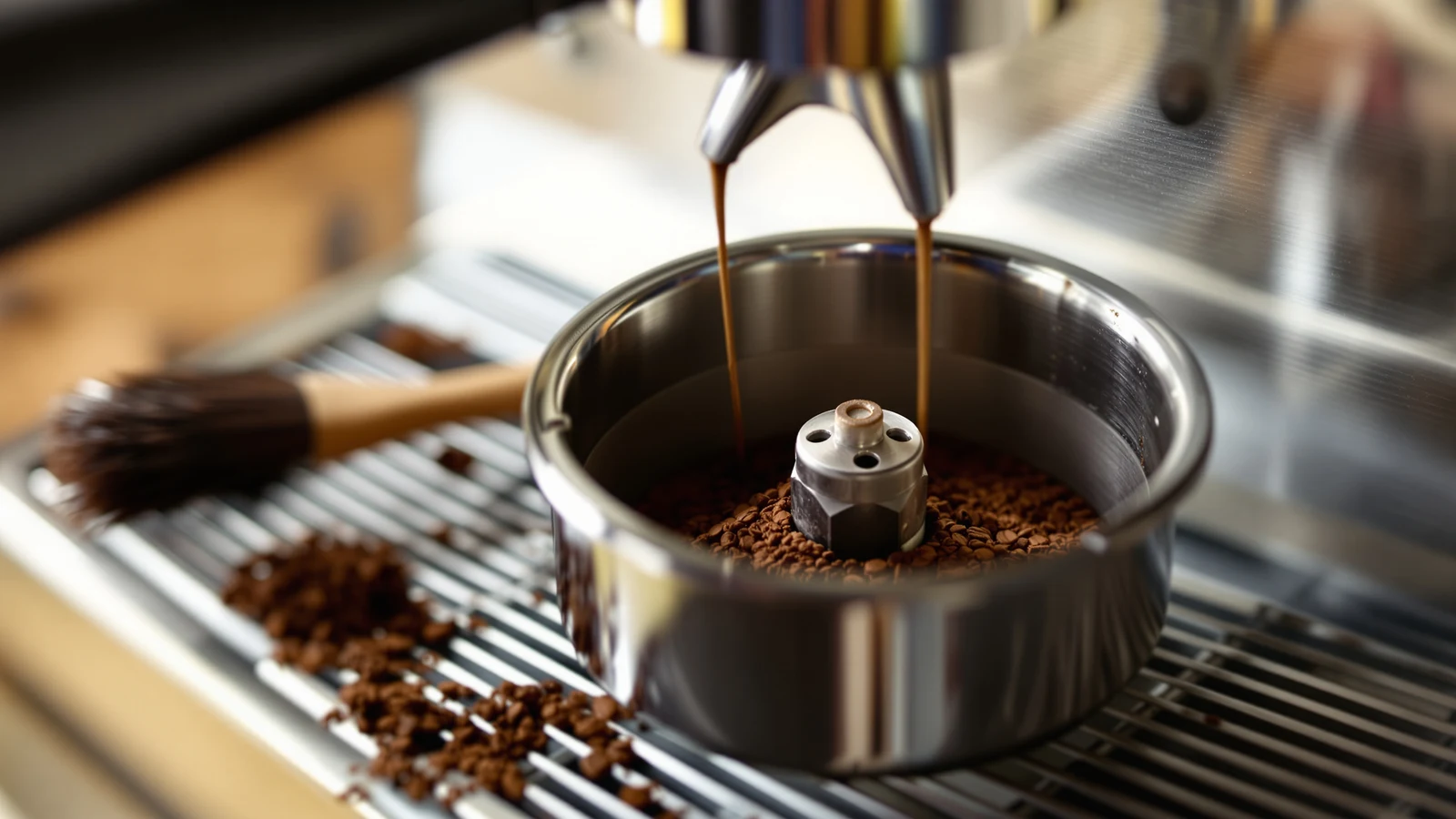
"Anti-clog" on a grinder listing almost always refers to a wider or reshaped exit channel between the burrs and the dosing chute — a geometry change that reduces the odds of fines packing solid in the narrowest part of the path. It is a real, physical difference, and it is also a partial fix. It addresses fines buildup inside the chamber. It does nothing about oily beans gumming the burrs themselves, and nothing about a bean that is simply too big or too hard for the hopper's intake, which is the other common way these grinders jam.
So treat the claim as what it is: a design detail worth having, not a guarantee you'll never clear a jam. Three of the four machines in this guide advertise it — the Electactic 20 Bar at $130.58 and the (2026 Upgrade) Espresso Machine with Grinder at $339.99 both name it directly in their listing titles — and the mechanism works the same way on each: a wider path, not a sealed system.
Why built-in grinders clog in the first place
A built-in grinder on a home espresso machine is a small, enclosed burr chamber doing a job that a countertop grinder does with more room to breathe. That compactness is the root of almost every clog.
Two separate failure modes get lumped under "clogging," and they call for different fixes. The first is fines buildup: every grind produces some portion of ultra-fine dust alongside the main grind, and fine particles are static-prone and sticky. In a cramped chute they pack against the walls instead of falling through, narrowing the path for the next dose until the grinder is pushing beans into a space that's already partly full. The second is oily bean residue: darker roasts carry more surface oil, and that oil coats the burrs and the chute walls over repeated grinds. A tacky film doesn't block anything on its own, but it gives fines something to stick to, which turns an occasional dusting problem into a hard cake over weeks of use.
Both failure modes get worse with volume and with time between cleanings — which is also why a grinder that worked fine for the first month of ownership can start jamming in month three with no change in beans or settings. The chamber accumulated residue gradually; nothing sudden caused it.
What an anti-clog mechanism physically changes about the burr chamber
Marketing copy rarely explains the mechanism, so here's the plain version: an anti-clog burr chamber widens the geometry at the point where ground coffee has to travel from the burrs to the dosing chute. That's the choke point on a standard design — burrs sit close together by necessity, since burr gap is what sets grind size, but the exit channel right after the burrs doesn't need to be narrow, and on a conventional compact grinder it often is anyway, simply because the engineers prioritized a smaller overall chassis.
Widen that channel, angle it so fines have less surface area to cling to, or add a slight vibration/knock step after grinding, and fewer particles get the chance to pack solid before they clear the chamber. That's the entire mechanism in most consumer machines carrying the label — it is not a seal, a filter, or an oil-resistant coating. It is a shape change that reduces one of the two failure modes described above.
The Gevi Dual Boiler at $359.97 doesn't carry the anti-clog name in its listing, which is worth noting precisely because it illustrates the point: a burr grinder without the marketing label isn't necessarily more clog-prone, and a burr grinder with the label isn't immune. The label describes a chamber design choice on the specific units that advertise it; it isn't a certification or a measured standard across the category, and nothing in the published specs for any of these four machines lets us quantify how much less often one jams than another.
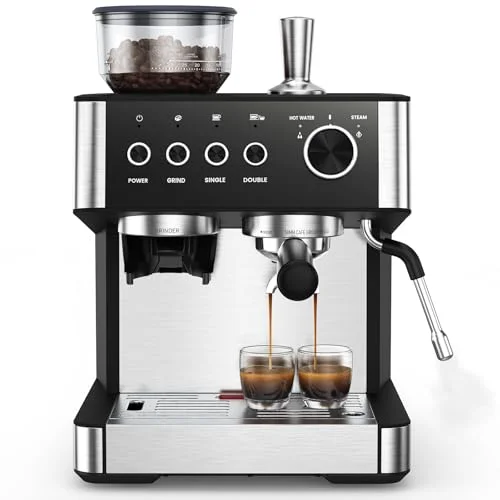
Electactic 20 Bar Espresso Machine with Built-in Anti-Clog Coffee Grinder
The cheapest machine in this guide to carry the anti-clog claim directly in its listing name. A 20-bar pump (pump maximum, not brew pressure — espresso brews at roughly 9 bar at the puck either way) and a built-in grinder in a medium-size body.
$130.58 Check price →The picks
All four machines below have a built-in grinder; two name an anti-clog design explicitly, and we've flagged which. Prices are what we recorded on the dates noted and move constantly on Amazon — confirm the live price before buying.
| Machine | Anti-clog claim | Grinder | Price | |
|---|---|---|---|---|
| Electactic 20 Bar | Named in listing | Built-in, anti-clog chamber | $130.58 | Price |
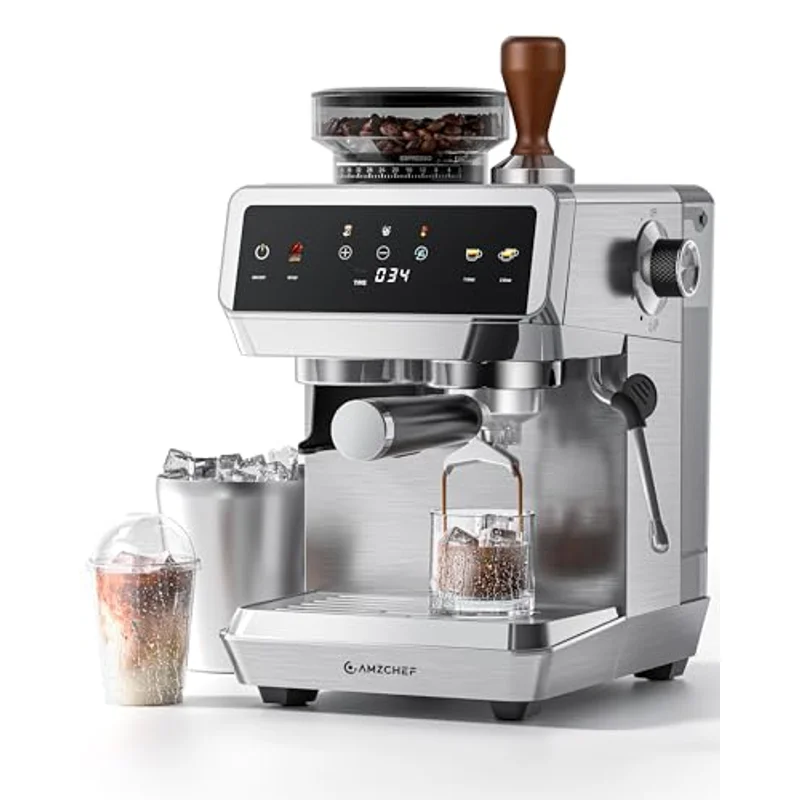 AMZCHEF with Grinder AMZCHEF with Grinder | Not named | Built-in, 44 grind settings, temp control | $199.99 | Price |
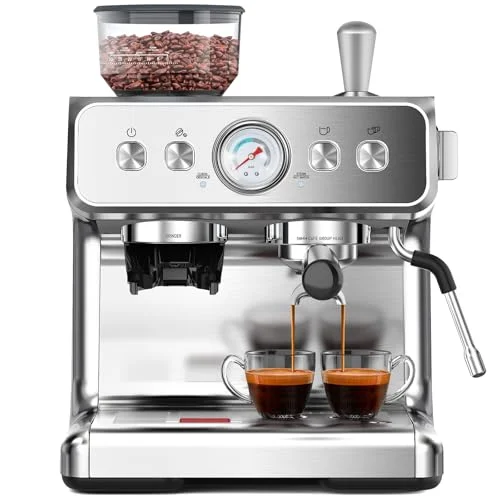 (2026 Upgrade) with Grinder/Steam Wand (2026 Upgrade) with Grinder/Steam Wand | Named in listing | Built-in, anti-clog chamber + steam wand/frother | $339.99 | Price |
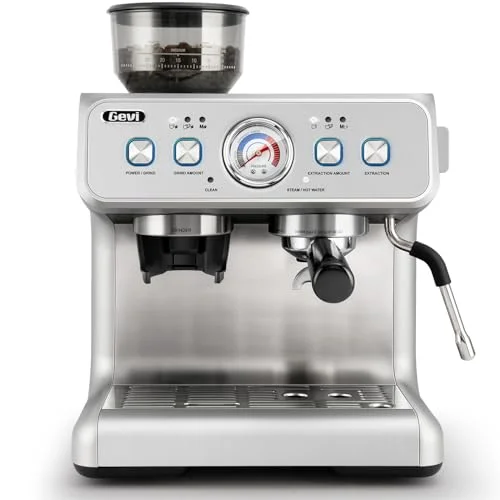 Gevi Dual Boiler with Burr Grinder Gevi Dual Boiler with Burr Grinder | Not named | Built-in burr grinder, dual boiler | $359.97 | Price |
The AMZCHEF Espresso Machine with Grinder at $199.99 doesn't use the anti-clog term, but its 44 grind settings and 190–201 °F temperature control address an adjacent cause of jamming indirectly: a grinder set finer than it needs to be produces more fines per dose, so a wider adjustment range makes it easier to find a setting that clogs less without sacrificing extraction. That's an inference from the spec, not a claim the listing itself makes.
(2026 Upgrade) Espresso Machine with Grinder
Pairs the anti-clog grinder claim with a milk steam wand and frother, aimed at cappuccino and latte drinks rather than espresso alone. The highest price of the anti-clog-labeled machines here.
$339.99 Check price →The Gevi Dual Boiler Espresso Machine with Built-In Burr Grinder at $359.97 is the one machine in this group built around a dual-boiler system rather than the anti-clog label — it measures 16.61"D x 15.66"W x 18.85"H, the largest footprint of the four, which is a function of carrying two boilers rather than anything to do with the grinder chamber. If counter clearance under a cabinet matters to you, measure against that figure before ordering; we don't have equivalent dimensions published for the other three to compare against.
Bean choice: the clogging cause no mechanism fully solves
A wider exit channel reduces how often fines pack solid. It does not change how much oil a dark-roast bean puts into the chamber on every single grind, and oil is the variable you actually control.
Darker roasts carry more surface oil because roasting drives oil to the bean's exterior, and the longer or hotter the roast, the more pronounced that effect. Grind an oily dark roast through any built-in grinder — anti-clog chamber or not — and some of that oil transfers to the burrs and the chute wall on every pass. Over weeks, that film is what fines actually stick to; an anti-clog geometry buys you a wider margin before the sticking becomes a hard block, not immunity from the sticking itself.
None of the four machines above publish a recommended roast level, so we're not going to invent one. What we can say generally: if a grinder of any kind is clogging on a predictable schedule and you're using a dark or flavor-oil-coated bean, the roast is a more likely lever than the machine. Lighter and medium roasts carry measurably less surface oil and tend to produce a cleaner-running chamber over the same number of grinds — a general roasting fact, not a claim about these specific units. Our guide to dialing in dark roast vs. light roast espresso covers how roast level also changes your grind and dose settings, separately from the clogging question.
Bean size and freshness matter too, in a smaller way. A bean that's unusually large, irregularly shaped, or still slightly damp from a very fresh roast can sit awkwardly in a hopper intake designed around an average bean geometry. That's a hopper-intake problem rather than a burr-chamber problem, and no anti-clog chamber design — wide exit channel or not — changes how a bean enters the grinder in the first place.
Clearing a jam safely, whichever grinder you own
A jam is not a failure state worth panicking over, and the fix is the same basic sequence on an anti-clog chamber or a standard one, because the exit channel being wider doesn't change how you'd clear it once something has packed.
- Power off and unplug the machine first. A grinder motor restarting unexpectedly while a hand or a tool is near the burrs is the actual safety risk here — not the coffee.
- Empty the hopper before doing anything else, so loose beans don't fall into the chamber while you're working.
- Follow the manufacturer's access instructions for your model to open the burr chamber or chute cover — this varies by machine and none of the four listings above publish a disassembly procedure, so check the included manual rather than guessing at screws.
- Clear packed grounds with a brush or a wooden/plastic tool, never metal against the burrs, which can nick the burr surface and change your grind consistency permanently.
- Reassemble, plug back in, and run a dose with no beans loaded to confirm the motor turns freely before adding beans back and brewing.
If a jam happens often enough to be a routine chore rather than an occasional nuisance, that's a sign to check two things before assuming the machine is defective: grind setting (too fine produces more fines) and roast (too oily accelerates buildup) — the bean-choice section above covers both levers in more detail. If the machine is shared by several people and gets more volume than one household typically runs through it, our guide to espresso machines for a shared office covers the maintenance tolerance that comes with higher use.
What we won't claim here
We have not physically disassembled these four grinders and timed how often each one jams under identical beans and settings — this site is built on published specifications, listing claims and general coffee-equipment facts, not a lab. Where a listing names "anti-clog" in its title, we report that it does; where it doesn't, we don't assume absence of the feature means a worse chamber design, because the manufacturers who skip the term may simply market differently.
Whether the anti-clog claim is worth paying extra for
On the four machines here, the anti-clog label doesn't cleanly track with price in a way that would let you call it a premium feature. The Electactic 20 Bar carries the claim at $130.58, the lowest price in the group; the (2026 Upgrade) machine carries it at $339.99, the second-highest. The two machines without the label — the $199.99 AMZCHEF and the $359.97 Gevi — sit on either side of that range. That spread is reason enough to treat "anti-clog" as a design detail you can get at multiple price points, not a tier you pay up into.
Given that, the more useful question is whether the detail is worth having at all when it's offered at no premium — and the answer is yes, with the caveat already stated twice in this guide: it reduces one failure mode (fines packing in a narrow chute) and leaves the other (oil buildup from your bean choice) exactly where it was. If a listing offers the feature at a price and spec level you'd otherwise choose anyway, there's no reason to avoid it. There's also no reason to pay a meaningful premium for it alone, or to assume a machine without the label clogs more in practice — we have no data across this category that measures jam frequency machine-to-machine, labeled or not.
The more consequential lever, by a wide margin, is the one covered above: what beans you run through any of these grinders, and how often you clean the chamber regardless of its shape.
How we compared these
We compare published specifications, listing claims, what ships in the box, and live pricing, and we read manufacturer claims — including "anti-clog" — for what they literally describe rather than what they imply. We do not physically test these machines, we do not run a testing lab, and we do not publish ratings we cannot verify: Amazon's product data returns no rating and no review count for the machines on this site, so there are no stars and no invented scores anywhere on this page, and no paraphrased buyer sentiment either.
Where a claim here is general coffee-equipment knowledge rather than a product-specific spec — that darker roasts carry more surface oil, that fines are more clog-prone than coarser grounds, that espresso brews at roughly 9 bar regardless of a pump's rated maximum — we've said so as background rather than attributing it to any one listing. The rest of our method sits on our main espresso machine guide.
Frequently asked questions
Does an anti-clog grinder mean it will never jam?
No. The design typically widens the exit channel between the burrs and the dosing chute, which reduces how often fines pack solid in that narrow point — one of the two common causes of grinder jams. It does nothing about oil buildup from dark or oily beans, which is the other main cause, so a machine with this feature can still clog if you run oily dark-roast beans through it without regular cleaning.
Why do built-in espresso grinders clog more than standalone grinders?
Built-in grinders fit inside a compact machine chassis, so the burr chamber and exit chute are smaller than on a dedicated standalone grinder with more internal room. That tighter geometry gives fines less space to clear and gives oil residue a smaller area to coat before it affects the whole path, which is why a built-in unit tends to jam sooner than a roomier standalone grinder run on the same beans.
What's the safest way to clear a clogged built-in grinder?
Power off and unplug the machine first, empty the hopper, then follow your model's manual to access the burr chamber or chute cover. Clear packed grounds with a brush or a wooden or plastic tool rather than metal, since metal against the burrs can nick the surface and permanently change your grind. Reassemble and run the grinder empty of beans once before loading beans back in, to confirm it turns freely.
Should I pay more for a machine that advertises an anti-clog grinder?
Not on the basis of that claim alone. Among the machines we track, the anti-clog label shows up at both the lowest and a higher price point in the group, so it isn't a premium tier you pay into — it's a design detail some listings name and others don't. If a machine you'd otherwise choose happens to offer it, there's no reason to avoid it, but it shouldn't be the deciding factor over grinder settings, boiler type and the beans you plan to run.