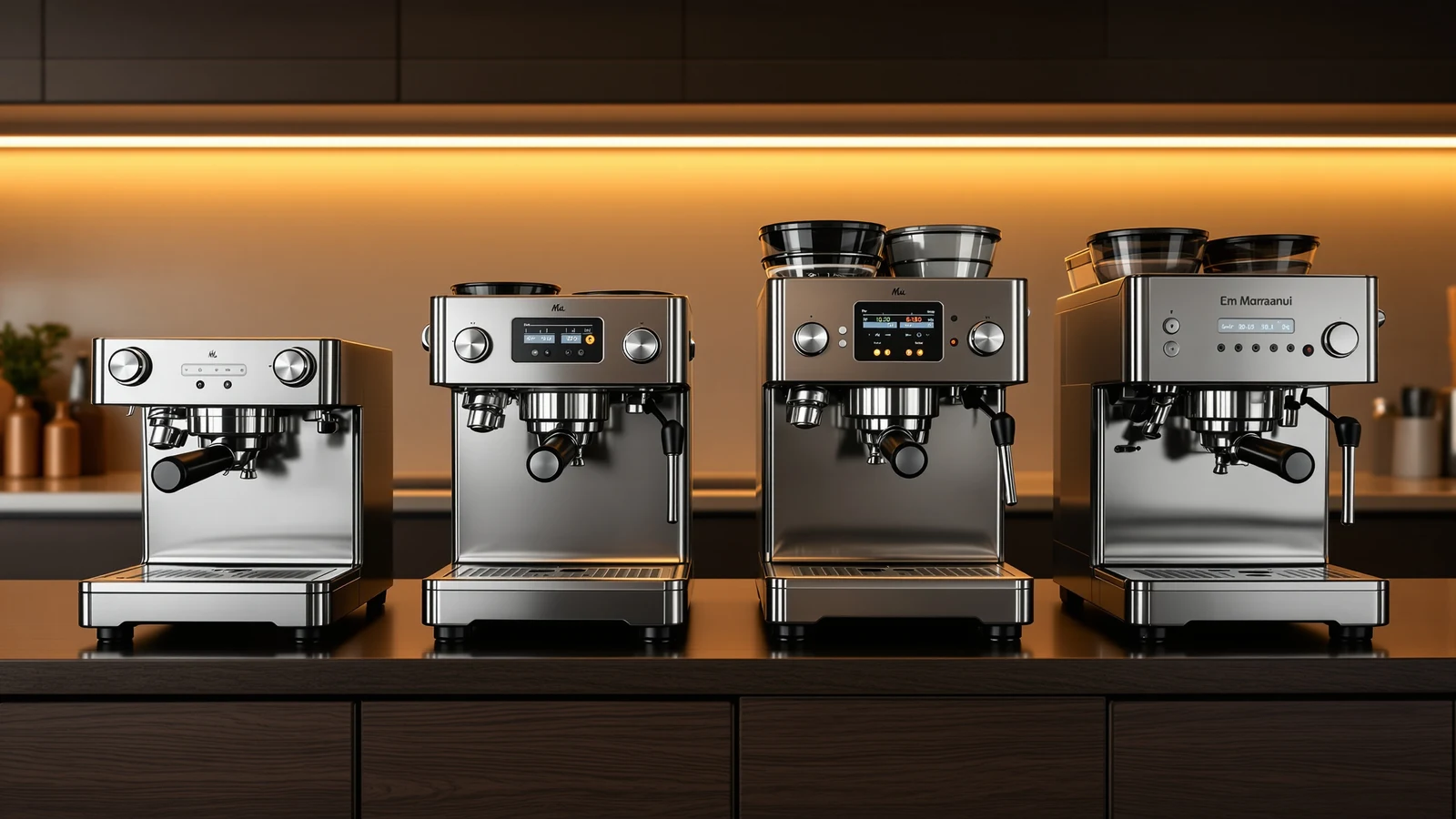
What stays the same across every Gevi machine in this lineup
Before getting into what separates these four machines, it's worth being clear about what doesn't. All four are pump-driven espresso machines with a built-in burr grinder — none of them hands you a blade grinder or asks you to grind separately. All four grind conical burrs rather than flat ones, which is the standard shape at home prices and the one that fits the smaller motors these machines use. And all four are sold under the Gevi name with the same Amazon storefront behind them, so the warranty and support path is identical whichever one you buy.
That consistency is the point of a single-brand lineup: Gevi is betting that once you trust the grinder-plus-machine idea at the entry price, you'll come back for the dual-boiler version later rather than switching brands. Whether that bet pays off for you depends on which of the four gaps below you actually care about.
What does change, machine to machine, is the boiler count, the portafilter size, the grinder's anti-clump handling, and — at the top of the range — whether you get a steam wand for milk at all. Those four variables are what this guide walks through.
The single-boiler models: where the $202.99 and $309.99 machines actually differ
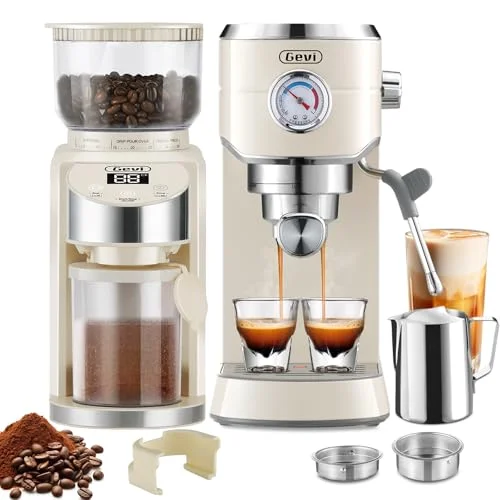
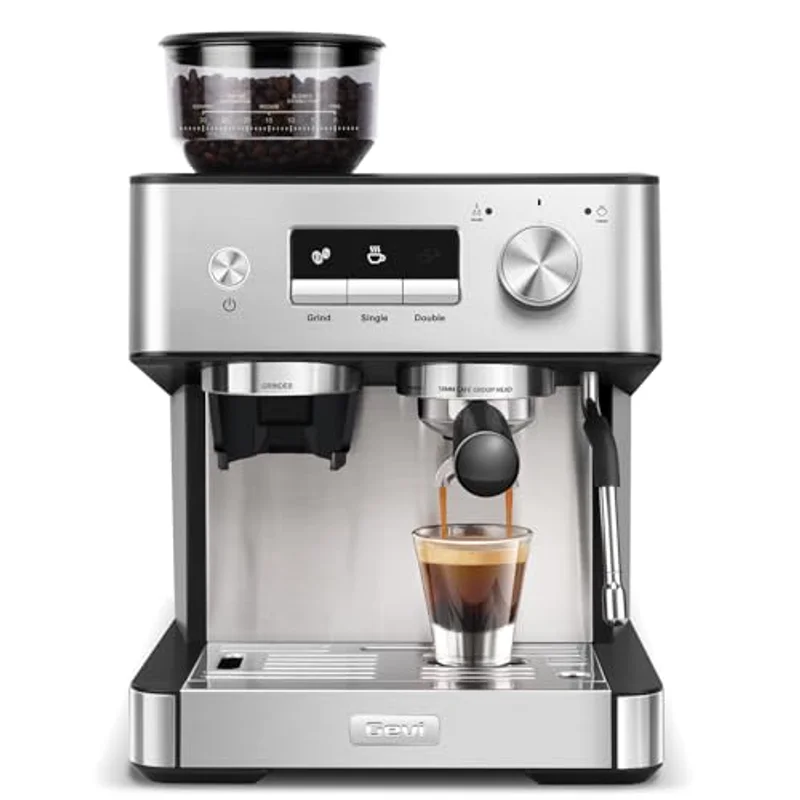
The two cheapest machines in the lineup look similar on a spec sheet — both single-boiler, both with a built-in conical burr grinder, both pump-driven — and the gap between the Gevi 20 Bar Espresso Machine with Conical Burr Anti-Static Coffee Grinder at $202.34 and the Gevi 20 Bar Espresso Machine with Grinder & Steam Wand for Latte Cappuccino at $289.99 is about $87, give or take whatever Amazon is charging the day you look.
The named difference is right there in the product titles. The $202.34 model markets its anti-static grinder as the headline feature — more on what that actually means below — while the $289.99 model leads with a steam wand for lattes and cappuccinos. If your coffee habit stops at straight espresso or an americano, the cheaper machine gives you the same brewing path for less money. If milk drinks are the point, the steam wand is what you're actually paying the extra $87 for, not a better grinder or a bigger boiler — both machines are single-boiler, and we have no published grind-setting count or boiler wattage to compare beyond that.
Size differs too, though not dramatically. The $202.34 model measures 12.28"D x 10.31"W x 12.4"H; the $289.99 model is 11.5"W x 12.01"D x 16.53"H — about 4 inches taller, which is the kind of difference that matters if you're sliding a machine under a cabinet rather than leaving the counter above it open.
Gevi 20 Bar Espresso Machine with Conical Burr Anti-Static Coffee Grinder
The entry point into the lineup: built-in conical burr grinder with anti-static handling, 20-bar pump, single boiler. 12.28"D x 10.31"W x 12.4"H. No steam wand listed in the name, so check the current listing before assuming milk-drink capability.
$202.34 Check price →
Anti-static grinding and why clumping grounds are a real annoyance, not a gimmick
"Anti-static" sounds like marketing filler next to "20 bar" and "dual boiler," but the problem it's solving is a real one, and anyone who has used a cheap burr grinder has run into it. Grinding coffee generates static charge as beans fracture and rub against the burr surfaces and the chute. That charge makes fine grounds cling to the inside of the grinder, to each other, and to the walls of whatever they're falling into — instead of dropping cleanly into the portafilter, a portion clumps and sticks.
Clumped grounds are not a cosmetic problem at the espresso stage. A clump that doesn't break up sits as a denser pocket in the puck, and water finds the path around it rather than through it — exactly the kind of uneven extraction that produces a sour, thin shot on one side of the basket and an over-extracted, bitter one on the other. It's a smaller-scale version of the channeling problem that any unevenly distributed dose causes, and it's hard to fix after the fact by tamping harder, because the clump is already formed before the tamp.
An anti-static grinder design is built to reduce that clinging — typically through how the chute and grinding chamber are shaped, or treated to resist charge buildup, so grounds fall more cleanly into the basket instead of sticking to the sides. We don't have the engineering specifics Gevi uses inside that chamber, so we won't describe the mechanism beyond what the product name tells us. What we can say is that the problem itself — static cling making cheap grinders maddening to clean and inconsistent to dose from — is well documented across burr grinders generally, not a problem Gevi invented a solution for out of nowhere.
The practical upshot: if you've used a budget grinder before and remember grounds sticking to the chute, scattering across the counter, or needing a tap and a brush every time, that's the annoyance this feature targets. It's a legitimate quality-of-life improvement for anyone grinding straight into a portafilter every morning, not a check-box spec that does nothing.
Dual boiler, two ways: the plain model versus the 58mm portafilter upgrade
At the top of the Gevi lineup are two dual-boiler machines, and a dual boiler is a genuine step up from the single-boiler models above: one boiler handles brewing water and the other handles steam, so you can pull a shot and texture milk back to back without waiting for the machine to switch modes and reheat. On a single-boiler machine, going from espresso to steam (or the reverse) usually means a pause while the water temperature shifts.
Both dual-boiler Gevi machines share that same footprint — 16.61"D x 15.66"W x 18.85"H for both the Gevi Dual Boiler Espresso Machine With Grinder & 58mm Portafilter at $349.99 and the Gevi Dual Boiler Espresso Machine With Built‑In Burr Grinder at $359.97 — same size, and only about $10 apart in price. So the decision between them isn't about size or budget. It's about the portafilter.
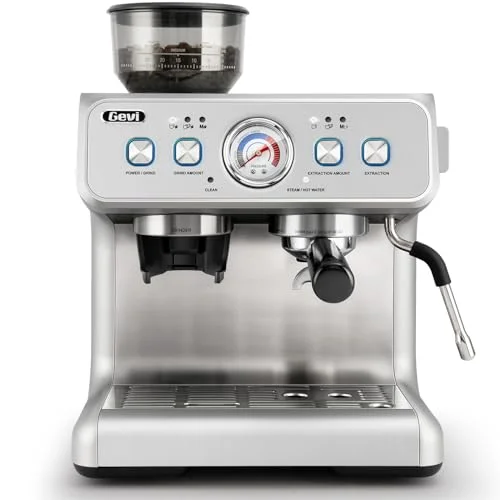
The $349.99 model specifically advertises a 58 mm portafilter, which is the size used by commercial and prosumer machines, not the narrower 51 mm or 54 mm baskets that show up on most home machines, including the two single-boiler Gevis above. A bigger portafilter means a shallower, wider coffee puck for the same dose, which generally extracts more evenly — one of the reasons 58 mm became the standard on café equipment in the first place. It also means any 58 mm-compatible baskets, tampers, or bottomless portafilters from the wider aftermarket ecosystem should fit, where a 51 mm or 54 mm machine locks you into a narrower (and sometimes harder to source) accessory size.
The $359.97 model's listing doesn't name a portafilter size, and per our rule of not asserting a spec we don't have, we won't guess at it — if portafilter size or aftermarket basket compatibility matters to you, check the current Amazon listing for that machine before buying. What we can say is that both machines include a built-in burr grinder and both are dual-boiler, so the 58 mm size is the clearest documented reason to pick one over the other if you already know you want that larger standard.
Gevi Dual Boiler Espresso Machine With Grinder & 58mm Portafilter
Dual boiler for simultaneous brew-and-steam, built-in grinder, and a 58 mm portafilter — the commercial-standard size, which opens up a much wider aftermarket of baskets and tampers than the narrower portafilters on the single-boiler models. 16.61"D x 15.66"W x 18.85"H.
$349.99 Check price →
The picks
01Best overall
Gevi 20 Bar Espresso Machine with Conical Burr Anti-Static Coffee Grinder
The one most people should start with
Single boiler · built-in conical burr grinder, anti-static · 20-bar pump · 12.28"D x 10.31"W x 12.4"H
At $202.34 this is the cheapest way into the Gevi lineup, and it already includes the thing that matters most: a built-in burr grinder, with the anti-static handling that keeps grounds from clumping on the way into your portafilter. For anyone whose daily drink is straight espresso or an americano rather than a milk-heavy one, there's no spec on the pricier single-boiler model that changes the shot itself — the extra money there buys a steam wand, not a better grind.
The trade-offNo steam wand named in this listing, so if lattes or cappuccinos are the point, this isn't the machine — move up to the $289.99 model instead.
02Best for milk drinks
Gevi 20 Bar Espresso Machine with Grinder & Steam Wand for Latte Cappuccino
The single-boiler machine built for lattes
Single boiler · built-in conical burr grinder · steam wand · 11.5"W x 12.01"D x 16.53"H
Same grinder-plus-machine idea as the entry model, with a steam wand added for texturing milk — the feature named right in the product title. At $289.99 it's about $87 more than the base machine, and that gap buys the wand and roughly 4 extra inches of height, not a documented upgrade to the grinder or boiler.
The trade-offStill single-boiler, so expect a pause switching between brewing and steaming — if you're pulling shots and steaming milk back to back for more than one drink, the dual-boiler models below handle that without the wait.
03Best for upgrading accessories
Gevi Dual Boiler Espresso Machine With Grinder & 58mm Portafilter
For buyers who want the commercial-standard portafilter size
Dual boiler · built-in grinder · 58 mm portafilter · 16.61"D x 15.66"W x 18.85"H
At $349.99 this is the only machine in the lineup with a documented 58 mm portafilter — the size used on commercial and prosumer equipment, which puts a much wider range of aftermarket baskets, tampers and bottomless portafilters within reach than the narrower sizes on the single-boiler Gevis. The dual boiler means brewing and steaming don't compete for the same water.
The trade-offA noticeably bigger machine than the single-boiler pair — nearly 19 inches tall — so measure your counter and any cabinet clearance before buying.
04Top of the lineup
Gevi Dual Boiler Espresso Machine With Built‑In Burr Grinder
Dual boiler without the portafilter-size commitment
Dual boiler · built-in burr grinder · 16.61"D x 15.66"W x 18.85"H
At $359.97, the most expensive machine in the lineup, and the same dual-boiler, built-in-grinder combination as the 58mm model above — minus the named portafilter size. If the 58 mm aftermarket ecosystem isn't something you plan to use, this is functionally the same machine for about $10 more, so there's no real reason to prefer it unless the 58mm model is out of stock.
The trade-offWithout a stated portafilter size, we can't tell you whether it matches the 58 mm standard or a narrower one — check the current listing if that matters to you.
All four, side by side
Prices are what we recorded in our product database between October 8 and October 9, 2026, except the 58 mm model, for which we have no dated price on file.
| Machine | Boiler | Grinder | Portafilter | Price | |
|---|
 Gevi 20 Bar with Anti-Static Grinder Gevi 20 Bar with Anti-Static Grinder | Single | Built-in conical burr, anti-static | Not stated — check listing | $202.34 | Price |
 Gevi 20 Bar with Grinder & Steam Wand Gevi 20 Bar with Grinder & Steam Wand | Single | Built-in conical burr | Not stated — check listing | $289.99 | Price |
 Gevi Dual Boiler with 58mm Portafilter Gevi Dual Boiler with 58mm Portafilter | Dual | Built-in | 58 mm | $349.99 | Price |
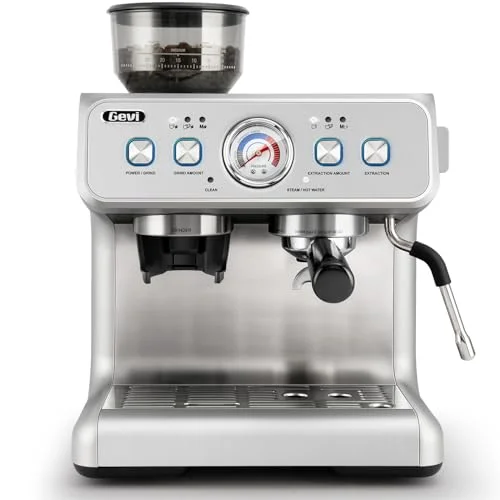 Gevi Dual Boiler with Built-In Burr Grinder Gevi Dual Boiler with Built-In Burr Grinder | Dual | Built-in burr | Not stated — check listing | $359.97 | Price |
Which Gevi model most buyers should actually land on
If you're new to Gevi and new to home espresso, the $202.34 anti-static grinder model is the sensible default. It has the one feature that matters most at this price — a built-in burr grinder — plus the anti-static handling that makes day-to-day use noticeably less annoying, and it costs roughly $150 less than the dual-boiler machines without giving up the core brewing path. You're not giving up espresso quality for lack of a steam wand; you're giving up the ability to texture milk, which is a real trade but a narrow one if your daily drink is already straight espresso.
Milk drinkers should skip straight to the $289.99 steam-wand model rather than buying the cheaper machine and regretting it later. An americano machine and a latte machine are not interchangeable once milk is part of the routine, and $87 is a cheap way to avoid finding that out after the fact.
The dual-boiler step up is worth the roughly $150 jump over the steam-wand single-boiler model specifically for households or routines where brewing and steaming happen back to back — multiple milk drinks in a row, or a shared machine where waiting for a boiler to switch modes is a real friction point, not a once-a-week inconvenience. Within the dual-boiler pair, choose the $349.99 58 mm model unless you have a specific reason not to: it's the same price bracket as the $359.97 machine, with a documented portafilter size that opens up more aftermarket accessories, against a competing machine where that spec is simply unstated.
What we would not do is buy the most expensive machine in the lineup by default. Without a stated portafilter size, the $359.97 model asks you to pay slightly more than the 58 mm machine for a spec we can't verify is actually better — and "most expensive" has never been a substitute for "best documented" on this site.
One thing not to assume
"20 bar" on the single-boiler models is the pump's maximum rating, not the pressure that reaches the coffee — espresso brews at roughly 9 bar at the puck on any properly functioning machine. It's a real spec, but it doesn't distinguish these machines from each other or from any other home espresso machine with a modern pump; don't let it be the deciding factor between the two single-boiler Gevis.
How we compared these
We compared these four machines on the specifications in their product listings — boiler count, grinder type, portafilter size where stated, dimensions, and live price — plus general, non-product-specific espresso facts: that static cling is a documented nuisance in burr grinders, that a 58 mm portafilter is the commercial standard with a wider accessory ecosystem than narrower home-machine baskets, and that dual boilers let a machine brew and steam without switching modes. We do not physically test these machines, we do not run a testing lab, and we do not publish ratings we cannot verify: Amazon's product data returns no rating and no review count for the machines on this site, so there are no stars and no invented sentiment anywhere on this page.
Where a product listing didn't name a spec — portafilter size on three of the four machines, exact grind-setting counts, boiler wattage — we said so rather than guessing, and pointed you to the current Amazon listing instead. Our guide to anti-clog grinder systems goes deeper on how grinder manufacturers handle jamming and clumping generally, if the anti-static mechanism here is the part you want to understand further.
Frequently asked questions
What does "anti-static" actually mean on a Gevi grinder?
It refers to design choices inside the grinding chamber and chute meant to reduce the static charge that builds up as beans are ground — charge that otherwise makes fine grounds cling to the inside of the grinder and clump together instead of falling cleanly into the portafilter. Clumped grounds extract unevenly, which can mean a sourer shot on one side of the puck and a more bitter one on the other. We don't have Gevi's internal engineering details beyond what the product name states, so we describe the problem it addresses rather than the exact mechanism.
Is a dual-boiler Gevi machine worth the extra money over the single-boiler models?
It depends on how often you brew and steam back to back. A dual boiler keeps separate water supplies for brewing and steaming, so you can pull a shot and texture milk without waiting for the machine to switch modes and reheat. If you make one drink at a time, that wait is minor; if you're making several milk drinks in a row, or sharing the machine with others, the roughly $150 jump from the steam-wand single-boiler model to the dual-boiler pair removes a real friction point.
Why does the 58mm portafilter matter on one of the dual-boiler models?
58 mm is the portafilter size used on commercial and prosumer espresso machines, rather than the narrower 51 mm or 54 mm baskets common on home machines, including the single-boiler Gevis in this lineup. A wider basket spreads the same coffee dose into a shallower puck, which tends to extract more evenly, and it also means a much larger range of aftermarket baskets, tampers and bottomless portafilters will fit — useful if you plan to upgrade accessories later rather than stay stock.
Do all four Gevi machines in this lineup have a steam wand?
No — only the $289.99 single-boiler model names a steam wand in its listing, and both dual-boiler machines include steam functionality as part of their second boiler. The $202.34 entry model's listing does not name a steam wand, so if milk drinks matter to you, check the current listing or move up to one of the other three machines before buying.
Keep reading