The entry machine: what $89.99 buys and what it skips
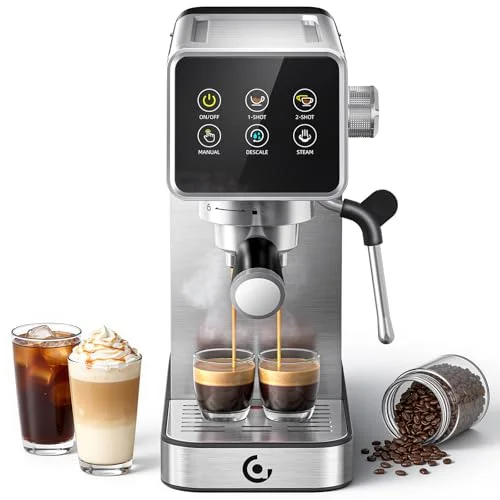
The AMZCHEF 20 Bar Home Espresso Coffee Machine at $89.99 is the cheapest way into the brand, and for that price it gives you the one thing that actually matters at the bottom of this category: a real pump rather than a steam-driven system. It carries a 41 oz water tank, which is on the small side for back-to-back drinks but fine for one or two cups, and the 20-bar pump rating is the pump's maximum, not the pressure that reaches the coffee — espresso brews at roughly 9 bar at the puck regardless of what number is printed on the box.
What it skips is named right in the gap between this model and the next one up: there is no built-in grinder. That means pre-ground coffee or a separate grinder is part of the deal from day one, and pre-ground coffee is milled to one fixed size meant to work across every brew method, which is too coarse for espresso and cannot be adjusted. If you already own a burr grinder, or you're willing to buy a cheap hand grinder alongside it, this machine gives you a legitimate semi-automatic starting point for under $100. If you don't have a grinder and don't want to shop for one separately, the mid-tier model below removes that decision for you.
We don't have a published boiler count, wattage, or steam-wand spec for this model beyond the tank size and bar rating in the product listing, so we won't guess beyond what's stated — check the current Amazon listing for anything more granular before buying.
AMZCHEF 20 Bar Home Espresso Coffee Machine
The entry point into the lineup: 20-bar pump, 41 oz water tank, no built-in grinder. The cheapest route to a real pump machine under the AMZCHEF name — bring your own grind.
$89.99 Check price →
Adding a grinder: what the mid-tier model actually changes about the morning routine
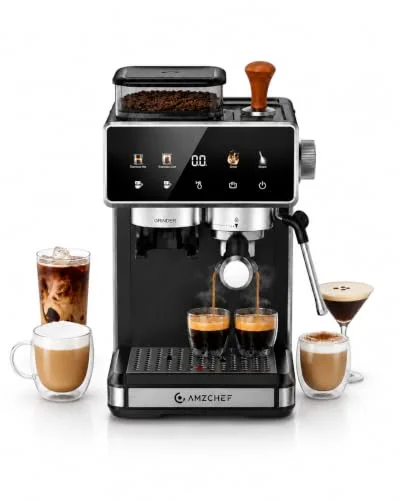
The AMZCHEF Espresso Machine with Grinder, Latte & Cappuccino for Home Use at $179.99 costs exactly $90 more than the entry machine, and that $90 buys the single biggest change you can make to a home espresso routine: a built-in grinder, so beans go in whole and grounds come out straight into the portafilter. Nothing is lost in a transfer between a separate grinder and a basket, and there's no second appliance, no second plug, and no counter space given up to a standalone unit.
The listing also names latte and cappuccino as intended drinks, which points to a steam wand for milk, and the tank grows to 61 oz — about 20 oz more than the entry model, which matters more than it sounds for a household making several drinks before a refill. What the listing does not give us is a grind-setting count, a boiler wattage, or a stated portafilter size, so we won't assert any of those; if they matter to your decision, check the current listing.
The practical shift is less about any single spec and more about the routine itself. With the entry machine, making espresso is a two-step morning: grind (wherever that happens), then brew. With the grinder built in, it collapses to one step at one appliance — the exact trade that built-in grinders are built to sell, and the reason this tier exists between the $89.99 and $499.99 machines rather than the brand skipping straight to the flagship.
AMZCHEF Espresso Machine with Grinder, Latte & Cappuccino for Home Use
Built-in grinder, 61 oz water tank, named for latte and cappuccino drinks. The one-appliance route: grind, dose, and brew without a separate grinder taking up counter space.
$179.99 Check price →
The dual-boiler flagship: automatic frother, manual OPV, and brewing and steaming at once
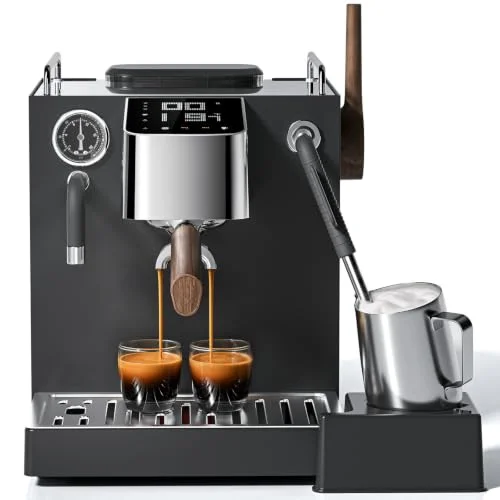
The AMZCHEF 9 Bar OPV Espresso Machine with Automatic Milk Frother, Dual Boiler at $499.99 is a different class of machine from the two below it, and the name says most of the reason why. It's dual-boiler, which means one boiler handles brewing water and the other handles steam — so you can pull a shot and texture milk at the same time instead of waiting for a single boiler to switch modes and reheat between them. On the two single-tier machines above, going from brew to steam (or back) typically means a pause.
It also adds an automatic milk frother, which is a meaningfully different experience from a manual steam wand: instead of holding a pitcher under a wand and texturing milk by hand, the machine handles the frothing step on its own. That's a walk-away convenience the two cheaper machines in this lineup don't offer at all — neither the entry machine nor the grinder model names any kind of milk frothing hardware in their listings.
The name also calls out "9 bar OPV" rather than the "20 bar" language on the entry machine, and that's worth unpacking rather than skimming past. OPV stands for over-pressure valve, the mechanism that caps brewing pressure so it doesn't overshoot past the roughly 9 bar that espresso is actually brewed at. Naming the OPV as manual means you can adjust that cap yourself rather than it being fixed at the factory — a feature aimed at someone who wants to tune brewing pressure deliberately, not someone comparing bar numbers on a box. It's a more technical, more involved spec than anything on the cheaper two machines, and it signals who this machine is actually built for: a buyer who wants to adjust how the machine brews, not just push a button and wait.
The tank matches the mid-tier model at 61 oz, so the step up from $179.99 to $499.99 isn't about capacity — it's entirely about the dual boiler, the automatic frother, and the manual OPV control, three features none of which are present on the two cheaper AMZCHEF machines.
AMZCHEF 9 Bar OPV Espresso Machine with Automatic Milk Frother, Dual Boiler
Dual boiler for simultaneous brewing and steaming, automatic milk frother, and a manual over-pressure valve for adjusting brew pressure yourself. 61 oz tank. The only machine in the lineup built for brewing and frothing at the same time.
$499.99 Check price →
The picks
01Best overall
AMZCHEF Espresso Machine with Grinder, Latte & Cappuccino for Home Use
The one most buyers should land on
Built-in grinder · 61 oz tank · latte & cappuccino named · $179.99
This is the machine that removes the most friction for the least money in the lineup. A built-in grinder means you're not shopping for a second appliance or losing coffee in a transfer between a standalone grinder and the portafilter, and the 61 oz tank is enough to get a household through several drinks between refills. For most people deciding between these three machines, the grinder is the single feature worth paying $90 more than the entry model for.
The trade-offNo dual boiler and no automatic frother, so milk drinks mean a manual wand and a pause between brewing and steaming — if that back-and-forth is a daily routine for you, the flagship below removes the wait.
02Best for milk drinks
AMZCHEF 9 Bar OPV Espresso Machine with Automatic Milk Frother, Dual Boiler
For households that brew and froth back to back
Dual boiler · automatic milk frother · manual OPV · 61 oz tank · $499.99
At $499.99 this is more than double the mid-tier machine, and the money goes into three things the cheaper machines don't have at all: a second boiler so brewing and steaming don't compete for the same water, an automatic frother that textures milk without a hand on a wand, and a manual over-pressure valve for buyers who want to tune brewing pressure rather than accept a fixed factory setting.
The trade-offThe manual OPV is a feature for someone who wants to adjust how the machine brews, not a convenience for someone who just wants coffee — if that doesn't interest you, you're paying for a capability you won't use.
03Cheapest
AMZCHEF 20 Bar Home Espresso Coffee Machine
The lowest-risk way to find out if espresso sticks
20-bar pump · no grinder · 41 oz tank · $89.99
Under $90, with a real pump rather than a steam-driven system — the floor for a home espresso machine worth owning, in a brand that also sells two pricier machines if you later decide you want more. Pair it with a separate burr grinder and it's a legitimate starting setup.
The trade-offNo grinder and the smallest tank in the lineup at 41 oz, so budget for a separate grinder and expect more frequent refills than the two pricier machines.
All three, side by side
Prices are what we recorded in our product database between September 2 and October 8, 2026.
| Machine | Boiler | Grinder | Milk | Tank | Price | |
|---|
 AMZCHEF 20 Bar Home Espresso Machine AMZCHEF 20 Bar Home Espresso Machine | Single | None | Not stated — check listing | 41 oz | $89.99 | Price |
 AMZCHEF with Grinder, Latte & Cappuccino AMZCHEF with Grinder, Latte & Cappuccino | Single | Built-in | Named for latte/cappuccino — wand not stated | 61 oz | $179.99 | Price |
 AMZCHEF 9 Bar OPV Dual Boiler AMZCHEF 9 Bar OPV Dual Boiler | Dual | Not stated — check listing | Automatic frother | 61 oz | $499.99 | Price |
Where the price jumps are justified — and where they are not
The first jump, $89.99 to $179.99, is the clearest one to justify. $90 buys a built-in grinder, which is not a minor convenience — it's the difference between needing a second appliance and not needing one, and between losing grounds in a transfer and grinding straight into the basket. The tank also nearly doubles, from 41 to 61 oz. Spec for spec, that's a well-spent $90 for almost anyone who doesn't already own a grinder.
The second jump, $179.99 to $499.99, is a bigger number and a narrower audience. The $320 difference buys a second boiler, an automatic frother, and a manual OPV — three real features, none of which exist on the cheaper machine, so this isn't a case of paying more for the same thing with a different badge. But it's also not a jump that pays off for everyone the way the first one does. The dual boiler only matters if you're brewing and steaming back to back often enough that the wait on a single-boiler machine is a genuine friction point rather than an occasional inconvenience. The automatic frother only matters if you drink milk-based espresso drinks regularly. And the manual OPV is squarely a feature for someone who wants to tune brewing pressure themselves — it adds nothing to the cup for a buyer who just wants to push a button and get espresso.
Put plainly: the first $90 is close to a universal upgrade. The next $320 is a specific upgrade for a specific routine — multiple milk drinks, back-to-back brewing, or a genuine interest in adjusting how the machine brews — not a better version of the same machine for everyone.
One thing not to assume
"20 bar" on the entry machine and "9 bar" on the flagship are not describing the same thing in opposite directions. The entry machine's 20-bar figure is the pump's maximum rating; the flagship's 9-bar figure, paired with "OPV," refers to the actual brewing pressure the valve is designed to hold the shot at. Both machines brew espresso at roughly the same pressure at the puck — the flagship's number is just the honest one.
Who should stop at the cheapest model
If you already own a burr grinder, or you're buying your first espresso machine specifically to find out whether the habit sticks before spending more, the $89.99 entry machine is the right place to stop. It has the one non-negotiable spec — a real pump — and nothing about the two pricier machines changes what a pump-driven shot tastes like. The grinder on the $179.99 model and the dual boiler and frother on the $499.99 model are routine and convenience upgrades, not quality-of-shot upgrades.
The same logic applies if your household drinks one or two espressos a day, straight, with no milk. A 41 oz tank and a single boiler cover that routine without friction, and the 61 oz tanks and dual boiler on the pricier machines are solving a capacity and back-to-back problem you don't have. Spend the saved $90 to $410 on a decent burr grinder and good beans instead — both will do more for the cup than a bigger tank you don't need to fill as often.
How we compared these
We compared these three machines on the specifications in their product listings — boiler count, grinder presence, tank size, named milk-frothing hardware, and live price — plus one general, non-product-specific espresso fact: that bar ratings above roughly 9 describe a pump's maximum rather than the pressure that reaches the coffee. We do not physically test these machines, we do not run a testing lab, and we do not publish ratings we cannot verify: Amazon's product data returns no rating and no review count for the machines on this site, so there are no stars and no invented sentiment anywhere on this page.
Where a listing didn't name a spec — grinder settings, boiler wattage, whether the mid-tier model's steam wand is manual or automatic, grinder presence on the flagship — we said so rather than guessing, and pointed you to the current Amazon listing instead. Our guide to anti-clog grinder systems and buying mistakes first-time buyers make go deeper on the grinder and budgeting questions this comparison touches on.
Frequently asked questions
Is the $179.99 AMZCHEF with a grinder worth $90 more than the entry model?
For most buyers, yes. The $90 difference buys a built-in burr grinder, which removes the need for a separate grinder and the coffee lost in transferring grounds from one to a portafilter, plus a tank that grows from 41 to 61 oz. If you already own a grinder you're happy with, the entry machine at $89.99 gives you the same brewing path for less.
What does OPV mean on the $499.99 AMZCHEF, and why is it called out by name?
OPV stands for over-pressure valve, the mechanism that caps brewing pressure near the roughly 9 bar that espresso is actually brewed at, regardless of how hard the pump can push. Calling it "manual" means the cap is adjustable by the user rather than fixed at the factory — a feature for buyers who want to tune brewing pressure themselves, not a convenience feature for someone who just wants to push a button.
Do all three AMZCHEF machines have a steam wand or frother?
Only the flagship $499.99 model names milk-frothing hardware in its listing — an automatic milk frother. The $179.99 model is named for latte and cappuccino drinks, which implies some milk-frothing capability, but its listing doesn't state whether that's a manual wand or an automatic system, so check the current listing if that distinction matters to you. The $89.99 entry model names no milk-frothing hardware at all.
Is a dual-boiler machine worth the jump from the mid-tier AMZCHEF?
It depends on how often you brew and steam at the same time. A dual boiler keeps separate water supplies for brewing and steaming, so you're not waiting for a single boiler to switch modes and reheat between a shot and a milk drink. If you make one drink at a time, that wait is minor; if you're making multiple milk-based drinks back to back, or sharing the machine, the $320 jump from the $179.99 model removes a real friction point rather than adding a feature you won't notice.
Keep reading