Espresso Machine Height: What Fits Under a Cabinet or Open Shelf
Width gets measured. Height gets guessed — and height is the dimension that actually fails you, because it is the one you can't see until the lid won't open or the water tank won't lift out. The machines in this catalogue run from 12 inches tall to one that doesn't list a height at all, and that gap is the whole story.
Reader-supported: we may earn a commission if you buy through our links, at no extra cost to you. Dimensions and prices below are the ones published for each listing as of October 2026 and can change — confirm them on the listing before you order.
The short answer
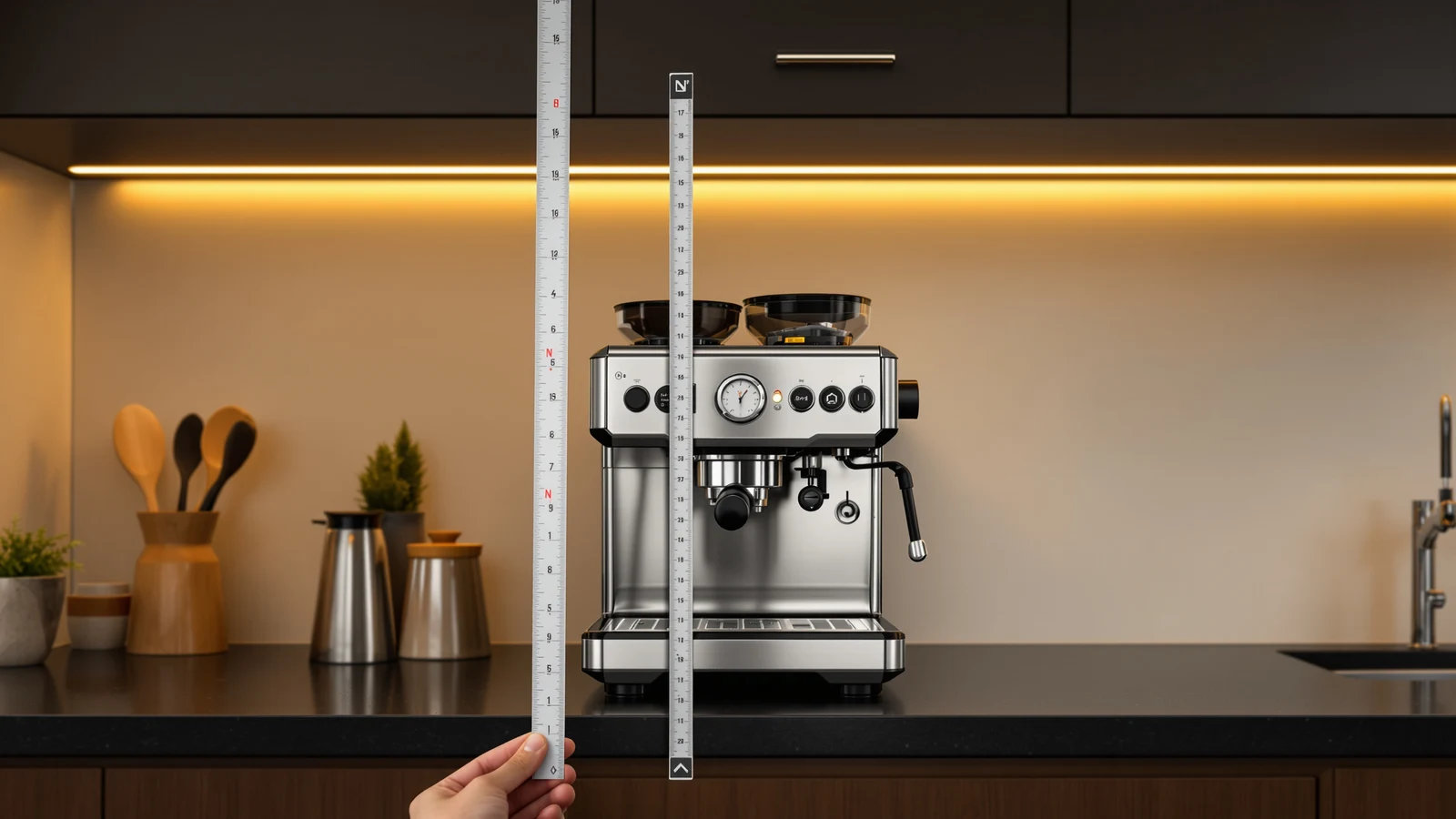
If a machine has to live under a cabinet or an open shelf, height is the only dimension that can actually stop you from using it, and it has to clear more than the sealed box in the listing photo. You need room above the chassis to lift a hinged lid, pour beans into a hopper, or pull a water tank straight up, and none of that extra clearance shows up in the width or depth numbers.
In this catalogue the shortest machine is the SECPOEDR 20 Bar Semi-Automatic at 12 inches tall — at $105.99, it is also the cheapest. The Gevi 20 Bar with Conical Burr Grinder comes in barely behind it at 12.4 inches, despite carrying a built-in grinder that the SECPOEDR doesn't have. The XIXUBX Espresso Machine with Grinder is taller at 14.34 inches, and the Kismile 20 Bar Dual Boiler doesn't publish a height figure at all — which, for a dual-boiler machine, is itself worth planning around rather than guessing past.
Why height matters more than width in a cabinet kitchen
Width decides whether a machine fits between two other things on the counter — a toaster on one side, a canister set on the other. It is forgiving, because counters run in a straight line and six inches of slack is easy to find by sliding something over. Depth is almost as forgiving, since most counters are 24 to 25 inches deep and even a large machine leaves room behind it.
Height is different because it is bounded on both ends. The counter sets the floor. The underside of a wall cabinet, a floating shelf, or a backsplash-mounted microwave sets a hard ceiling that does not move. There's no sliding a cabinet out of the way. And the number that actually matters isn't even the machine's resting height — it's the resting height plus whatever clearance the machine needs above itself to function: a lid that swings up, a hopper lid that lifts off, a water tank that has to come straight up and out rather than slide forward.
That second number almost never appears in a listing. A spec sheet will tell you a machine is 12.4 inches tall closed. It will not tell you that the water tank needs another 3 inches of headroom to clear the top before you can lift it free. That's the gap between "fits on the counter" and "fits under the cabinet" — and it's the gap that generates the one-star reviews about machines that have to be pulled out every time someone wants to refill the tank.
The shortest machines, and what the low profile costs
The SECPOEDR 20 Bar Semi-Automatic is the shortest machine in this catalogue at 12 inches tall, and it's also the narrowest at 6.7 inches wide — a 13.2 by 6.7 by 12 inch footprint that will slide into gaps a wider machine can't. At $105.99 it's a straightforward pump espresso machine: a 20-bar pump, a pressure gauge on the front so you can watch extraction rather than guess at it, a removable water tank, and a milk frother for cappuccino and latte. There's no built-in grinder listed, which is the trade a machine this compact and this cheap generally makes — you bring your own ground coffee or a separate grinder, and the separate grinder then needs its own spot on the counter or shelf.
What's notable is how little height the grinder-equipped machines actually cost you over that 12-inch floor. The Gevi 20 Bar with Conical Burr Grinder is 12.4 inches tall — 12.28 by 10.31 by 12.4 inches — which is only four-tenths of an inch taller than the grinder-less SECPOEDR, despite packing a conical burr grinder with anti-static design into the chassis. If your cabinet gap is tight, that's the useful takeaway: a built-in hopper and grinder assembly doesn't automatically add the two or three inches you might expect. It's the SECPOEDR's narrower 6.7-inch width, not its 12-inch height, that's the real space-saver — useful if the gap you're fitting into is narrow rather than short.
The cost of the lowest-profile machines shows up in control, not clearance. A pressure gauge tells you what the pump is doing in real time, but it's an analog readout you read and react to, not a programmable target. No grinder means no dose control and no single setting that remembers your grind — you're managing that variable yourself, every time. For a first machine, or a machine that has to disappear under a shelf, that's often the right trade. For buyers who want to tune brew temperature or grind settings from a digital panel, it's worth reading the buying mistakes first-time buyers make before assuming shortest is always best.
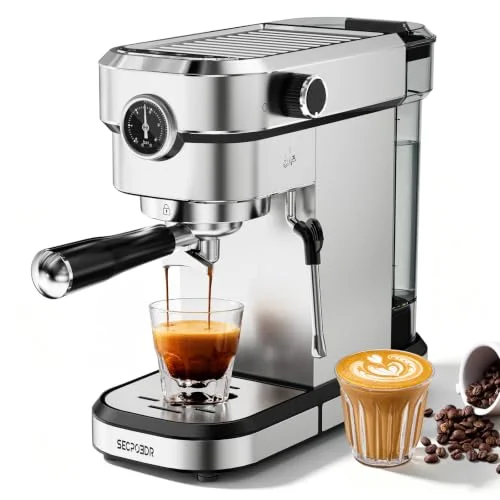
SECPOEDR 20 Bar Semi-Automatic Espresso Machine
13.2"D x 6.7"W x 12"H — the shortest and narrowest machine in this group. 20-bar pump, front-mounted pressure gauge, removable water tank, milk frother for cappuccino and latte. No built-in grinder.
$105.99 Check price →Mid-height grinder machines: where most buyers land
Between the 12-inch pump-only machines and whatever a full dual-boiler setup eventually requires sits a middle tier — roughly 12.4 to 14.3 inches tall in this catalogue — where a built-in grinder, a digital control panel, and a cabinet-friendly footprint can coexist. This is where most buyers actually land, because it's the first height band that includes genuine dial-in control without yet demanding a tall, standalone footprint.
The Gevi 20 Bar with Conical Burr Grinder sits at the bottom of that band, 12.4 inches tall with a conical burr anti-static grinder built in — the anti-static design matters specifically because it's aimed at the problem grind-equipped machines are known for: fine coffee grounds clinging to the chute from static buildup instead of falling cleanly into the basket. At $202.34, it's the only one of these four machines that names that mechanism directly.
The XIXUBX Espresso Machine with Grinder runs taller at 14.34 inches — 12.61 by 9.5 by 14.34 inches — and adds PID temperature control with programmable settings, at $179.99. PID control holds brew temperature to a tighter, steadier target than a basic thermostat, which matters more as you dial in a specific roast than the extra two inches of chassis height does. If brew-temperature consistency across dark and light roasts is the priority, it's worth reading dialing in dark roast vs. light roast espresso alongside this comparison, since that's the exact control this machine is built around.
Both machines fit most standard under-cabinet gaps — a typical kitchen upper cabinet sits 18 inches above the counter — but the XIXUBX eats more of that gap before you've accounted for lid clearance, hopper refills, or a coffee mug underneath the spout. If your gap is closer to 15 inches than 18, the Gevi's extra 1.9 inches of headroom is the more forgiving choice.
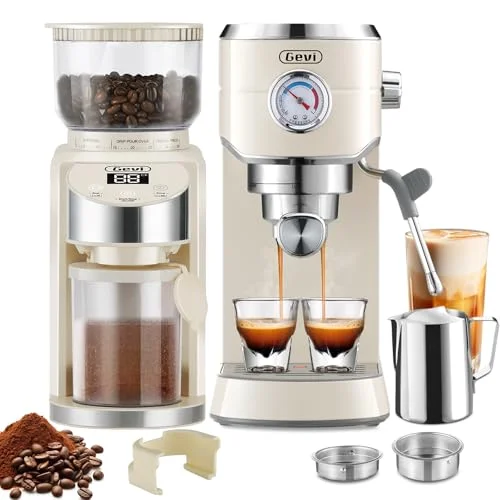
Gevi 20 Bar Espresso Machine with Conical Burr Anti-Static Coffee Grinder
12.28"D x 10.31"W x 12.4"H — a built-in conical burr grinder with anti-static design, in a footprint barely taller than the grinder-less SECPOEDR above.
$202.34 Check price →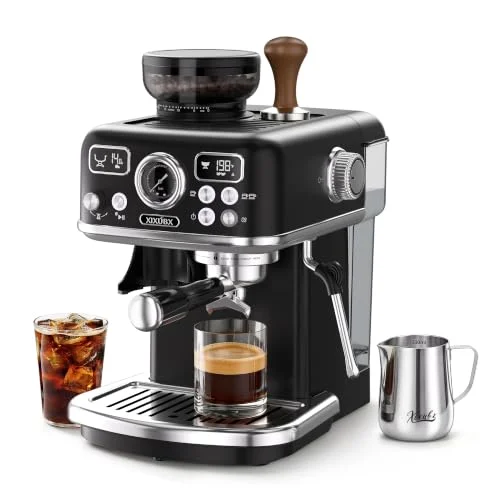
XIXUBX Espresso Machine with Grinder
12.61"D x 9.5"W x 14.34"H — built-in grinder plus PID temperature control with programmable settings, in the tallest of the three machines with a listed height.
$179.99 Check price →The picks, shortest to tallest
Ordered by the dimension this guide is about. Confirm the live listing before ordering — dimensions and prices both move.
| Machine | Height | Footprint (D x W) | Grinder | Price | |
|---|---|---|---|---|---|
| SECPOEDR 20 Bar Semi-Automatic | 12" | 13.2" x 6.7" | None | $105.99 | Price |
| Gevi 20 Bar with Grinder | 12.4" | 12.28" x 10.31" | Conical burr, anti-static | $202.34 | Price |
| XIXUBX with Grinder, PID | 14.34" | 12.61" x 9.5" | Built-in, PID control | $179.99 | Price |
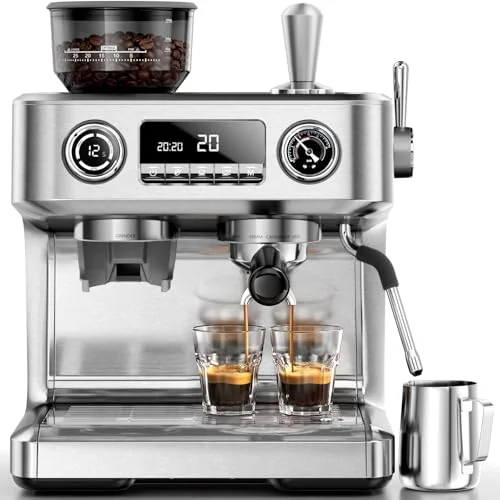 Kismile Dual Boiler with Grinder Kismile Dual Boiler with Grinder | Not listed | Not listed | Built-in, dual boiler | $589.99 | Price |
The Kismile sits last deliberately, not because we've measured it against the other three, but because we can't — its listing gives a bar rating, not a height or footprint. Dual-boiler machines generally run larger than single-boiler compacts, for reasons the next section covers, so budgeting for the tallest spot in your kitchen is the sensible default. Confirm the exact figure on the listing before you buy on the assumption that it will fit.
Measuring your own cabinet gap before you order
None of the four numbers above tell you whether a machine fits your kitchen — only whether it fits a kitchen. The measurement that matters is the one you take yourself, and it takes about two minutes with a tape measure.
1. Measure from the counter to the underside of the cabinet or shelf
Not to the front lip — to the lowest point the machine's tallest feature will pass under, which on an angled cabinet bottom or a shelf bracket may not be where you first expect.
2. Subtract the machine's listed height, not its box height
Shipping dimensions and product dimensions are routinely different numbers on the same listing. Use the product dimension, and if a listing gives only one figure, treat it as the more conservative of the two until you can confirm otherwise.
3. Add clearance for whatever the machine needs to do above itself
A hinged lid, a hopper you fill from above, or a water tank that lifts straight out all need headroom beyond the resting height — often several inches. If the listing doesn't say how the tank or hopper is accessed, that's a question for the Q&A section or seller before you order, not after.
4. Account for the cup, not just the machine
A tall travel mug under the brew head adds its own height requirement in front of the machine, separate from the cabinet clearance above it — the two problems look similar but aren't. Our guide to drip tray and cup clearance for tall mugs covers that dimension specifically.
5. Re-measure after the machine arrives, before you return the box
Listed dimensions can be off by a feature you didn't anticipate — a steam wand that sits proud of the chassis, rubber feet that add a half-inch, a power cord exit that needs its own clearance out the back. Confirming fit in the first few days, while a return window is still open, costs nothing and avoids the alternative.
What a taller dual-boiler machine buys you that a short one cannot
The height trade isn't only a cost. A single-boiler machine — which describes the SECPOEDR, the Gevi, and the XIXUBX here — uses one heating element to do two jobs that want different temperatures: brewing espresso and generating steam for milk. Steam needs to run hotter than brew water, so a single-boiler machine has to shift its internal temperature between the two, which is why pulling a shot and steaming milk back-to-back on a compact machine usually means a short wait while the boiler retargets.
A dual-boiler design, which is what the name on the Kismile 20 Bar Dual Boiler Espresso Machine with Grinder & Milk Steamer describes, runs two separate boilers at two separate temperatures simultaneously — one tuned for brewing, one tuned for steam. That's a structural reason a dual-boiler chassis tends to need more internal room than a single-boiler one: two heating elements, two thermostat systems, and in this case a built-in grinder and milk steamer besides, all sharing one footprint. It's also why we can't simply assume the shortest height it could get away with — the listing doesn't give one, and we'd rather send you to confirm it than guess at a number to fill the gap.
What that height and that $589.99 price buy you, in terms this listing does support, is a grinder and a milk steamer built around a machine designed to run both processes at once rather than switching between them. If back-to-back lattes for more than one person is a daily reality rather than an occasional one, that's the category difference worth the extra counter commitment — and it's worth reading what actually matters for a shared-office machine for how that same logic plays out when several people are drawing on one machine through a morning.
If that's not your situation — one or two cups, mostly for yourself, and a short wait between a shot and a milk drink is a non-issue — the height a dual-boiler machine asks for buys you a capability you won't use. That's the honest version of the trade-off, not a verdict that taller is better.
One thing not to do
Don't assume "20 Bar" on a product title tells you anything about size or class. Three of the four machines here carry that same "20 Bar" pump-pressure label — the SECPOEDR, the Gevi, and the Kismile — and they range from a 12-inch countertop compact to a dual-boiler machine nearly six times the price with no published height at all. The bar number describes the pump, not the footprint.
How we compared these
We compare published specifications, listed dimensions, price, and product class — we do not physically test these machines, and we do not run a testing lab. Where a listing gives a dimension, we use it; where it doesn't, as with the Kismile's height, we say so plainly rather than estimate a number and present it as fact. The reasoning about why dual-boiler machines tend to run larger is a general mechanical point about running two boilers at once, not a measurement we're attributing to this specific listing.
This site also publishes no star ratings or review counts. Amazon's product data returns neither for these machines, so there are no scores here and no paraphrased review sentiment standing in for data we don't have. What you're reading is specs, prices, and the structural reasoning that connects them — nothing claimed beyond that. For how we approach the full catalogue rather than just these four machines, see our main espresso machine guide.
Frequently asked questions
What's the shortest espresso machine that still has a built-in grinder?
In this catalogue, the Gevi 20 Bar with Conical Burr Grinder, at 12.4 inches tall — only four-tenths of an inch taller than the SECPOEDR, which has no grinder at all. A built-in hopper and grinder doesn't automatically push height up by much; it depends on how the manufacturer packages it.
How much clearance do I need above an espresso machine, beyond its listed height?
Enough for whatever the machine needs to do above itself — a hinged lid lifting open, a hopper lid coming off to add beans, or a water tank lifting straight out. None of that is included in a listed height figure, and listings rarely specify it, so it's worth checking the product Q&A or images before assuming the resting height is the only number that matters.
Why doesn't the Kismile Dual Boiler list a height?
Its listing gives a "20Bar" pump-pressure spec in the size field rather than physical dimensions. We won't invent a number to fill that gap — if your cabinet gap is tight, confirm the exact height on the current listing or with the seller before ordering, and budget for it being the tallest machine in this group, since dual-boiler designs generally run larger than single-boiler compacts.
Does a taller machine always mean a better one?
No. Height on a dual-boiler machine like the Kismile buys simultaneous brewing and steaming at two different temperatures, which matters if you're making back-to-back milk drinks for more than one person. If your routine is a cup or two for yourself, that capability — and the cabinet clearance it demands — may not be worth trading for a shorter, cheaper, single-boiler machine.