Quick answer
If you want one appliance, one plug and one thing to clean, buy the integrated route. All five machines here grind beans straight into the brew, so pre-ground coffee never enters the picture. The Breville BES870XL Barista Express at $685.00 is the most complete version of the idea — a 54 mm portafilter, a razor dose-trimming tool, and a full accessory kit around its built-in conical burr grinder. For most people, though, the AMZCHEF Espresso Machine with Grinder at $199.99 gets you the same core idea — 44 grind settings and adjustable brew temperature — for well under a third of the price. If your budget is tighter still, the Hausmojo CM1620 at $164.99 pairs its 44-setting grinder with a touchscreen that reads back grind time, extraction time and temperature in real time, which is more feedback than most machines twice its price give you.
Why there are no star ratings on this page
Amazon's product data returns no rating and no review count for any machine named in this guide, so we don't print one and we don't paraphrase review sentiment we can't verify. Every claim below traces back to a published spec, a price, or a general coffee fact that holds regardless of brand.
Things to know before you buy
- An integrated grinder locks you into whatever burr set, hopper size and dosing method the manufacturer picked — you can't swap it for a better grinder later without replacing the whole machine.
- More grind settings is not automatically better; what matters is how fine a change each click makes, and no listing in this category publishes that number.
- A grinder retains a few grams of coffee after every grind, so your first shot each morning is never made entirely from fresh beans.
- The hopper on top is why bean-to-cup machines are tall — measure your cabinet clearance with the lid open, not closed.
- Every specification in this guide comes from the product listing itself. Where a listing doesn't state something, we say so instead of guessing.
Why you should trust this guide
We do not physically test these machines and we do not run a testing lab. We compare what's published for each product — grinder type, number of grind settings, tank size, wattage, footprint and price — against general, well-established facts about how espresso extracts, and we're explicit whenever a listing leaves a detail unstated rather than filling the gap with a guess. Ilane Tall has covered the home-espresso category on this site since it launched, and this guide is built the way every guide here is: from spec sheets and current prices, not from a taste panel we don't have. Our full buying guide covers machine classes generally; this page is specifically about the ones that grind for you.
Why an integrated grinder changes the morning, not just the counter
The obvious pitch for a built-in grinder is tidiness — one box instead of two. The bigger change is what it does to the sequence of a weekday morning, because it removes a decision point rather than just a device.
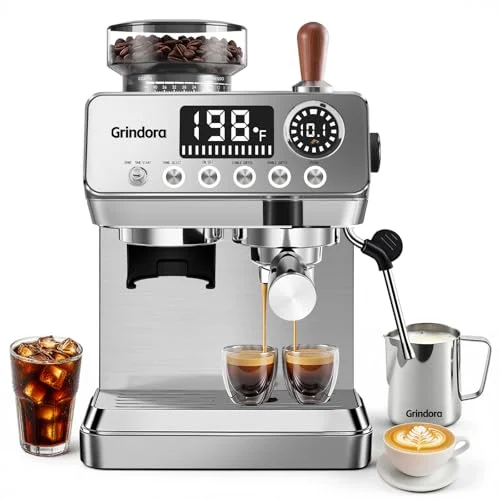
With two separate appliances, making espresso starts with a choice: walk to the grinder, weigh beans, grind into a container, carry the grounds to the machine, load the portafilter. Every one of those steps is a place to get distracted, over-grind, or reach for the pre-ground bag in the cupboard instead, especially at 6:45 on a weekday. An integrated machine collapses that into one motion. On the Grindora, for instance, the grinder doses in 0.1-second increments straight ahead of the brew step, so there's no intermediate container and no walk across the kitchen — you're grinding into the same footprint you're about to pull the shot from.
That matters more than it sounds, because espresso is unforgiving of shortcuts. The gap between "fresh, correctly ground coffee" and "whatever was fastest to reach for" is the single biggest swing in cup quality available to a home setup — bigger than the machine's pressure rating, bigger than the price tag. An integrated grinder doesn't guarantee you'll use it well, but it removes the friction that usually explains why people stop.
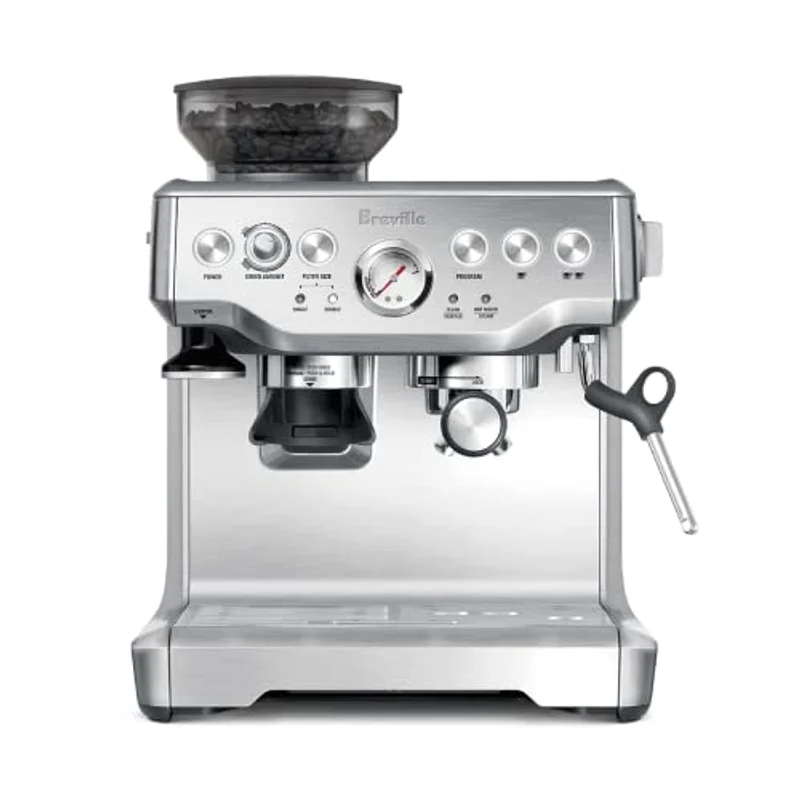
The Breville BES870XL Barista Express takes this furthest of the five. Its grinder has adjustable grind amount with manual override, dispenses through a chute sized for the included 54 mm portafilter, and ships with a razor dose-trimming tool specifically so the bed can be leveled to a repeatable height before tamping — a workflow built around consistency, not just convenience.
Breville BES870XL Barista Express
Built-in conical burr grinder with adjustable grind amount and manual override, a 54 mm stainless portafilter, razor dose-trimming tool, integrated tamper, a ½ lb bean hopper, and a 67 oz tank at 1,600 W. Ships with single and dual-wall baskets, a stainless milk jug, cleaning disc and tablets, a brush, an allen key, and a water filter with holder, backed by a 1-year limited warranty.
$685.00 Check price →
Grind settings: what thirty steps versus forty-four means in the cup
Every machine in this guide advertises a grind-setting count, and the numbers aren't decoration — they describe how many discrete stops sit between the coarsest and finest position the burrs can reach. The Gevi 20 Bar Espresso Machine with Grinder lists 30 adjustable settings. The Hausmojo CM1620, AMZCHEF and Grindora each list 44.
More stops between the extremes generally means a smaller jump in grind size from one click to the next, and for espresso that resolution matters more than it does for any other brew method. The workable window between "too coarse, water races through, tastes sour and thin" and "too fine, the pump chokes, tastes bitter and over-extracted" is genuinely narrow — often the difference of a click or two on a home grinder. A machine with fewer, coarser steps can make it harder to land inside that window: the setting just below correct is still too coarse, and the one above is already too fine, with nothing in between to try.
Two honest caveats. First, a settings count tells you how many stops exist, not how wide the total range between coarsest and finest is — a grinder with 30 tightly-spaced steps across a narrow range can out-resolve one with 44 steps spread across a wider one, and none of these listings publish that total range. Second, more settings doesn't fix a grinder with worn or misaligned burrs; it only matters if the burr set is doing its job in the first place, which is not something a spec sheet can confirm. Our guide to beans and grind size walks through how to actually find your window once the machine is on the counter.
What the higher counts do buy you in practice is fewer all-or-nothing failures while you're dialing in a new bag of beans. Roasts vary — a lighter roast is denser and generally wants a slightly finer grind than a dark one — and switching between them means re-finding the window each time. The AMZCHEF pairs its 44 settings with adjustable brew temperature from 190 °F to 201 °F for the same reason: grind and temperature both move when the beans change, and having finer control over both shortens how long that re-dialing takes.
Where integrated grinders fall short
None of this makes a built-in grinder strictly better than a standalone one — it's a different shape of compromise, and three of its edges are worth knowing before you buy.
Retention. Every burr grinder holds back a small amount of coffee in the chamber and chute after each grind — a structural fact of how burr grinders work, not a defect specific to any machine here. Because ground coffee stales within days rather than weeks, some of what comes out on your first grind of the morning is leftover from the day before. A grinder that can't be opened and brushed out easily makes that residue harder to manage; check how accessible the chute is before you buy if this bothers you, since it isn't something every listing states.
Single dosing. A hopper is built to hold a working supply of beans, not to be refilled one dose at a time. The Hausmojo CM1620 ships with a 51 mm dosing funnel specifically to keep grounds contained during that transfer, which is a genuinely useful accessory — but it doesn't change the fact that the hopper above it is sized for repeated grinding, not for weighing out exactly 18 grams and stopping. If you want to single-dose — grind only the exact amount for one shot, with nothing left sitting in a hopper — a standalone grinder built around a bare burr set and a scale is a more natural fit than a hopper-fed integrated one.
Changing beans. Switching from one roast to another means clearing whatever is left in the hopper first, or accepting a blended transition dose that's part old bean, part new. On a machine with a half-pound hopper like the Barista Express, that's a real quantity of beans to work through or discard, not a trivial amount. A standalone grinder with no hopper — or a small one you empty by hand — makes swapping bags a five-second decision instead of a small waste-management problem. If a jam or an inconsistent grind ever does show up, our troubleshooting guide covers the most common fixes before you assume the machine needs service.
Bean-to-cup machines get sold on saving counter space, and the claim is only half right. They save width — one appliance instead of two — but they tend to cost you height, because the hopper sits on top and needs clearance above it to be filled without dragging the machine forward first.
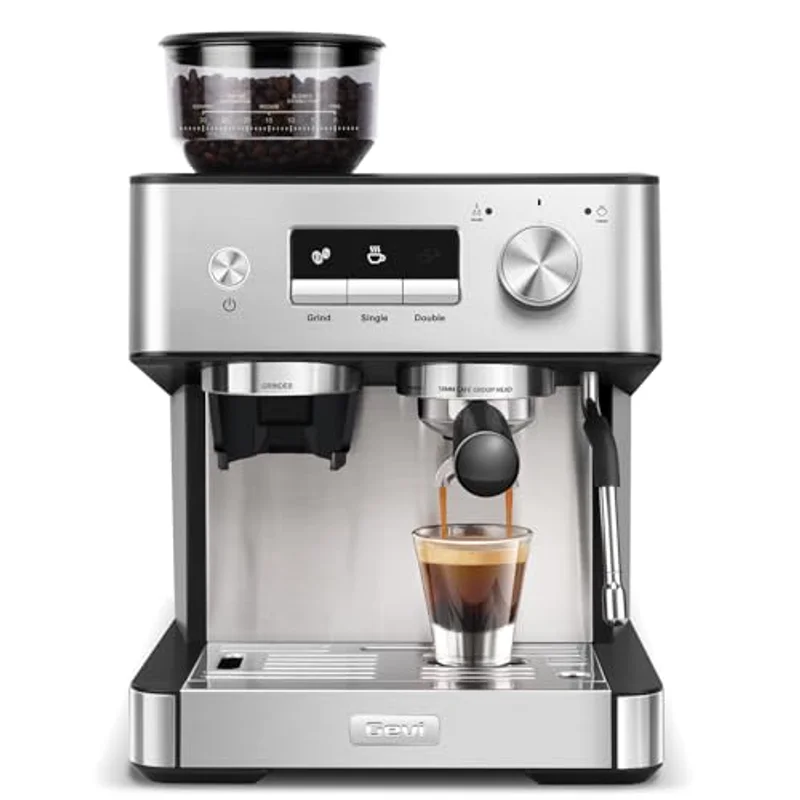
The Gevi is the only machine in this guide with a published footprint: 11.5 inches wide, 12.01 inches deep, and 16.53 inches tall. That last number is the one people underestimate when they measure a cabinet gap — 16.53 inches clears a lot of open counters, but it does not clear a standard upper cabinet set at 18 inches with any room to lift the lid and pour beans in. Always measure with the lid open and, where the machine has a removable tank, with the tank pulled, since that's usually the tallest configuration.
A standalone burr grinder, by contrast, is typically shorter than a bean-to-cup machine's hopper-and-body stack, because it has no brew group or boiler underneath it — just the motor base and the hopper. Two shorter appliances side by side can slide under a cabinet where one tall integrated machine can't, even though the combined width is greater. Which trade-off wins depends entirely on your kitchen: a narrow gap between counter and cabinet favors the split route; a wide but shallow counter favors one machine that does both jobs. If your whole kitchen is tight, our guide to compact espresso machines for small kitchens looks specifically at the footprint question across machine types, not just grinder placement.
The picks
Five integrated machines, ordered by who each is for rather than by price. Every spec below comes from the product listing; where a listing doesn't state something, we've left it out rather than guessed.
01Best overall
Breville BES870XL Barista Express
For someone who wants the built-in route done properly
Semi-automatic · built-in conical burr, adjustable grind + manual override · 54 mm portafilter · 67 oz tank · 1,600 W
This is the machine the "integrated" argument is built around: a grinder with dose control, a razor tool that trims the bed to a repeatable height, an integrated tamper, and both single- and dual-wall baskets in the box, alongside a stainless milk jug and a full cleaning kit. A 1-year limited warranty covers the unit as a whole.
The trade-offGrinder and brew group share one chassis, so a grinder fault typically means the whole machine goes in for service. It's also the largest and most expensive machine here — the ½ lb hopper is a real quantity of beans to clear when you switch roasts.
02Best value
AMZCHEF Espresso Machine with Grinder
The 44-setting grinder and temperature control for under $200
Semi-automatic · built-in grinder, 44 settings · 190–201 °F temperature control · 60 oz tank · cold-brew mode
The pairing that matters here is grind settings plus brew temperature, adjustable across an 11-degree range — normally a combination you pay several hundred more for. A one-touch cold-brew mode and a stated descaling function round it out, at roughly a quarter of the Breville's price.
The trade-offThe manual steam wand is the only milk system listed, and the listing doesn't specify hopper capacity or grinder motor wattage. It's also a newer listing from a smaller brand, so long-term parts availability is unproven next to Breville.
03Cheapest way in
Hausmojo CM1620
Real-time grind feedback on a touchscreen, for the lowest price here
Semi-automatic · built-in conical burr, 44 settings · IMD touchscreen display · 51 mm dosing funnel included · 61 oz tank · 1,500 W steam wand
The touchscreen is the differentiator: it shows grind time, extraction time and brew temperature as they happen, rather than leaving you to count seconds. Stated anti-static technology and the included 51 mm dosing funnel are both aimed at the same problem — grounds ending up on the counter instead of in the portafilter. A 20-bar pump with low-pressure pre-infusion and a 61 oz (1.8 L) tank round out the spec sheet.
The trade-offThe lowest price of the five usually means the newest brand track record — Hausmojo isn't an established name the way Breville is, so weigh that against the touchscreen feedback you're getting in return.
04Best for dialing in temperature
Grindora Espresso Machine with Grinder
Three fixed temperatures and dosing to a tenth of a second
Semi-automatic · built-in conical burr, 44 settings · PID control, 194 °F / 198 °F / 205 °F · 0.1-second dosing timer · 20-bar with pre-infusion · milk frother
Where the AMZCHEF gives you a temperature range to set anywhere within it, the Grindora gives you three fixed, PID-held points — a narrower choice, but one that's easier to repeat exactly the same way each time. The 0.1-second grind-dosing timer is the finest increment stated by any machine in this guide.
The trade-offThree fixed temperatures is less flexible than a continuous range if you regularly switch between very different roasts. The listing doesn't specify tank size or wattage.
05Best dual-function wand
Gevi 20 Bar Espresso Machine with Grinder
A steam wand that also pours hot water, in a footprint we can actually quote
Semi-automatic · built-in conical burr, 30 settings · 20-bar pump · steam wand doubles as hot water tap · 11.5 × 12.01 × 16.53 in
The wand here does two jobs: turn one way for milk-frothing steam, the other for hot water, which covers an Americano or a quick flush without a second spout. It's also the only machine in this guide with a full published footprint, which makes it the easiest one to measure against your counter before buying.
The trade-off30 grind settings is the fewest of the five, meaning a coarser step between adjacent positions — worth knowing if you expect to fine-tune often. At $289.99 it's also the second-most expensive machine here, behind only the Breville.
How the five compare
Same five machines, side by side. Grind-setting counts and prices are what each listing states — confirm the live price before buying.
| Machine | Grind settings | Milk / water | Price | |
|---|
 Breville BES870XL Barista Express Breville BES870XL Barista Express | Adjustable, no fixed count | Manual wand | $685.00 | Price |
 Gevi 20 Bar with Grinder Gevi 20 Bar with Grinder | 30 | Wand + hot water | $289.99 | Price |
 Grindora with Grinder Grindora with Grinder | 44 | Milk frother | $199.99 | Price |
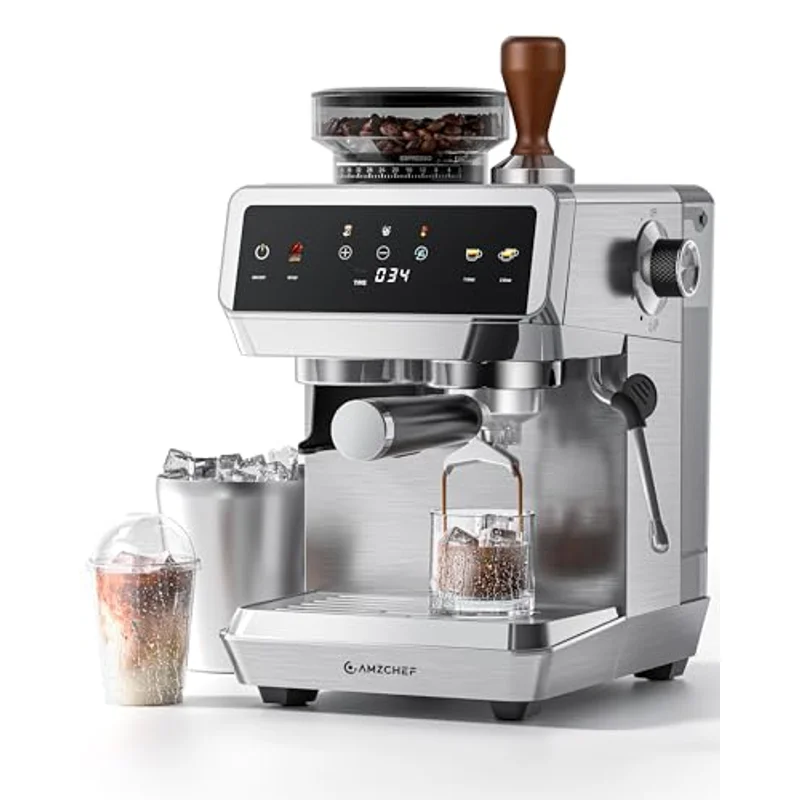 AMZCHEF with Grinder AMZCHEF with Grinder | 44 | Manual wand | $299.99 | Price |
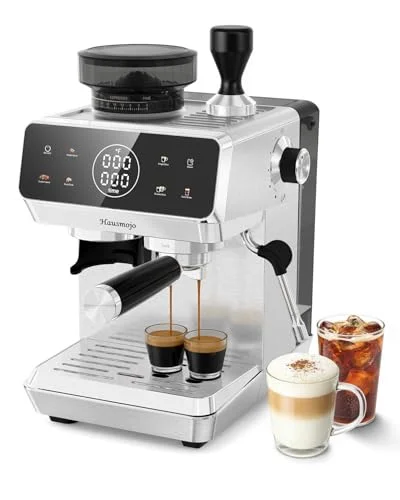 Hausmojo CM1620 Hausmojo CM1620 | 44 | Manual wand, 1,500 W | $164.99 | Price |
When a separate grinder is worth the second plug
None of this means integration is always the right call. Three situations tilt the other way, and they're worth checking against your own habits before you commit a counter and a few hundred dollars to a single appliance.
You already know you single-dose or switch beans often. If you keep two or three bags open at once and want to grind exactly one dose with nothing left over, a hopper-fed grinder fights that habit no matter how many settings it has. A bare-burr standalone grinder built for weighing beans in and grounds out is the more natural tool, and it's the one part of a split setup that survives every machine upgrade after it.
You're not sure espresso will stick. Committing $165 to $695 to one integrated appliance is a bigger bet than a sub-$100 pump machine plus a modest grinder, and if the habit doesn't take, you're left with one expensive object instead of two smaller, separately resellable ones. Our picks under $500 cover both routes at gentler price points if you're still deciding.
A repair should not take out your whole coffee routine. On any of the five machines above, the grinder and the brew group share a chassis and, on the Breville, a single one-year warranty. A failed grinder inside a bean-to-cup machine typically means the whole unit goes in for service, not a $150 accessory. If continuity matters more to you than the tidiness of one appliance, a separate grinder keeps that failure contained to itself.
Where none of those apply — you want one thing to plug in, one thing to learn, and you're reasonably confident the habit will stick — the picks above are where we'd start, in the order we ranked them.
How we compared
We compare published specifications, what ships in the box, machine class, footprint where it's stated, and live pricing, and we read marketing language skeptically — a "20-bar" pump describes the pump's maximum rating, not the roughly 9 bar at which espresso actually brews. We do not physically test these machines, we do not run a testing lab, and we do not publish ratings we cannot verify: Amazon's product data returns no rating and no review count for any machine named here, so there are no stars and no invented scores anywhere on this page. Where a claim is a judgment rather than a specification — that more grind settings generally help, that a repair risk favors the split route — we've said so in our own voice and shown the reasoning behind it, so you can weigh it yourself rather than take our word for it.
Frequently Asked Questions
Does a built-in grinder make better espresso than a separate one?
Not automatically. What matters is grind consistency and how well the grinder resolves the narrow window between under- and over-extraction, and a good standalone grinder can match or beat an integrated one on that. What a built-in grinder reliably wins on is friction: grinding straight into the portafilter, with no container to carry across the kitchen, removes a step that's often where people reach for pre-ground coffee instead.
What does a higher grind-settings count actually change?
It generally means a smaller jump in particle size between adjacent positions, which matters for espresso because the workable window between a sour, under-extracted shot and a bitter, over-extracted one is only a click or two wide on most home grinders. A machine with 44 settings, like the Hausmojo, AMZCHEF or Grindora here, gives you finer resolution to search that window than one with 30, like the Gevi — though none of these listings state the total range the settings span, so settings count alone doesn't tell the whole story.
Can I switch between different bags of beans easily with a built-in grinder?
Less easily than with a standalone grinder. A hopper is sized to hold a working supply, not to be refilled bean-by-bean, so switching roasts means running the hopper down or clearing out beans you'd rather keep. On a machine with a larger hopper, such as the Breville's ½ lb capacity, that's a real quantity to work through each time you change bags.
How much counter space does a machine with a built-in grinder actually need?
More height than most buyers expect, because the hopper sits on top and needs clearance to be opened and refilled. The Gevi in this guide is 16.53 inches tall, which fits under many cabinets but not all — always measure with the lid open and any removable tank pulled out, since that's usually the tallest the machine gets.
Keep reading