Water Quality and Descaling: The Cheapest Way to Double Your Machine's Life
Most espresso machines don't die of old age. They die of scale — a chalky mineral crust that builds up inside the boiler or thermoblock every time you brew with hard water, until the machine can no longer heat evenly or pump reliably. The fix costs a few dollars a month and ten minutes a quarter. Almost nobody does it on the schedule that actually matches their water.
Reader-supported: we may earn a commission if you buy through our links, at no extra cost to you. Prices are the ones we recorded on August 24, 2026 and they move constantly — confirm the live price before buying.
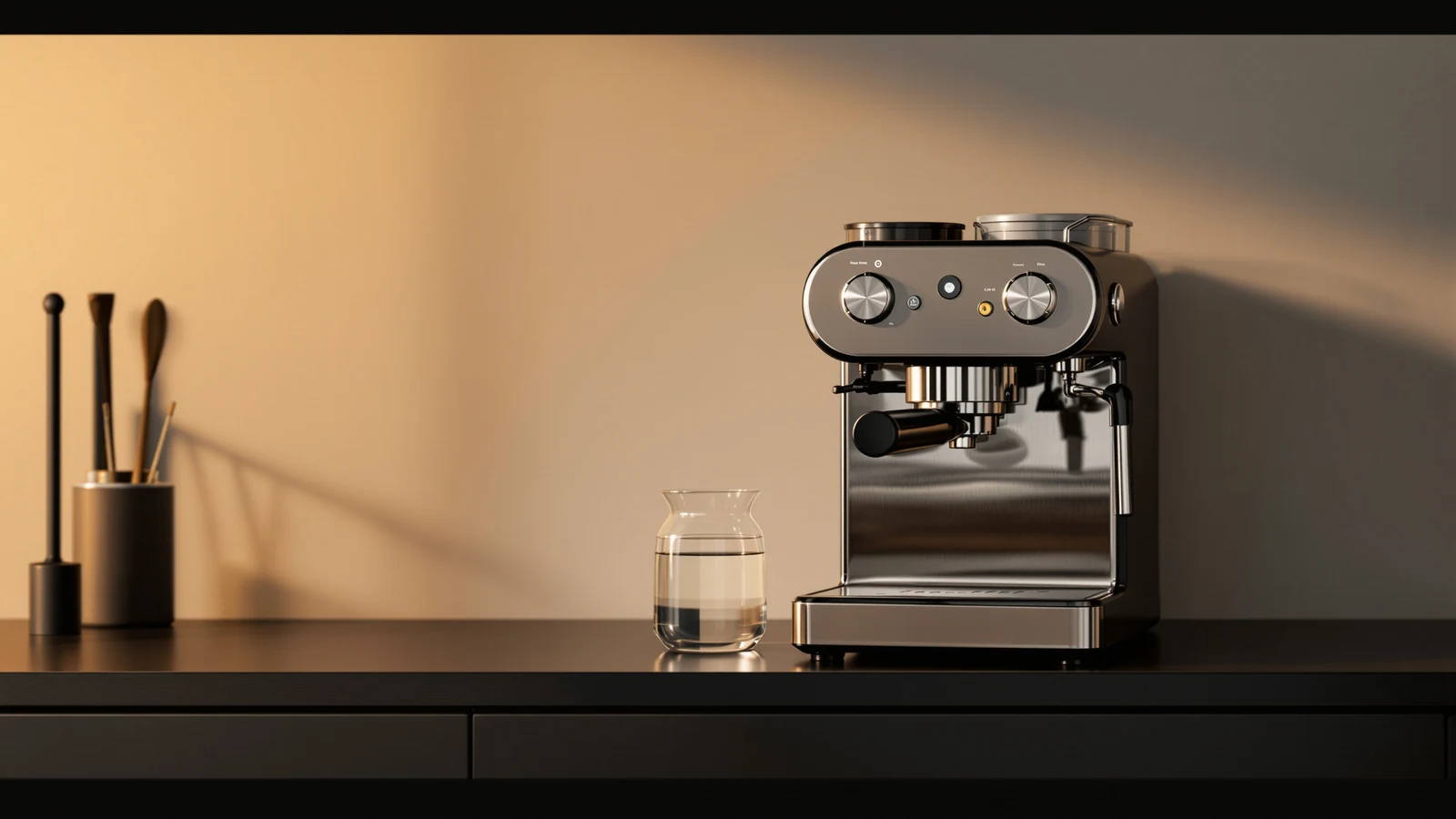
Why scale forms, and what it does to a thermoblock
Tap water almost everywhere in the US carries dissolved calcium and magnesium, picked up as the water passes through rock and soil on its way to the reservoir. Those minerals are invisible and harmless to drink. The problem is what happens when that water gets heated to around 195–205°F inside a boiler or thermoblock, which is the temperature window most espresso machines brew at.
Heat drives dissolved calcium and magnesium out of solution, and they don't just float away — they bond to the hottest surface in the system, which is the metal wall of the heating element itself. That deposit is limescale: a hard, chalky layer of calcium carbonate that keeps building with every tank you run through, because the water always finds the same hot metal on its way to your cup.
A thermoblock is where this does the most damage, because it's a narrow metal channel, not an open tank. Espresso machines use thermoblocks specifically because they heat water fast in a small footprint — the tradeoff is that the channel is thin enough for a scale layer of even a millimeter to meaningfully choke water flow. Boiler-based machines have more open volume and buy you more time, but the mechanism is identical: minerals coat the heating surface and stay there until dissolved back out or physically removed.
Scale is also a poor heat conductor compared to metal, so as the layer thickens the heating element has to work harder and longer to bring water to brew temperature. That's the first thing you'll notice — a machine that used to be ready in under a minute is suddenly still warming up two minutes later. Left long enough, scale can narrow the channel enough to choke flow entirely, which is when a pump machine starts producing weak, dribbling shots or throws an error and stops heating altogether. None of this is a design flaw. It's what happens to any device that repeatedly heats hard water in a narrow channel, and it's true of a $79.99 Chefman CraftBrew and a $699.95 Breville BES870XL Barista Express alike — the thermoblock doesn't care what the machine cost.
Tap, filtered, bottled or distilled — the honest ranking
The water you pour into the tank is the entire scale problem or the entire solution, depending on how much dissolved mineral it carries. Here's how the common options actually compare, ranked on what they do inside a thermoblock rather than on taste or convenience.
Tap water: fine in soft-water regions, the main cause of scale everywhere else
Straight tap water is the default for most owners, and in a genuinely soft-water region — much of the Pacific Northwest and New England, broadly — it's a reasonable one. The problem is that "tap water" covers an enormous range: the same brand of machine can run for years in Seattle and choke with scale within months in Phoenix or Las Vegas, purely because of what's dissolved in the local supply. Tap water is never a fixed answer; it's only as good as your specific municipal report says it is, which is why finding your actual hardness number matters more than any general rule about tap water.
Filtered tap water: meaningfully better, not a fix on its own
A standard pitcher or faucet carbon filter (the kind sold for taste and chlorine removal) reduces some hardness but is not built to strip calcium and magnesium the way a dedicated water-softening filter is. It helps — every bit of mineral removed before it reaches the thermoblock is scale that never forms — but it should be treated as a reduction in descaling frequency, not a reason to skip descaling. A dedicated inline scale-reducing filter, the kind some machines accept as a cartridge, does more of the real work; check whether your machine has a filter housing before assuming a generic pitcher filter is doing the job.
Bottled water: usually no better than filtered tap, and sometimes worse
"Bottled" isn't a single category. Bottled spring water frequently carries mineral content similar to or higher than tap, because it's marketed on mineral taste. Bottled "purified" or "drinking" water is closer to filtered tap. There's no consistent answer here because there's no consistent product — you'd have to check the mineral content on each label, and most people don't. As a rule, don't assume bottled water is safer for your machine than your own tap; some of it is worse.
Distilled or deionized water: lowest scale risk, with one real caveat
Distilled water has had essentially all dissolved minerals removed by evaporation and condensation, and deionized water has had them stripped by resin — both leave almost nothing behind to deposit as scale. Used alone, this is the single most effective way to prevent scale buildup, and it's why some prosumer machine manufacturers recommend it outright.
The caveat is that completely mineral-free water is unusually corrosive to certain metals and gaskets over the very long term, and some machine manufacturers specifically advise against 100% distilled water for that reason, recommending a blend with tap or filtered water instead. This is a manufacturer-specific instruction, so check yours rather than assuming pure distilled is always the safest choice — read it as "extremely low scale risk" rather than "risk-free."
The honest ranking
For scale prevention specifically: distilled or deionized water first (check your manual on blending), filtered tap water with a dedicated scale-reducing cartridge second, plain filtered tap water third, tap water in a genuinely soft-water region fourth, and unfiltered tap water in a hard-water region last. Bottled water sits wherever its label puts it — assume nothing.
How to find your water hardness in five minutes
Water hardness is measured in grains per gallon (GPG) or parts per million (ppm) of dissolved calcium and magnesium, and it's the single number that should decide your descaling schedule — not the machine's default interval, which is a generic assumption the manufacturer had to make for every buyer in the country.
Three ways to find your actual number, from fastest to most precise:
Your utility's water quality report. If you're on municipal water, your provider publishes an annual water quality report (sometimes called a Consumer Confidence Report) that includes hardness, usually in ppm or mg/L. Search "[your city] water quality report" and you'll typically find a PDF within a couple of minutes — this is the fastest route and it's free.
A test strip. Inexpensive hardness test strips are sold at hardware stores and online for a few dollars for a pack of several. Dip the strip in a glass of your tap water, compare the color change to the chart on the package, and you have a GPG reading in under a minute. This is the right choice if you're on a well, since well water has no published municipal report and can vary significantly even between neighboring properties.
A digital TDS meter. A small handheld meter reads total dissolved solids in ppm when you dip the probe in water. TDS isn't identical to hardness — it measures all dissolved solids, not just calcium and magnesium — but it's a reasonable proxy and the meters are cheap and reusable, so if you want an ongoing way to spot-check water quality (including after installing a filter, to confirm it's working) this is the more durable option of the three.
Once you have a number, the general classification used by water treatment professionals is: soft water is under 60 ppm (roughly 3.5 GPG), moderately hard is 60–120 ppm, hard is 120–180 ppm, and very hard is above 180 ppm. Anything in the hard or very hard range means your descaling interval should be shorter than whatever the manual defaults to.
Descaling intervals by hardness, not by the manual's guess
Machine manuals typically print one descaling interval — often "every 2–3 months" or "every 200 brew cycles" — because the manufacturer has to give a single number to buyers in Miami and buyers in Portland alike. That number is a compromise, and for most owners it's wrong in one direction or the other. The honest schedule is built from your actual water hardness and how often you brew, not from the page in the box.
As a working guide, scaled to daily use (roughly 1–3 shots pulled per day):
Soft water (under 60 ppm): every 3–4 months. Scale still forms, just slowly enough that a quarterly rhythm keeps ahead of it.
Moderately hard water (60–120 ppm): every 6–8 weeks. This is the range a large share of US tap water actually falls into, which is why "every 2–3 months" as a blanket manual instruction undershoots a lot of real households.
Hard water (120–180 ppm): every 4–6 weeks. At this hardness, monthly is a safer default than the manual's quarterly guess.
Very hard water (above 180 ppm): every 2–4 weeks, or switch to filtered/distilled water and re-test, because at this level frequent descaling alone is treating the symptom rather than the cause.
Two adjustments to make on top of the base number. If you brew less than daily, you can stretch these intervals somewhat, since fewer heating cycles means less mineral deposited — but don't assume "occasional use" means "never," because a machine that sits full of hard water between uses still scales, just more slowly. And if you're using a dedicated scale-reducing filter or distilled water, you can generally move one tier down (hard-water intervals behave more like moderate, moderate behaves more like soft) — but confirm with a periodic descale anyway, since filters degrade and blends vary.
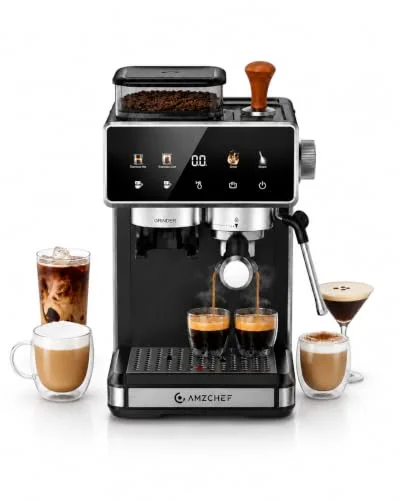
AMZCHEF Espresso Machine with Grinder
A 61 oz tank means fewer refills, but a larger reservoir also means more standing water exposed to the thermoblock between uses if you don't run it dry — a reason to stick to a fixed descaling calendar rather than judging by how the machine sounds or looks.
$179.99 Check price →Descaler vs vinegar: why the cheap option can cost more
White vinegar is acidic enough to dissolve calcium carbonate, which is why it shows up constantly as a free-and-easy descaling trick. It does work, chemically. The problem is what it does alongside the scale removal.
Vinegar is acetic acid at roughly 5% concentration, and that acidity doesn't stop at limescale — it also attacks rubber gaskets, seals and certain internal metal components over repeated use, softening or degrading parts that a purpose-made descaler is formulated to leave alone. Commercial descaling solutions are typically built around citric acid or a blend designed specifically to dissolve calcium carbonate while being gentle on the rubber and metal parts inside a coffee machine. That's the entire premium you're paying for: not stronger scale removal, but a formula that doesn't damage the machine it's cleaning.
Vinegar also leaves a smell and taste behind that's notoriously hard to fully rinse from internal lines — it can take several extra rinse cycles to stop tasting it in your espresso, and complaints about a lingering vinegar taste are common enough that it's worth planning for. A dedicated descaler is formulated to rinse clean in the number of cycles the instructions specify.
Do the cost math honestly: a bottle of purpose-made descaler runs a few dollars and treats several descaling cycles, so the actual cost difference per descale between vinegar and a real descaler is often under a dollar. Weighed against a seal that degrades early or a gasket that needs replacing, "the cheap option" is cheap only on the bottle, not over the life of the machine. Some manufacturers explicitly warn against vinegar in their care instructions and note that damage from using it isn't covered under warranty — check yours before reaching for the pantry.
Signs you have already left it too long
Scale builds gradually, so the early warning signs are easy to write off as "the machine just needs a minute" until they aren't. Watch for these, roughly in the order they tend to appear:
Slower heat-up. If a machine that used to be ready to brew in under a minute now takes noticeably longer, that's scale insulating the heating element and making it work harder to reach brew temperature.
Weaker or slower shots. A scale layer narrowing the water channel restricts flow, which shows up as a shot that drips rather than flows, or pulls thin and watery because water is finding the path of least resistance around a partially blocked channel rather than through the coffee bed evenly.
Louder or different pump noise. A pump working against restricted flow from a scaled channel often sounds more strained or makes a different pitch of noise than it did new.
Visible white or chalky residue. If you can see white deposits around the water outlet, portafilter basket, or steam wand tip, that's scale that has already made it out of the internal channel — a sign the buildup inside is well established, not just starting.
Reduced or sputtering steam. Steam wands run through the same heating system, so a wand that used to produce strong, steady steam and now sputters or produces a weaker stream is showing the same restriction as slow shots.
Error codes or a machine that won't heat. The end state, on machines with electronic controls, is a heating or flow-related error code, or the machine simply refusing to come up to temperature at all. At this point a routine descale may not fully clear the blockage, and professional descaling or a service visit becomes the realistic option — which is a good reason not to wait for this stage. Our troubleshooting guide covers what to try if a machine is already at this point.
How to actually descale a home machine
The exact steps vary by machine, so always follow the manufacturer's instructions in your manual first — this is the general shape most home machines share. Descaling mode, where the machine has one, typically runs the solution through the system automatically and prompts you through each stage; without a dedicated mode, the process is manual but follows the same logic.
Empty the water tank and remove the portafilter and any water filter cartridge (cartridges are designed to be bypassed during descaling, not descaled themselves). Mix the descaling solution per the product's instructions — concentration and water ratio matter, so don't eyeball it. Run the solution through the group head and steam wand in the cycles or duration the machine or descaler specifies, usually with pauses to let the solution sit in the lines and dissolve scale rather than just flushing through. Then run at least two to three full tanks of plain water through the same paths to rinse the solution out completely — this step is the one people skip and shouldn't, since leftover descaler in the lines is unpleasant in your next several shots. Reinstall the filter cartridge and portafilter, and you're done.
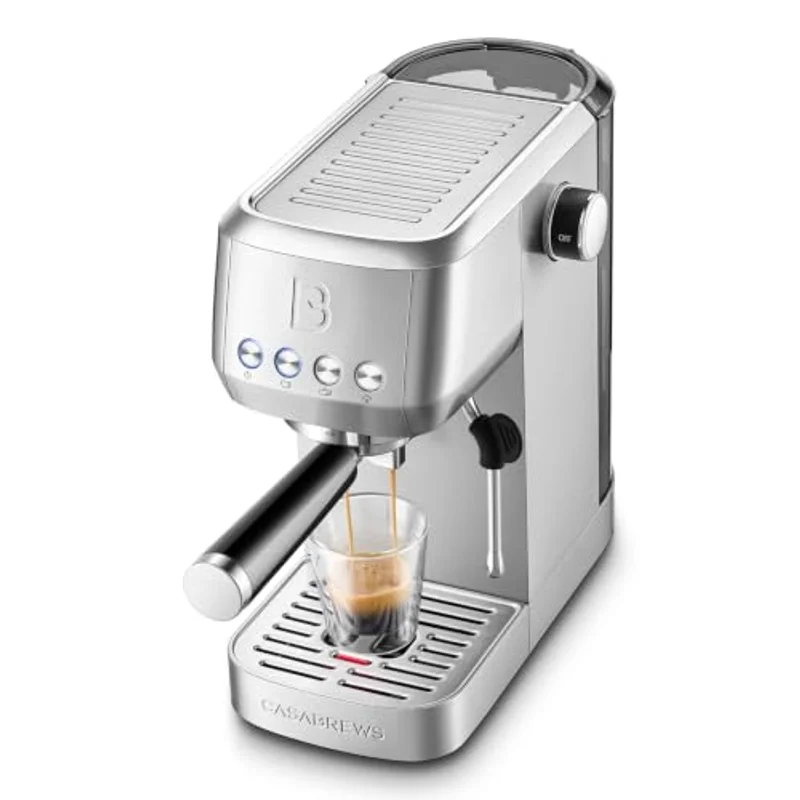
CASABREWS 3700 Essential
An entry machine with a steam wand and no descaling program — on machines like this, descaling is a fully manual process through the water reservoir and group head, so the calendar reminder matters more than it would on a machine that prompts you.
$93.49 Check price →A machine's descaling program, when it has one, is only as good as the reminder that triggers it — most run on a fixed cycle count rather than on your actual water hardness, so treat the light or prompt as a floor, not a ceiling. If your water is hard and you're descaling on your own calendar rather than waiting for the machine to ask, you're ahead of most owners. On machines built around milk workflows, like the Breville BES450BSS Bambino, the steam wand runs through the same heated path and deserves the same attention as the brew side — a wand that sputters is often the first sign of scale before the shots themselves show it.
How we compared this
This guide is built on the general chemistry and mechanics of scale formation in heated water systems, on published manufacturer care instructions and specifications for the machines named, and on standard water-hardness classifications used by water treatment professionals. We do not physically test these machines, we do not run a testing lab, and we do not publish ratings we cannot verify: Amazon's product data returns no rating and no review count for the machines on this site, so there are no stars and no invented scores anywhere on this page. Where a recommendation is a judgment rather than a documented fact — such as choosing a dedicated descaler over vinegar — we've explained the reasoning so you can weigh it yourself, and any manufacturer-specific instruction (blending distilled water, warranty exclusions for vinegar use) should be checked against your own machine's manual rather than assumed from this guide.
Frequently asked questions
How do I know if my water is hard without testing it?
You can't know for certain without checking, because hardness varies enormously by location and even by well on private water. The fastest free check is your municipal water utility's annual water quality report, usually available as a PDF search for "[your city] water quality report." If you're on well water or want a direct reading, a hardness test strip costs a few dollars and gives you a grains-per-gallon result in under a minute.
Can I use tap water in my espresso machine at all?
Yes, in a genuinely soft-water region tap water is a reasonable default. The issue isn't tap water as a category — it's that "tap water" covers a huge range of hardness depending on where you live, so the same machine can run scale-free for years in one city and need monthly descaling in another. Check your actual number rather than assuming either way.
Is vinegar as good as a real descaling solution?
Vinegar's acidity does dissolve limescale, but it also attacks rubber gaskets and seals over repeated use in a way purpose-made descalers, typically built around citric acid, are formulated to avoid. It also tends to leave a smell and taste that takes extra rinse cycles to clear. The cost difference between vinegar and a real descaler is usually under a dollar per descale, which makes the cheap option a poor trade against a degraded seal or a voided warranty — some manufacturers explicitly exclude vinegar damage from coverage.
What happens if I never descale my espresso machine?
Scale keeps building with every heating cycle, gradually insulating the heating element and narrowing the internal water channel. In order, expect slower heat-up, weaker or slower shots, a more strained-sounding pump, visible white residue at the outlet or steam wand, and eventually an error code or a machine that won't heat at all. At that final stage, a routine descale may not fully clear the buildup, and professional service or replacement becomes the realistic path — descaling on a schedule is dramatically cheaper than reaching that point.