The Best Espresso Machines Between $250 and $350
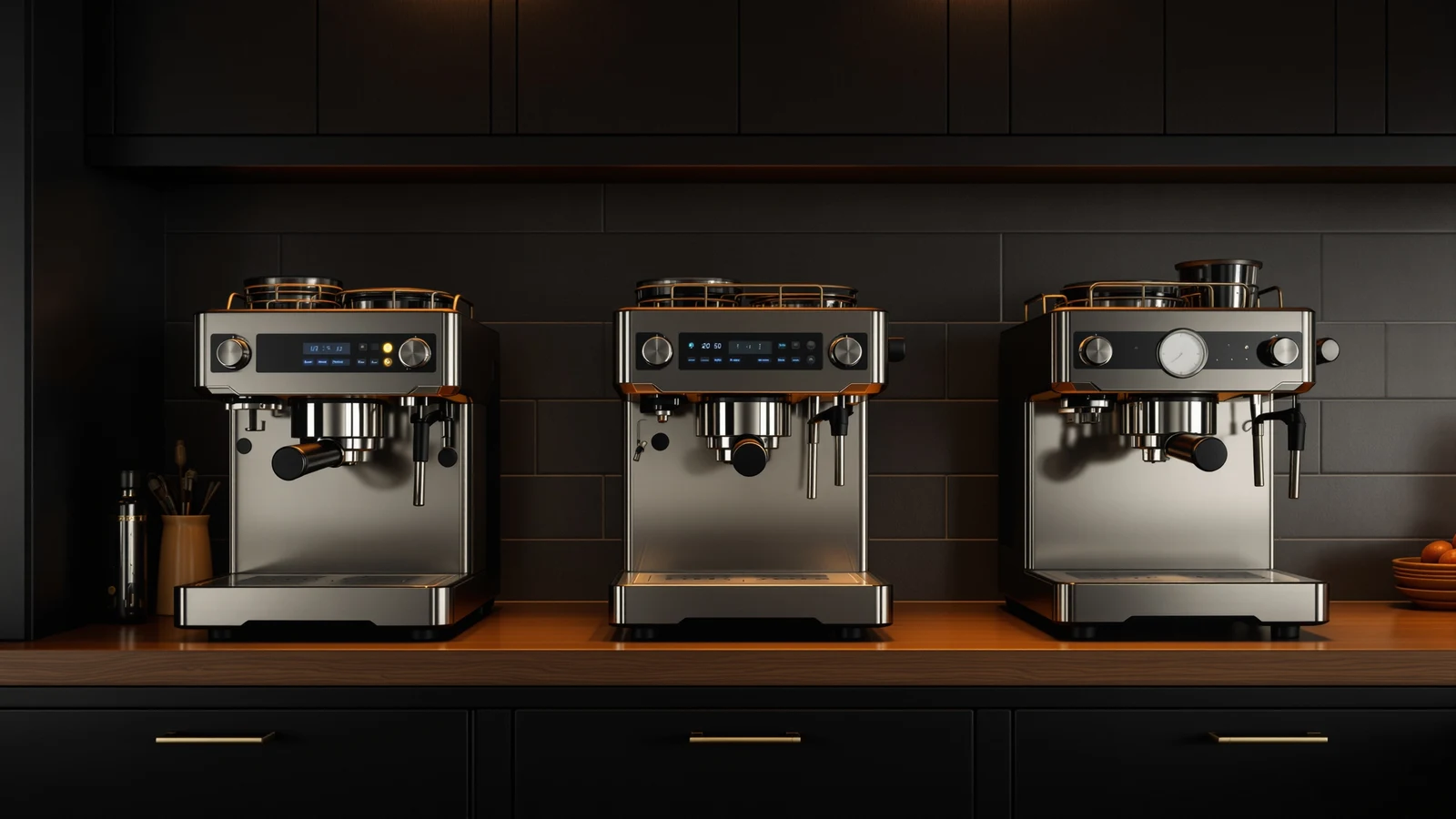
Above the budget tier and below semi-commercial pricing — the band where a built-in grinder, a second boiler or a wider portafilter start showing up together, sometimes two of the three on the same machine. Here is what $250-to-$350 actually buys, and where it still falls short.
Reader-supported: we may earn a commission if you buy through our links, at no extra cost to you. Prices are the ones we recorded between October 20 and November 1, 2026 and they move constantly — confirm the live price before buying.
What separates this band from the sub-$200 tier
Our guide to machines under $200 covers a tier defined by absence: no grinder, or a grinder with few settings, usually a single boiler, and a portafilter that is narrower than what semi-commercial gear uses. Between $250 and $350, the absences start getting filled in, though rarely all at once on one machine.
The clearest example is the jump from the Gevi 20 Bar Espresso Machine with Conical Burr Anti-Static Coffee Grinder at $213.99 to the Gevi Dual Boiler Espresso Machine With Grinder & 58mm Portafilter at $270.44 — the same brand, a $57 gap, and the second machine adds a dual-boiler system and a 58 mm portafilter on top of the grinder the cheaper model already has. That is the pattern across this band: you are not buying a feature that did not exist below $250, you are buying it paired with a second feature that previously came separately or not at all.
Footprint also grows. The Gevi 20 Bar is 12.28 by 10.31 by 12.4 inches, while the Gevi Dual Boiler is 16.61 by 15.66 by 18.85 inches — taller, wider and deeper on every axis. A second boiler and a wider portafilter are not free in counter space, and that is worth measuring before you order, lid-open clearance included.
Dual boilers start appearing here: what that buys
A single-boiler machine heats one reservoir to one temperature and switches jobs: brew, then wait while it adjusts for steam, then wait again to brew the next shot. A dual-boiler machine runs a dedicated boiler for brewing and a separate one for steam, so both are ready at the same time and neither job interrupts the other.
The practical gain is sequencing, not flavor you can taste shot-to-shot: pull a shot, then texture milk immediately, with no waiting for the machine to re-stabilize at a different temperature. For a single cup that barely registers. For back-to-back lattes in the morning, or for a shot followed immediately by frothing, it removes a wait that single-boiler machines build in by design.
Two machines in this band carry the feature. The Gevi Dual Boiler Espresso Machine With Grinder & 58mm Portafilter at $270.44 pairs it with a built-in grinder and the wider 58 mm portafilter — a combination that, below $250, generally does not exist. The Tuni E2 Gen3 Dual Boiler Espresso Machine with Super+ Steam Power at $299.00 leads with the boiler system and steam output rather than the grinder; its name advertises "Super+ Steam Power," which we read as a steam-output claim rather than a brew-pressure one, and we do not have a wattage or psi figure from the database to size that claim further.
A dual boiler is also, mechanically, two heating elements instead of one — more parts that can fail, in a machine still priced under $350. That is not a prediction that either model will have problems; we have no reliability data for these two units. It is a structural note: more plumbing generally means more that can eventually need service, and it is the kind of trade a $500-plus machine absorbs more comfortably than a $280 one does.
Grinder quality and settings across the five
Three of the five machines in this band carry a built-in grinder; two do not. That split alone is useful for sorting them.
The Gevi 20 Bar Espresso Machine with Conical Burr Anti-Static Coffee Grinder at $213.99 is built around its grinder in the name itself: a conical burr grinder with an anti-static design, aimed at the common complaint with small burr grinders — ground coffee clinging to the chute from static buildup rather than falling cleanly into the basket. We do not have a settings count for this unit from the database, so we will not invent one; check the current listing if the number of grind steps matters to your routine.
The Gevi Dual Boiler at $270.44 also ships with a built-in grinder, this time paired with the wider 58 mm portafilter rather than the 54 mm or narrower baskets common below $250. A wider portafilter holds a larger coffee bed for the same depth, which generally makes dosing a touch more forgiving — small dose errors spread over more surface area rather than concentrating in a narrow column.
The Chefman Crema Supreme 15 Bar Espresso Machine at $299.00 is the one machine here that states a specific number: 30 grind settings, alongside a milk frother, a barista-style steam wand and a 3 L removable water tank — the largest reservoir of the five, useful if more than one person in the house is drawing from it between refills. Thirty settings is a wide adjustment range for this price tier, and more granularity generally means an easier time landing between "too fast and sour" and "choked and bitter" than a grinder with only a handful of click-stops.
The Hanrose Espresso Machine with Grinder and Milk Frother at $319.79 also includes a built-in grinder, run behind a 20-bar ULKA pump. We have covered what naming the pump brand actually tells you elsewhere on this site: it identifies the component supplier, not a quality guarantee, and it does not substitute for a grind-settings count we do not have for this unit.
The Tuni E2 Gen3 at $299.00 is the exception: no grinder in the spec data we have for it. If you choose the Tuni for its dual-boiler steam system, budget separately for a burr grinder — pre-ground coffee will waste the sequencing advantage the boilers are built to provide.
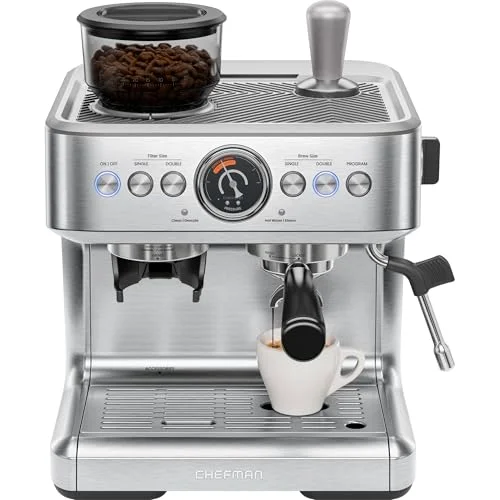
Chefman Crema Supreme 15 Bar Espresso Machine
Built-in grinder with 30 grind settings, milk frother, barista-style steam wand, 3 L removable water tank, stainless steel finish. The widest grind-adjustment range with a stated number anywhere in this band.
$299.00 Check price →The picks
Five machines, five different reasons to choose one over the others. None of them is a universal winner — pick by the trait you actually need.
Best grinder control: Chefman Crema Supreme
At $299.00, the Chefman Crema Supreme is the only machine in this band with a stated grind-settings count — 30 — alongside a milk frother, a barista steam wand and a 3 L tank. If dialing in grind size matters more to you than boiler count, this is the pick: more adjustment range to work with than the other four, on paper.
Best for sequencing milk drinks: Gevi Dual Boiler
The Gevi Dual Boiler Espresso Machine With Grinder & 58mm Portafilter at $270.44 is the cheapest way into this band's dual-boiler feature, and it does not make you give up the grinder or the wider portafilter to get there. The trade-off is size: at 16.61 by 15.66 by 18.85 inches, it is the largest footprint of the five by a wide margin, so measure your counter and cabinet clearance before ordering.
Best entry point into the band: Gevi 20 Bar with Conical Burr Grinder
At $213.99, this is technically below the $250 floor of this guide, but it belongs in the conversation as the sibling comparison point: the same brand's single-boiler machine with the anti-static conical burr grinder, at the smallest footprint of the five (12.28 by 10.31 by 12.4 inches). If the dual boiler and the wider portafilter on its sibling do not matter to your routine, this is the money saved.
Best steam output, bring your own grinder: Tuni E2 Gen3
The Tuni E2 Gen3 Dual Boiler Espresso Machine with Super+ Steam Power at $299.00 is built around its dual-boiler steam system rather than a grinder. We do not have grinder specs for this unit, so treat it as a machine-plus-grinder purchase rather than a complete bean-to-cup setup, and size that into your total budget before comparing it against the three machines above that already include one.
Best tank size and pump-brand transparency: Hanrose with Grinder and Milk Frother
The Hanrose Espresso Machine with Grinder and Milk Frother at $319.79 is the most expensive of the five and pairs a built-in grinder and milk frother with a 20-bar ULKA pump — one of the few listings on this site's database that names its pump supplier outright. At 12.99 by 13.23 by 16.54 inches it sits in the middle of the band for footprint.
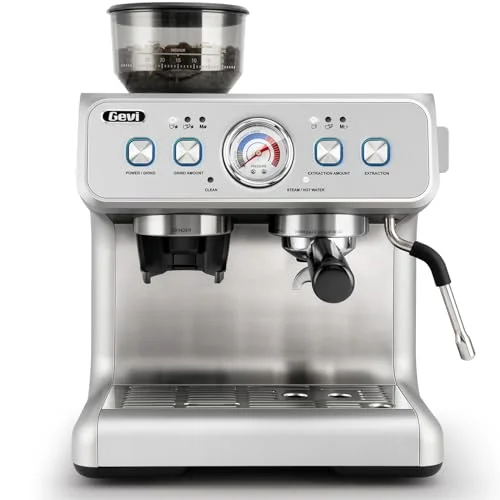
Gevi Dual Boiler Espresso Machine With Grinder & 58mm Portafilter
Dual-boiler system for simultaneous brew and steam readiness, built-in grinder, 58 mm portafilter. Largest footprint in this band at 16.61 by 15.66 by 18.85 inches.
$270.44 Check price →Where a $300 machine still cuts a corner a $500 one does not
Dual boilers and built-in grinders at $270-to-$320 sound like they have closed the gap with pricier machines, and in sequencing and grind adjustment they largely have. Two things still separate this band from $500-and-up machines, and neither shows up as a headline spec.
The first is build consistency and the brand track record behind it. Every machine in this band comes from a brand with a shorter or thinner public history than the established names that dominate the $500-plus tier — we are not asserting a reliability difference we cannot measure, only that there is less of a track record to point to. At $270 to $320, you are paying for the feature list; at $500 and up, part of what you pay for is a longer history of that feature list actually holding up over years of daily use.
The second is PID temperature control. A PID is a feedback loop that holds brew temperature to within a fraction of a degree rather than letting it swing as the boiler cycles on and off. None of the five machines in this guide lists PID control in the data we have for them, and that is typical for this price band generally — it is a feature that becomes common closer to $500 and above. Temperature swings of a few degrees will not ruin a shot, but they are the kind of variable that shows up as inconsistency from one cup to the next, especially with lighter roasts that are pickier about brew temperature.
Neither gap is unique to these five products specifically — we are describing a pattern typical of this price band, not a confirmed shortfall we measured on each unit. If either one matters more to you than the dual boiler or the grinder settings above, that is the signal to look higher.
When to stretch toward $500 instead
Three situations make the extra $150 to $250 worth finding. First: if you are buying for more than two people drawing espresso and milk drinks daily, the single boilers and smaller tanks common in this band (the Chefman's 3 L tank is the largest here) will mean more refilling and, on the single-boiler machines, more waiting between jobs. Second: if PID-level temperature consistency matters to you — serious light-roast drinkers tend to feel this first — it becomes more common as you move up. Third: if brand longevity and parts availability matter more to you than any single spec on this page, the $500-plus tier generally carries more established names.
If none of those three apply — you are making coffee for one or two people, you are not chasing degree-level temperature consistency, and the brand names here do not bother you — this band is very likely the better buy. You are not leaving much functionality on the table for $200 to $250 more.
How the five compare
Prices are what we recorded between October 20 and November 1, 2026.
| Machine | Grinder | Boiler | Portafilter / tank | Price | |
|---|---|---|---|---|---|
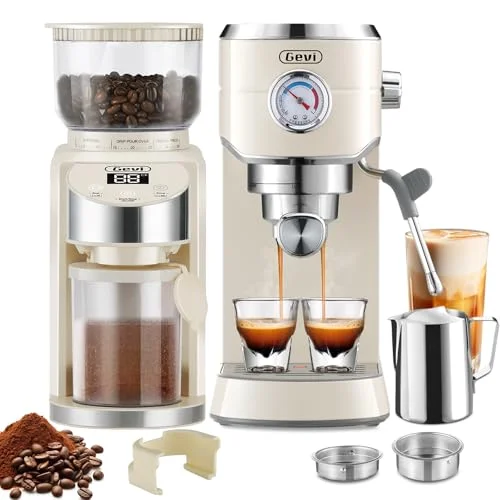 Gevi 20 Bar with Conical Burr Grinder | Built-in, anti-static conical burr | Single | 12.28×10.31×12.4 in | $213.99 | Price |
| Gevi Dual Boiler with Grinder & 58mm Portafilter | Built-in | Dual | 58 mm portafilter · 16.61×15.66×18.85 in | $270.44 | Price |
| Chefman Crema Supreme 15 Bar | Built-in, 30 settings | Single | 3 L tank | $299.00 | Price |
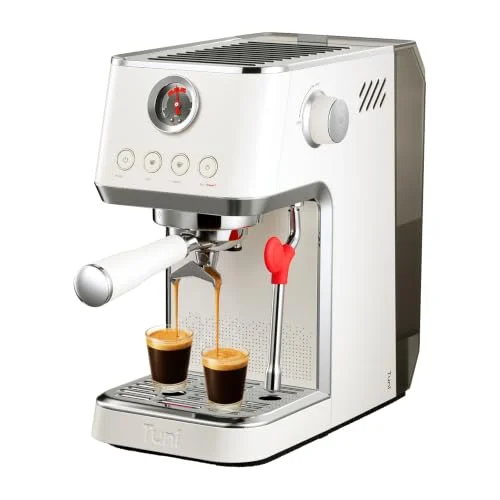 Tuni E2 Gen3 Dual Boiler | None (bring your own) | Dual | — | $241.44 | Price |
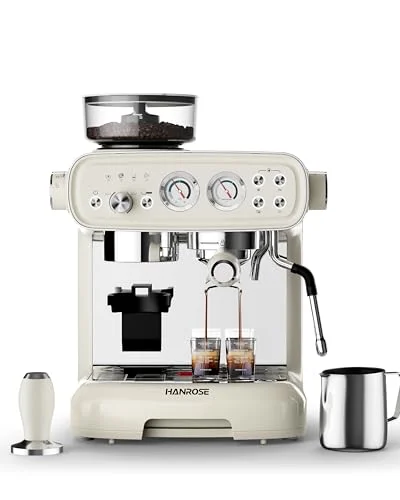 Hanrose with Grinder and Milk Frother | Built-in | Single | 12.99×13.23×16.54 in | $319.79 | Price |
For context one tier down, our SHARDOR comparison and AYCHIRO comparison both cover brands where the entry model sits well under $200 and the step-up model still lands below this band. For a closer look at one single-versus-dual-boiler jump within a single brand, see Kismile single boiler vs dual boiler — a different pair of machines, but the same structural trade this band keeps repeating.
A safety feature worth checking regardless of price
None of the five listings above state whether they include an automatic pressure relief valve — a safety feature that vents excess boiler pressure before you open the water tank or portafilter, which several listings in this category omit from their spec sheets entirely. We cover what it is and why it matters in our guide to the automatic pressure relief valve. If it is not listed, check the current Amazon listing or manual before buying, especially on a dual-boiler machine running two heating elements.
How we compared these
We compare published specifications, what ships in the box, machine class, footprint and live pricing — we do not physically test these machines, we do not run a testing lab, and we do not publish ratings we cannot verify. Amazon's product data returns no rating and no review count for any of the five machines above, so there are no stars and no invented scores anywhere on this page. Where we note that a spec is missing from our data — grind-settings counts, pressure-relief-valve presence, PID control — that is a statement about what the database gives us, not a claim that the feature is absent from the product.
General coffee facts used above (espresso brewing at roughly 9 bar at the puck, burr grinders beating blade grinders, PID control reducing temperature swings) are standard background knowledge, not product-specific claims. The rest of our method sits on our main espresso machine guide, and our under-$200 and under-$500 tiers are covered in best espresso machines under $200 and best espresso machines under $500.
Frequently asked questions
Is a dual-boiler espresso machine worth it under $350?
It is worth it specifically for sequencing: a dual-boiler machine keeps a separate boiler for brewing and one for steam, so you can pull a shot and texture milk back-to-back without waiting for the machine to re-stabilize at a different temperature. For a single cup it barely matters. For households making multiple milk drinks in a row each morning, two machines in this band — the Gevi Dual Boiler at $270.44 and the Tuni E2 Gen3 at $299.00 — offer the feature well under the $500-plus price point where it is more common.
Do machines in this price band need a separate grinder?
Three of the five do not: the Gevi 20 Bar, the Gevi Dual Boiler and the Chefman Crema Supreme all ship with a built-in grinder, as does the Hanrose. The Tuni E2 Gen3 is the exception in this group — budget for a separate burr grinder if you choose it, since pre-ground coffee will not take advantage of its dual-boiler steam sequencing.
What does a 58mm portafilter change versus a narrower one?
A wider portafilter holds a larger coffee bed at the same depth, which generally makes dosing a bit more forgiving because small measuring errors spread across more surface area rather than concentrating in a narrow column. The Gevi Dual Boiler is the only machine in this band with a stated 58 mm portafilter; we do not have portafilter width data for the other four.
What do $250-to-$350 machines still lack compared with $500-plus machines?
Mainly two things: a longer brand track record, and PID temperature control, which holds brew temperature to within a fraction of a degree rather than letting it swing as the boiler cycles. None of the five machines here lists PID control in our data, which is typical of this price band rather than a shortfall specific to these products. If consistent temperature or brand longevity matters more to you than a dual boiler or grind settings, that is the case for spending more.