Best SHARDOR Espresso Machines Compared (2026)
SHARDOR currently sells two espresso machines on Amazon, and they split the brand's formula in opposite directions. The SHARDOR Espresso Machine 20 Bar with Milk Frother and Touchscreen runs $93.49 and leads with a screen, adjustable temperature and a milk frother. The SHARDOR 20 Bar Espresso Machine with Built-In Grinder runs $199.99 — $90 more — and drops every one of those stated features from its own title in favor of one: a grinder. Here is what that trade actually buys, and who it's worth it for.
Reader-supported: we may earn a commission if you buy through our links, at no extra cost to you. Prices below are what we recorded for each model — $93.49 for the touchscreen machine on October 28, 2026, and $199.99 for the grinder model — and both move constantly on Amazon; confirm the live price before buying.
The short answer
Both current SHARDOR espresso machines state a 20-bar pump, and both ship in stainless steel. Past that, their listings diverge almost completely. The touchscreen model (B0GHQQ195Y) states a touchscreen, a milk frother and adjustable temperature control, aimed squarely at cappuccino and latte drinks, at $93.49. The grinder model (B0H7RJW4MC) states exactly one additional feature over the bare machine — a built-in grinder — and its listing doesn't restate a touchscreen, a frother or temperature adjustment at all, at $199.99.
That's not a case of one machine being a strictly better version of the other. It's two different bets about where $90 is best spent: on an interface and milk system you'll use every single day, or on grinding your own beans instead of buying them pre-ground. Neither listing gives us a reason to assume the grinder model quietly keeps the touchscreen and frother and just adds a grinder on top — if SHARDOR wanted to claim that, the title is the place to do it, and it doesn't. We'll treat the two machines as the listings describe them, not as we'd guess they might be.
What the touchscreen adds on the cheaper model
The $93.49 model's full title is "SHARDOR Espresso Machine 20 Bar, Professional Espresso Machine with Milk Frother and Touchscreen, Expresso Coffee Machines with Adjustable Temperature, for Cappuccino, Latte, Stainless Steel, Black" — a mouthful, but one that front-loads three stated features before the brand even gets to color. A touchscreen on a home espresso machine generally replaces a row of unlabeled buttons or a single dial with a panel that can show which drink mode is selected, what temperature is set, and whether the machine is heating, brewing or idle — a general interface pattern across small kitchen appliances, not a SHARDOR-specific claim. Pairing that with "for Cappuccino, Latte" in the same title suggests the screen is doing double duty as a drink-mode selector, not just a status display, though the listing doesn't spell out exactly how many modes it offers or whether they're preset or programmable.
What a screen does not do is change the physics of the shot. It brews on the same stated 20-bar pump as the pricier model, and espresso itself is extracted at roughly 9 bar at the coffee puck regardless of what the pump's rated maximum says — a 20-bar figure describes headroom in the pump, not pressure you'll taste. So the honest read on the touchscreen is that it's a convenience and legibility upgrade over blind buttons, not a brewing upgrade, and it's one of the two things (the other being the frother) that justify this being the "Professional" and "Cappuccino, Latte" model in SHARDOR's own naming rather than a bare pump machine.
The grinder model's title doesn't mention a screen, a dial or any control-panel detail at all. We don't know from either listing whether it uses physical buttons, a simpler display, or something else — and rather than guess at a control layout neither title states, we'd point you to the live Amazon listing's photos and Q&A section if that's a deciding factor for you. It's the same kind of listing gap we flagged in our EUHOMY comparison, where a brand's pricier model dropped a stated spec from its title without telling us what, if anything, replaced it.
Adding a built-in grinder: what it changes about the morning
The $199.99 model's entire stated differentiator is right there in its name: "SHARDOR 20 Bar Espresso Machine with Built-In Grinder, Stainless Steel." No touchscreen claim, no frother claim, no temperature-control claim — just the pump rating it shares with the cheaper machine, plus a grinder.
A built-in grinder changes one specific thing about a morning routine: where the coffee comes from right before it hits the water. Instead of opening a bag of pre-ground coffee milled to a single compromise size meant to work across every brew method, you're grinding whole beans fresh, into the machine, each time you pull a shot. That matters for espresso more than for almost any other brew method, because espresso is unusually sensitive to particle size — slightly too coarse and water races through the puck in a few seconds, producing something thin and sour; slightly too fine and the puck chokes, dripping for a minute into something bitter. Fresh, correctly sized grounds are the single biggest lever on cup quality in the entire category, which is why a grinder — built in or standalone — is treated as close to mandatory by anyone serious about the drink, not a nice-to-have.
What the listing doesn't state is the grind-mechanism type (burr versus blade), the number of grind settings, or the bean hopper's capacity. That matters because the quality gap between a true burr grinder and a blade grinder is enormous for espresso specifically — a blade grinder smashes beans into an uneven mix of dust and boulders that neither extracts cleanly nor adjusts meaningfully, while a burr grinder pushes beans through a fixed gap for a far more uniform result you can actually dial in. We're not going to assume "Built-In Grinder" means burr just because that's the more respectable answer; if the mechanism matters to your decision, it's worth confirming on the live listing before you order, the same caution we raised about SHARDOR's unstated grind detail elsewhere in our look at the honest floor under $80.
What a built-in grinder does not change is milk. Nothing in this model's title claims a frother, automatic or manual, so if lattes and cappuccinos are part of your routine, grinding your own beans doesn't buy you a way to texture milk — that would need to come from a separate pitcher and whisk, or a feature the listing simply doesn't mention.
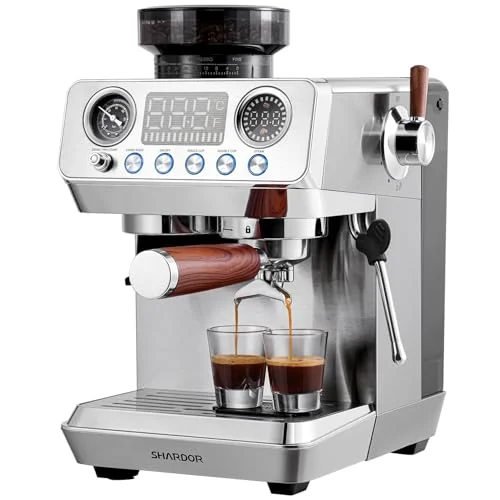
SHARDOR 20 Bar Espresso Machine with Built-In Grinder
A stated 20-bar pump plus a built-in grinder, in stainless steel, in the "Standard" size listing. The pricier of SHARDOR's two current machines, and the one whose title drops the touchscreen, frother and temperature claims entirely.
$199.99 Check price →Adjustable temperature control, compared across both
This is the section where the two listings are easiest to compare honestly, because only one of them states the feature at all. The touchscreen model's title explicitly includes "Adjustable Temperature," which is a genuinely useful spec rather than a filler phrase: brew temperature affects how a shot extracts, and lighter roasts generally extract better at the higher end of a typical espresso range while darker roasts can be more forgiving lower in that range — a general coffee fact, not a number SHARDOR has published for this specific machine's adjustable window. Being able to nudge that temperature at all, rather than brewing at one fixed setting, gives you a lever to chase a better shot as you try different beans.
The grinder model's title says nothing about temperature, in either direction. That's not evidence the feature is missing — plenty of listings simply don't restate every spec in the title — but it's also not evidence it's present, and we won't split the difference by assuming it carries over. The two listings give us one machine with a stated, named temperature-control feature and one machine with no temperature claim at all, and that's the comparison we can actually stand behind. It's the same gap we highlighted in our Chefman comparison, where moving up a brand's price ladder didn't uniformly add stated specs — it sometimes just traded one for another.
If brewing temperature is something you'd actually use — chasing a sweeter shot out of a light-roast single origin, for instance — that's a point in the cheaper machine's favor on paper, not the grinder model's, regardless of which one costs more.
Where the cheaper model is honestly the better buy
For most people buying their first SHARDOR machine, the $93.49 model is the stronger purchase, and it's worth saying plainly rather than hedging around it. It states three features that directly affect daily use — a touchscreen interface, a milk frother, and adjustable temperature — in a single $93.49 package, with no ambiguity about what's included. If your coffee habit already runs on whole beans you grind elsewhere, or you're happy buying pre-ground for now, there's nothing the pricier model adds that you'd actually use, and you'd be paying $90 more for a grinder sitting idle next to a bag of beans you bought at the store.
It's also the lower-risk way to find out whether a SHARDOR machine fits your routine at all. A $93.49 outlay that includes the parts of the experience people interact with most — the screen, the milk system, the temperature dial — tells you more about whether you'll actually use an espresso machine daily than a pricier model would, for less money at stake if the habit doesn't stick. That's the same budget-tier logic we lay out in our guide to what espresso machines under $80 actually get you: spend to confirm a habit before you spend to deepen it.
The one place this reasoning doesn't hold is if you already know, going in, that grinding your own beans is non-negotiable for you. In that specific case the touchscreen model's extra conveniences don't compensate for the one thing it doesn't do.
Who should pay the extra $90 for the grinder
The $90 gap between these two machines buys exactly one stated thing: grinding beans fresh at the machine instead of buying them pre-ground. That's a real and meaningful upgrade to cup quality for the reason we laid out above — grind freshness and particle size are the biggest levers on how an espresso shot tastes — but it's only worth paying for if you don't already have a way to grind beans, and if you're willing to give up the touchscreen, frother and stated temperature control the cheaper model offers in writing.
That makes the grinder model the right buy for a narrower group than "anyone who wants better coffee." It fits someone who: already drinks mostly straight shots or black americanos rather than milk drinks, since nothing here claims a frother; doesn't currently own a separate grinder and doesn't want to buy one as a second appliance; and is comfortable operating a machine whose control layout isn't described in the listing we could find. It's a similar fork to the one in our Kismile single-boiler versus dual-boiler comparison, where the pricier model's added hardware only pays off for a buyer whose routine actually uses it — here, that routine is "grinds fresh beans and doesn't need a screen to do it."
If you drink milk-based drinks regularly and still want to grind your own beans, neither SHARDOR machine covers both as stated, and pairing the grinder model with a separate milk pitcher and handheld whisk — or a standalone frother — is the more honest plan than hoping the feature was simply left off the title.
Both machines, side by side
Prices are what we recorded on the dates noted at the top of this page. Where a listing doesn't state a spec, we've marked it rather than guessed.
| Machine | Pump | Touchscreen | Milk frother | Adjustable temp | Grinder | Price | |
|---|---|---|---|---|---|---|---|
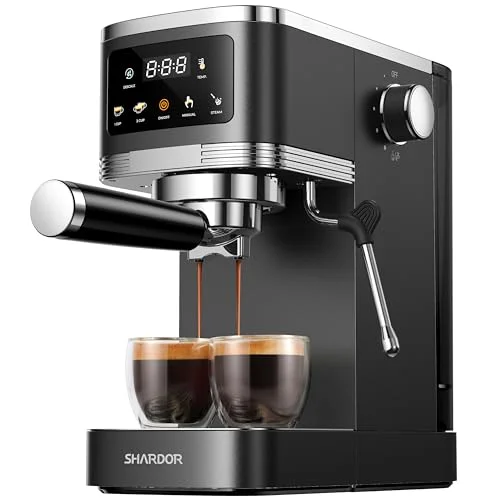 Espresso Machine with Frother & Touchscreen | 20 bar | Yes | Yes | Yes | Not stated | $93.49 | Price |
| Espresso Machine with Built-In Grinder | 20 bar | Not stated | Not stated | Not stated | Built-in | $199.99 | Price |
Our picks
If you want the most stated features for the least money, and your routine leans on milk drinks and a screen you can actually read, the $93.49 touchscreen model is the one to buy — it names a frother and adjustable temperature control the pricier machine's own listing doesn't. Check price →
If grinding fresh beans is the one thing you won't compromise on, and you're fine giving up the touchscreen and frother to get it, the $199.99 built-in grinder model is SHARDOR's answer to that — at a real $90 premium for one stated feature. Check price →
How we compared these
We compare published specifications, what each listing states in its own title, and live pricing — we do not physically test these machines and we do not run a testing lab. Where a feature isn't published, as with the grinder model's touchscreen, frother and temperature-control status, and the grind mechanism and setting count on both machines, we've said so rather than estimating. We show no star ratings or review counts because Amazon's product data returns neither for these machines, and we never paraphrase review sentiment we haven't verified.
Where we've made a judgment call — that the cheaper model is the better default buy, or that the grinder premium only pays off for a buyer without milk drinks or an existing grinder — we've said so in our own voice, so you can weigh it against your own routine. The general coffee facts referenced along the way (9 bar at the puck versus a pump's rated maximum, burrs beating blades, temperature's effect on extraction) are standard background, not claims about these two specific products.
Frequently asked questions
Does the SHARDOR grinder model also have a touchscreen and milk frother?
Its listing doesn't say so. The grinder model's title states a 20-bar pump and a built-in grinder only; it doesn't restate a touchscreen, a milk frother or adjustable temperature the way the cheaper model's title does. We treat features a listing doesn't mention as unconfirmed rather than assuming they carry over.
What does the touchscreen actually control on the cheaper SHARDOR machine?
The listing doesn't spell out the exact menu structure. In general, a touchscreen on a home espresso machine typically shows which drink mode is selected and the machine's status rather than requiring blind buttons or a single dial, and this model's title pairs the screen with "for Cappuccino, Latte," suggesting it's used to select drink modes. That's a general interface pattern, not a confirmed feature list for this specific unit.
Is the built-in grinder worth the extra $90?
Only if you don't already have a way to grind beans and you're willing to give up the touchscreen, frother and stated temperature control the cheaper model offers in writing. Fresh, correctly ground beans are a genuine upgrade to espresso quality, but the grinder model's listing doesn't claim the milk and interface features that make the cheaper machine easy to live with day to day.
Which SHARDOR espresso machine should I buy?
For most first-time buyers, the $93.49 touchscreen model is the stronger purchase: it states a frother and adjustable temperature control the pricier model's listing doesn't, for $90 less. Buy the $199.99 grinder model only if grinding fresh beans at the machine is the specific feature you're paying for, since that's the one thing its title adds over the base pump machine.