The short answer
All three machines here — the De'Longhi Classic Matte Black at $149.95, the De'Longhi Classic Signature at $149.95, and the De'Longhi Classic Stainless Steel at $129.95 — heat water with a Thermoblock rather than a boiler. That single design choice explains most of what they have in common and most of what separates them from pricier prosumer machines like the Rancilio Silvia Pro X: they're ready for a first shot in well under a minute, and they ask you to wait a little between shots if you're pulling more than one back to back.
Neither trait is a flaw exactly. It's a consequence of a heating element with very little thermal mass, chosen because it's compact and cheap to manufacture at this price tier. Understanding that one piece of engineering tells you almost everything about how these three machines will behave on a weekday morning versus a dinner party.
What a Thermoblock actually is, mechanically
A boiler is a sealed metal reservoir — typically brass or steel — that holds a volume of water and keeps it continuously hot, the way a kettle left on a low simmer would. Because there's mass of both metal and water sitting at temperature, a boiler holds thermal energy in reserve: pull a shot, and the reservoir's remaining hot water and the heated metal around it buffer the drop in temperature.
A Thermoblock skips the reservoir. It's a block of metal — usually aluminum — with a narrow channel running through it, wrapped by a heating element. Water doesn't sit inside it; it passes through on its way from the pump to the group head, and the heating element brings it up to brewing temperature in that short transit. There's no standing hot-water tank to drain or maintain, which is a large part of why Thermoblock machines are smaller, lighter and cheaper to build than boiler machines of comparable brewing pressure.
The practical difference comes down to thermal mass. A boiler's stored heat means the system has reserves to draw on. A Thermoblock has almost none — its block of metal is small by design, so it heats fast precisely because there isn't much of it to heat. That same smallness is what limits how much hot water it can deliver before it needs to recover.
None of the three machines in this guide publish their Thermoblock's wattage or channel volume, and we won't invent numbers Amazon doesn't list. What the listings do confirm is the technology itself: all three use Thermoblock heating rather than a boiler, which is the detail that actually predicts how they'll behave, regardless of the finish or the frother on top.
The upside: heat-up time across all three
This is the Thermoblock's strongest, least disputed advantage, and it's the reason the design exists in home machines at this price at all. Because there's no standing reservoir to bring up to temperature — just a small metal block in the water's path — a Thermoblock machine can go from a cold start to brewing temperature in a fraction of the time a boiler needs. Boiler-based machines in the prosumer tier, including dual-boiler designs like the ones in our Breville Oracle comparison, are often built to stay on and hold temperature between uses specifically because heating their reservoir from cold takes long enough that leaving it idle isn't practical.
All three De'Longhi Classic-line machines here inherit that fast-start property simply by using Thermoblock heating. Practically, that means a machine you can switch on and have ready close to the time it takes to grab a cup and a bag of beans — rather than a machine you learn to switch on five or ten minutes before you actually want coffee. For a single morning shot, where the machine has sat cold all night, this is the scenario where a Thermoblock machine is working entirely in its favor: one heat-up, one shot, done.
It's worth being precise about what "fast heat-up" buys you and what it doesn't. It solves the problem of starting cold. It says nothing about what happens once you start asking for a second shot shortly after the first — that's a different thermal event, covered next.
The tradeoff: temperature recovery on back-to-back shots
This is the half of the story that spec sheets and listing photos don't show, and it's the direct mirror image of the heat-up advantage: the same lack of thermal mass that lets a Thermoblock heat quickly from cold is what limits how much hot water it can push out before its temperature sags.
A boiler's stored reserve means pulling a second shot soon after the first draws down a tank that was still mostly hot — the drop is real but cushioned. A Thermoblock has no reserve to draw down. Once the water in transit has absorbed the heating element's output for one shot, the metal block itself needs a moment to recover before it can bring the next volume of water up to the same temperature at the same flow rate. Pull a second shot immediately, and you're more likely to be drawing on a system that hasn't fully reset than you would be with a boiler of equivalent output.
This is the scenario a boiler is built for and a Thermoblock isn't: two or three drinks in quick succession, like making espresso for two people back to back, or pulling a shot, deciding it's not quite right, and pulling another right after. None of the three machines here publish a specific recovery-time figure or a shot-to-shot temperature-stability spec, so we won't attach a number to how much the second shot actually drops — that's a claim the listings don't support. What we can say, from the mechanism itself, is that back-to-back consistency is structurally the weaker side of the Thermoblock's design, in the same way fast heat-up is structurally its strength. One always comes with the other; no Thermoblock machine gets the first without some exposure to the second.
In practice, this generally means pacing: a short pause between shots gives the block time to re-stabilize, rather than firing the pump again the instant the first cup is full. That's a usage habit, not a defect, but it is a real difference from how a boiler machine is used, and it's worth knowing before you buy if your household regularly wants two espressos within a minute of each other.
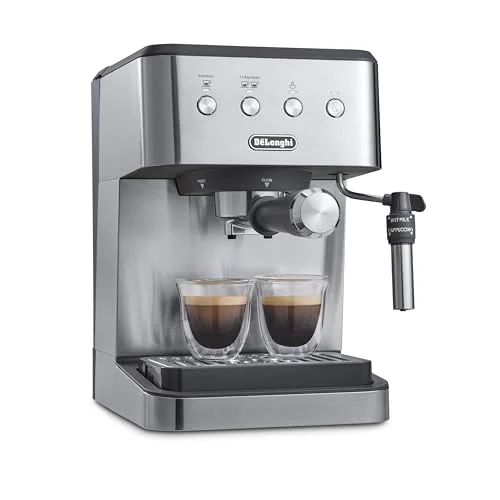
De'Longhi Classic Espresso Machine, Milk Frother, Stainless Steel
The most expensive of the three at $129.95, in a stainless finish rather than the painted matte-black or Linea Classic bodies of the other two. Thermoblock heating, milk frother included.
$129.95 Check price →
How the $76 price spread breaks down, feature by feature
Line these three up and the spread from $149.95 to $225.99 looks wide for machines sharing the same core heating technology, so it's worth being specific about what the extra money is and isn't paying for.
At the bottom, the De'Longhi Classic Matte Black and the De'Longhi Classic Signature both list at $149.95 — the same price, two different finishes and frother designs. The Matte Black is described as "easy-to-use," pointing to a simpler milk-frothing mechanism aimed at minimal fuss. The Signature's frother is described as adjustable, which on this line typically means some control over froth texture rather than a single fixed setting — a small but real difference in what you can do with milk, at an identical price.
One tier up, the De'Longhi Classic Stainless Steel at $129.95 adds $30 over the entry pair. Nothing in the listing we have points to a difference in heating technology or brewing pressure between it and the cheaper two — it's still a Thermoblock machine. The documented difference is the stainless-steel body in place of painted plastic or matte finishes, plus its own milk frother. Whether $30 for a steel shell over a painted one matters to you is a durability and aesthetics question, not a brewing-performance one — we have no spec showing the stainless unit heats, recovers, or brews any differently than its siblings.
The top of the $76 spread, at $225.99, isn't a fourth product in this guide — it's the ceiling of what De'Longhi's Classic line reaches once you account for color and frother variants beyond these three. Within the three we do cover, the honest read is that $30 of the spread buys a different shell material, and the rest of any gap you see on a given day is ordinary Amazon price movement rather than a feature you're paying for. If the brewing mechanism is identical across a price range, the extra dollars are going to materials and accessories, not to shot quality.
The picks
01Best value
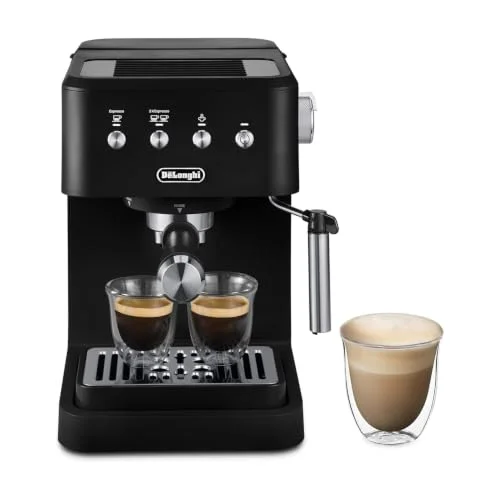
De'Longhi Classic Matte Black Espresso Machine
The simplest route into a Thermoblock machine
Thermoblock heating · easy-to-use milk frother · matte black finish
At $149.95, this is the most straightforward of the three: a Thermoblock machine with a frother the listing specifically calls easy to use, in a matte black body. If your priority is getting a shot going fast on a weekday morning without fussing over frother settings, this is the one that asks the least of you before your first cup.
The trade-offLike its siblings, back-to-back shots ask for a short pause between pulls — pace yourself if you're making more than one drink at once.
02Best adjustable froth
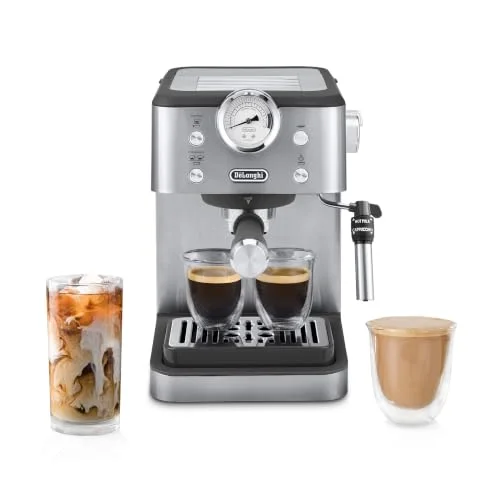
De'Longhi Classic Signature Espresso Machine
Same price, more say over your milk
Thermoblock heating · adjustable milk frother · Linea Classic body
Identical $149.95 price to the Matte Black, but the frother is described as adjustable rather than easy-to-use — meaning you get more control over froth texture if you're the kind of person who wants to dial in milk for a latte versus a cappuccino rather than accept one default. Same Thermoblock core, same fast heat-up, same recovery behavior.
The trade-offMore adjustment also means more to learn before the frother gives you what you want. If you'd rather not think about it, the Matte Black's simpler frother may suit you better at the same price.
03Best finish
De'Longhi Classic Espresso Machine, Stainless Steel
The same core machine, in a body that resists wear differently
Thermoblock heating · milk frother · stainless steel body
At $129.95, this is $30 above the other two, and the documented difference is the shell: stainless steel in place of a painted or matte plastic body. We have no spec showing a brewing-performance difference between this unit and the two cheaper ones — all three share the same Thermoblock design, with the same fast heat-up and the same shot-to-shot pacing consideration.
The trade-offYou're paying for materials, not for a different or better heating system. If the finish doesn't matter to you, the two $149.95 machines do the same brewing job for less.
Milk frothing on a Thermoblock machine, honestly
All three of these machines come with a milk frother, and the same thermal-mass story that governs espresso shots applies to steam. Producing steam for frothing asks a heating system for a burst of energy on demand, and a Thermoblock's small thermal mass means that burst comes from the same limited reserve a shot does — it isn't a separate, unlimited system sitting alongside the brewing path.
In practice, that tends to mean choosing between a shot and milk froth in close sequence rather than doing both simultaneously without any wait — pull an espresso, then froth milk, rather than expecting the machine to do both at full output at once. This is a structural property of Thermoblock designs generally, not a defect specific to any one of these three machines, and it's consistent with why dedicated dual-boiler machines exist at all: a second boiler lets a machine brew and steam at the same time without either task competing for the same limited reserve.
Beyond the shared heating limitation, the frother quality itself differs by model, per the listings: the Matte Black's is described as easy-to-use, suggesting a simpler, more automatic design; the Signature's and the Stainless Steel's are both just described as having a milk frother without the same "easy-to-use" framing in the Matte Black's case, and the Signature's is specifically called adjustable. None of the three listings gives froth volume, temperature range, or a texture spec, so beyond "it has a frother" and "adjustable means more control," we can't say more than what's published.
Who a Thermoblock machine actually suits versus who needs a boiler
The honest framing isn't "Thermoblock is worse" — it's that the two designs are built for different drinking patterns, and matching the machine to your actual routine matters more than the spec sheet alone.
A Thermoblock machine, like any of these three, suits someone who mostly drinks one shot or one milk drink at a time, wants the machine ready quickly rather than pre-warmed and waiting, and isn't regularly making espresso for several people back to back. That's a large share of home users — a single morning cup, maybe a second one later in the day with a natural gap in between, which is exactly the pattern where a Thermoblock's fast start matters and its recovery limitation barely comes up.
A boiler-based machine suits someone who regularly makes multiple drinks in a short window — entertaining, a household of several espresso drinkers each wanting their own shot in the same ten minutes, or steaming milk and pulling a shot at close to the same time. That's the scenario where a boiler's stored thermal reserve earns its higher price and larger footprint, and it's the reason prosumer dual-boiler machines like the ones compared in our Breville Oracle guide and our Rancilio Silvia Pro X vs. Diletta Alto comparison exist well above this price tier.
If you're shopping specifically within the budget bracket these three occupy, our best espresso machines under $150 with a built-in grinder guide and our Electactic machines comparison cover adjacent options at a similar price, with different trade-offs around grinding rather than heating.
One thing not to assume
Don't assume "Thermoblock" automatically means a lesser machine, or that "boiler" automatically means better. They're suited to different use patterns. A single-cup household gains almost nothing from a boiler's stored reserve and pays for a feature they rarely need; a household making three espressos in a row loses real consistency on a Thermoblock and should budget for a boiler instead.
How we compared these
We compare published specifications, product descriptions, machine class and live pricing — we do not physically test these machines, we do not run a testing lab, and we do not publish ratings we cannot verify. The heat-up and recovery behavior described in this guide follows directly from the documented difference between Thermoblock and boiler heating as physical designs, not from a timed test we ran on these specific units. Where the three listings here give us a concrete fact — the Thermoblock heating method, the frother description, the price, the finish — we've used exactly that fact and no more. Where a spec isn't published, such as a recovery-time figure or steam output, we've said so rather than estimate one.
Prices for these three machines were recorded as of November 15, 2026, and Amazon pricing on this line moves often — confirm the live price before buying. The general heating-technology facts in this guide (boiler thermal mass, Thermoblock channel heating, the shared-reserve relationship between brewing and steaming) are standard engineering background rather than claims about any single product's measured performance.
Frequently asked questions
Is a Thermoblock worse than a boiler?
Not worse — different, with a trade-off in each direction. A Thermoblock heats water fast because it has very little thermal mass, which also means it has less reserve to draw on for back-to-back shots or simultaneous brewing and steaming. A boiler holds a reservoir of hot water that recovers more gracefully between drinks, but takes meaningfully longer to heat from cold. Which one suits you depends on whether you drink one coffee at a time or several in quick succession.
Can a Thermoblock machine make two espressos back to back?
Yes, but expect to pace the shots rather than fire them one immediately after the other. None of the three machines in this guide publish a specific recovery-time figure, but the mechanism — a small block of metal with little thermal mass — means the system benefits from a short pause between pulls to stabilize, where a boiler's stored reserve would absorb a quick second shot more readily.
Why do these three De'Longhi machines cost different amounts if they all use Thermoblock heating?
The documented difference between the $149.95 pair and the $129.95 model is the body material — stainless steel versus a painted or matte finish — plus differences in the milk frother description (easy-to-use versus adjustable). None of the listings point to a different heating system or brewing pressure across the three; the extra cost buys materials and frother features, not a different core technology.
Does a Thermoblock affect milk frothing too?
Yes, in the same way it affects shots. Producing steam draws on the same limited thermal reserve as brewing, so a Thermoblock machine generally handles pulling a shot and frothing milk better in sequence than at the exact same moment. This is a structural property of the design rather than a flaw in any one of these three machines.
Keep reading