Espresso Machines With a Cup Warming Tray: Does Preheating the Cup Change the Shot
Four budget machines build a flat warming plate into the top panel, between $79.99 and $155.99, and the pitch is always the same photo: a cup sitting on the machine while it heats up. What a warm cup actually changes about an espresso that starts losing heat the moment it leaves the spout, and whether it's worth paying for.
Reader-supported: we may earn a commission if you buy through our links, at no extra cost to you. Prices are the ones we recorded in our database on the dates noted below and they move constantly — confirm the live price before buying.
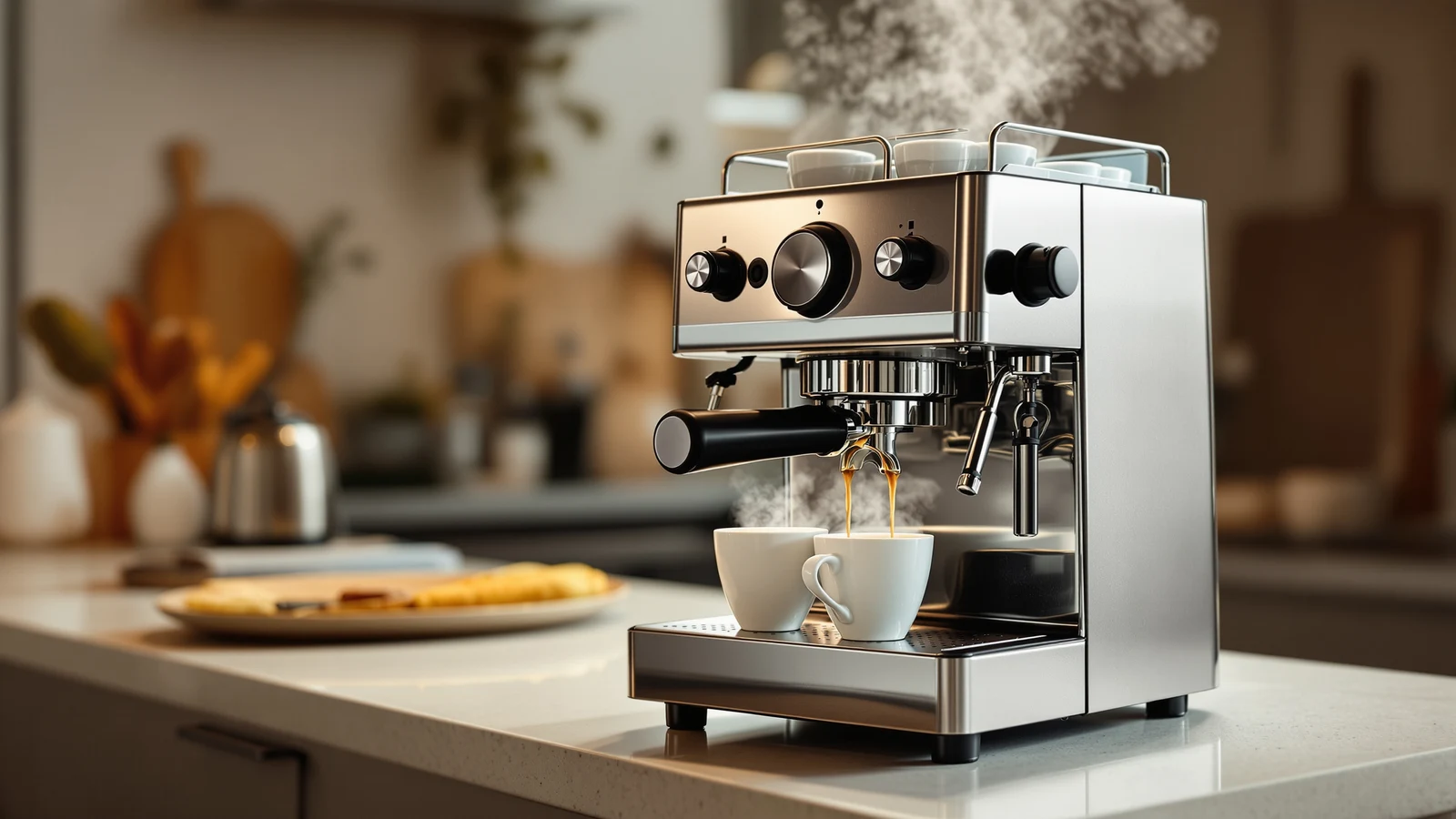
The short answer
A cup warming tray takes a cold ceramic cup from room temperature to warm-to-the-touch while the machine heats up for its first shot of the day. That is a real, measurable effect, and all four machines here build it the same way: a flat plate on the top panel that warms passively from the heat the boiler already generates, not a heated element of its own.
What it does not do is meaningfully change how long your two-ounce double stays hot once it's poured, because a double shot has so little thermal mass that it loses most of its advantage to the room within a couple of minutes regardless of where the cup started. The tray is a small, genuine convenience on a machine you were buying anyway — not a reason by itself to pick one machine over another at this price. All four machines below are legitimate semi-automatic espresso machines first; the warming tray is a $0 line item bundled onto the spec sheet, and we treat it that way.
What a warming tray physically does, and what it doesn't
Every machine in this piece puts the warming tray directly above the boiler or thermoblock, so the metal top panel runs warm during normal operation and radiates a little of that heat upward into whatever is sitting on it. Leave a ceramic espresso cup there while the machine comes up to brew temperature — typically a minute or two on these models — and the cup itself warms several degrees above room temperature. That's the entire mechanism: passive conduction and radiation from a panel that's already hot, not a dedicated heating coil with its own thermostat.
That matters for what you should expect. A warming tray isn't going to bring a cup to serving temperature from a cold start the way a commercial machine's actively-heated cup rail can — it's riding on waste heat, for as long as the machine has been powered on. A cup left there for ten seconds while you tamp a basket gets a token warm-up. A cup left there through the whole heat-up cycle, and ideally kept there between back-to-back pours, gets closer to genuinely warm.
None of the four machines here publish a tray temperature or a time-to-warm figure, and we're not going to invent one. What the spec sheets agree on is the placement — flat tray, top panel, passive — and that's as far as the manufacturer data goes.
Why a shot cools in under five minutes anyway
Here's the physics that the marketing photos don't show: a double espresso is roughly one to one-and-a-half fluid ounces of liquid in a small cup with a lot of surface area relative to its volume. That combination — thin layer, wide exposed surface, thick ceramic walls that absorb heat fast if the cup started cold — is close to the worst-case setup for heat retention. Espresso brewed around 195–205°F in a cup that started at room temperature is commonly observed to drop into "lukewarm" territory well inside five minutes, sometimes inside two or three, depending on the room, the cup, and how much milk (if any) goes in after.
A pre-warmed cup shifts that curve, but it doesn't flatten it. If the espresso itself is at the same brew temperature either way, the difference a warm cup makes is how much heat the shot loses to the cup walls in the first ten to twenty seconds after pouring, rather than how long the whole drink stays hot afterward. Put differently: pre-heating buys you a slightly hotter first sip, not a hotter cup five minutes later. Room temperature, cup material, and whether you drink it in one go versus letting it sit all do more to the end result than the tray does.
This is worth being honest about on a page selling machines with the feature: a cup warmer is a nice-to-have that softens one specific moment — the first taste — and does very little about the problem most people actually mean when they say "my espresso went cold," which is leaving it on the counter for ten minutes while they deal with milk, texting, or kids.
The two Kismile listings: same warming tray, $57 apart
The clearest illustration of how little the warming tray itself costs sits inside one brand's own lineup. Kismile sells two 20 Bar Espresso Machine with Milk Frother listings — both stainless steel, both with a pressure gauge, both with a 1.4L water tank, both with a hot water function for cappuccino and latte, both in silver — and both with the same warming tray on top. One is $79.99 (ASIN B0HDD4F6BR) and the other is $155.99 (ASIN B0HDD3S37J). Beyond the ASIN and the price, we have no published spec that separates them — no size/variant distinction, no stated capacity difference, nothing on the listing text we were given that explains the $57.
That gap is the single most useful fact in this article, and it has nothing to do with warming trays: it tells you the tray itself is close to a free addition on a machine that already has a hot top panel. If a brand can sell what appears to be the same physical machine at two prices, the feature everyone photographs on top of it isn't where the money is going. Treat identical-looking listings at different prices as a prompt to check the live listing for anything that's changed — a bundle, a color run, a date-of-manufacture difference — rather than assume the higher price buys a better tray.
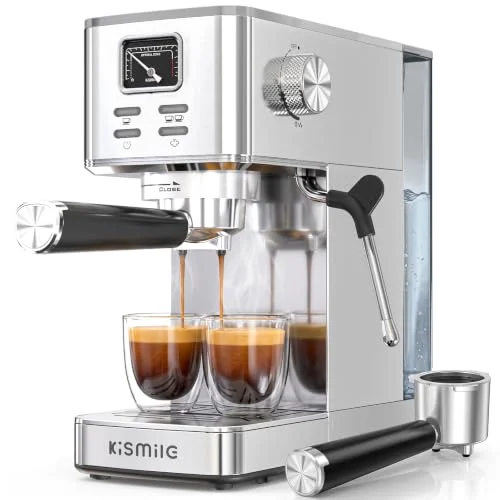
Kismile 20 Bar Espresso Machine with Milk Frother — $79.99 listing
Stainless steel, pressure gauge, 1.4L water tank, hot water function for cappuccino and latte, built-in warming tray. Price recorded in our database on 2026-11-13.
$79.99 Check price →If you're choosing between the two Kismile listings with no other information in front of you, the lower-priced one at $79.99 is the rational default — there's no spec here that justifies paying $155.99 instead. The one legitimate reason to pay more would be something only the live listing shows: a different bundle, a newer manufacture date, or a seller-specific warranty term. Check that page yourself before paying the premium; we won't guess at a justification we can't verify.
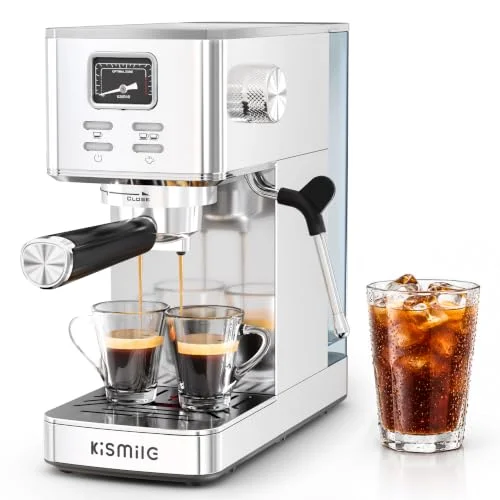
Kismile 20 Bar Espresso Machine with Milk Frother — $155.99 listing
Same stated spec set as the listing above — stainless steel, pressure gauge, 1.4L tank, hot water function, warming tray — at a higher price with no published feature difference.
$155.99 Check price →RIOSKY's PID + NTC control alongside its warming surface
The RIOSKY Compact Espresso Machine with Steam Wand (ASIN B0HHL5P32L, $109.99 as of 2026-10-20) pairs its warming tray with the one feature in this group that's a genuine step up from the entry tier: PID + NTC dual control. An NTC thermistor reads the boiler's actual temperature, and a PID loop uses that reading to hold brew temperature steady rather than letting it swing the way a basic on/off thermostat does. On a machine this size, that's the difference between a brew temperature that drifts shot to shot and one that's close to consistent — which matters more to how your espresso tastes than the tray on top does.
Put in context: the warming tray on the RIOSKY softens the first sip of your first cup. The PID + NTC control affects every shot you pull on the machine, because it's doing something about the temperature of the water hitting the puck, not the temperature of the cup catching the result. If you're weighing this machine against the Kismile listings or the NEWBULIG below, the dual temperature control is the spec worth paying attention to — the warming surface is a shared feature across all four and isn't what separates them.
RIOSKY's listing describes it as compact; we have no further dimensions to report, so if footprint matters, check the live listing before buying.
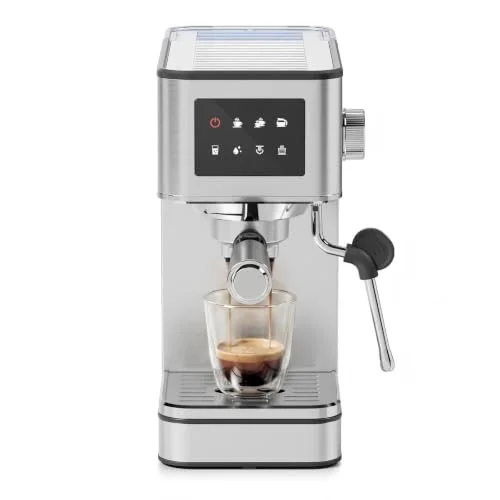
RIOSKY Compact Espresso Machine with Steam Wand
PID + NTC dual temperature control, steam wand, built-in warming tray, compact footprint. Price recorded in our database on 2026-10-20.
$109.99 Check price →NEWBULIG's dedicated warming zone at $109.24
Wait — our database lists the NEWBULIG Compact Expresso Coffee Machine (ASIN B0HHHLF5M9) at $109.24, recorded 2026-11-04. What distinguishes NEWBULIG's approach is the framing on the listing itself: rather than a generic flat top, it's described as a dedicated warming zone — language that suggests a bounded, purpose-built section of the top panel rather than the whole surface running warm incidentally. We have no measurements of that zone and no published temperature figure, so we can't tell you it runs hotter or warms faster than the Kismile or RIOSKY trays — only that NEWBULIG chose to call it out as a distinct feature rather than bundle it silently into the spec list.
On the rest of the sheet, NEWBULIG is a 20 Bar machine with a steam wand — the same basic architecture as the other three. At 11.74 inches deep, 6.01 inches wide and 11.23 inches tall, it's one of the narrower footprints in this group, which is worth knowing if counter space is tight. The steam wand puts it in the same "manual microfoam, do it yourself" category as the RIOSKY and both Kismile listings, rather than the automatic-frother category some pricier machines use.
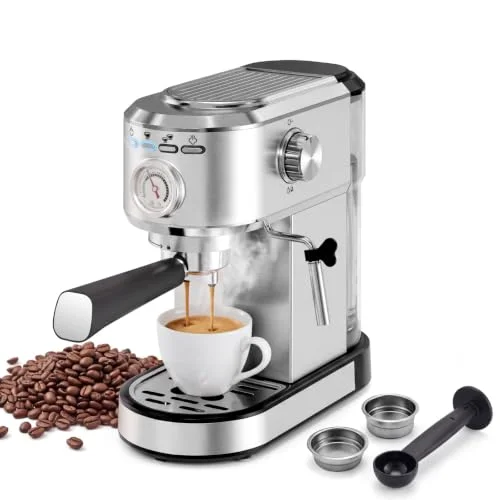
NEWBULIG Compact Expresso Coffee Machine
20 Bar pump, steam wand, dedicated cup warming zone on the top panel. 11.74"D x 6.01"W x 11.23"H. Price recorded in our database on 2026-11-04.
$109.24 Check price →How the four compare
Same category, same price band, same core promise — a warm top panel for your cup. Prices are the ones recorded in our database on the dates shown; confirm the live price before buying.
| Machine | Price | Date recorded | What sets it apart | |
|---|---|---|---|---|
| NEWBULIG Compact Expresso | $109.24 | 2026-11-04 | Dedicated warming zone, narrowest footprint | Price |
| RIOSKY Compact | $109.99 | 2026-10-20 | PID + NTC dual temperature control | Price |
| Kismile 20 Bar (lower-priced listing) | $79.99 | 2026-11-13 | Milk frother, pressure gauge, 1.4L tank | Price |
| Kismile 20 Bar (higher-priced listing) | $155.99 | n/a | Identical stated spec to the listing above, at a $57 premium | Price |
The picks
None of these four wins on the warming tray, because the tray is close to identical across all of them. They separate on what else is on the spec sheet.
Best overall: RIOSKY Compact Espresso Machine with Steam Wand — $109.99
PID + NTC dual control is the only feature in this comparison that changes something about every shot rather than just the first sip, and it comes in at the lowest price in the group alongside NEWBULIG. If you want the warming tray as a bonus on top of a machine that's trying to do something about brew-temperature consistency, this is the one.
Best value / narrowest footprint: NEWBULIG Compact Expresso Coffee Machine — $109.24
The cheapest of the four, the narrowest at 6.01 inches wide, and the only one that calls its warming surface a distinct "zone" rather than a flat afterthought. A reasonable pick if counter width is the binding constraint and you don't need the temperature-control story RIOSKY is telling.
If you want a milk frother bundled in: Kismile 20 Bar, the $79.99 listing
Of the two identical Kismile listings, buy the cheaper one. A built-in milk frother, pressure gauge and 1.4L tank at $79.99 is a reasonable value proposition on its own; paying $155.99 for the same stated spec sheet is not, unless the live listing shows you something we can't see from here.
Why a cold cup actually matters less than people assume for espresso specifically
This is the part worth being blunt about. Cup-warming culture comes largely from full-size drip coffee and from cappuccino service in cafés, where a 12-ounce mug of coffee sitting in a cold ceramic vessel for the length of a meal is a real, noticeable loss. Espresso is a different drink by volume and by occasion. A double shot is poured, consumed in a handful of sips, and finished — often inside the window where even an unwarmed cup hasn't dragged the temperature down to unpleasant yet. The entire drink exists for less time than it takes most drip coffee to go from "too hot" to "fine."
That's the honest reason a warming tray is a nice-to-have bundled onto a budget machine rather than a feature that should drive your buying decision: the problem it solves (a slightly cooler first sip from a cold cup) is smaller, for espresso specifically, than the problem people picture when they hear "warming tray" (a whole drink going cold while sitting out). If you're drinking milk-based drinks — a latte or cappuccino with several ounces of steamed milk added — the milk's own temperature and volume will do far more for how long the drink stays warm than whether the empty cup started at room temperature or slightly above it.
None of this is a knock on the four machines here. It's a reason not to let the warming tray be the deciding factor between them, or between them and a similarly priced machine that skips the tray entirely in favor of something else on the spec sheet.
Should you bother preheating a cup by hand on a machine without this feature?
If your machine doesn't have a warming tray, the low-effort version of the same benefit is running hot water from the steam wand or the brew head into the empty cup for a few seconds before pulling the shot, then tipping it out immediately before brewing into the warmed cup. It costs a few seconds and a small amount of water, and it gets you most of what a passive warming tray gets you — a cup that isn't actively pulling heat out of the shot in the first few seconds after pouring.
Whether it's worth doing is the same calculation as the tray itself: it improves the first sip, not the fifth-minute temperature. If you drink your espresso fast, in a small cup, right after pulling it, you probably won't notice the difference either way. If you tend to let it sit on the counter while you steam milk or deal with something else, neither hand-preheating nor a warming tray solves that — the fix there is pulling the shot after the milk is ready, not before.
The one thing worth remembering
A warming tray is riding on heat the machine was already generating. It costs the manufacturer very little to add, which is exactly why you'll find it on four budget machines between $79.99 and $155.99 rather than reserved for anything premium. Treat it as a pleasant extra on a machine you're buying for its pump, its steam wand and — on the RIOSKY — its temperature control, not as the reason to choose one machine over another.
How we compared these
We compare published specifications, listing prices on the dates noted above, and manufacturer-stated feature descriptions — we don't physically test these machines, we don't run a testing lab, and we don't publish star ratings or review counts we can't verify. Where a listing describes a feature (RIOSKY's "PID + NTC dual control," NEWBULIG's "dedicated warming zone") we report the manufacturer's own framing rather than paraphrasing a sentiment we have no data for. The general thermodynamics here — that a thin layer of liquid in a wide cup loses heat quickly, that passive conduction from a warm panel is weaker than active heating — are standard physics rather than claims about any specific product, and we've marked them as such throughout. Where we say the tray "matters less" for espresso, that's our own editorial read of the mechanism, stated plainly so you can weigh it yourself.
Frequently asked questions
Does a cup warming tray actually keep espresso hot longer?
Not by much. The tray warms the empty cup before you pour, which reduces how much heat the shot loses to the cup walls in the first few seconds — it doesn't add heat to the espresso itself or meaningfully extend how long the finished drink stays hot. A double shot's small volume and wide surface area mean it loses most of its heat to the room within a few minutes regardless of the cup's starting temperature.
Why are the two Kismile 20 Bar listings priced $57 apart?
We don't know, based on the information available to us. Both listings describe the same stainless-steel build, pressure gauge, 1.4L water tank, hot water function and warming tray, in silver, with no stated spec difference between the $79.99 and $155.99 versions. If you're choosing between them, check the live listing for anything that's changed since this was recorded, since nothing in the published spec sheet justifies the gap.
Is RIOSKY's PID + NTC control better than a basic thermostat?
An NTC thermistor gives the machine a direct, continuous read of the boiler's actual temperature, and a PID control loop uses that reading to hold brew temperature steady rather than letting it swing between an on and off threshold the way simpler thermostats do. That generally produces more consistent shot-to-shot brew temperatures than a basic on/off system, which is a meaningful feature at this price point — more consequential to the final cup than the warming tray shared across all four machines here.
Should I preheat my cup if my espresso machine doesn't have a warming tray?
You can run hot water from the steam wand or brew head into the cup for a few seconds, then empty it right before pulling the shot — this gets you most of the same benefit as a passive warming tray, at the cost of a few seconds and a small amount of water. It helps the first sip taste warmer; it won't stop the drink from cooling if you let it sit on the counter for several minutes afterward.