Rancilio Silvia Pro X vs Diletta Alto: Two Prosumer Dual Boilers Over $2,000
Both machines are dual boiler and PID controlled, which is the line that separates near-commercial home espresso from everything below it. The Rancilio Silvia Pro X costs $2,195.00. The Diletta Alto costs $2,399.00 and names a shot timer and an adjustable OPV that the Rancilio listing does not mention. That is a $604.00 gap, and it does not buy what you might assume.
Reader-supported: we may earn a commission if you buy through our links, at no extra cost to you. Prices are the ones in our database as of November 3, 2026 and move constantly — confirm the live price on each listing before you buy.
The short answer
Buy the Diletta Alto at $2,399.00 if a shot timer and a user-adjustable OPV are things you will actually use — they are named features on this listing, and they are not named anywhere on the Rancilio listing. Buy the Rancilio Silvia Pro X (Mid-Size) at $2,195.00 if you want the lower of these two prosumer prices and you are comfortable timing shots yourself and living with the factory-set pressure relief.
Both machines are dual boiler and PID controlled, which already puts this pair in a different conversation than almost anything most buyers consider. The $604.00 difference between them is not a markup on the same machine wearing a different badge — it tracks to two specific, named control features on one listing that the other listing simply does not claim. Nothing else here is implied, and where a listing is silent we are going to say so rather than guess.
What "prosumer dual boiler" means above $2,000
"Dual boiler" used to be shorthand for a serious machine. It no longer works that way on its own. Our look at the Kismile single boiler versus dual boiler pair shows a dual-boiler machine selling for $589.99 — a real second boiler, running brew and steam at independent temperatures, for a fraction of what either machine here costs. So if two dedicated boilers were the whole story, this comparison would not exist: you could stop at $590 and call it solved.
It is not the whole story. What separates a $589.99 dual boiler from a $2,195.00-to-$2,399.00 one is everything wrapped around those two boilers rather than the boiler count itself: how tightly the PID loop actually holds temperature under repeated draws, whether the pump and plumbing are sized for back-to-back shots rather than occasional ones, and whether the controls in front of you are built for someone pulling several drinks a day, every day, rather than one cappuccino on a Saturday. That is also the gap between this pair and the $250-to-$350 tier we cover elsewhere on this site — a tier that is a perfectly capable home setup, just not built around daily, near-commercial-pace use the way these two are.
Both the Rancilio Silvia Pro X and the Diletta Alto sit above that line. Neither listing states a duty-cycle rating or a shots-per-hour figure, so we are not going to invent one — but the price bracket itself, dual boiler plus PID at over $2,000, is the signal that both machines are built for sustained daily use rather than for the occasional cup.
PID control: the same acronym, not the same system
A PID controller — proportional-integral-derivative, if you want the full name — reads the boiler's temperature continuously and adjusts the heating element in small, constant corrections rather than switching it fully on and fully off the way a basic thermostat does. The practical effect is a temperature band that holds much tighter around its target, shot after shot, instead of swinging a few degrees up and down as a thermostat cycles. That is true of PID control in general, independent of brand, and it is why "PID controlled" shows up as a selling point across this entire price tier.
Both machines in this comparison are PID controlled and dual boiler. That much is settled and it is the reason they belong in the same article rather than two different ones. Where the listings actually pull apart is not whether a PID chip is present — both say yes — but what you can see and adjust once the machine is running. Neither listing details the display type, the number of stored temperature profiles, or whether brew and steam temperatures are independently programmable beyond their factory defaults, so we are not going to assert a difference that is not stated. What is stated is the next section, and it is where the real daylight between these two machines actually shows up.
The shot timer and adjustable OPV, and what Rancilio asks you to do instead
The Diletta Alto's listing names two specific control features: a shot timer and an adjustable OPV. Neither appears on the Rancilio Silvia Pro X listing. That is the single most concrete, named difference between these two machines, so it is worth being precise about what each one actually does.
A shot timer counts the pull as it happens, which matters because espresso extraction is judged partly by how long it runs — a double shot conventionally lands somewhere in the 25-to-30-second range, and knowing your actual time without reaching for a phone or counting under your breath is one less variable between you and a repeatable cup. On a machine without a built-in timer, that job falls to you: a phone, a kitchen timer, or watching the stream and trusting your sense of pace. It works, and plenty of serious home baristas do exactly that, but it is manual where the Diletta's is not.
An OPV — an over-pressure valve — caps the maximum pressure the pump actually delivers to the group, independent of how hard the pump itself can push. Across the category, factory OPV settings commonly sit near the roughly 9 bar that espresso brews at, and "adjustable" on a listing means that ceiling is something you, or a technician you hire, can change without a full teardown of the machine. The Diletta's listing claims that access point by name. The Rancilio's listing does not, and we have no information on whether its OPV is user-accessible, factory-sealed, or something in between — so we are not going to tell you it is either. What we can tell you is the practical result: on the Rancilio, you work within whatever pressure ceiling the machine ships with, and changing it, if it is even possible, is not something the listing promises you.
Build quality and group head mass: what the spec sheet undersells
A meaningful share of what separates machines in this bracket from the tier just below it never shows up as a line on a listing at all. Thermal mass in the brew group — literally how much metal is sitting at brew temperature around the portafilter — affects how well a machine holds its temperature through a shot and recovers for the next one. A heavier, denser group head acts as its own heat reservoir on top of whatever the boiler and PID are doing; a lighter one leans on the boiler alone to keep up. Neither effect is something either listing quantifies.
That is deliberate honesty, not an evasive dodge: neither the Rancilio Silvia Pro X listing nor the Diletta Alto listing states a machine weight, a group head material, or a brew-group mass figure. We are not going to assign either machine an advantage on a dimension that is invisible from here. What we can say is that this is exactly the kind of detail a spec sheet systematically undersells across the whole category, this pair included — it is felt in day-to-day use rather than read off a page, and it is a legitimate reason to read owner discussion on the specific listing, where people describe how a machine behaves across a run of shots, rather than to rely on either title alone.
Fit and finish sit in the same blind spot. "Black" is the stated finish on both machines, and beyond that we have no documented information on panel material, control layout, or drip-tray capacity for either unit — so none of that factors into this comparison, and it should not factor into your decision unless you confirm it on the listing yourself.
The picks
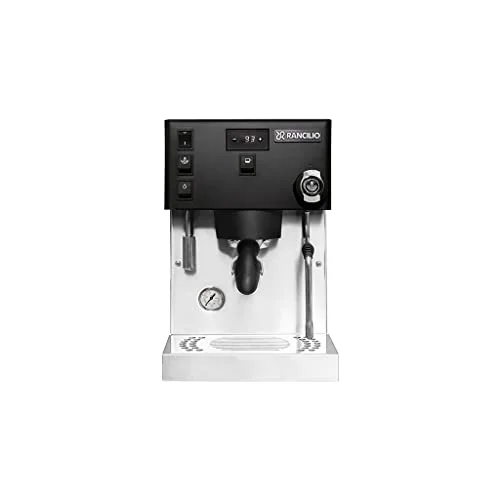
Rancilio Silvia Pro X (Mid-Size), Black
Dual boiler, PID controlled, at the lower of these two prosumer prices. The listing does not name a shot timer or an adjustable OPV, so both are on you to handle manually. The pick if the $604.00 saved matters more than either named control feature.
$2,195.00 Check price →This is the machine for someone who already knows how to time a shot by feel, who is comfortable working within whatever pressure ceiling the unit ships with, and who wants the dual-boiler, PID-controlled tier at the lower of these two entry points. It asks more of you than the Diletta does on two specific points and gives back $604.00 for the trade.
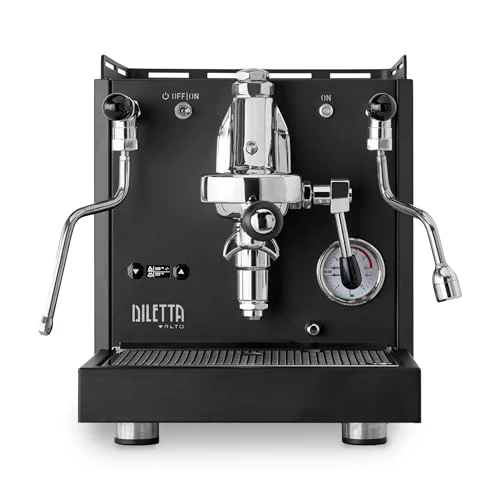
Diletta Alto (Without Flow Control), Black
Dual boiler, PID controlled, with a shot timer and an adjustable OPV named directly on the listing — the two features missing from the Rancilio's page. This specific listing is the variant without flow control, worth noting since Diletta sells more than one configuration.
$2,399.00 Check price →This is the machine for someone who wants the timer and the pressure-relief access documented rather than assumed, and who is willing to pay $604.00 for having both named on the page instead of having to work around their absence. It is also worth confirming on the listing that "without flow control" is the configuration you want before buying, since the same machine is sold in at least one other form.
Side by side
Prices are the ones in our database as of November 3, 2026. Blanks are left blank where a listing does not state the feature — not filled in with a guess.
| Machine | Boiler | PID | Shot timer | Adjustable OPV | Price | |
|---|---|---|---|---|---|---|
| Rancilio Silvia Pro X, Mid-Size | Dual | Yes | Not stated | Not stated | $2,195.00 | Price |
| Diletta Alto, Without Flow Control | Dual | Yes | Yes | Yes | $2,399.00 | Price |
Who should actually spend this much on a home machine
This tier makes the most sense for someone who already owns, and has outgrown, a single-boiler or heat-exchanger machine — someone who knows from experience that waiting for a boiler to retarget between a shot and a milk drink is the specific friction they are paying to remove, not a hypothetical one. It also fits a household making several espresso drinks back-to-back most mornings, where a dedicated steam boiler and a PID loop built to hold up under repeated draws are doing daily work rather than sitting mostly idle.
It makes much less sense for someone pulling one or two shots on weekend mornings. The structural advantages of this bracket — sustained temperature stability across a run of shots, simultaneous brew and steam, and in the Diletta's case, a documented shot timer and adjustable OPV — are advantages that compound with frequency of use. At occasional use, a CASABREWS-tier machine or something in the Philips 2200-to-2300 Series range delivers a genuinely good cup without asking you to justify $2,195.00 or more sitting mostly idle between weekends.
Between the two machines here specifically, the decision reduces to the two named features. If you have ever wished a machine would just tell you how long a shot has run, or wanted to adjust pressure relief yourself instead of sending the machine out for service, that is worth $604.00 to you and the Diletta Alto is the pick. If neither of those has ever bothered you in practice, the Rancilio Silvia Pro X gets you the same dual-boiler, PID-controlled foundation for less. Our note on what naming a pump brand actually tells you makes a related point from a different angle: a named spec is worth something specific, not a blanket assurance of quality, and that applies just as much to a shot timer or an OPV as it does to a pump.
One thing not to assume
Do not assume the cheaper machine here is simply the pricier one with two features removed and nothing else changed. We have no information suggesting the Rancilio Silvia Pro X is a stripped-down Diletta Alto, or vice versa — they are two different manufacturers' machines that happen to share a dual-boiler, PID-controlled category and a price bracket. Compare them on what each listing actually states, not on an assumption that one is a subset of the other.
How we compared these
We compared the Rancilio Silvia Pro X and Diletta Alto listings on what each one states — boiler configuration, PID control, named control features and live pricing — and we treated an unstated feature as an absence of information, not as proof that the feature is missing. Where a listing names something specific, like the Diletta's shot timer or adjustable OPV, we explained what that feature generally does in this category without inventing a number, a setting, or a spec that is not on the page.
We do not physically test these machines, we do not run a testing lab, and we do not publish ratings we cannot verify. Amazon's product data returns no rating and no review count for either machine, so there are no stars and no invented scores anywhere on this page — only what each listing states, general espresso-machine mechanics that apply across the category, and our own labeled judgment where a call is a trade-off rather than a fact.
Frequently asked questions
Are both the Rancilio Silvia Pro X and the Diletta Alto dual boiler machines?
Yes. Both listings describe a dual-boiler, PID-controlled design, which means brewing and steaming each run off their own dedicated boiler rather than switching one boiler between the two jobs. That shared foundation is what puts both machines in the same near-commercial tier despite the $604.00 price gap between them.
What does the Diletta Alto's adjustable OPV let you do that the Rancilio listing doesn't mention?
An OPV, or over-pressure valve, caps the maximum pressure the pump delivers to the group. "Adjustable" on the Diletta's listing means that ceiling can be changed by the owner or a technician without a full teardown. The Rancilio Silvia Pro X listing does not name an adjustable OPV, so we have no information on whether its pressure ceiling is user-accessible at all.
Does the higher price always mean better build quality in this tier?
Not necessarily, and we would not claim that from a listing alone. Neither the Rancilio nor the Diletta listing states a machine weight, group head material, or brew-group mass — the details that most affect how a machine behaves across a run of shots. The $604.00 gap here tracks to two named control features, the shot timer and the adjustable OPV, not to a documented build-quality difference.
Who should actually spend $2,195 to $2,799 on a home espresso machine?
Someone making several espresso drinks a day, most days, who has already felt the limits of a single-boiler or heat-exchanger machine and wants simultaneous brewing and steaming built on a PID-controlled foundation. For occasional weekend use, the structural advantages of this tier compound far less, and a machine well under $1,000 will usually serve that routine just as well.