Quick answer
All three machines here grind beans into the brew, so none of them force you onto pre-ground coffee — that much is true at every price point in this bracket. Where they split is pump pressure, boiler count and what the manufacturer is willing to call out by name. The Electactic 20 Bar Espresso Machine with Built-in Anti-Clog Coffee Grinder at $144.34 is the one we'd start with: a 20-bar pump that comfortably clears the roughly 9 bar espresso actually brews at, plus a grinder the listing specifically markets against jamming. If you can stretch to $148.99, the JustSmart Deluxe Espresso Machine with Double Boiler, Built-in Burr Grinder adds a second boiler — a feature that normally doesn't show up until well past $300. The Reemix 6 Bar Espresso Machine with Built-in Conical Burr Grinder at $79.99 is the floor of this category, and its own name tells you the catch: a 6-bar pump, which is below the pressure espresso needs to brew at all.
Why there are no star ratings on this page
Amazon's product data returns no rating and no review count for any machine named in this guide, so we don't print one and we don't paraphrase review sentiment we can't verify. Every claim below traces back to a published spec, a price, or a general coffee fact that holds regardless of brand.
Things to know before you buy
- Espresso brews at roughly 9 bar of pressure at the coffee puck. A pump rated above that number has headroom to spare; a pump rated below it — like the Reemix's 6 bar — structurally cannot reach brewing pressure, no matter how good the grinder sitting on top of it is.
- None of the three listings in this guide states a specific grind-settings count. That's a real gap in the published spec, not an oversight on our part, and we'd rather flag it than invent a number.
- A second boiler, like JustSmart's, means the brew side and the steam side can be ready at the same time instead of one waiting on the other — a feature that typically starts appearing well above $300.
- Every grinder jams eventually; the question worth asking before you buy is whether the listing says anything about preventing it, which is exactly what sets Electactic's name apart from the other two.
- Where a listing doesn't publish a spec — wattage, tank size, hopper capacity — we leave it out below rather than guess at it.
Why you should trust this guide
We do not physically test these machines and we do not run a testing lab. We compare what's published for each product — pump pressure, boiler count, grinder description and price — against general, well-established facts about how espresso extracts, and we say so explicitly whenever a listing leaves a detail unstated rather than filling the gap with a guess. Ilane Tall has covered the home-espresso category on this site since it launched, and this guide is built the way every guide here is: from spec sheets and current prices, not a taste panel we don't have. Our guide to bean hopper capacity covers the grinder side of this bracket from a different angle if hopper size is your main concern.
What a sub-$150 grinder can't do that a $300 one can
Dropping below $150 doesn't remove the grinder — all three machines here have one — but it removes almost everything around the grinder that makes it easy to use well. A $300 bean-to-cup machine typically publishes a grind-settings count you can compare against competitors and states its hopper capacity so you know how much coffee is going stale on the counter. None of the three machines in this guide state a grind-settings count, which is the clearest marker of the gap: a $300 machine wants you to know exactly how fine an adjustment you're making, and a sub-$150 one generally doesn't say.
Pump pressure is the sharper version of the same story. Marketing around "bar" ratings is misleading at every price tier — a 20-bar pump is quoting its maximum, not the roughly 9 bar at which espresso actually brews, and everything above 9 changes nothing in the cup. But a pump rated below 9 bar is a different problem entirely: it isn't marketing inflation, it's a structural ceiling. The Reemix's own name states a 6-bar rating, and 6 is short of 9 — the brewing side can't finish what the grinder started, the opposite failure from what most "20 bar" skepticism is usually about.
Accessory kits are the other place the gap shows. None of the three listings here mention a dose-trimming tool, a dedicated tamper, or multiple basket sizes — standard on $300-plus bean-to-cup machines. That's not a defect; it's where the savings came from. If a feature isn't named in a listing at this price, assume it isn't included rather than that the manufacturer forgot to mention it.
Fixed settings, adjustable settings, and what none of these three will tell you
A grind-settings count matters more for espresso than for any other brew method, because the workable window between a sour, under-extracted shot and a bitter, over-extracted one is often a click or two wide on a home grinder. Machines that publish a high settings count — 30, 44, sometimes more — are telling you how finely they can search that window. The honest answer for all three machines in this guide is that none of them say. Their names describe the grinder type — "conical burr," "anti-clog," "burr grinder" — but not how many stops sit between coarsest and finest, or whether the dial is continuously variable or locked to a handful of presets.
That's worth treating as information in itself. On the two machines whose names do give us a number to compare — pump pressure — the split is stark: the Reemix states 6 bar, well under brewing pressure, while the Electactic states 20 bar, comfortably over it. The JustSmart's name doesn't give a bar rating at all, which fits the same pattern: the fewer numbers a listing publishes, the more worth checking the current listing page before buying, since a product name alone won't tell you what you need to know.
Practically, grind adjustability is the one spec in this guide we won't claim either way. If fine-grained control matters most to you, check the live listing for a stated settings count rather than assuming from the name — the same gap our guide to built-in scales runs into from the dosing side.
Electactic's anti-clog claim, and what clogging actually looks like
The Electactic is the only one of the three that names a specific grinder problem it claims to solve: its full listed name is the "Electactic 20 Bar Espresso Machine with Built-in Anti-Clog Coffee Grinder," and "anti-clog" is doing real marketing work there, not decoration. Clogging in a small home grinder isn't abstract — it's grounds building up in the chute between the burrs and the portafilter until the flow narrows or stops, usually because the grind is too fine for the chute's geometry, or because humidity has made the grounds clump instead of falling freely. When it happens, you hear the grinder running, but little or no coffee reaches the basket, and what did land often sits in an uneven pile instead of a level bed.
An uneven bed matters for the shot itself, not just the mess. Espresso extraction depends on water finding roughly equal resistance across the whole puck; a lopsided dose from a partial clog gives water a path of least resistance straight through the thin side, and the shot runs fast and sour even though the grind setting was correct. So "anti-clog" isn't a nice-to-have convenience claim — if it works as named, it's solving a problem that would otherwise show up as a bad-tasting shot, not just a dirty counter. The listing doesn't specify the mechanism behind the claim, but it's naming a real, specific failure mode rather than a vague "premium grinder" line — a point in the Electactic's favor relative to the other two, whose names make no equivalent claim either way. For how Electactic handles the same problem elsewhere in its lineup, see our comparison of Electactic's espresso machines.
JustSmart's double boiler: the one feature that justifies the top of this range
At $148.99, the JustSmart Deluxe Espresso Machine with Double Boiler, Built-in Burr Grinder costs almost twice the Reemix and about $22 more than the Electactic — and the reason to pay it is right in the name. A double boiler means two separate heating chambers: one dedicated to brewing water, one dedicated to steam. On a single-boiler machine, those two jobs compete for the same tank, so pulling a shot and then steaming milk usually means waiting for the machine to reheat between the two, or accepting that one won't be at its ideal temperature. A second boiler removes that wait: the brew side sits at brewing temperature while the steam side independently reaches steaming temperature, so a flat white doesn't turn into a timing exercise.
This is genuinely rare below $300 — most machines in that range use a single boiler with a thermocoil or fast-reheat system to fake the same convenience, and true dual-boiler machines are usually reserved for prosumer-tier equipment. Finding "double boiler" on a sub-$150 listing is unusual enough to call it the single biggest differentiator in this guide. Our look at automatic grinding versus a dedicated dual boiler covers how the feature behaves once you're spending over $1,000 instead of under $150. The caveat: the JustSmart's listing doesn't state a pump pressure, wattage or tank size, so we can't confirm the rest of the machine backs up that one headline feature. Judge it as the best milk workflow in this bracket, not the best machine on every spec.
JustSmart Deluxe Espresso Machine with Double Boiler
The only machine in this guide with two separate boilers — one for brewing, one for steam — so milk and espresso don't have to wait on each other. Built-in burr grinder included. A semi-automatic machine, per the listing.
$148.99 Check price →
The picks
Three machines, ordered by who each is for rather than strictly by price. Every spec below comes from the product listing name; where a listing doesn't state something, we've left it out rather than guessed.
01Best overall under $150
Electactic 20 Bar Espresso Machine with Built-in Anti-Clog Coffee Grinder
A pump with headroom and a grinder that names its own failure mode
20-bar pump · built-in anti-clog coffee grinder · $144.34
The only machine in this guide that pairs a pump comfortably above brewing pressure with a grinder whose own name promises to solve a specific, real problem — clogging — rather than making a vague quality claim. At $144.34 it sits in the middle of this bracket on price while leading it on what's actually stated in the listing.
The trade-offThe listing doesn't state a grind-settings count, tank size or wattage, so you're trusting the anti-clog claim without a way to verify the mechanism behind it.
02Best for milk
JustSmart Deluxe Espresso Machine with Double Boiler, Built-in Burr Grinder
The only dual-boiler machine under $150 in our database
Semi-automatic · double boiler · built-in burr grinder · $148.99
A second, dedicated steam boiler is the single rarest feature at this price, and it's the reason to spend the extra $22 over the Electactic: brewing and steaming no longer compete for the same heating element, so back-to-back milk drinks don't mean waiting on the machine to catch up.
The trade-offIt's the most expensive machine in this guide and the listing is the least specific of the three on everything except the boiler — no stated pump pressure, wattage or tank size.
03Cheapest way in
Reemix 6 Bar Espresso Machine with Built-in Conical Burr Grinder
The floor of this category, with a floor-level pump to match
6-bar pump · built-in conical burr grinder · $79.99
The cheapest machine in this guide, and the only one whose own name states a pump pressure below the roughly 9 bar espresso brews at. The conical burr grinder is a real, named feature — it just isn't paired with a pump that can finish the job the grinder starts.
The trade-offA 6-bar pump is structurally under brewing pressure, not just under-rated by marketing standards. Treat this as an entry-level grinder-equipped drip-adjacent machine rather than a true espresso setup, and confirm the current bar rating on the live listing before buying.
How the three compare
Same three machines, side by side. Pump pressure and price are what each listing states — confirm the live price before buying.
| Machine | Pump | Named grinder feature | Price | |
|---|
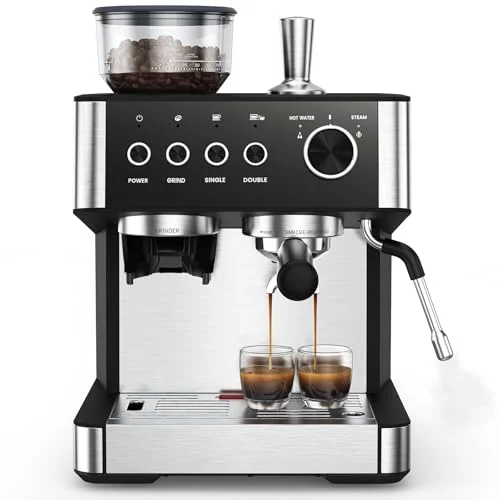 Electactic with Anti-Clog Grinder | 20 bar | Anti-clog | $144.34 | Price |
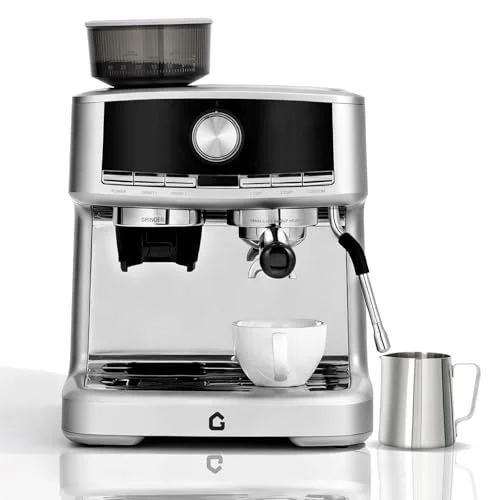 JustSmart Deluxe Double Boiler | Not stated | Burr grinder | $148.99 | Price |
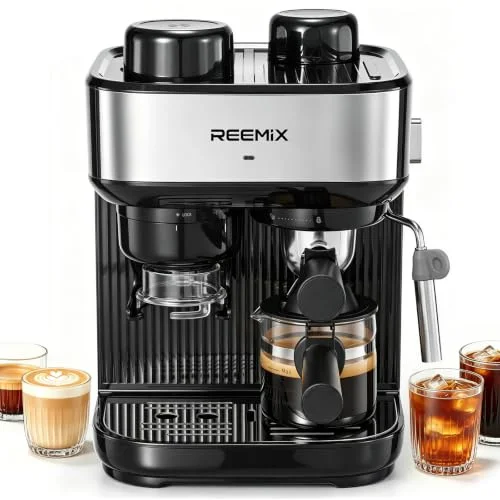 Reemix with Conical Burr Grinder | 6 bar | Conical burr | $79.99 | Price |
Built-in grinder versus a $50 hand grinder
A fair question at this end of the market is whether a built-in grinder this cheap is actually better than skipping the integration and pairing a plain pump machine with a separate hand grinder in the roughly $40–100 range — a general category estimate, not a specific product we track here. It depends which you're optimizing for: convenience, or grind quality.
On convenience, the built-in route wins outright. Grinding into the portafilter in one motion, with no funnel, no second appliance and no counter choreography, is exactly the friction a hand grinder reintroduces — and at 6:45 on a weekday, that friction is often the difference between making espresso and reaching for instant coffee instead.
On grind quality, the comparison is closer than the price gap suggests, and sometimes favors the hand grinder. With no motor to pay for, a hand grinder's money goes entirely into the burrs, the shaft and the bearing that keeps them aligned — and burr quality plus alignment is most of what grind consistency depends on. None of the three listings here state a settings count, which, as covered above, makes it impossible to confirm how finely any of them can be dialed in; a hand grinder's single adjustment ring is at least a known, inspectable mechanism.
The Electactic's anti-clog claim is solving a problem a hand grinder doesn't have in the same form — it clogs differently, by seizing under too fine a grind, not by jamming a chute — so swapping to a hand grinder trades one failure mode for another, not for none. On the Reemix, the comparison tilts harder toward splitting the two: no grinder fixes a 6-bar pump that can't reach brewing pressure, so the money saved choosing Reemix over Electactic doesn't buy a comparable espresso machine, just a comparable grinder bolted to a weaker one. If you want the strongest grind-quality floor and don't mind two appliances, a budget pump machine plus a hand grinder is defensible; if you want the fewest moving parts, the Electactic or JustSmart is the better $127–150 spend.
How we compared
We compare published specifications — pump pressure, boiler count, grinder description and price — against general, well-established espresso facts, and we read marketing language skeptically: a stated "bar" number only tells you something once you know whether it's above or below the roughly 9 bar espresso actually brews at. We do not physically test these machines, we do not run a testing lab, and we do not publish ratings we cannot verify: Amazon's product data returns no rating and no review count for any machine named here, so there are no stars and no invented scores anywhere on this page. Where a claim is a judgment rather than a specification — that the Electactic is the strongest overall pick, that a hand grinder can rival a sub-$150 built-in one — we've said so in our own voice, so you can weigh it yourself. Specs that would normally appear in a comparison like this — settings count, wattage, tank size — simply aren't published for these three listings, and we've said so rather than filled the gap with a guess.
Frequently Asked Questions
Can a machine under $150 with a built-in grinder actually make real espresso?
It depends on the pump, not the grinder. Espresso brews at roughly 9 bar of pressure at the coffee puck, and a grinder can't compensate for a pump that can't reach that number. The Electactic's stated 20-bar pump clears it comfortably; the Reemix's stated 6-bar pump does not, regardless of how good its conical burr grinder is.
Why does the Reemix list a 6 bar pump when most espresso machines advertise 15 or 20?
We can't say why the manufacturer chose that number, only what it means: it's below the roughly 9 bar needed to brew true espresso. Most machines that advertise 15 or 20 bar are quoting the pump's maximum rating, which is typically well above brewing pressure and therefore irrelevant to the cup. A 6-bar rating is the opposite problem — a ceiling that sits below what's needed, not above it.
What does Electactic's "anti-clog" grinder actually prevent?
Clogging in a small home grinder means grounds backing up in the chute between the burrs and the portafilter, usually from a too-fine grind or clumped, humid coffee — the result is an uneven dose and a shot that runs fast and sour from the thin side of the bed. The listing names this specific problem but doesn't state the mechanism it uses to prevent it.
Is JustSmart's double boiler worth $148.99 instead of $79.99 for the Reemix?
If your priority is milk drinks, yes: a second boiler lets the brew and steam sides reach their own temperatures independently, which is normally a feature reserved for machines well above $300. But the JustSmart's listing doesn't state a pump pressure, so weigh the double boiler against the fact that the rest of the spec sheet is less documented than the Electactic's.
Keep reading