Legacy Brand or Direct-to-Consumer: What You're Really Paying For
A Breville or a De'Longhi almost always costs more than a newer, direct-to-consumer machine with a similar spec sheet. Sometimes that premium buys a real feature. Sometimes it buys a logo. We matched four machines on paper — specs against specs, not brand against brand — to see which is which.
Reader-supported: we may earn a commission if you buy through our links, at no extra cost to you. Prices below are the ones we recorded between September 15 and October 17, 2026, and they move constantly — confirm the live price before buying.
The short answer
Match the specs first, and the brand premium gets much easier to see for what it is. Of the four machines in this comparison, two pairs land close enough in price or in features that the difference is almost entirely the name on the front: a De'Longhi Classic Espresso Machine with Milk Frother at $179.95 sits one nickel from an AMZCHEF Espresso Machine with Grinder at $179.99, and a Breville BES500BSS Bambino Plus at $499.95 costs $209.96 more than a Gevi 20 Bar Espresso Machine with Grinder & Steam Wand at $289.99.
Neither premium is nonsense, and neither is fully justified either. The De'Longhi name buys you a company that has made espresso machines since the 1970s and a dense service network; it does not, on the spec sheet we have, buy you a built-in grinder, which the AMZCHEF includes at effectively the same price. The Breville name buys you Breville's own automatic milk-texturing system on the Bambino Plus, a real and specific feature difference; it does not buy you a grinder or a steam wand, both of which the cheaper Gevi includes. Read on for the pairing, spec by spec, and then the picks.
Matching specs, not logos
The instinct in espresso-machine shopping is to compare brands: Breville versus Gevi, De'Longhi versus AMZCHEF, as though the name were the variable that matters. It mostly is not. A pump is a pump, a tank is a tank, and a grinder either exists on a given machine or it does not — the brand on the housing changes none of that.
So instead of ranking these four machines against each other in one list, we paired them by what's actually comparable: price-for-price and feature-for-feature. That produces two pairs that happen to split cleanly along the legacy-versus-DTC line.
Pair one is priced almost identically: the De'Longhi Classic Espresso Machine with Milk Frother at $179.95 against the AMZCHEF Espresso Machine with Grinder at $179.99 — four cents apart. Pair two is priced apart by $209.96 but overlaps on features: the Breville Bambino Plus at $499.95 against the Gevi 20 Bar Espresso Machine with Grinder & Steam Wand at $289.99. Lay each pair's confirmed specs next to each other and the premium — or the lack of one — becomes a number, not a feeling.
One housekeeping note before the pairing: we are comparing what each manufacturer states in the product listing rather than running the machines ourselves. We don't run a testing lab, and every spec below is either in the product name or the listed size/variant data — nothing here is estimated or inferred from the brand's general reputation.
The $180 pair: De'Longhi Classic vs. AMZCHEF
At $179.95 and $179.99, this is the cleanest same-price comparison on the page, and it is also the one where the legacy brand's spec sheet is thinnest. The De'Longhi Classic Espresso Machine, Milk Frother, Stainless Steel is sold with a milk frother included, in a stainless finish — a clear, no-frills entry point from a company whose name recognition in espresso predates the direct-to-consumer category entirely. We don't have a published grinder, tank size or wattage figure for this listing, so we won't assert one; what we can confirm is the price, the stainless build and the included frother.
The AMZCHEF Espresso Machine with Grinder, Latte & Cappuccino for Home Use ships with a built-in grinder and a 61-ounce water tank — both confirmed in the listing — for four cents more. That is the entire comparison in one sentence: at the same price, one machine grinds your beans and the other does not. If you already own a decent burr grinder, the De'Longhi may still be the simpler, more recognizable buy. If you don't, the AMZCHEF's included grinder is real money you'd otherwise spend separately, and our look at matched grinder-and-machine bundles walks through why a built-in grinder at this price point is usually worth more than its line item suggests.
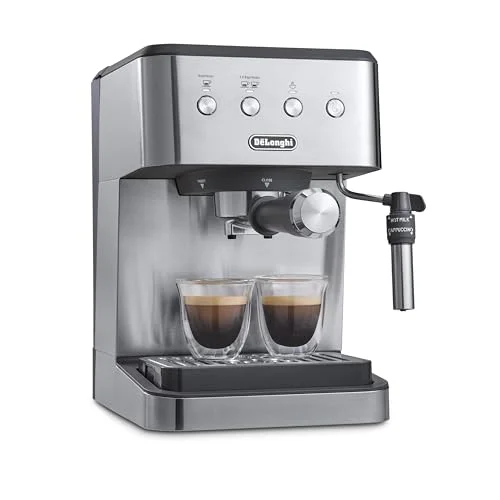
De'Longhi Classic Espresso Machine, Milk Frother, Stainless Steel
The legacy half of the $180 pair. Stainless-steel build, milk frother included. No built-in grinder is listed for this model, so plan on grinding separately or buying pre-ground.
$179.95 Check price →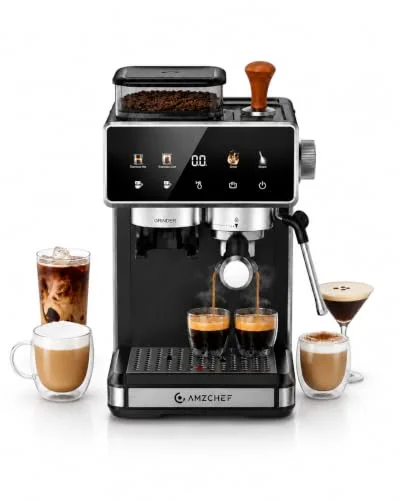
AMZCHEF Espresso Machine with Grinder
The DTC half of the $180 pair. Built-in grinder and a 61-ounce tank, confirmed in the listing, for four cents more than the De'Longhi above.
$179.99 Check price →The $290-to-$500 pair: Gevi vs. Breville Bambino Plus
This pair is not priced the same, so the question changes from "which costs more for the same thing" to "what does the extra $209.96 actually buy." The Gevi 20 Bar Espresso Machine with Grinder & Steam Wand is $289.99 and lists a built-in grinder and a steam wand directly in the product name, plus a measured footprint of 11.5"W by 12.01"D by 16.53"H — a figure worth checking against your counter and cabinet before you buy, which our guide to espresso machine height and cabinet clearance covers in more detail, since 16.53 inches is tall enough to matter under a shelf.
The Breville BES500BSS Bambino Plus is $499.95, and its listing carries no grinder and no stand-alone steam-wand callout in the name — Breville sells the Bambino line specifically on automatic milk texturing rather than on a manual steam wand or an on-board grinder. That is a genuine, confirmed point of difference rather than a brand assumption: the Bambino Plus and the standard Bambino are both built around Breville's automatic milk system, which is the feature the line is named and marketed for, and neither includes a built-in grinder. So the $209.96 gap here is not paying for a feature the Gevi also has; it's paying for a different feature entirely, plus the name.
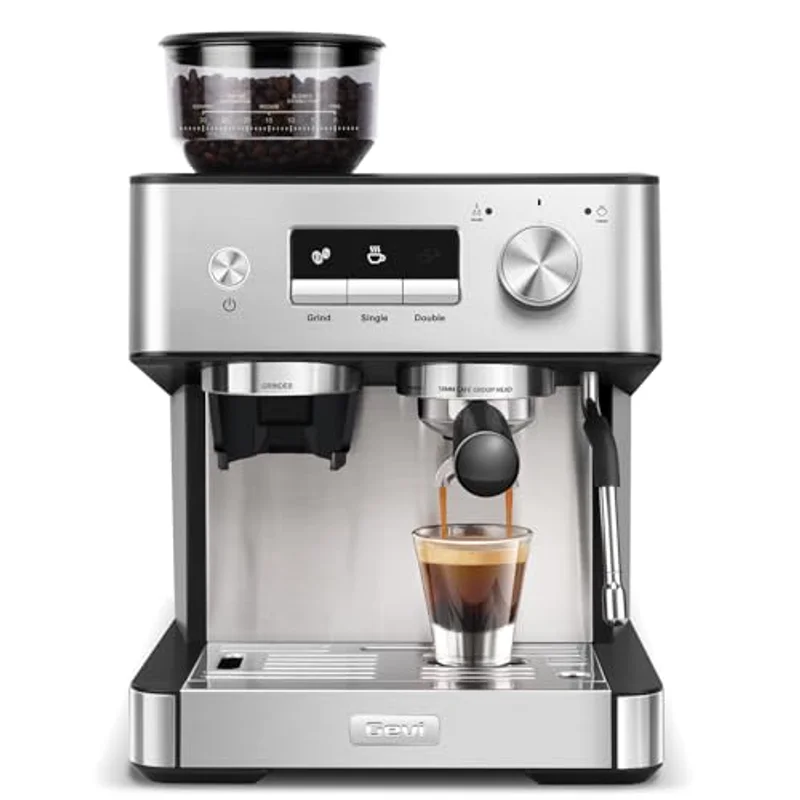
Gevi 20 Bar Espresso Machine with Grinder & Steam Wand
The DTC half of the higher-price pair. Built-in grinder and a steam wand, both named in the listing, 20-bar pump, and a measured 11.5"W x 12.01"D x 16.53"H footprint, for $209.96 less than the Bambino Plus below.
$289.99 Check price →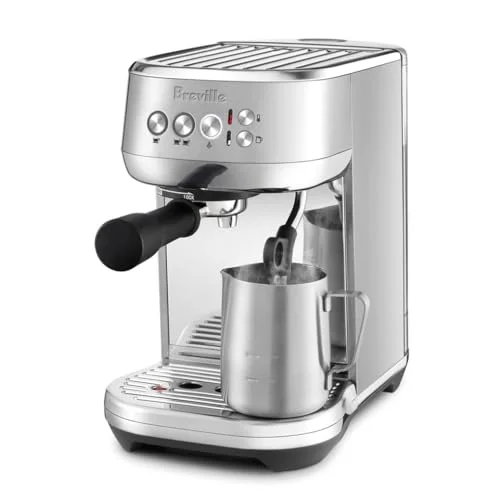
Breville BES500BSS Bambino Plus
The legacy half of the higher-price pair. No built-in grinder listed; the Bambino line's defining feature is Breville's automatic milk-texturing system rather than a manual wand or an on-board grinder.
$499.95 Check price →Where the legacy premium is backed by a real spec difference
The honest case for paying more sits almost entirely with the Bambino Plus. Automatic milk texturing is a mechanical and software feature, not a marketing phrase: the machine controls steam injection and milk temperature itself rather than handing you a wand and leaving the technique to you. That's a genuinely different user experience from a manual steam wand like the Gevi's, not a nicer-sounding name for the same part. If the daily habit in your house is a latte or a flat white rather than a straight shot, and you don't want to spend a few weeks learning to texture milk by hand, that automation is worth something real, and it is the kind of feature that tends to survive brand-loyalty arguments because it changes what actually happens in the cup.
Name recognition itself is a thinner justification but not a worthless one. Breville and De'Longhi have both sold espresso machines in the US for decades, which means a longer trail of published specifications, user manuals, and replacement-parts listings than a newer brand can offer — not necessarily a better machine, but a better-documented one. Where that stops being a real spec difference and starts being just a logo is the De'Longhi Classic in pair one: at $179.95 it has no confirmed grinder, no confirmed tank size beyond what's standard for the category, and no feature in its listing that the AMZCHEF doesn't match or beat for four cents more.
Where a DTC machine matches or beats the spec sheet for less
Run the same two pairs the other direction and the DTC machines win the line-item comparison twice. In pair one, the AMZCHEF includes a grinder and a 61-ounce tank at essentially the same price as a De'Longhi that lists neither. In pair two, the Gevi includes both a grinder and a steam wand — two features, not one — at $209.96 less than the Bambino Plus, which includes neither. If your buying criteria are "grinder, steam wand, lowest price," the Gevi is the only machine in this entire set of four that checks every box, and it's also the cheapest of the two machines in its pair.
What the DTC machines are not confirmed to match is the legacy machines' documentation trail and the Bambino Plus's specific automatic-milk feature. "Cheaper and more features on paper" is not the same claim as "better machine" — it's a claim about what you can verify in the listing today, which is exactly what this comparison is built to isolate. Our AMZCHEF lineup comparison and Gevi lineup comparison go deeper on each brand's own range if one of these two is the direction you're leaning.
The picks
Four machines, two clear situations, and one judgment call each. We're not naming a single winner across all four, because the two pairs serve different budgets and different habits.
If your ceiling is around $180: the AMZCHEF
At effectively the same price as the De'Longhi Classic, the AMZCHEF's built-in grinder is the deciding line item. The exception is if you already own a burr grinder you like — in that case the De'Longhi's stainless build and included frother, from a brand with decades of parts history, is a reasonable and simpler buy. Otherwise, a grinder included for free is the harder fact to argue against.
If you drink straight shots and want the grinder: the Gevi
Grinder and steam wand, both confirmed, at $289.99 — the only machine in this set of four with both features at the lower end of the price range. Measure your cabinet clearance first; 16.53 inches tall is not small.
If lattes and flat whites are the daily habit: the Bambino Plus
This is the one place in the comparison where paying more buys a specific, confirmed feature rather than a name: automatic milk texturing that a manual wand can't replicate without practice. Pair it with a separate burr grinder, since it doesn't include one, and budget for that line item on top of the $499.95.
If you want the broadest safety margin on service history: either legacy machine
If parts availability and a long public repair history matter more to you than any single spec, the De'Longhi or the Breville is the lower-risk pick regardless of the line-item math above — see the next section for why that's a real, separate axis from the spec sheet.
Parts availability and support: the one place brand age still matters
Spec sheets don't capture what happens in year three, and this is the one category where a decades-old brand has an advantage that isn't just reputation. De'Longhi and Breville have been selling espresso machines in the US long enough to have built out authorized service centers, published exploded parts diagrams, and trained independent repair shops that stock common wear parts — gaskets, group-head seals, steam-wand tips — as a matter of course. If a Bambino Plus needs a $12 seal in four years, there is a reasonable chance a local appliance-repair shop has seen one before.
A newer, direct-to-consumer brand selling primarily through Amazon has a thinner version of that infrastructure by definition — fewer years on the market means fewer repair shops have serviced one, and a generic gasket kit is more likely to be your only option than a brand-specific one. That's not a defect in the AMZCHEF or the Gevi; it's a structural fact about how long each brand has existed, and it's the clearest place where "legacy" is doing real work rather than just sounding reassuring. If a steam wand clogging or a grinder jamming is the kind of thing you'd rather diagnose yourself than ship the whole machine back, our explainer on anti-clog grinder claims is useful background before you buy either grinder-equipped machine here.
None of the four listings gives us a stated warranty length, so we won't invent one — check the current listing or the manufacturer's site for the exact term before you buy. What we can say with confidence is the general pattern: a machine that's one product generation from the beginning of its brand's US presence will have a shorter paper trail to lean on than one that's the latest in a decades-long line, independent of anything about the sticker price.
What the spec sheet cannot tell you about either machine
A listing tells you what's in the box. It does not tell you how consistent the grind is from the AMZCHEF's or the Gevi's built-in burr set after six months of daily use, how loud either pump actually is in a quiet kitchen, or how the Bambino Plus's automatic milk system behaves with oat milk versus dairy — all real variables, none of them in any product description, and none of them something we'll guess at here. Amazon's listing data for all four of these machines does not include a rating or a review count, so there is no sentiment to report either; we're not going to paraphrase what buyers supposedly think when we have no buyer data to draw on.
What a spec sheet also can't tell you is your own kitchen: counter depth, outlet placement, how often you actually clean a steam wand versus how often you plan to, and whether you're the kind of household that will dial in a grinder or the kind that will leave it on one setting forever. Those variables routinely matter more than the gap between a $289.99 machine and a $499.95 one, and no comparison — ours included — can do that measuring for you.
How we compared these
We compared published product listings, prices and named features — grinder, steam wand, milk system, tank size, footprint — rather than running these machines ourselves. We do not physically test these machines, we do not run a testing lab, and we do not publish ratings we cannot verify: none of the four listings carries a rating or review count, so nothing on this page is a star, a score, or a paraphrase of review sentiment. Every spec stated above comes directly from the product name or the listed size/variant field; where a listing didn't state a spec — tank size on the De'Longhi, wattage on any of the four — we said so rather than filling the gap with a plausible-sounding number.
Judgment calls, like which pick fits which habit, are flagged in our own voice as judgment calls, not presented as test results. Prices were recorded between September 15 and October 17, 2026, and move on Amazon independently of anything in this article — confirm the live price before buying any of the four.
Frequently asked questions
Does a legacy brand like Breville or De'Longhi always make a better espresso machine?
Not on the spec sheet alone. In this comparison, the De'Longhi Classic at $179.95 lists no built-in grinder where the similarly priced AMZCHEF does, and the Gevi at $289.99 lists both a grinder and a steam wand where the pricier Breville Bambino Plus lists neither. The legacy brands' real advantages are a longer parts and service history and, in the Bambino Plus's case, a specific automatic milk-texturing feature — not a blanket spec-sheet edge.
Is a DTC machine with a grinder actually a better buy than a legacy machine without one?
For the same or a lower price, a confirmed built-in grinder is hard to argue against on paper — it's a real cost you'd otherwise pay separately. The trade-off is the parts and service history: newer, primarily Amazon-sold brands have fewer years of authorized repair infrastructure behind them than De'Longhi or Breville.
Why doesn't the Breville Bambino Plus have a built-in grinder at $499.95?
Because the Bambino line is built around a different feature: automatic milk texturing. Breville's listing for the Bambino Plus does not include a grinder, so the price is paying for the milk system, the brand's service history and the build, not for an on-board grinder — pair it with a separate burr grinder if you need one.
Which of these four machines should I actually buy?
If your budget is around $180 and you don't already own a grinder, the AMZCHEF includes one for about the same price as the De'Longhi Classic. If you want both a grinder and a steam wand at the lower end of the price range, the Gevi at $289.99 is the only one of the four that has both. If lattes and flat whites are the daily habit, the Bambino Plus's automatic milk system at $499.95 is the one place here where the higher price buys a specific, confirmed feature.