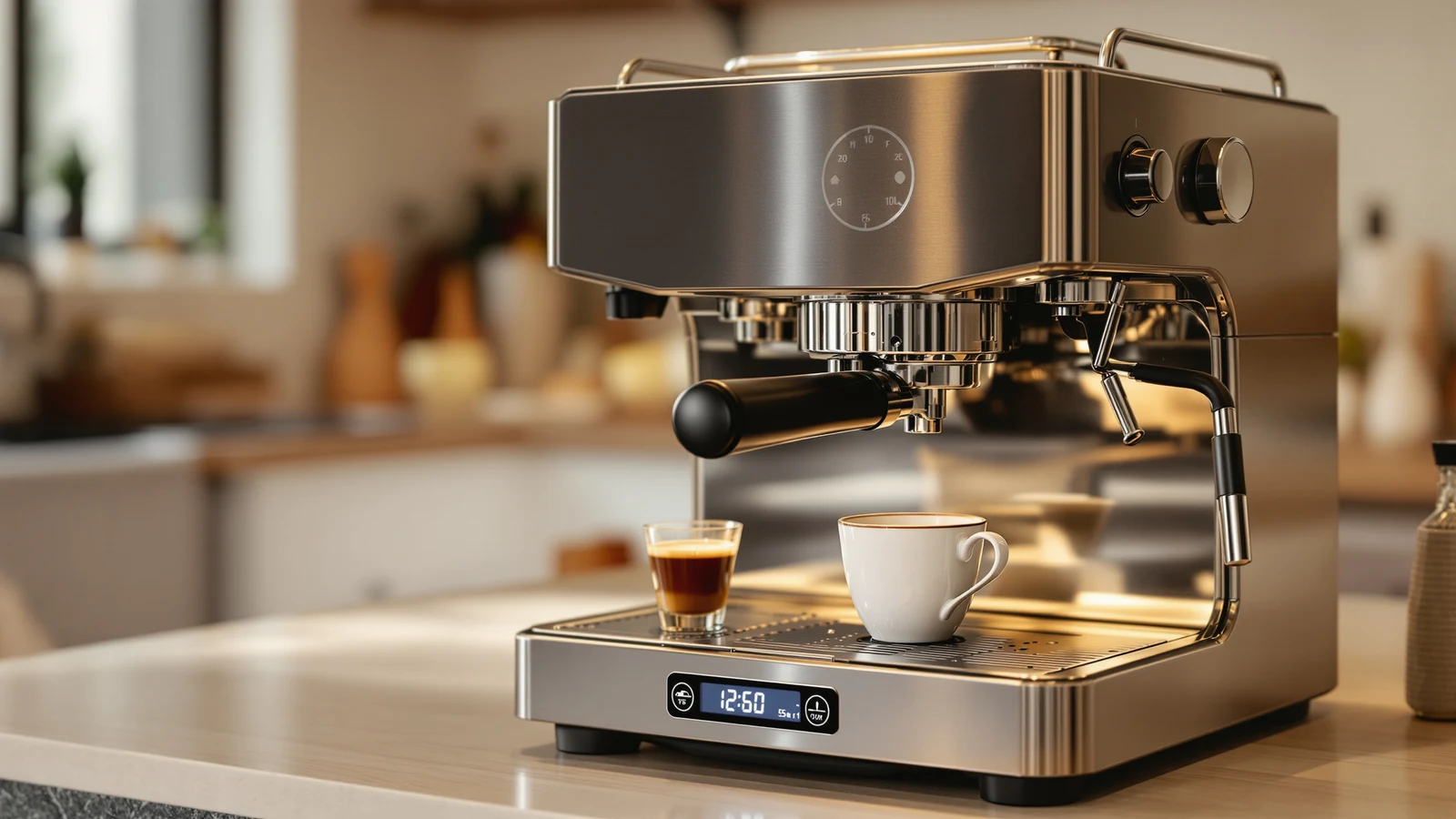
Why weighing the dose matters more than counting seconds
Espresso recipes are written as ratios, not durations: 18 grams of dry coffee in, roughly 36 grams of liquid espresso out, a 1:2 ratio that's the standard starting point for a double shot. Time is what most people actually use to stop a shot, because every machine has a clock and not every machine has a scale, but time is a proxy for weight — and a noisy one.
The same bean, the same grind setting and the same 25-second pull can land anywhere from 30 to 42 grams out, depending on how packed the puck is, how fresh the beans are, and how much the portafilter basket happened to hold that morning. Flow rate drifts for reasons that have nothing to do with the clock: a slightly finer grind, a few more degrees of ambient humidity swelling the grounds, a basket that's a hair fuller than yesterday's. Stop on 25 seconds every time and you still get a different cup every time.
Weight removes that variable at both ends. Dosing by weight means the same mass of coffee goes into the basket every single time, so the one thing that's supposed to change — your grind setting, as you dial in — is the only thing that actually changes. Weighing the yield means the shot stops when the ratio is hit, not when a timer guesses it's probably done. Put both together and you've isolated grind and extraction time as the only variables left to tune, which is the entire point of dialling in a shot in the first place.
None of this requires an expensive machine. A $20 kitchen scale under the cup does the yield half of the job for any espresso machine ever made, and a cheap scale under the portafilter does the dose half. What a built-in scale does is fold both steps into the machine so you aren't shuffling a scale, a portafilter and a cup around a wet drip tray before 7 a.m.
Ninja's Precision Scale: what Barista Assist actually calibrates automatically
The Ninja Luxe Café Mini Plus builds its scale into the base the machine sits on, under the name Barista Assist. Practically, that means the portafilter sits on an integrated scale while you grind, and the machine's display tracks the weight of what's landing in the basket in real time rather than running a fixed-time dose cycle and hoping the basket fills predictably.
That's the dose half of the equation, automated rather than manual. On a machine without a scale, dosing by weight means grinding into the portafilter balanced on a separate scale, watching the number, and stopping the grinder by hand the moment it hits target — three things to coordinate while also not spilling grounds everywhere. Barista Assist removes the separate scale and the manual stop-watching: the base under the portafilter is doing the weighing, and the built-in burr grinder and the display are talking to each other about when the target dose has been reached.
The same base also underwrites the machine's other automated behaviors — AutoFroth milk texturing and the one-touch latte and cappuccino routines that the ES351 and ES351WH1 Mini Plus models are built around. The scale isn't a separate gadget bolted onto a conventional machine; it's the sensor the rest of the "Hands-Free" workflow is built on top of, which is also why Ninja attaches a name to it rather than listing it as a line-item spec.
What we don't have from the listing is a numeric accuracy spec for the Precision Scale — no stated gram tolerance, the way some standalone kitchen scales advertise ±0.1 g. If that number matters to you, the honest move is to check the current Amazon listing and the included manual before buying, not to assume a figure we can't verify here.
Ninja Luxe Café Mini Plus, ES351 (Stainless)
Built-in burr grinder paired with Barista Assist's integrated Precision Scale, plus AutoFroth hands-free milk frothing for lattes and cappuccinos. The compact "Mini" build of the Luxe Café line.
$499.99 Check price →
Meraki's dual scales: measuring both the dose going in and the yield coming out
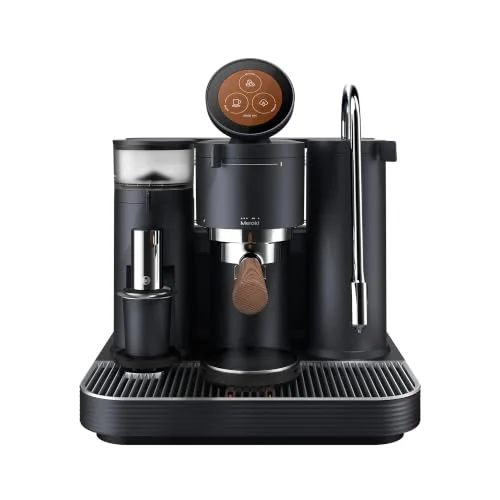
The Meraki Dual Boiler Espresso Machine with Grinder goes a step further and puts a scale on each end of the shot. One scale sits under the grinder path to weigh the dose going into the portafilter; a second sits under the brew group to weigh the liquid coming out into the cup. That's the full 1:2 ratio measured automatically at both ends, rather than one end measured and the other timed or eyeballed.
The mechanical reason this is a meaningfully different build, not just a marketing phrase, is that dual boilers already separate brewing and steaming into two independent heating circuits so you can pull a shot and steam milk at the same time without either one waiting on the other's temperature. Adding dual scales on top means the machine is instrumenting both halves of the process it already physically separates: brew-side weight for the shot, steam-side timing for the milk, running in parallel rather than queued one after another.
Practically, weighing the yield automatically removes the step most dialled-in home baristas already do by hand with a scale under the cup — stopping the shot visually or by a programmed volume is a rougher proxy than stopping it by weight, for the same reason counting seconds is rougher than weighing the dose. Building that into the machine means the "stop" decision is made on the actual output mass, not on a timer or a pre-set volume that assumes every shot flows at the same rate.
Two listings for this machine appear in the database — "Dual Built-In Scales" (B0HG8HPTCY) and "Built-In Dual Scales" (B0HFW93RHZ) — both priced at $1,699.00 and both described as a dual boiler with a grinder and dual scales. Treat them as the same machine under two listing titles rather than two different products; check the live listing for either ASIN for the exact current configuration before buying.
Meraki Dual Boiler Espresso Machine with Grinder and Dual Built-In Scales
Dual boiler (independent brew and steam circuits) with a built-in grinder and two scales — one weighing the dose into the portafilter, one weighing the yield into the cup.
$1,699.00 Check price →
The picks
Four machines, two approaches to the same idea: weigh what a timer can only estimate. Sorted by what each one actually weighs and what it costs.
01Best overall scale
Ninja Luxe Café Mini Plus, ES351
Dose-weighing without a dual-boiler price
Built-in burr grinder · Barista Assist Precision Scale · AutoFroth hands-free milk · Mini size
The lowest-cost route to an automatically weighed dose. The portafilter sits on the machine's integrated scale while the burr grinder runs, so the grind-to-target-weight step that normally requires a separate scale and your undivided attention happens on the machine itself. AutoFroth handles lattes and cappuccinos hands-free on the milk side, which is a separate system from the scale but shares the same "walk away and it's done" design logic.
The trade-offIt weighs the dose, not the yield — this model doesn't have a second scale under the cup, so the output side of the ratio is still down to your technique or a timer. We have no stated gram-accuracy figure for the Precision Scale; check the current listing if that number matters to you.
02Best color option
Ninja Luxe Café Mini Plus, ES351WH1 (Bone & Champagne)
The same Precision Scale build, in an Amazon-exclusive finish
Built-in burr grinder · Barista Assist Precision Scale · AutoFroth hands-free milk · Mini size
Same machine, same Barista Assist scale, same AutoFroth frothing — the difference the database records is the finish, an Amazon-exclusive Bone and Champagne colorway on the ES351WH1 instead of the stainless ES351. If the scale and grinder are what you're buying for and the color is a tiebreaker, this is the one to check for availability and any price difference against its stainless sibling.
The trade-offSame limitation as its sibling: no yield-side scale. Confirm on the current listing whether the colorway carries any price premium over stainless before choosing between the two.
03Dose and yield, both weighed
Meraki Dual Boiler with Grinder and Dual Built-In Scales
For weighing the full ratio, not just one end of it
Dual boiler · built-in grinder · two built-in scales — dose and yield · Large
Independent brew and steam boilers, a built-in grinder, and two scales rather than one: one under the portafilter for the dose, one under the brew group for the yield. That's the complete 1:2 ratio weighed on both ends automatically — the dual-boiler design means pulling a shot and steaming milk don't compete for the same heating circuit while that's happening.
The trade-off$1,699.00 is roughly four times the Ninja Mini Plus's price, and this is a large-format machine — the "Large" size/variant in the database means a real counter commitment, not a compact footprint. This is a serious-home-barista purchase, not an entry point.
04Same machine, second listing
Meraki Dual Boiler with Grinder and Built-In Dual Scales
Appears as a separate listing at an identical price
Dual boiler · built-in grinder · two built-in scales — dose and yield · Large
The database carries this as a distinct ASIN from the pick above, with the words "Dual" and "Built-In" swapped in the title, the same $1,699.00 price, and the same dual-boiler-plus-grinder-plus-two-scales description. We're listing it separately because it's a separate ASIN with a separate listing page — not because we have evidence it's a meaningfully different machine.
The trade-offBefore buying either Meraki listing, open both current Amazon pages side by side and confirm which configuration, bundle or seller is actually being offered — listing titles for the same base machine can drift over time in ways a static database entry won't catch.
| Machine | Scale weighs | Grinder | Price | |
|---|
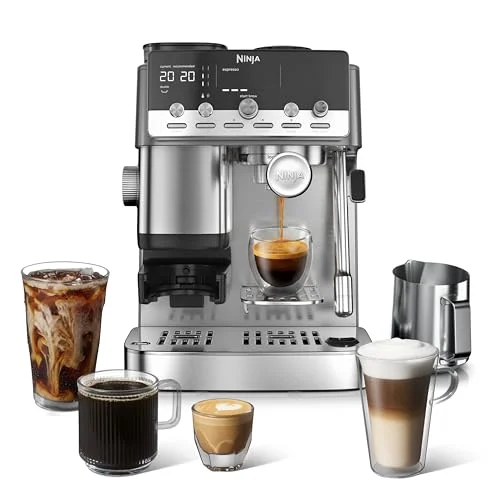 Ninja Luxe Café Mini Plus, ES351 | Dose only | Built-in burr | $499.99 | Price |
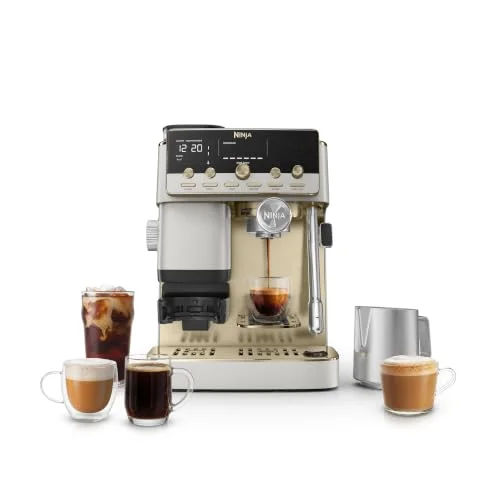 Ninja Luxe Café Mini Plus, ES351WH1 | Dose only | Built-in burr | $499.99 | Price |
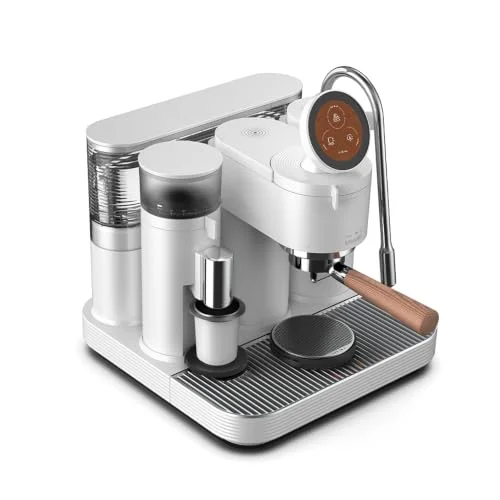 Meraki Dual Boiler (Dual Built-In Scales) | Dose and yield | Built-in | $1,699.00 | Price |
 Meraki Dual Boiler (Built-In Dual Scales) | Dose and yield | Built-in | $1,699.00 | Price |
What a 0.2 g accuracy claim means in practice, and how to check it yourself
Scale accuracy claims in this category are usually expressed as a tolerance — plus or minus a fraction of a gram — and it's worth being precise about what that number does and doesn't promise. We don't have a verified gram-accuracy figure for either the Ninja Precision Scale or the Meraki dual scales in the product data behind this article, so treat the figure in this heading as the category benchmark worth checking for, not a spec we're asserting about any product named above.
A ±0.2 g tolerance means a scale reading 18.0 g could be holding anywhere from 17.8 to 18.2 g of actual coffee. For an 18 g double that's roughly a 1% swing either way — small enough that it won't be the reason a shot tastes sour or bitter, since grind size and extraction time move the cup far more than a tenth of a gram does. Where accuracy starts to matter is at the extremes: a lighter single-basket dose around 9–10 g turns that same ±0.2 g into a 2% swing, and repeated small errors in the same direction — always rounding down, say — compound into a dose that's consistently off rather than randomly noisy.
You can check any built-in scale's real-world accuracy with a $10–15 set of calibration weights, sold for kitchen and jewelry scales, or with any object of a precisely known weight — a set of coins, a sealed product with a printed net weight. Place the known weight on the scale, read the display, and see how far it lands from the true figure; repeat it a few times to see whether the error is consistent (fixable by zeroing or noting an offset) or random (a sign the sensor itself is noisy). It's a five-minute test, and it's the only way to know whether a built-in scale is actually accurate on the unit that arrives at your door, rather than on the unit in a manufacturer's lab.
The other practical check costs nothing: weigh the same nominal dose on the built-in scale and then on a separate kitchen scale, back to back, a few times. If the two agree, the built-in scale is trustworthy enough to stop cross-checking. If they disagree by more than a tenth of a gram or two, consistently in one direction, that's useful information before you've built a dial-in routine around a number that's quietly wrong.
When a $20 kitchen scale is still the better buy
A built-in scale is worth paying for when it removes a step you were already doing badly or skipping — most people who dose by eye or by a timer are leaving real consistency on the table, and automating it into the machine means it happens every single time without you remembering to do it.
It's a worse deal in a few specific situations. If you already own a decent kitchen or jewelry scale and a habit of using it, a built-in scale duplicates a tool you've already paid for and already know how to use — the $20 scale under your current machine's portafilter does the same job the Ninja's Precision Scale does, just with one extra manual step. If you're choosing between machines primarily on grinder quality, boiler type or milk system, and the scale is a tie-breaker rather than the reason you're shopping, it's worth asking whether that budget is better spent on the grinder — grind consistency affects every shot more than dose-weighing precision does, and a mediocre grinder with a precise scale still produces an inconsistent cup. And if you're not sure espresso at home is going to stick as a habit at all, a $20–40 standalone scale paired with almost any semi-automatic machine — like the machines compared in our roundup of machines between $250 and $350 — gets you most of the consistency benefit at a fraction of the commitment.
Where a built-in scale earns its keep unambiguously is the dual-scale case: weighing the yield automatically removes a step that's genuinely awkward to do by hand on every shot, because it means holding a cup under the group head on a scale while watching a number climb in real time, rather than grinding into a stationary portafilter that's already sitting on a scale. If you want the convenience, a dual-boiler build that weighs both ends — like the Meraki machines above — is solving a problem a cheap kitchen scale structurally can't solve on its own, since one scale can only be in one place at a time.
How we compared these
We compare published specifications, what ships in the box, machine class and live pricing, and we read manufacturer naming — "Precision Scale," "Dual Built-In Scales" — for what it mechanically implies rather than taking the marketing language at face value. We do not physically test these machines, we do not run a testing lab, and we do not publish ratings we cannot verify: these four machines carry no rating or review-count data in the product database behind this site, so there are no stars and no invented sentiment anywhere on this page.
Where a point here is general coffee knowledge rather than a product-specific claim — the 1:2 dose-to-yield ratio, flow-rate drift under identical timing, how a ±0.2 g tolerance compounds at smaller doses — we've flagged it as background rather than attributing it to any machine. Our running comparison of current Ninja espresso machines and our look at what automatic grinding and tamping costs on a Breville Oracle versus a dual boiler cover the other automation trade-offs in this price range if a built-in scale isn't the only thing you're weighing — no pun intended — in a buying decision.
Frequently asked questions
Do I need a built-in scale, or is a $20 kitchen scale good enough?
A standalone scale does the same job for a fraction of the cost — the built-in version just removes the step of placing and watching it yourself. If you already use a kitchen scale under your portafilter or cup, a built-in one duplicates a tool you own. It earns its keep mainly when it automates a step you were skipping, or when it weighs both the dose and the yield at once, which a single standalone scale can't do simultaneously.
What does the Ninja Precision Scale in the Luxe Café Mini Plus actually measure?
It weighs the dose: the portafilter sits on an integrated scale built into the machine's base while the burr grinder runs, so the grind-to-target-weight step is tracked by the machine rather than by you watching a separate scale. It's part of the Barista Assist system that also governs the machine's AutoFroth milk routines. We don't have a verified gram-accuracy figure for it, so check the current listing if that number matters to your decision.
How is the Meraki's dual-scale system different from a single scale under the portafilter?
It weighs both ends of the shot automatically: one scale under the portafilter path for the dose going in, a second under the brew group for the yield coming out. A single standalone scale can only be in one place, so it either measures the dose (then gets moved, or a second scale is added for the cup) or measures the yield — not both at once without extra equipment. The Meraki's dual-boiler design, with independent brew and steam circuits, is the same "instrument both halves separately" logic applied to heating as well as weighing.
What does a ±0.2 g scale accuracy claim mean for my coffee?
On an 18 g double shot, a ±0.2 g tolerance is roughly a 1% swing either way — too small to be the reason a shot tastes off, since grind size and extraction time matter far more. It matters more on lighter single-basket doses around 9–10 g, where the same ±0.2 g becomes a larger percentage of the total. You can check any scale's real accuracy with inexpensive calibration weights or an object of known weight, and by cross-checking against a separate kitchen scale a few times.
Keep reading