The short answer
Ninja's espresso shelf splits into two systems that share a brand name and almost nothing else. The CFN601 at $279.95 is a capsule machine: drop in a Nespresso original pod, pull a shot, no beans and no grinder involved. The Luxe Café line — Mini Plus ($499.99), Premier 3-in-1 ($499.99) and Pro 4-in-1 ($749.95) — is a separate, bean-based system that starts with a built-in grinder and auto-frothing and adds a drip-coffee side, a cold-brew mode, an integrated tamper and a hot-water tap as you move up the three tiers.
For most households making one or two drinks a day, the Mini Plus is the one that earns its keep: it is the cheapest Luxe Café model, it already grinds beans and froths milk hands-free, and it skips the drip and cold-brew hardware that a smaller household rarely uses. The Premier and Pro earn their higher prices only if you actually want those extra brew modes, or if hands-free tamping specifically matters to you. The CFN601 is the odd one out — buy it only if you are already committed to Nespresso capsules and want a full pot of drip coffee from the same footprint.
Two Ninja espresso systems, one confusing shelf
The naming is the first trap. "Ninja Espresso & Coffee Maker" and "Ninja Luxe Café" both show up as espresso machines from the same company, in the same price range on the same Amazon search results page, and it is easy to assume they are tiers of one product line. They are not.
The CFN601 is a capsule system built around Nespresso-compatible pods: you're buying a pump and a pod reader, not a coffee-making process. The Luxe Café models are a bean-to-cup system built around a grinder, differing only in how much of that process is automated and how many brew types the chassis supports. Comparing a $279.95 pod machine against a $499.99-and-up bean machine on the same axis doesn't work — they solve different problems, and the real first question is whether you want to buy capsules indefinitely or buy beans.
The CFN601: Nespresso capsules with a 19-bar pump, not a Luxe Café machine at all
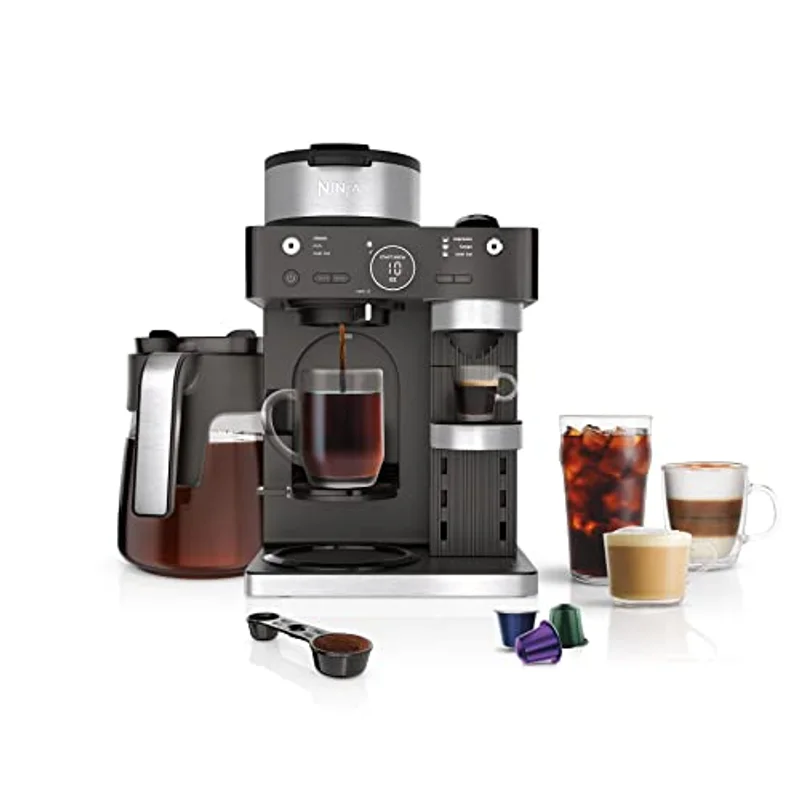
Ninja Espresso & Coffee Maker, CFN601
Nespresso original-capsule compatible, 19-bar pump, 12-cup drip coffee side, fold-away milk frother. Capsule espresso and a full pot of filter coffee from one footprint.
$279.95 Check price →
The CFN601 is two machines in one body: a capsule espresso side that takes Nespresso original pods, and a 12-cup drip coffee side for everyone else in the house who just wants a mug of filter coffee. A fold-away frother sits on top for milk drinks and tucks away when you don't need it. There is no grinder here and no bean hopper — the entire cup quality ceiling is set by whichever capsule you buy, not by anything the machine does.
Ninja markets the espresso side as a 19-bar system, and it's worth being precise about what that means before it does any work in your buying decision. Espresso brews at roughly 9 bar of pressure at the coffee; a 19-bar figure describes the pump's maximum output, not the pressure reaching the pod. Every capsule machine in this price range clears that 9-bar threshold easily, so the bar number tells you about marketing, not about the shot in the cup — we go through why pump numbers are a weak signal on their own in our look at what naming (or quoting) a pump actually proves.
What the CFN601 actually buys you is convenience with a recurring cost. There's no grinder to maintain, no beans to go stale, no dialing-in — you load a capsule and press a button, which is precisely the appeal for someone who wants espresso without adopting it as a hobby. The trade is that capsules cost more per cup than ground beans over time, and you cannot adjust grind, dose or pressure to chase a better shot; the ceiling is fixed by the pod manufacturer. At $279.95 it is also the cheapest machine in this guide, and if your household is split — one person wants quick espresso, another just wants a full pot — the dual-side design solves a real problem a single-spout Luxe Café machine doesn't.
Luxe Café Mini Plus: built-in grinder and auto-frothing at the line's smallest footprint
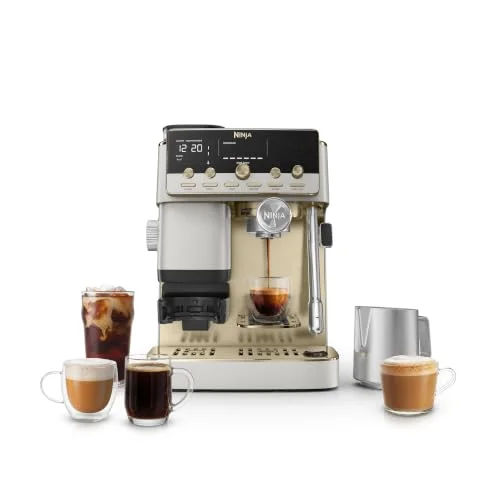
Ninja Luxe Café Mini Plus with AutoFroth
Built-in burr grinder, precision scale and hands-free auto-frothing for lattes, cappuccinos and more — the entry point to the Luxe Café line, sized as the "Mini" of the range.
$499.99 Check price →
The Mini Plus is where the Luxe Café line actually begins, and the name tells you its job: it's the smallest-footprint model in the range, built to do espresso and milk drinks well without the drip-coffee or cold-brew hardware the two machines above it carry. A built-in burr grinder means you're working from whole beans rather than capsules or pre-ground coffee from the first cup, and a precision scale — named directly in the listing — takes dose weighing out of your hands rather than leaving you to eyeball it.
The other half of the pitch is hands-free auto-frothing: no steam-wand technique to learn, no positioning the pitcher at the right angle, the machine textures the milk for a latte or cappuccino on its own. Combined with the grinder, that's the entire daily workflow — beans in, milk in, drink out — compressed into the smallest chassis in a line that gets progressively larger as it adds brew modes. Ninja also sells this model in an Amazon-exclusive Bone and Champagne colorway, for anyone whose counter doesn't want another black or stainless box.
What you give up versus the two machines above it is breadth, not quality: no drip-coffee side for a full pot, no dedicated cold-brew mode, no integrated tamper. For a one-or-two-person household whose coffee needs are "an espresso drink or two," that's not really a loss — it's the Luxe Café line's core function with the extra hardware left out, at $100 to $250 less than the models that include it.
Premier 3-in-1: adding drip coffee and cold brew to the same machine
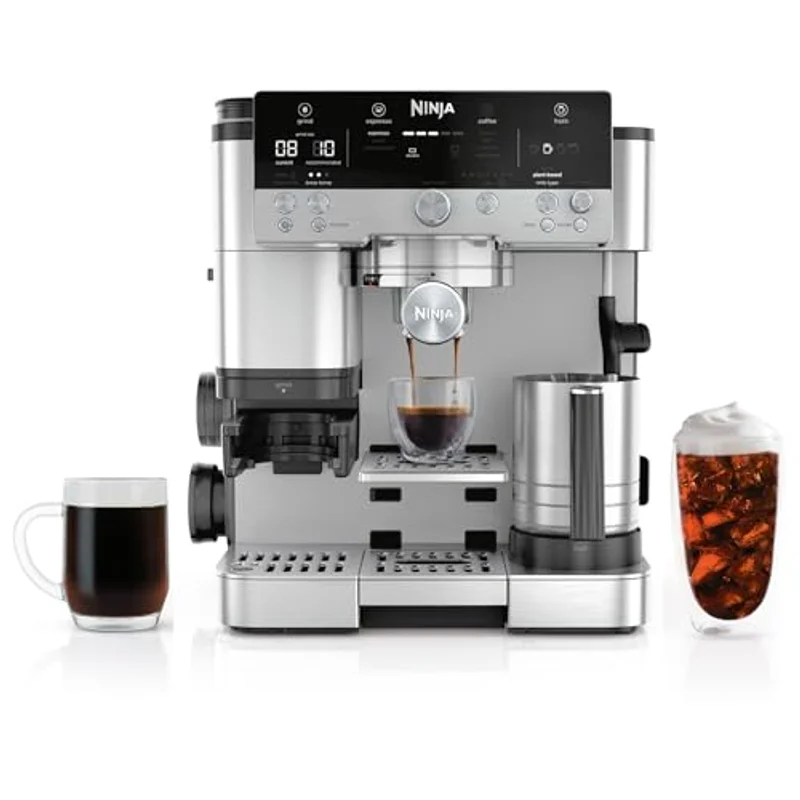
Ninja Luxe Café Premier 3-in-1
Built-in burr grinder, dual automatic froth system, and three brew types — espresso, drip coffee in multiple styles and sizes, and cold brew — from one 12.99 x 13.39 x 14.57-inch chassis.
$499.99 Check price →
The Premier 3-in-1 keeps the Mini Plus's built-in burr grinder and adds two entire brew categories: a drip-coffee side with multiple styles and sizes for a full pot, and cold-brew modes for iced coffee made without hot extraction. The frothing system also steps up to a dual automatic setup — a spinning whisk paired with an automatic steamer — that handles both hot microfoam and cold foam, which is the detail most multi-function machines get wrong by only doing one or the other well.
At $499.99, roughly $99 more than the Mini Plus, you're paying for breadth: one appliance replacing what would otherwise be a separate drip coffee maker and a cold-brew setup. That's the right trade for a household where one person wants espresso, another wants a full pot of drip, and a third wants iced coffee in summer — the Premier serves all three from a single machine and a single bean hopper, at a chassis size of 12.99 by 13.39 by 14.57 inches, meaningfully larger on the counter than the Mini Plus.
The trade-off is the same one every multi-function appliance makes: breadth over depth. If your household genuinely only drinks espresso-based drinks, you're paying nearly $100 more than the Mini Plus for a drip side and cold-brew mode that may sit unused, on a larger footprint you don't need. The Premier earns its price only when more than one brew format is actually in regular rotation.
Pro 4-in-1: what the integrated tamper and hands-free frother add for $150 more
Ninja Luxe Café Pro 4-in-1
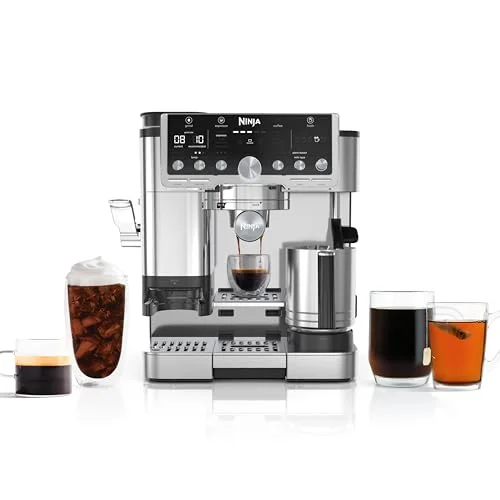
Built-in grinder, hands-free milk frother and an integrated tamper, plus a fourth brew mode — hot water, for tea — on top of espresso, drip and cold brew. Stainless steel, 13.39 x 12.48 x 14.84 inches.
$749.95 Check price →
The Pro 4-in-1 sits $150.95 above the Premier and adds two things the listing calls out specifically: an integrated tamper and a hands-free milk frother, alongside a fourth brew mode — hot water, aimed squarely at tea drinkers who share the machine with espresso drinkers. The "4-in-1" in the name is espresso, drip coffee, cold brew and hot water; the Premier's "3-in-1" stops at cold brew.
The integrated tamper is the more interesting addition of the two, because tamping is normally the one manual, technique-dependent step left in an otherwise automated bean-to-cup workflow: press the ground coffee into a level, even puck, by hand, with uneven pressure producing an uneven extraction. Building the tamper into the machine removes that variable entirely — you're no longer relying on your own wrist pressure for a consistent puck. The hands-free frother on the Pro is a continuation of the automatic steaming already present on the Premier, rather than a wholly new mechanism, but it's named as a standalone feature in the listing, which suggests Ninja considers the frothing hands-free end-to-end on this tier in a way it wasn't fully specified on the Premier.
The finish changes too: the Pro ships in stainless steel at a slightly different footprint — 13.39 by 12.48 by 14.84 inches, narrower but taller than the Premier's 12.99 by 13.39 by 14.57. Whether $150.95 for a built-in tamper, a hot-water tap and a stainless finish is worth it depends on how much you value removing that one manual step; if hand-tamping never bothered you, the Premier does nearly everything else the Pro does for less.
How the four compare
Same brand, two different systems. Prices are what we recorded on November 4, 2026.
| Machine | System | Grinder | Milk | Price | |
|---|
 CFN601 | Capsule + 12-cup drip | None (capsule) | Fold-away frother | $279.95 | Price |
 Luxe Café Mini Plus | Espresso only | Built-in burr + scale | Hands-free auto froth | $499.99 | Price |
 Luxe Café Premier 3-in-1 | Espresso + drip + cold brew | Built-in burr | Dual auto froth | $499.99 | Price |
 Luxe Café Pro 4-in-1 | Espresso + drip + cold brew + hot water | Built-in + integrated tamper | Hands-free frother | $749.95 | Price |
The picks
Four machines, four different jobs. Here's who each one is actually for.
01Daily driver
Luxe Café Mini Plus
One or two espresso drinks a day, no drip coffee needed
Built-in burr grinder · precision scale · hands-free auto froth · smallest Luxe Café footprint
Grinds, doses and froths without asking you to learn a steam wand, in the smallest chassis the line offers. The default pick if your household's coffee habit is lattes and cappuccinos rather than a full pot.
02Multi-drink household
Luxe Café Premier 3-in-1
Espresso, a full pot of drip and iced cold brew, from one machine
3-in-1 · built-in burr grinder · dual automatic froth · 12.99 x 13.39 x 14.57 in
Replaces a drip coffee maker and a cold-brew setup as well as an espresso machine, for about $99 more than the Mini Plus. Worth it once more than one brew format is in regular use.
03Hands-off tamping
Luxe Café Pro 4-in-1
Everything the Premier does, plus an integrated tamper and hot water for tea
4-in-1 · integrated tamper · hands-free frother · stainless steel
Removes the last manual step in the bean-to-cup process and adds a hot-water tap for tea drinkers sharing the machine. The $150.95 premium over the Premier buys those two specific things, not a different core system.
04Capsule convenience
Ninja CFN601
Already own Nespresso capsules and want a full pot of drip too
Capsule · Nespresso original-capsule compatible · 12-cup drip side · fold-away frother
Cheapest machine in this guide and the only one with no grinder of any kind. Right choice if you want zero technique and are fine paying per capsule indefinitely.
Which Ninja model actually matches a daily one-or-two-cup routine
Strip away the marketing names and the decision comes down to how many brew formats you actually use on a normal day, because every Luxe Café tier above the Mini Plus is priced for breadth you may not need.
If your routine is a latte or a cappuccino once or twice a day and nothing else, the Premier's drip-coffee side and cold-brew mode are hardware you paid for and won't touch, and the Pro's integrated tamper and hot-water tap compound that further. The Mini Plus covers the entire routine — grind, dose, froth, drink — in the smallest footprint in the line, for $99 less than the Premier and $250 less than the Pro. There's no efficiency gain from the larger machines if drip coffee and cold brew aren't part of your week; you're paying for capability that sits idle.
The calculation changes the moment a second brew format enters the routine on any kind of regular basis — someone in the house drinking filter coffee every morning, or cold brew becoming a summer habit rather than an occasional one. At that point the Premier's $99 premium over the Mini Plus is cheaper than buying a separate drip machine, and it stops being excess capability. The Pro's additional $150.95 only makes sense on top of that if manual tamping specifically bothers you, or if hot water for tea is a standing need in the household — it is not a reason to skip the Mini Plus on its own.
The CFN601 sits outside this ladder entirely and answers a different question: do you want to commit to capsules at all. None of the Luxe Café tiers are capsule machines, so the CFN601 isn't a cheaper way into the same system — it's the only machine here with no grinder, which is either exactly what you want or a dealbreaker. For a one-or-two-cup daily routine, our lean is the Mini Plus unless you're already a confirmed capsule household, in which case the CFN601's $279.95 and zero learning curve is the more honest fit.
How we compared these
We compare published specifications, what each listing states is in the box, machine class, footprint and live Amazon pricing. We do not physically test these machines, we do not run a testing lab, and we do not publish ratings we cannot verify — Amazon's product data returns no rating and no review count for any of the four machines here, so this page carries no stars and no invented scores. Where we describe a feature — the Mini Plus's precision scale, the Pro's integrated tamper, the Premier's dual froth system — it is pulled directly from the manufacturer's own product listing and title, not from a demo we ran ourselves.
Where a conclusion here is a judgment rather than a spec — that the Mini Plus suits a one-or-two-cup routine, that the Pro's premium only pays off if hands-off tamping matters to you — we've said so in our own voice and shown the reasoning behind it, so you can weigh it differently if your household's habits differ from the ones we assumed. The one general coffee fact used above — that espresso brews at roughly 9 bar at the puck regardless of a pump's rated maximum — is standard background, not a claim about any specific product.
Frequently asked questions
Is the Ninja CFN601 part of the Luxe Café line?
No. The CFN601 is a Nespresso-capsule machine with a 19-bar pump and a 12-cup drip coffee side; the Luxe Café line (Mini Plus, Premier 3-in-1 and Pro 4-in-1) is a separate, bean-based system built around a grinder. They share a brand name and a price category, not a brewing method.
What's the difference between the Luxe Café Mini Plus and the Premier 3-in-1?
Both have a built-in burr grinder and automatic milk frothing. The Premier adds a drip-coffee side with multiple styles and sizes and a cold-brew mode, on a larger chassis, for about $99 more than the Mini Plus's $499.99. The Mini Plus is the smallest-footprint, espresso-and-milk-only entry point to the line.
Is the integrated tamper on the Pro 4-in-1 worth $150 more than the Premier?
It depends on whether hand-tamping is a step you want removed. The Pro 4-in-1 adds a built-in tamper, a formalized hands-free frother and a hot-water tap for tea, plus a stainless finish, for $150.95 over the Premier's $499.99. If you're not bothered by tamping by hand and don't need hot water on tap, the Premier delivers nearly the same machine for less.
Which Ninja espresso machine is right for one or two cups a day?
For an espresso-or-milk-drink routine with no regular drip coffee or cold brew, the Luxe Café Mini Plus is the best fit: it grinds, doses and froths hands-free in the smallest Luxe Café footprint, without paying for brew modes you won't use. If you're already committed to Nespresso capsules and want zero grinder maintenance, the CFN601 at $279.95 is the lower-commitment alternative.
Keep reading