How Loud Is an Espresso Machine, Really?
Vibration pumps, rotary pumps and grinder motors all sound different, and none of it shows up on a spec sheet. Here is what actually makes noise in a home espresso routine, and what to expect before one of these lands on a shared kitchen counter.
Reader-supported: we may earn a commission if you buy through our links, at no extra cost to you. Prices are the ones we recorded in late September 2026 and they move constantly — confirm the live price before buying.
The short answer
Almost every noise complaint about a home espresso machine traces back to one of three sources, and they are not equally loud or equally avoidable. The brew pump runs for 20 to 30 seconds and is the background hum of the whole routine. The grinder, if the machine has one built in, is the single loudest moment in the sequence but is also the shortest. The steam wand hisses the whole time it is texturing milk, which can be longer than the shot itself if you are still learning to judge when the milk is ready.
None of the four machines in this guide publish a decibel rating, and almost no machine in this price category does — Amazon's listings for the Mr. Coffee 4-Shot Steam Espresso Cappuccino and Latte Maker ($54.99), the AERCANA Espresso Machine 20 Bar ($99.99), the Hausmojo CM1620 ($164.99) and the AMZCHEF Espresso Machine With Grinder ($199.98) all give pressure, wattage and tank size, and none give a sound figure. What follows is not a ranking by measured loudness, which we cannot do without a decibel meter in a lab we do not run. It is a comparison of pump type, grinder presence and class, which is the information we do have and which is what actually predicts how a machine sounds in daily use.
Vibration pump versus rotary pump: the mechanical difference behind the sound
Almost every espresso machine under a few hundred dollars uses a vibration pump, also called a vibratory or solenoid pump. The mechanism is a spring-loaded piston driven back and forth by an electromagnet pulsing at line frequency — 60 times a second on US household power. Each pulse pushes a slug of water forward, and the piston knocking against its stop is what you hear: a buzzing, rattling drone for the length of the shot, often audible through a cabinet wall.
A rotary pump works differently. A motor spins a rotor continuously, moving water with a smoother, more consistent pressure curve instead of a few dozen individual pulses a second. The sound changes character from a buzz to a lower, steadier whir, and it is genuinely quieter — but rotary pumps are larger, need their own housing, and show up almost exclusively on prosumer and semi-commercial machines that cost several times what a vibration-pump machine does. None of the four machines in this guide list a rotary pump; all are consistent with the vibration-pump category that dominates this price range, which is the honest way to say it since none of the listings state the pump type outright.
The practical takeaway is not that vibration pumps are a flaw — they are what makes a $100–200 espresso machine possible at all. It is that if pump noise is your actual concern, no machine at these prices solves it; the fix is a rotary-pump machine at a materially higher price point, which is outside the scope of what we cover here. For everything under roughly $300, expect a buzz for the length of the shot and plan your counter placement around that fact rather than around a model that claims to be quiet.
Grinder motors: the loudest ten seconds of the routine
If a machine has a built-in burr grinder, the grinder is the loudest single thing it does — louder than the pump, louder than the steam wand, and loud enough that it is the part people specifically mention when a machine wakes someone else in the house. The reason is simple: a grinder motor has to spin fast enough to drive beans through a burr gap, and that includes both motor whine and the clatter of beans breaking apart, which is a harsher, higher-pitched sound than a pump's drone.
The good news is duration. Grinding a single or double dose takes somewhere in the range of five to fifteen seconds depending on the grind setting and dose, and then it stops completely — compare that to a 25–30 second pump cycle or steam texturing that can run even longer. A grinder is loud but brief; a pump is quieter but sustained. If the household rule is "nothing loud before 7am," the grinder is the thing to time carefully, not the thing to avoid buying.
Of the four machines here, only the Hausmojo CM1620 and the AMZCHEF Espresso Machine With Grinder have a built-in burr grinder — the Hausmojo offers 44 grind settings and a touchscreen, the AMZCHEF also lists 44 grind settings with temperature control. Both will have that short, sharp grinding burst as part of every cup. The Mr. Coffee 4-Shot and the AERCANA have no grinder listed, so whatever dosing routine you build around them depends on pre-ground coffee or a separate grinder you control on your own schedule — which, for a noise-sensitive household, is itself a kind of feature: you decide when the loud ten seconds happen instead of having them built into every single cup.
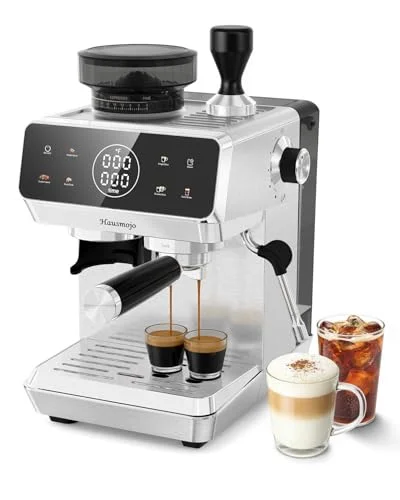
Hausmojo CM1620 Espresso Machine with Built-in Burr Grinder
20 bar pump, built-in burr grinder with 44 grind settings, steam wand, touchscreen controls. The grinder adds a short, sharp motor burst to every cup that the two non-grinder machines in this guide skip entirely.
$164.99 Check price →Steam-driven machines and the hiss most people forget about
Pumps and grinders get the attention because they are mechanical and motorized, but the steam side of an espresso machine makes noise too, and it is a different kind: a continuous hiss rather than a buzz or a whine, closer to a kettle than to a motor. Any machine with a steam wand produces this sound for as long as the wand is open, which for someone still learning to texture milk can run well past the length of the shot itself.
There is also a distinct category worth naming separately: steam-driven machines, as opposed to pump-driven ones that happen to have a steam wand for milk. The Mr. Coffee 4-Shot Steam Espresso Cappuccino and Latte Maker is a steam-driven design — it builds pressure with steam rather than a mechanical pump, which is the budget-tier approach to getting pressurized water through coffee. Steam-driven machines tend to run audibly through more of the brew cycle than a pump machine, where the pump runs in a shorter, defined window and then stops; the honest expectation is that a steam-driven machine simply sounds "on" for longer per cup than a pump-driven one does, because building and sustaining that steam pressure is the whole mechanism, not a side task.
None of this is a defect to be fixed. Steam escaping into a liquid is physically going to hiss, on every machine in every price tier, including ones costing many times more than anything in this guide. The only lever you actually have is duration — how long you hold the wand open — and that comes down to practice and the milk-texturing routine, not the model you buy.
The picks, and when each one runs loudest
Same four machines, the moment in their cycle where you will notice sound most, based on what their listed features mechanically require rather than anything we measured.
| Machine | Type | Grinder | Loudest moment | Price | |
|---|---|---|---|---|---|
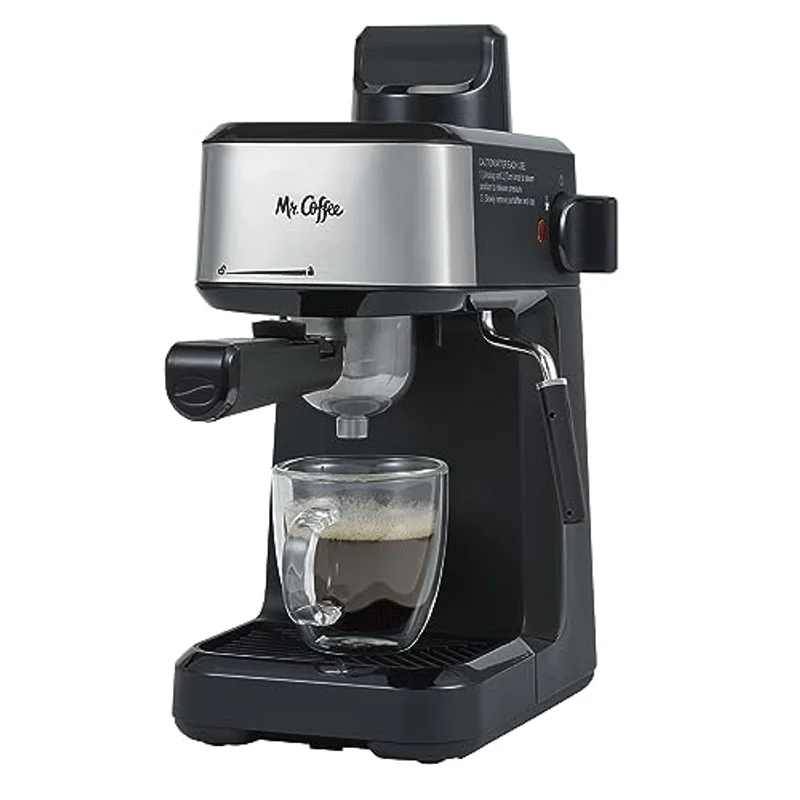 Mr. Coffee 4-Shot Steam Espresso Mr. Coffee 4-Shot Steam Espresso | Steam-driven | None | Steam build-up, sustained through the brew | $54.99 | Price |
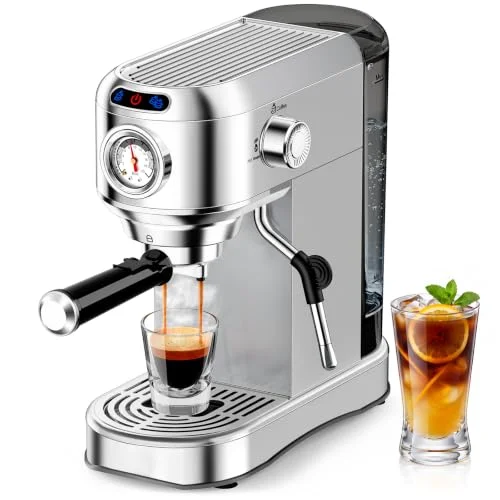 AERCANA Espresso Machine 20 Bar AERCANA Espresso Machine 20 Bar | Pump (vibration) | None | Pump cycle, roughly 20–30 seconds | $99.99 | Price |
| Hausmojo CM1620 | Pump (vibration), bean-to-cup | Built-in, 44 settings | Grinder burst, then the pump cycle | $164.99 | Price |
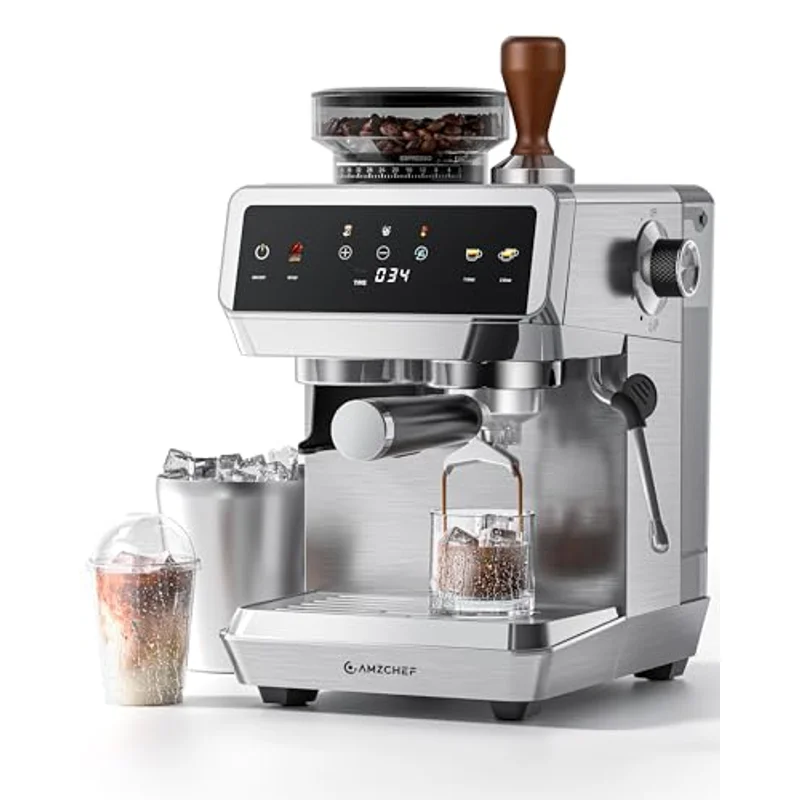 AMZCHEF with Grinder AMZCHEF with Grinder | Pump (vibration), bean-to-cup | Built-in, 44 settings | Grinder burst, then the pump cycle | $199.98 | Price |
The Mr. Coffee 4-Shot at $54.99 is the simplest case: no grinder to add a motor burst, but its steam-driven design means the audible build-up phase likely runs for more of the total cycle than a pump machine's shorter, defined pump window. It is also the only one of the four with no pump stage at all to compare against, since steam pressure replaces it.
The AERCANA Espresso Machine 20 Bar at $99.99 has a pump but no grinder, so its noise profile is the cleanest comparison point in this guide: whatever a bare vibration pump sounds like for 20 to 30 seconds, without a grinder burst stacked on top and without the steam-driven hiss of the Mr. Coffee. Its 34 oz removable water tank and compact build are listed features; pump noise level is not something the listing specifies.
The Hausmojo CM1620 at $164.99 and the AMZCHEF Espresso Machine With Grinder at $199.98 both stack a grinder burst onto a pump cycle, which is the loudest combined sequence of the four on paper, simply because it is doing the most mechanical work per cup — grinding beans, then pumping water through them. Both list 44 grind settings and a steam wand, so both also carry the steam hiss during milk texturing. Neither listing states a grinder decibel figure, so this is a structural read based on what built-in grinding mechanically requires, not a measured comparison between the two.
Where you put it: counters, cabinets and sound
Placement changes perceived loudness more than most buyers expect, because a vibration pump's buzz travels efficiently through hard, connected surfaces. A machine sitting directly on a laminate or stone counter that is itself bolted to cabinetry can transmit that buzz into the cabinet box, turning a small motor sound into something closer to a resonance you feel through the counter as much as hear. A folded kitchen towel or a thin silicone mat under the machine's feet breaks that contact and is a low-cost way to cut transmitted vibration — it will not touch the sound coming directly off the pump or grinder into the air, but it meaningfully reduces what carries into cabinets and walls.
Open shelving versus an enclosed cabinet nook makes a difference too, in the opposite direction from what intuition suggests. An open counter lets sound dissipate into the room; a tight cabinet alcove with hard surfaces on three sides can reflect and slightly amplify the same noise, especially the higher-pitched grinder sound. If the machine is going into a cabinet nook specifically to hide it, expect the sound to be a little more present there than it would be sitting out in the open, not less.
Shared walls matter for exactly the reason you'd guess: a kitchen counter that backs onto a bedroom wall, or sits near a baby's room, is the placement where even a short grinder burst or a 25-second pump cycle gets noticed at 6am. None of the four machines here changes that physics — moving the machine a few feet, or timing the loud parts of the routine around when people are already awake, does more than choosing between any two of these models.
What a quieter machine actually costs
Meaningfully quieter espresso machines exist, but the honest framing is that quiet is not a line item at these prices — it is a byproduct of spending considerably more on a different pump architecture. Rotary-pump machines, which trade the vibration pump's buzz for a steadier motor whir, are a prosumer and semi-commercial category, and they routinely cost several times what any of the four machines in this guide do. None of the machines named here use one; a rotary pump is simply not part of the sub-$200 category these four compete in.
Within the price range this guide actually covers, the lever that is available to you is not "buy the quiet one" but "buy the one whose noise profile matches your schedule." If the household constraint is "nothing loud before everyone is up," the AERCANA at $99.99 has the simplest profile of the four — a pump cycle with no grinder stacked on top. If the constraint is "I don't care about the grinder noise because I'm already awake and it's over in ten seconds," the Hausmojo CM1620 at $164.99 or the AMZCHEF at $199.98 buy you fresh-ground coffee for that trade-off. Spending more within this guide's four machines does not buy quiet — it buys a grinder, which is a louder machine, not a quieter one. Quiet, if it's the priority, is a different and considerably more expensive category entirely.
How we compared these
We compare published specifications, machine class and price — we do not physically test these machines, run a decibel meter on them, or operate a testing lab. None of the four machines in this guide publish a decibel rating, which is typical for this price category, so the noise comparisons above are drawn from what pump type, grinder presence and machine class mechanically require, not from a measurement we took.
We also publish no star ratings or review counts on this site: Amazon's product data returns neither for these machines, and inventing a number, or paraphrasing review sentiment we have not verified, would be the same offence as inventing a score. Every claim here is anchored in the specs listed above, the general mechanics of vibration pumps, rotary pumps, steam-driven brewing and burr grinders, and the price each machine was listed at in late September 2026.
A note on expectations
If there is one thing worth repeating before you buy: there is no silent home espresso machine at these prices, and there likely isn't one at any price, because the physics involved — a pump pulsing or spinning, burrs breaking apart beans, steam forcing itself into liquid — all produce sound by design, not by manufacturing defect. The realistic goal is not eliminating noise but sequencing it: know which part of your routine is loud, know how long it lasts, and place the machine somewhere that short burst doesn't travel into a room where someone is still asleep.
For more on where wattage and circuit load factor into placement decisions, see our guide to watts and amps and what an espresso machine draws from your outlet. If space on the counter is the real constraint driving where the machine ends up, our guide on water tank size and refill frequency covers the other dimension of that trade-off.
Frequently asked questions
Are vibration pump espresso machines always loud?
They all produce an audible buzz for the length of the pump cycle, typically 20 to 30 seconds per shot, because the mechanism is an electromagnet pulsing a piston back and forth at line frequency. It is not a defect specific to one machine — it is how vibration pumps work, and they are standard across almost every home espresso machine under a few hundred dollars, including the AERCANA, Hausmojo and AMZCHEF in this guide.
Is a machine with a built-in grinder louder overall than one without?
It adds a distinct, short burst of motor and bean-breaking noise, typically five to fifteen seconds, on top of whatever the pump or steam system already produces. The Hausmojo CM1620 and AMZCHEF Espresso Machine With Grinder both have this stage; the Mr. Coffee 4-Shot and AERCANA do not, since neither has a built-in grinder listed.
Does a steam-driven machine make different noise than a pump machine?
Yes. A steam-driven machine, like the Mr. Coffee 4-Shot in this guide, builds and sustains steam pressure to brew, which produces an audible build-up and hiss through more of the cycle than a pump machine's shorter, defined pump window. A pump machine's steam wand still hisses when texturing milk, but that is a separate, optional stage rather than the brewing mechanism itself.
Can I make an espresso machine quieter without buying a different one?
Placing the machine on a folded towel or a thin silicone mat reduces vibration transmitted into a counter and cabinetry, though it does not reduce the sound coming directly off the pump or grinder into the air. Positioning also matters: an open counter lets sound dissipate, while a tight, hard-surfaced cabinet nook can slightly reflect and amplify it. Beyond that, the only other lever is timing the loudest moments — the grinder burst and the pump cycle — around a household's schedule.