Breville Barista Express vs Barista Pro vs Barista Touch: Where the Money Actually Goes
Three Breville tiers, roughly $150 apart at a time. Every step up keeps the same conical burr grinder and the same 54 mm portafilter — so what are you actually paying for, and where should a normal household stop climbing?
Reader-supported: we may earn a commission if you buy through our links, at no extra cost to you. Prices are the ones we recorded on October 18, 2026 and they move constantly — confirm the live price before buying.
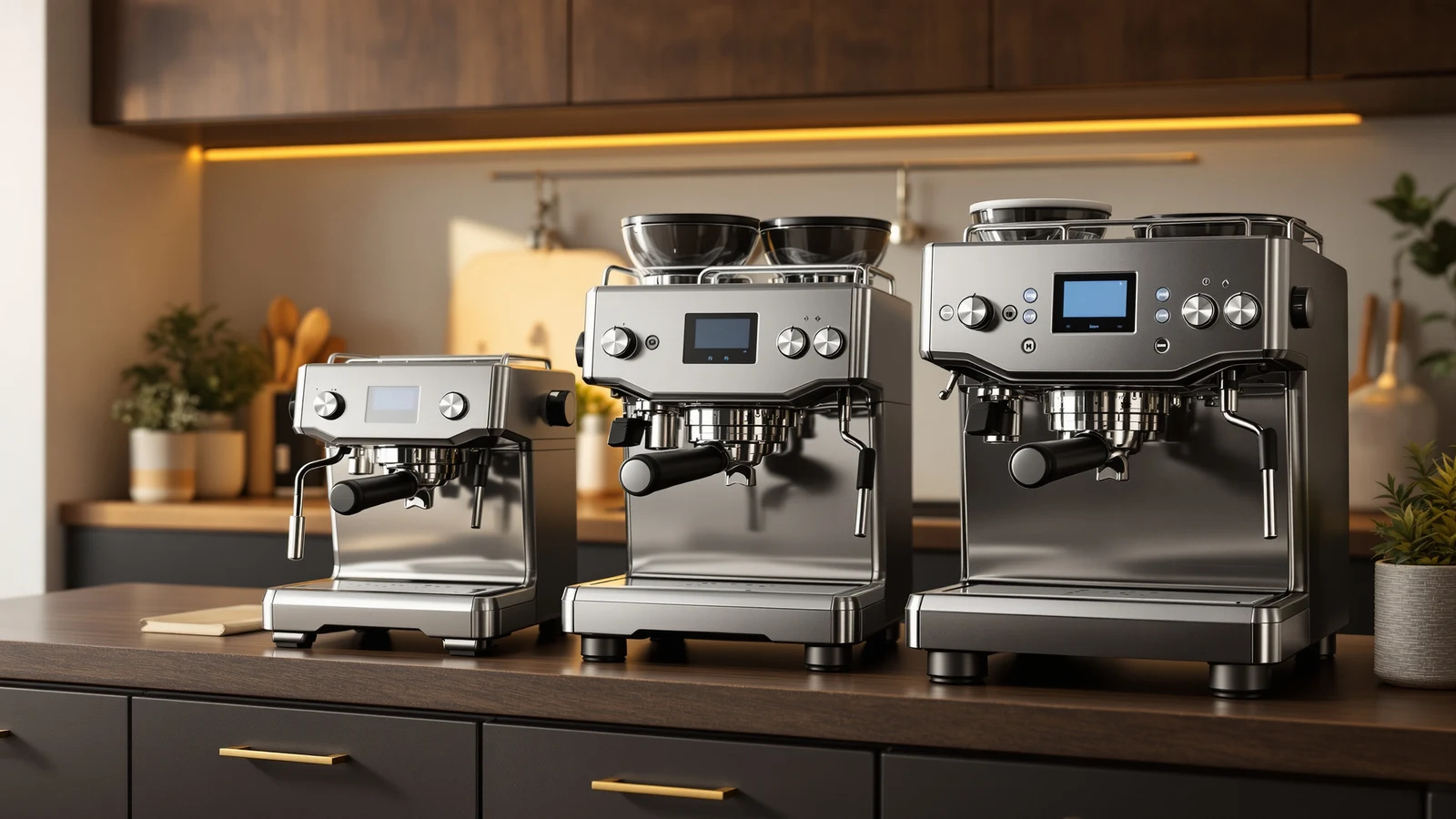
The quick verdict
Breville sells three versions of essentially the same espresso machine. The BES870XL Barista Express is listed at $699.95, the BES878BSS Barista Pro at $849.95, and the BES880BSS Barista Touch at $999.95 — two steps of roughly $150 each, $300 total from bottom to top. None of those steps touches the part of the machine that decides how the espresso tastes: all three grind through the same conical burr grinder and pull the shot through the same 54 mm portafilter. What you're buying as the price climbs is speed, a dialing-in aid, an interface, and — only at the top — automation of the milk step.
In order, here's how we'd rank them for most buyers: buy the Barista Pro if the $150 step is affordable, because it removes the Express's main daily friction (a multi-minute wait to heat up) without asking you to learn a touchscreen. Buy the Barista Express if budget is the deciding factor — it is a complete, capable machine, not a crippled one, and the extraction quality is identical to its pricier siblings. Buy the Barista Touch only if milk drinks are most of what gets made on this machine, because its real upgrade is a wand, not a shot.
What never changes between the three
Start here, because it reframes the whole comparison: the conical burr grinder and the 54 mm portafilter are identical across the Express, the Pro and the Touch. Grind size, dose, tamp and extraction all happen through the same mechanical path regardless of which one you buy. That means the espresso coming out of a $699.95 Express is not meaningfully different from the espresso coming out of a $999.95 Touch — the coffee doesn't know which model it's in.
That's a deliberate decision on Breville's part, not an oversight. The grinder and portafilter are the parts that determine cup quality, and keeping them constant means the company isn't asking buyers to pay more for a better shot — it's asking them to pay more for a faster, easier, or more automated path to the same shot. Once you see the comparison this way, the $300 spread between the cheapest and the most expensive machine stops being about coffee and starts being about your morning routine.
It also means accessories move freely between tiers. The 54 mm baskets, the tamper and the dosing habits you build on an Express carry over without modification if you ever trade up to a Pro or a Touch — nothing about your technique becomes obsolete.
The baseline: Barista Express
The Express is the machine that has anchored "first real espresso machine" recommendations for over a decade, and it already includes everything that matters mechanically: a built-in conical burr grinder with dose control that grinds straight into the portafilter, a razor dose-trimming tool to level the bed, an integrated tamper, a 54 mm stainless portafilter, low-pressure pre-infusion, and a manual steam wand. You dial the grind, dial the dose, tamp, lock in, and pull the shot — every step is yours to control, and every step is already present at $699.95.
What the Express lacks is speed between cups. Its heating element is a conventional thermocoil, which needs real time to come up to temperature from cold, and switching between brewing and steaming asks the boiler to recover rather than simply drawing from a second heat source. For a single cup on a weekday morning that's a one-time wait; for a household pulling several drinks back-to-back, it's the thing you notice.
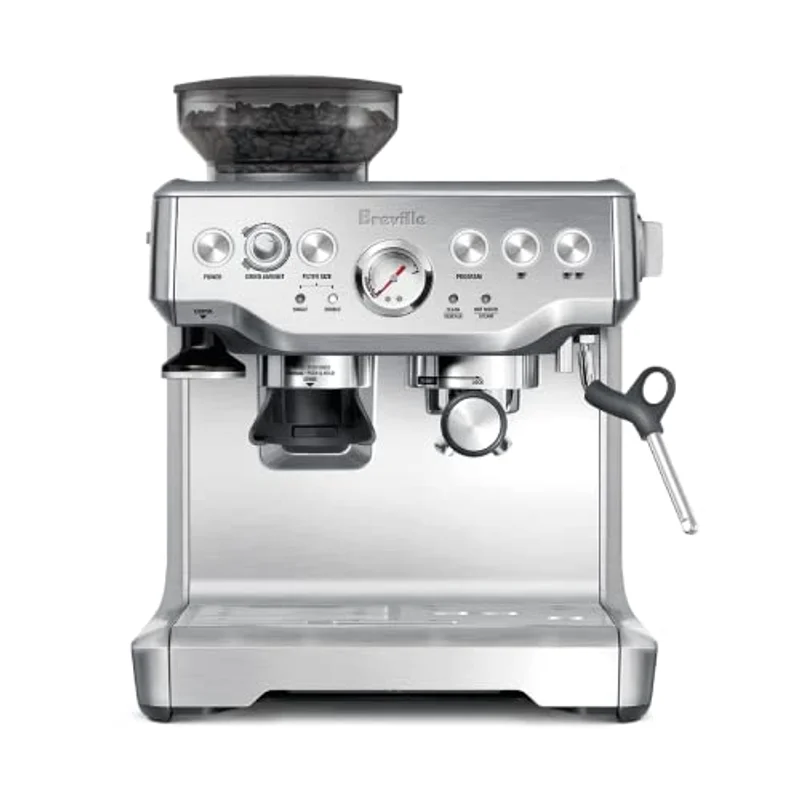
Breville BES870XL Barista Express
Conical burr grinder with dose control, 54 mm portafilter, razor dose-trimming tool, integrated tamper, low-pressure pre-infusion, manual steam wand. The full mechanical package, at the entry price of the three.
$699.95 Check price →The first jump: Express to Pro
Step up to the Pro at $849.95 and the grinder, the portafilter and the manual steam wand all carry over unchanged. What changes is everything around the shot. The Pro replaces the Express's thermocoil with Breville's ThermoJet heating system, which brings water to brew temperature in a few seconds instead of minutes — the practical effect is a machine that's ready close to the moment you switch it on, and one that recovers between a shot and a steam cycle almost instantly instead of making you wait.
The Pro also adds a digital interface the Express doesn't have: an LCD screen with an adjustable shot timer, so you can watch extraction time in real time and tune your grind against a number instead of a stopwatch on your phone. Alongside it is an over-pressure valve, which caps brew pressure even if your grind runs fine, reducing the odds that a slightly-too-fine dose stalls the shot or channels unevenly. Neither feature changes what the grinder or portafilter can do — both make it easier to hit a good shot consistently and faster to get there on a weekday morning.
That's the honest way to frame this step: you are not buying better coffee. You're buying a shorter wait and an easier path to repeating a shot you've already dialed in. If your mornings involve one drink and you don't mind a warm-up, that upgrade is easy to skip. If you make espresso more than once in a session, or you're new to dialing in a shot and want a number instead of a guess, the Pro earns its roughly $150 premium quickly.
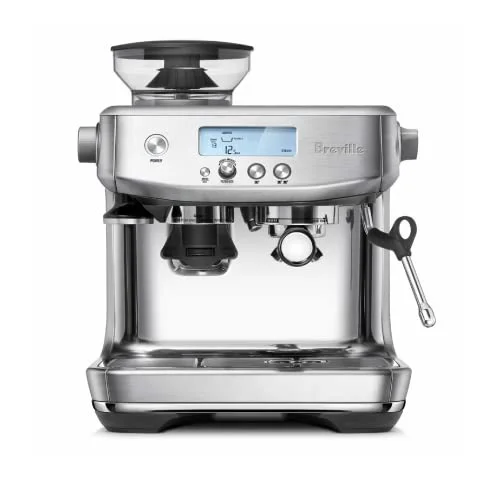
Breville BES878BSS Barista Pro
Same conical burr grinder and 54 mm portafilter as the Express, plus ThermoJet fast heating, a digital shot timer and an over-pressure valve. Manual steam wand carries over unchanged.
$849.95 Check price →The second jump: Pro to Touch
The Touch, at $999.95, carries forward the Pro's ThermoJet heating and its grinder-and-portafilter combination unchanged — and then makes the one change in this lineup that's about more than speed. The dials and the LCD are replaced with a color touchscreen that stores customizable drink profiles for espresso, americano, flat white, cappuccino and latte, so a saved setting can be recalled with a tap instead of re-set each time by hand.
The bigger change rides along with that screen: the Touch is the only one of the three with an automatic milk-texturing wand. Instead of positioning a pitcher under a manual wand and judging texture and temperature by feel, you set a milk type and texture level on the touchscreen and the machine purges, positions and times the steaming itself. The espresso side of the machine — grinder, portafilter, extraction — is unchanged from the Pro; the step you're paying roughly $150 more for is almost entirely the milk workflow and the saved-profile convenience.
It's worth being precise about what the Touch doesn't do. It is not a super-automatic bean-to-cup machine — you still insert, tamp and lock in the portafilter by hand, and the touchscreen is guiding a semi-automatic process rather than replacing it. If one-button hands-off brewing from bean to cup is actually what you want, that's a different category of machine; our guide to super-automatic espresso machines covers it.
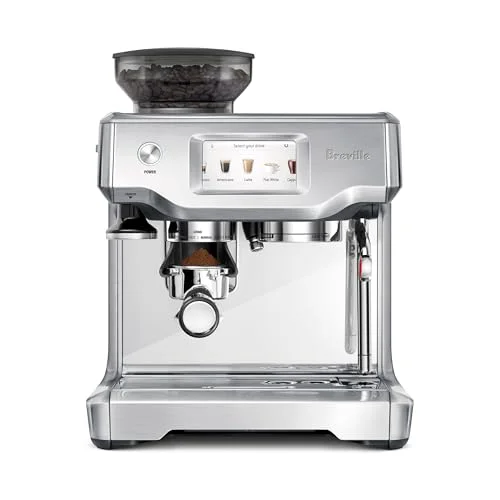
Breville BES880BSS Barista Touch
Same conical burr grinder, 54 mm portafilter and ThermoJet heating as the Pro, plus a color touchscreen with saved drink profiles and an automatic milk-texturing wand. The espresso side is unchanged; the milk side is automated.
$999.95 Check price →Manual wand vs automatic wand
This is the one feature in the whole lineup worth treating as its own decision, because it splits the three machines two against one. The Express and the Pro both use a manual steam wand: you position the pitcher, open the steam valve, and judge temperature and texture by sound and feel. It takes real practice — milk that's too thin or too hot is a common early result — but a manual wand is also the only route to the kind of fine control that produces latte art, and once the technique is learned it's fast and free of any extra moving parts to maintain.
The Touch's automatic wand removes the technique requirement. You choose a milk type and a texture setting on the touchscreen, and the machine purges, submerges and times the steaming itself, aiming for the same result every time without asking you to learn anything. The trade-off is flexibility: you're working within the presets the machine offers rather than adjusting on the fly, and the purge-and-position cycle adds a few seconds of overhead per drink that a practiced hand with a manual wand doesn't need.
Who does the automation actually help? Households where more than one person makes milk drinks and not everyone wants to learn the hand positioning, anyone making several different milk drinks back-to-back where consistency matters more than fine adjustment, and buyers who have tried a manual wand before and know they don't enjoy the learning curve. It helps less if you're the only person using the machine, you drink one milk drink a day, or you actually want to develop the skill — in that case the Express or Pro's manual wand and the roughly $150–300 you save are the better trade.
Which tier a two-cups-a-day household should stop at
Most of what separates these three machines rewards volume and variety, and a household making two espresso-based drinks a day has neither in large supply. The ThermoJet heating on the Pro and Touch mainly pays off when you're brewing more than once in a sitting or steaming milk right after pulling a shot; at two cups a day, spaced out, a few minutes of warm-up on the Express is a one-time event rather than a recurring tax.
Our take: a two-cups-a-day household should stop at the Barista Express if the $150 difference matters, and stop at the Barista Pro if it doesn't, mainly for the shot timer — it's a genuinely useful aid for a household still learning to dial in a new bag of beans, independent of how many cups you make. What we would not recommend at this volume is the Touch. Its two real upgrades — saved drink profiles and automatic milk texturing — earn their keep when multiple people are making multiple drink types or when milk volume is high enough that automation saves real time across a day. At two cups, you're paying roughly $150 for conveniences you'll use twice.
Side-by-side comparison
Same grinder, same portafilter, three different prices. Prices are what we recorded on October 18, 2026.
| Machine | Grinder | Heating | Interface | Milk | Price | |
|---|---|---|---|---|---|---|
| Barista Express | Conical burr, dose control | Thermocoil | Analog dials | Manual wand | $699.95 | Price |
| Barista Pro | Conical burr, dose control | ThermoJet (seconds) | Digital shot timer, OPV | Manual wand | $849.95 | Price |
| Barista Touch | Conical burr, dose control | ThermoJet (seconds) | Touchscreen, saved profiles | Automatic wand | $999.95 | Price |
All three are bean-to-cup machines with a hopper mounted above the brew group, which makes them taller than a basic pump machine — if cabinet clearance is a concern in your kitchen, measure with the lid open rather than trusting a listing photo; our guide to height and under-cabinet clearance walks through what to check before you buy any of them.
How we compared these
We compare published specifications, what ships in the box, and live pricing, rather than running our own side-by-side testing. We do not physically test these machines, we do not run a testing lab, and we do not publish ratings we cannot verify — Amazon's product data returns no rating and no review count for these three listings, so there are no stars and no invented sentiment anywhere on this page. Where a claim here is a judgement rather than a specification — that the Pro is the sweet spot, that a two-cup household doesn't need the Touch — we've said so in our own voice and shown the reasoning behind it, so you can weigh it against your own routine.
Because all three machines share a grinder and a portafilter, this guide is really a comparison of workflow, not of espresso quality — a different kind of decision than choosing between machines from different brands. For that broader question, including what a built-in grinder buys you over a separate one, see our guide to machine-and-grinder bundles and our breakdown of what you're really paying for with a legacy brand like Breville versus a direct-to-consumer alternative. And since the grinder itself is identical across all three, our explainer on anti-clog grinder systems applies equally to whichever tier you land on.
Frequently asked questions
Is the espresso better on the Barista Pro or Touch than on the Express?
No — all three use the same conical burr grinder and the same 54 mm portafilter, so the mechanical path that determines extraction quality is identical. The Pro and Touch change heating speed, the interface, and — on the Touch — the milk workflow, not the grinder or the brew group.
Does the Barista Touch still require a manual portafilter?
Yes. The Touch is a semi-automatic machine guided by a touchscreen, not a super-automatic bean-to-cup unit — you still insert, tamp and lock in the 54 mm portafilter by hand. The touchscreen manages timing and recalls saved drink profiles; the only fully automated step is milk texturing.
Is the roughly $150 jump from Express to Pro worth it?
It depends on how you use the machine. The jump buys ThermoJet fast heating and a digital shot timer with an over-pressure valve — genuinely useful if you brew more than once per sitting or are still learning to dial in a shot. If you make one drink a day and don't mind a multi-minute warm-up, the Express delivers the same espresso for less.
Which Breville tier should a two-cups-a-day household buy?
Most two-cup households are well served by the Barista Express or the Barista Pro. The Pro's digital shot timer is useful at any volume, but the Touch's two real upgrades — saved drink profiles and automatic milk texturing — mainly pay off with higher volume, multiple users, or heavy milk-drink variety, none of which a two-cup household typically has.